Accutrend vs Zintlr 2026: Which B2B Data Tool Wins?
Accutrend vs Zintlr compared for 2026: data coverage, accuracy, personality intelligence, pricing, and which B2B data platform actually fits your sales motion.
Choosing between Accutrend and Zintlr usually comes down to one question: do you need raw contact data at scale, or do you need context about the human you're emailing? They sit in the same B2B data category, but they solve different problems. This breakdown cuts through the marketing pages so you can match the tool to your actual sales motion.
TL;DR#
- Accutrend leans toward broad B2B contact and company data — firmographics, decision-maker records, and list-building for volume outbound.
- Zintlr differentiates with personality intelligence ("Zollege"/persona insights) layered on top of contact data, aimed at reps who personalize before they hit send.
- Accuracy and freshness matter more than headline record counts for both tools — always verify before you load a list into a sequencer.
- Pricing for both skews toward seat-based plans; neither publishes a generous free tier the way some pure email finders do.
- If your priority is verified emails at a predictable cost, a dedicated email finder like Tomba often beats a broad data suite on cost-per-valid-contact.
What are Accutrend and Zintlr?#
Both are B2B data and intelligence platforms, but they emphasize different layers of the prospecting stack.
Accutrend positions itself as a B2B data provider focused on contact discovery and company information. The pitch is coverage: find decision-makers across industries, pull firmographic detail, and export lists you can push into outreach. It's the kind of tool a team reaches for when the bottleneck is "we don't have enough names."
Zintlr is a B2B sales intelligence platform that adds a personality and persona layer. Beyond name, title, and email, Zintlr tries to tell you how a prospect thinks and communicates, so reps can tailor tone and messaging. The bet is that personalization at the human level lifts reply rates more than another thousand raw records do.
That difference — coverage versus context — is the whole comparison. Everything below is downstream of it.
How do Accutrend and Zintlr compare head-to-head?#
Here's the practical breakdown across the attributes that change how a deal-team actually works day to day.
| Attribute | Accutrend | Zintlr |
|---|---|---|
| Primary strength | Broad contact + company coverage | Personality / persona intelligence |
| Core use case | List building, volume outbound | Personalized 1:1 outreach |
| Data types | Emails, firmographics, decision-makers | Emails, phone, persona/behavioral signals |
| Personalization layer | Limited | Strong (personality insights) |
| Best-fit team | SDR teams running high volume | AEs and founders doing tailored outreach |
| Free tier | Limited / trial-based | Limited / trial-based |
| Verification built in | Varies — verify before send | Varies — verify before send |
| Learning curve | Low (familiar list UI) | Moderate (insights take interpretation) |
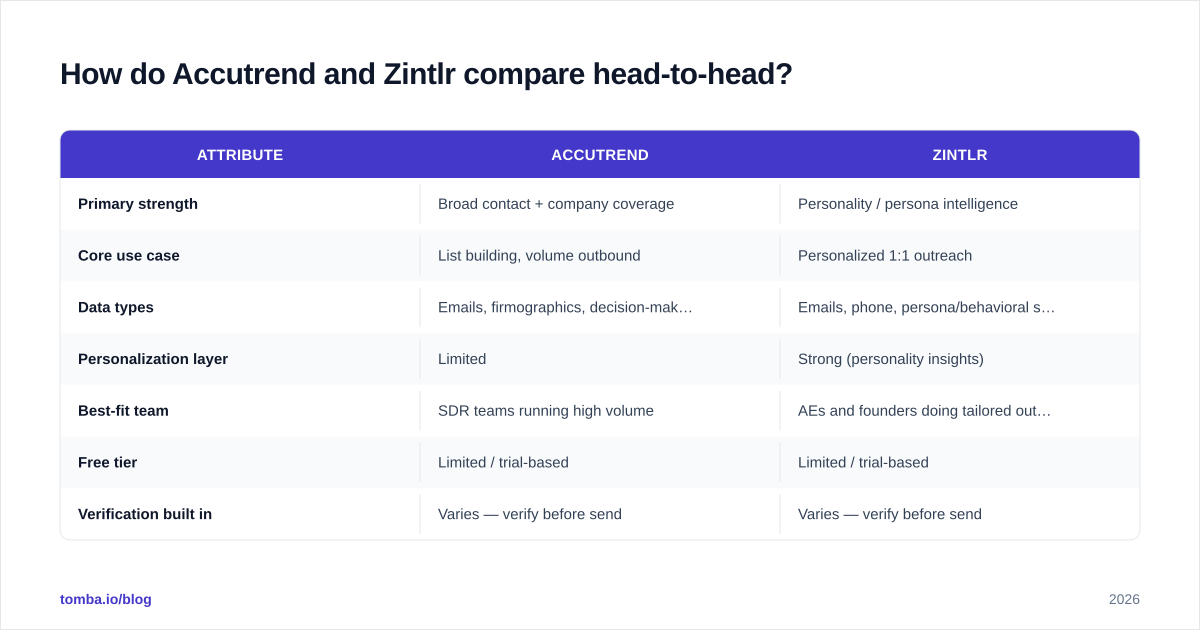
The table makes the split obvious. Accutrend is a coverage play. Zintlr is a context play. Neither is "better" in the abstract — the right answer depends on whether your reply rates are limited by who you can reach or how well you connect once you reach them.
Which tool has more accurate data?#
Neither vendor wins this by default — and you shouldn't trust any provider's self-reported accuracy number without testing it on your own ICP.
B2B data decays fast. Industry estimates put contact-data decay at roughly 22–30% per year as people change jobs, companies get acquired, and domains shift. A platform can claim "95% accuracy" on the day a record is scraped and still serve you a stale email six months later. That's true of Accutrend,
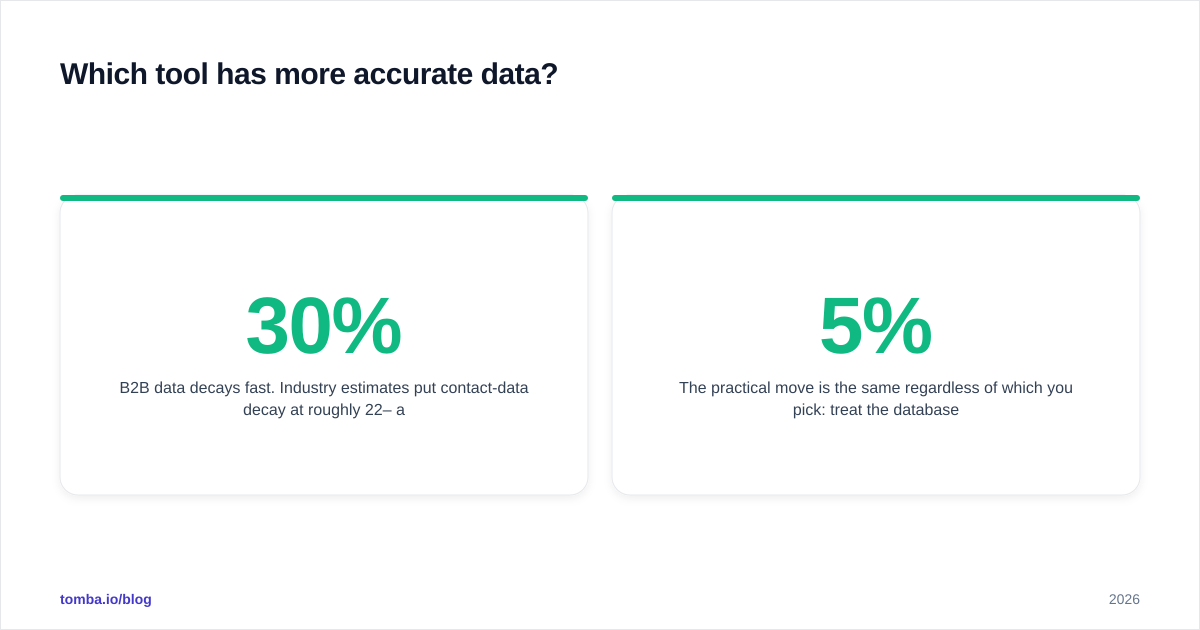
Zintlr, and every other database — it's a property of B2B data itself, not a knock on one vendor.
The practical move is the same regardless of which you pick: treat the database as a source, not the final answer. Run every exported email through an email verifier before it touches your sequencer. A bounce rate above 3–5% damages your sender reputation and quietly tanks deliverability for your whole domain — which costs you far more than the few minutes verification takes.
Where the two differ is in how they source. Accutrend's value is in the breadth of its record set, so the risk is volume-driven staleness. Zintlr's persona signals are inference layers on top of contact data — useful for messaging, but the underlying email still needs the same verification discipline. If you want to understand how providers assemble and refresh records, Tomba publishes its data sources openly, which is a reasonable transparency bar to hold any vendor to.
Is Zintlr's personality intelligence worth it?#
It depends entirely on your sales motion — and on whether your reps will actually use it.
Personality intelligence is genuinely useful for low-volume, high-value outreach. If you're an AE working 30 named accounts, knowing that a prospect is analytical and prefers data-dense messaging (versus relationship-driven and prefers warmth) can meaningfully change your opener. Founders selling to a short list of strategic buyers get real mileage here.
It's far less useful for high-volume SDR motions. If a rep is sending 200 emails a day, they don't have time to read and act on persona insights for each one. At that scale, the insight becomes a field nobody opens, and you're paying a premium for data you don't operationalize.
So the honest test is throughput. Map it like this:
- < 50 highly personalized touches/week per rep → Zintlr's persona layer can pay off.
- High-volume, templated-but-segmented outbound → you'll get more from coverage + a strong cold email framework than from personality data.
A persona insight only earns its cost when a human reads it and changes the message. Buy it for the motion you actually run, not the one you aspire to.
How does pricing compare for Accutrend vs Zintlr?#
Both lean on seat-based or credit-based plans, and both tend to gate their best features behind higher tiers. Exact published numbers move around, so confirm current rates on each vendor's site and on review platforms like G2 and Capterra before you commit — but the structural comparison is stable.
| Pricing factor | Accutrend | Zintlr | Tomba (reference) |
|---|---|---|---|
| Entry plan | Trial / quote-based | Trial / tiered | Free (25 searches/mo) |
| Paid starting point | Seat / credit based | Seat / credit based | $49/mo (Starter) |
| Mid tier | Volume-driven | Adds persona depth | $99/mo (Growth) |
| Higher tier | Custom / enterprise | Custom / enterprise | $249/mo (Pro) |
| Verification included | Often add-on | Often add-on | Built in |
| API access | Varies by plan | Varies by plan | Yes, all paid plans |
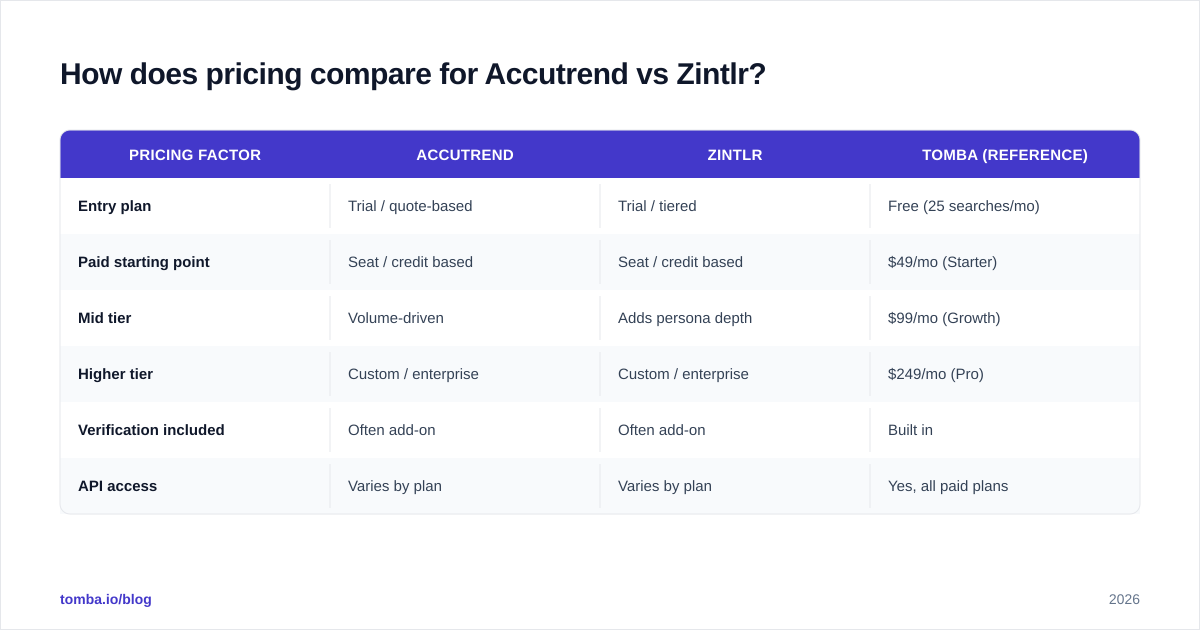
The pattern to watch: cost-per-valid-contact, not cost-per-record. A cheap plan that serves stale data costs you more once you factor in bounces, wasted sequencer slots, and reputation damage. Tomba's pricing is included above purely as a reference point for what a verification-first, finder-centric tool runs — not because it does everything Zintlr's persona layer does. They're different categories of spend.
Accutrend vs Zintlr: which should you choose?#
Match the tool to the constraint that's actually slowing your pipeline.
Choose Accutrend if:
- Your bottleneck is list size — you need more names across more accounts.
- You run high-volume outbound where coverage beats per-contact context.
- Your reps work from segments and templates rather than 1:1 research.
Choose Zintlr if:
- You sell into a focused set of high-value accounts.
- Personalization at the human level is your differentiator.
- Your reps have the time and skill to act on persona insights.
Consider neither (or pairing with a finder) if:
- Your real need is verified emails at a predictable price, in which case a dedicated finder plus a verifier covers the core job at lower cost.
- You want clean data flowing into your CRM via a HubSpot integration or Salesforce integration rather than a separate intelligence dashboard.
A useful way to think about it: Accutrend and Zintlr are intelligence suites, while a tool like Tomba is a precision instrument. Suites are worth it when you'll use the breadth. Instruments win when you have one job — find and verify the right email — and want it done cheaply and accurately.
How do you get the most out of either tool?#
Whichever platform you land on, the workflow that protects your results is the same. Most teams skip steps 2 and 3 and then blame the data.
- Source the contacts (Accutrend for breadth,
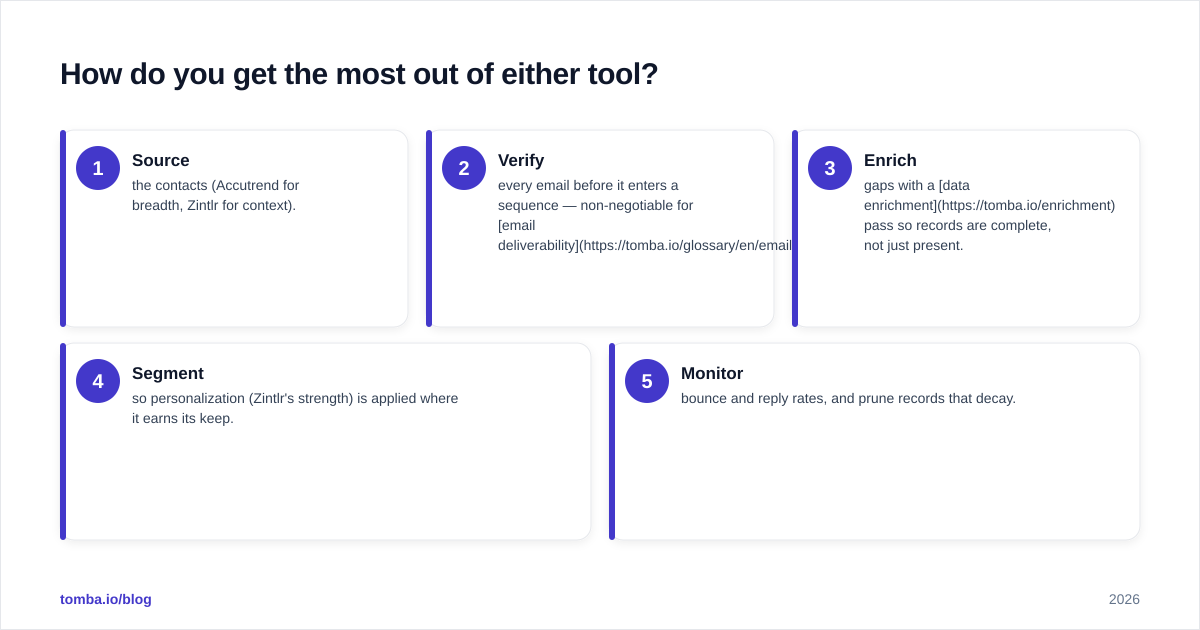
Zintlr for context). 2. Verify every email before it enters a sequence — non-negotiable for email deliverability. 3. Enrich gaps with a data enrichment pass so records are complete, not just present. 4. Segment so personalization (Zintlr's strength) is applied where it earns its keep. 5. Monitor bounce and reply rates, and prune records that decay.
The single highest-leverage habit is verification. It's cheap, it's fast, and it's the difference between a sequence that lands in the inbox and one that gets your domain flagged. If you only adopt one practice from this post, make it that one.
Frequently asked questions#
Is Accutrend or Zintlr better for cold email? Accutrend's coverage helps you build larger lists, but cold email success hinges on deliverability and message fit. Zintlr's persona data can lift reply rates on personalized sends. For either, verify emails first — list quality drives inbox placement more than list size.
Do these tools replace an email finder? Partly. Both surface emails, but they're broader intelligence platforms. If your single need is finding and verifying professional emails by name or company, a focused domain search and finder tool is usually cheaper per valid contact.
Can I trust the accuracy numbers vendors publish? Treat them as best-case, day-of-scrape figures. B2B data decays 22–30% annually. Always run a verification pass on real exports against your own ICP before trusting any provider's headline accuracy.
Which is easier for a new SDR team? Accutrend's list-building UI tends to have a gentler learning curve. Zintlr's persona insights require interpretation, so they reward teams that already personalize and have time to act on the signals.
The bottom line#
Accutrend wins on coverage; Zintlr wins on context. Pick based on whether your pipeline is starved for names or starved for connection. But notice that both leave the same gap: you still have to verify before you send, and you still pay suite pricing for breadth you may not use.
If your core job is simpler — find the right professional email, confirm it's deliverable, and move on — start with the Tomba Email Finder. You get a free tier (25 searches/month), verification built in, and a predictable jump to $49/mo when you scale, with API access on every paid plan. Use a suite when you'll use the suite. Use a precision tool when you just need the email, done right.
// get started
Find, verify and enrich your first contacts today
Start on the free plan with 25 searches a month, then scale when your team is ready.
Free plan · No credit card required · GDPR & CCPA
// about the author