Acefone Pricing Reviews Pros and Cons: 2026 Guide
A neutral, numbers-first look at Acefone pricing, real user reviews, and the pros and cons every sales and support team should weigh before buying in 2026.
TL;DR
- Acefone is a cloud-based business phone system and contact center platform. It targets sales, support, and high-volume call teams that need toll-free numbers, IVR, and call routing without on-prem hardware.
- Pricing is quote-led and usage-based. Published entry plans have historically started around the low double digits per user per month. Real costs depend on minutes, numbers, and contact-center add-ons, so always get a custom quote.
- Strengths: predictable per-user plans, strong inbound call management (IVR, ACD, call queues), unlimited-style calling bundles, and solid uptime for UK, US, and India coverage.
- Weaknesses: unclear public pricing, a learning curve on the admin panel, and an interface reviewers call functional rather than modern.
- Best fit: outbound and inbound calling teams that live on the phone. It is less ideal if you mainly need email-first prospecting or one all-in-one sales engagement suite.
If you are weighing a cloud phone provider in 2026, you want the same three things from every vendor page: what it actually costs, what real users say, and where it breaks. This Acefone pricing reviews pros and cons guide covers all three, in that order. The tone is neutral and concrete, with no marketing gloss.
What is Acefone?#
Acefone is a cloud telephony and contact-center provider. In plain terms, it replaces the physical PBX box in your server room with a phone system that runs over the internet. You get business numbers (local, national, and toll-free), an IVR menu builder, call routing, and call recording. You also get a dashboard your managers use to watch live queues, all without buying hardware.
Think of it like moving from a landline filing cabinet to a cloud drive. The calls, recordings, and routing rules now live on someone else's infrastructure. You rent capacity instead of owning a box that ages out every five years.
Acefone serves three broad jobs:
- Business phone system for general office calling and number management.
- Inbound contact center with IVR, automatic call distribution (ACD), and queue management.
- Outbound calling for sales and collections teams, including click-to-call and CRM integrations.
The platform competes with names like RingCentral, Aircall, CloudTalk, and JustCall. Where Acefone leans hardest is reliable inbound call handling and toll-free coverage across the UK, US, and India.
How much does Acefone cost in 2026?#
Short answer: Acefone uses tiered per-user plans plus usage. Most real quotes are custom, so you will not find every number on the public site.
Acefone has historically published a few seat-based tiers. There is an entry plan, a mid "professional" plan, and an enterprise plan, each with calling bundles attached. The platform also sells toll-free and virtual numbers separately. Contact-center features (advanced IVR, ACD, analytics) often sit in the higher tiers or as add-ons. The vendor moves promotions and bundles around often. So treat any single published figure as a starting point, not a contract.
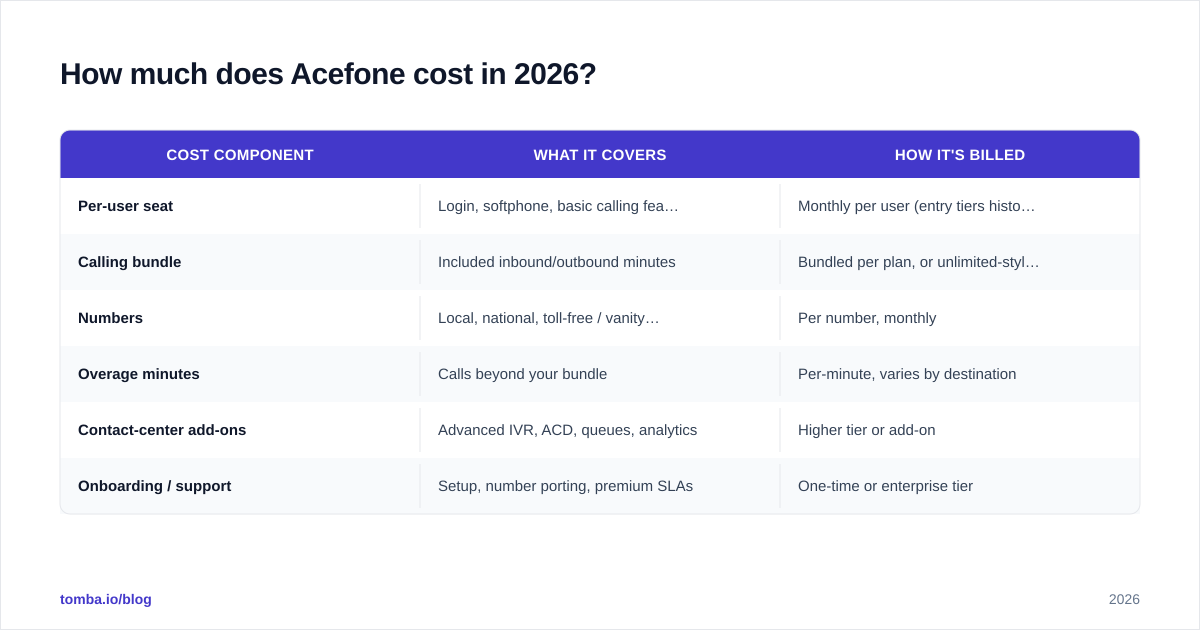
Here is the practical cost structure to budget against:
| Cost component | What it covers | How it's billed |
|---|---|---|
| Per-user seat | Login, softphone, basic calling features | Monthly per user (entry tiers historically low double digits/user) |
| Calling bundle | Included inbound/outbound minutes | Bundled per plan, or unlimited-style on higher tiers |
| Numbers | Local, national, toll-free / vanity numbers | Per number, monthly |
| Overage minutes | Calls beyond your bundle | Per-minute, varies by destination |
| Contact-center add-ons | Advanced IVR, ACD, queues, analytics | Higher tier or add-on |
| Onboarding / support | Setup, number porting, premium SLAs | One-time or enterprise tier |
What this means in practice: a small inbound support team of five agents with one toll-free number and a moderate call volume pays very differently from a 30-seat outbound sales floor burning through international minutes. Once volume scales, the seat price is the smallest part of the bill.
Budgeting tip: ask the vendor for an all-in monthly estimate. It should include seats, your expected minutes by destination, number rental, and any contact-center modules. Then compare that single number across vendors, not the headline per-seat price. For a sense of how clear pricing pages should read, compare against a published model like Tomba pricing, where every tier and limit is on one page.
Is Acefone good? What do the reviews say?#
Acefone reviews land in solidly positive territory. Scores on the big software directories are generally strong. Reviewers praise reliability and support, but gripe about the interface and pricing clarity.
Here are the themes from public review sites like G2 and Capterra:
What reviewers like:
- Call reliability and audio quality. This is the most repeated positive. For teams whose revenue depends on calls connecting, that matters more than any feature list.
- Responsive support. Many reviews call out fast, helpful account management and onboarding. That is a real edge over self-serve-only competitors.
- Inbound call management. Reviewers describe IVR, routing, and queue tools as flexible and capable once configured.
- Value on calling bundles. Teams with high call volume often find the bundled-minutes model cheaper than per-minute rivals.
What reviewers criticize:
- Interface feels dated. A recurring note: it works, but it is not the slick modern UI of some newer rivals.
- Admin learning curve. Setting up complex IVR trees and routing rules takes time and sometimes support hand-holding.
- Pricing is unclear. Buyers dislike having to request quotes to understand total cost.
- Reporting depth. Some users want richer, more customizable analytics out of the box.
The honest read: Acefone is a dependable workhorse. It earns its ratings on uptime and support rather than on flashy design. If your priority is "calls connect, queues route correctly, and someone picks up when I need help," it reviews well. If you want a consumer-grade UI and a self-serve pricing page, you will feel friction.
What are the pros and cons of Acefone?#
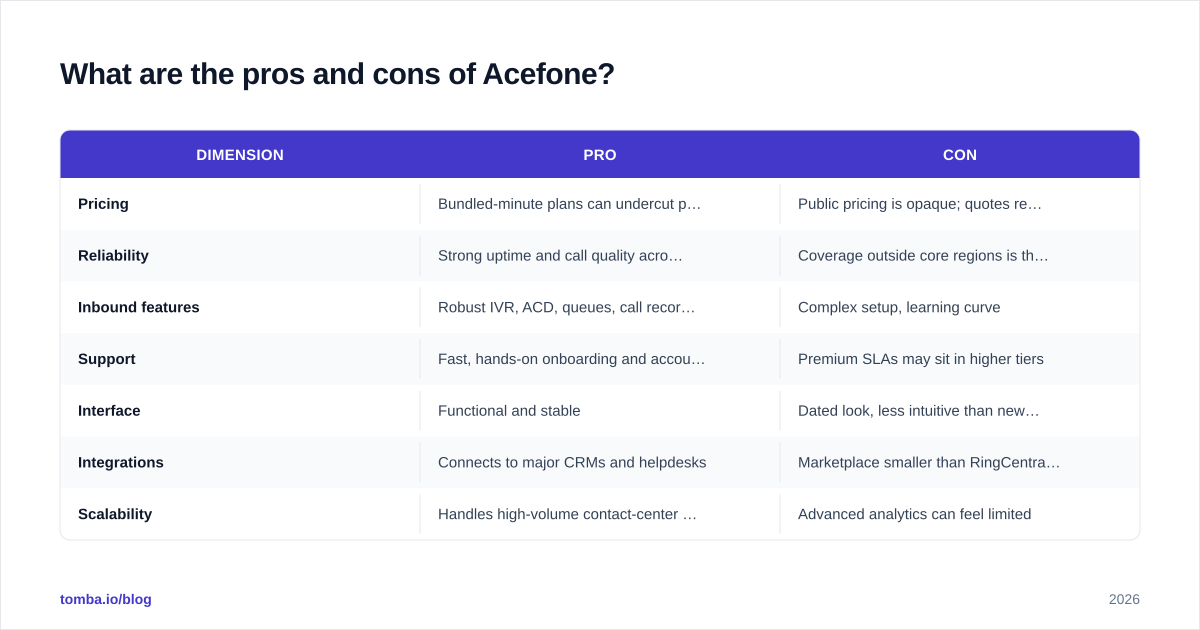
Here is the balanced scorecard. Use it as a filter, not a verdict. The same con that rules out one team is irrelevant to another.
| Dimension | Pro | Con |
|---|---|---|
| Pricing | Bundled-minute plans can undercut per-minute rivals at volume | Public pricing is unclear; quotes required |
| Reliability | Strong uptime and call quality across UK/US/India | Coverage outside core regions is thinner |
| Inbound features | Robust IVR, ACD, queues, call recording | Complex setup, learning curve |
| Support | Fast, hands-on onboarding and account management | Premium SLAs may sit in higher tiers |
| Interface | Functional and stable | Dated look, less intuitive than newer tools |
| Integrations | Connects to major CRMs and helpdesks | Marketplace smaller than RingCentral/Aircall |
| Scalability | Handles high-volume contact-center loads | Advanced analytics can feel limited |
Who Acefone fits:
- Inbound support and service desks that need serious IVR and routing.
- Outbound sales or collections floors with high call volume and bundle economics.
- UK-, US-, or India-centric operations wanting toll-free coverage and local numbers.
Who should look elsewhere:
- Tiny teams wanting instant self-serve signup and a published price.
- Email-first sales teams whose main bottleneck is finding and verifying contacts, not dialing.
- Buyers who want a single all-in-one engagement suite (dialer + email sequencing + analytics) in one pane.
How does Acefone compare to alternatives?#
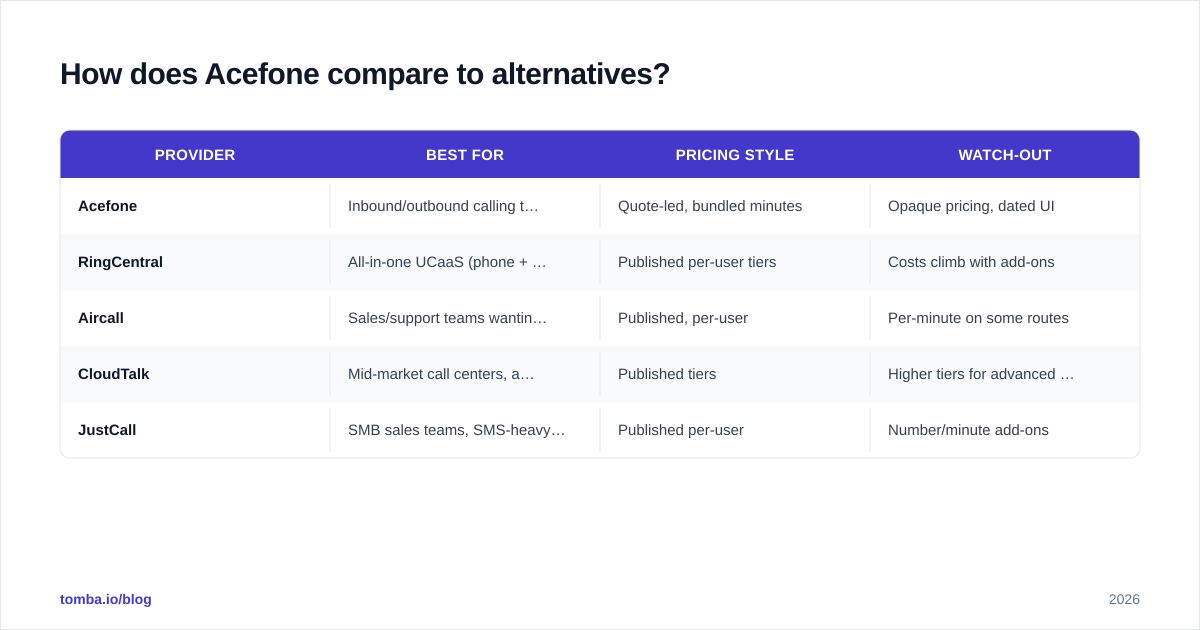
Acefone sits in a crowded cloud-telephony field. The differences come down to pricing clarity, UI polish, and how much of the "contact center" you actually need.
| Provider | Best for | Pricing style | Watch-out |
|---|---|---|---|
| Acefone | Inbound/outbound calling teams, toll-free coverage | Quote-led, bundled minutes | Unclear pricing, dated UI |
| RingCentral | All-in-one UCaaS (phone + messaging + video) | Published per-user tiers | Costs climb with add-ons |
| Aircall | Sales/support teams wanting modern UI + integrations | Published, per-user | Per-minute on some routes |
| CloudTalk | Mid-market call centers, analytics | Published tiers | Higher tiers for advanced features |
| JustCall | SMB sales teams, SMS-heavy outreach | Published per-user | Number/minute add-ons |
The strategic point: if calling is the core of your motion, compare these on call quality, routing depth, and total cost at your real minute volume. But many teams find their real constraint is upstream of the dial. They do not have accurate phone numbers or verified contacts to call in the first place. That is a data problem, not a dialer problem.

Where does a phone system stop and your data stack start?#
A cloud phone system routes calls. It does not find the right person to call. That difference decides whether a tool like Acefone delivers ROI.
Suppose your reps spend their morning hunting for direct-dial numbers and decision-maker contacts. Then the bottleneck is not your dialer. It is your data. A great phone system pointed at stale or missing contact data just helps you reach voicemail faster. This is where a contact-data layer sits in front of whatever phone platform you choose:
- Build the target list with a phone finder to source B2B direct-dial numbers. Then validate them with a phone validator so your dialer is not burning minutes on dead lines.
- Add email as a parallel channel using an email finder. Confirm addresses with an email verifier before sequences go out.
- Push the cleaned records into your CRM and dialer through integrations. Reps then work from one enriched list instead of three tabs.
Done right, the phone system and the data layer work together. Acefone (or any rival) handles the conversation. Your enrichment stack makes sure the conversation is with the right person on a number that actually rings.
How should you evaluate Acefone before buying?#
Run a short, evidence-based trial rather than trusting the demo. Five checks separate a good fit from buyer's remorse:
- Get an all-in quote. Seats + your real minute volume by destination + numbers + contact-center modules. Compare that single figure across vendors.
- Test call quality on your routes. Run a pilot with the actual regions you call. Reliability claims only matter on your traffic.
- Build one real IVR. If your routing logic is complex, configure it during the trial. This exposes the learning curve before you commit.
- Stress the support channel. Open a ticket during the trial and time the response. Support quality is a top reason Acefone reviews well, so verify it for yourself.
- Check your integrations. Confirm the CRM and helpdesk connectors you depend on are first-class, not "via
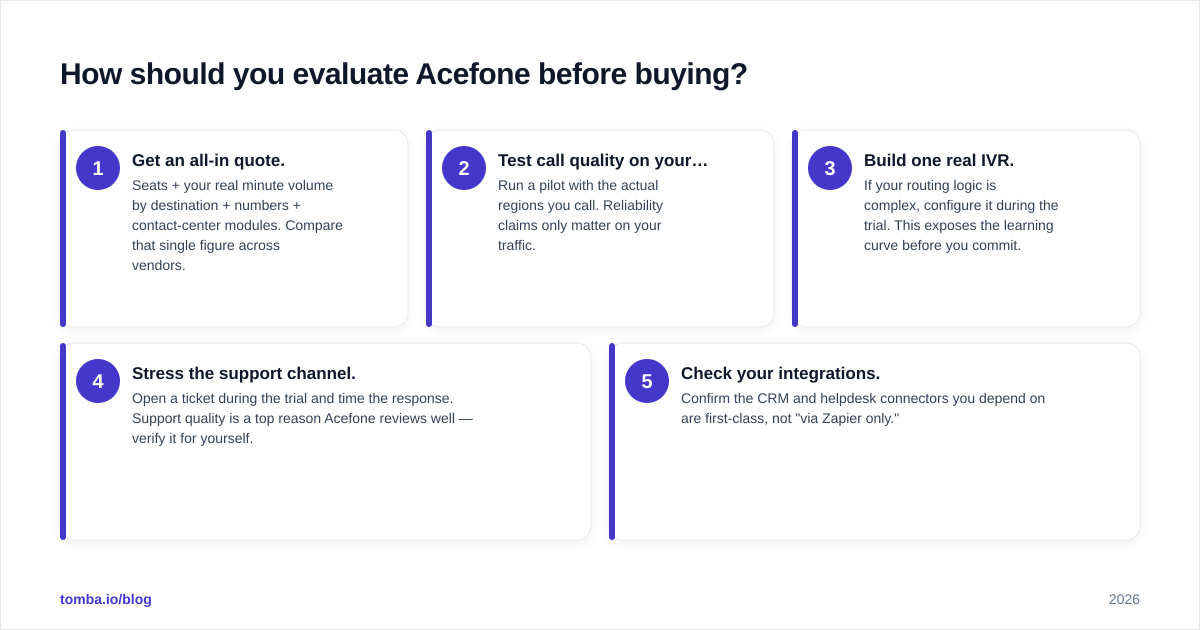
Zapier only."
If those five pass at a cost you can defend, Acefone is a reasonable buy. If pricing stays murky or call quality wobbles on your routes, keep shopping.
Acefone pricing reviews pros and cons: the bottom line#
Acefone is a reliable, support-led cloud phone system. It earns its positive reviews on uptime and inbound call management rather than on UI or pricing clarity. The pros (bundled-minute economics, strong routing, hands-on onboarding) make it a credible pick for calling-heavy sales and support teams. The cons (unclear pricing, a dated interface, and a setup learning curve) mean you should run a real trial and demand an all-in quote before signing.
And remember the upstream truth: the best phone system in the world cannot dial a number you do not have. Before you optimize how you call, fix what you are calling. Start with accurate, verified contact data. Use the Tomba Email Finder to source decision-maker emails by domain or name. Pair it with data enrichment and phone lookup to feed your dialer clean records, and let your phone platform do what it does best: connect the call. Spin up a free Tomba account (25 searches a month, no card) and put real contacts in front of your reps before your next outbound push.
// get started
Find, verify and enrich your first contacts today
Start on the free plan with 25 searches a month, then scale when your team is ready.
Free plan · No credit card required · GDPR & CCPA
// about the author