How to Acquire a Customer in 2026: A B2B Growth Playbook
A practical 2026 playbook on how to acquire a customer in B2B: CAC math, channel selection, and a repeatable acquisition funnel that actually converts.
TL;DR
- To acquire a customer profitably, you need three numbers in agreement: customer acquisition cost (CAC), lifetime value (LTV), and payback period. Everything else is tactics.
- Pick channels based on your deal size and sales cycle, not on what's trendy. High-ACV deals justify outbound and sales-led motions; low-ACV products live or die on self-serve and content.
- A repeatable acquisition funnel beats a lucky campaign every time. Define each stage, instrument it, and fix the worst-converting step first.
- Accurate contact data is the cheapest lever you have. Bad emails inflate CAC silently by burning rep time and sender reputation.
- Aim for an LTV:CAC ratio of 3:1 or better and a payback under 12 months before you pour fuel on any channel.
What does it actually mean to acquire a customer?#
To acquire a customer means to move a stranger through a repeatable process until they pay you money — and to do it for less than that customer is worth. That second clause is where most teams fail. Getting signups is easy. Getting profitable customers, predictably, at a cost you can sustain, is the entire game.
Think of customer acquisition like fishing with a net instead of a single line. A lucky cast catches one fish. A well-built net — the right mesh size, cast in the right water, hauled in on a schedule — catches fish every time you throw it. Your acquisition system is the net. This guide is about building it, not about getting lucky.
Technically, acquisition spans every touch from first awareness to closed-won: the channel that surfaced the prospect, the offer that earned their attention, the nurture that built trust, and the conversion event that took payment. Each of those is measurable, and each can be improved independently.
How do you calculate customer acquisition cost (CAC)?#
Start here, because CAC is the number that tells you whether your acquisition is a business or a hobby.
The basic formula:
CAC = (total sales + marketing spend in a period) ÷ (new customers acquired in that period)
If you spent $20,000 on ads, salaries, tools, and content last quarter and closed 40 customers, your CAC is $500. Simple. The mistakes happen in what you leave out. Include salaries, software, agency fees, and content production — not just ad spend. A CAC that ignores your SDR's salary is a fiction that will catch up with you.
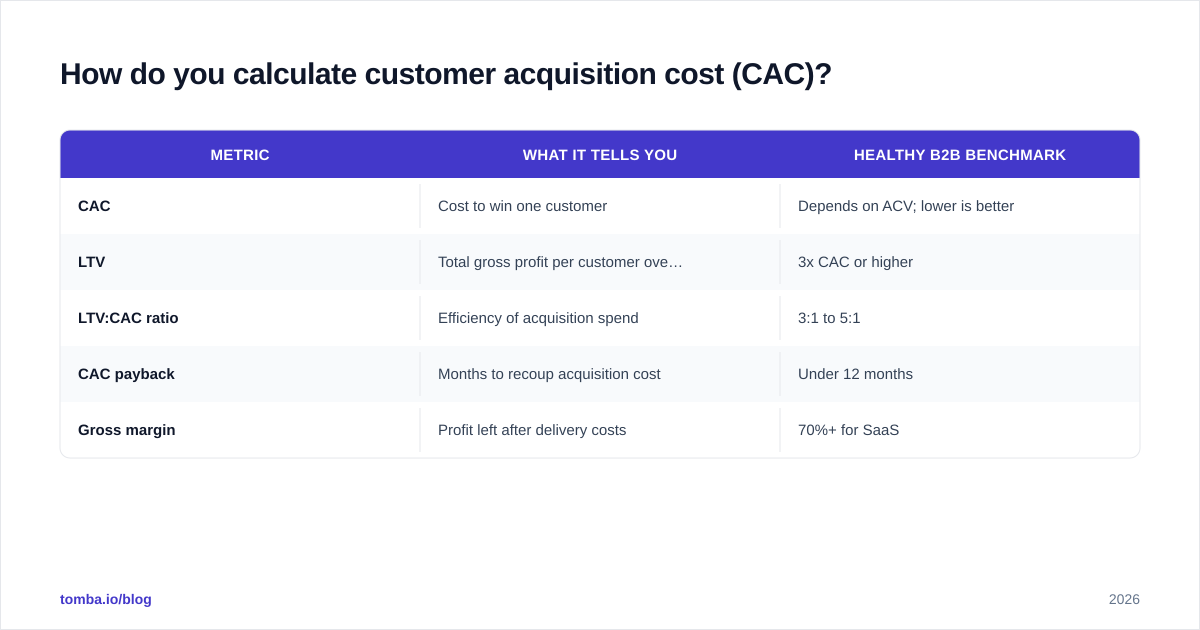
CAC alone means nothing without two companions: lifetime value and payback period.
| Metric | What it tells you | Healthy B2B benchmark |
|---|---|---|
| CAC | Cost to win one customer | Depends on ACV; lower is better |
| LTV | Total gross profit per customer over their lifetime | 3x CAC or higher |
| LTV:CAC ratio | Efficiency of acquisition spend | 3:1 to 5:1 |
| CAC payback | Months to recoup acquisition cost | Under 12 months |
| Gross margin | Profit left after delivery costs | 70%+ for SaaS |
If your LTV:CAC is below 3:1, you're either underpricing, churning too fast, or overspending to acquire. A ratio above 5:1 isn't always a trophy — it can mean you're underinvesting in growth and leaving the market to competitors. For a deeper treatment of the underlying metrics, HubSpot's guide to customer acquisition cost is a solid reference.
Which channels should you use to acquire customers?#
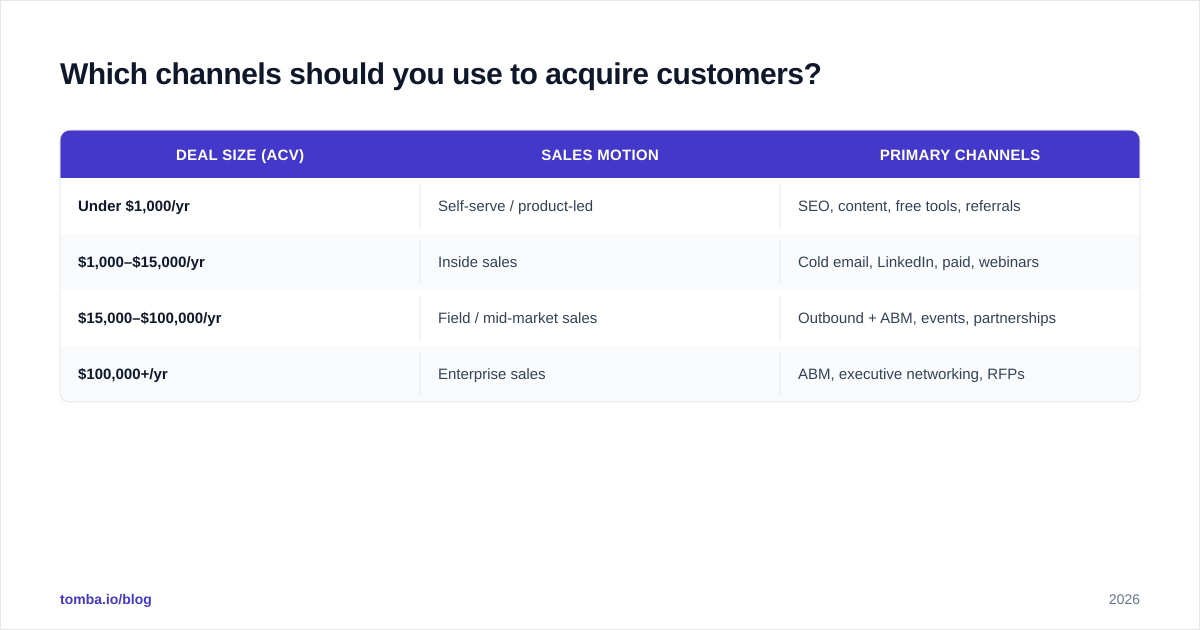
Choose channels by your deal economics, not by what worked for some unicorn on a podcast. The single biggest predictor of which channel fits is your average contract value (ACV) paired with your sales cycle length.
Here's the rule of thumb:
| Deal size (ACV) | Sales motion | Primary channels |
|---|---|---|
| Under $1,000/yr | Self-serve / product-led | SEO, content, free tools, referrals |
| $1,000–$15,000/yr | Inside sales | Cold email, LinkedIn, paid, webinars |
| $15,000–$100,000/yr | Field / mid-market sales | Outbound + ABM, events, partnerships |
| $100,000+/yr | Enterprise sales | ABM, executive networking, RFPs |
A $40/month product cannot afford a salesperson making 60 calls to close it — the math never works. A $60,000 contract, on the other hand, easily justifies a dedicated rep, custom demos, and months of nurture.
For most B2B teams selling in the $1,000–$15,000 range, outbound is the fastest path to predictable acquisition because you control the volume. You decide how many qualified prospects enter the funnel each week. Inbound and content compound beautifully over time but take months to ramp. The smart play is running both: outbound for predictable near-term pipeline, content for compounding long-term CAC reduction. If you want a structured framework for the outbound side, see our breakdown of outbound sales strategy fundamentals.
Whatever channel mix you pick, resist the temptation to chase every shiny new tactic. The fastest way to blow your budget is spreading thin across eight channels and mastering none.
What does a repeatable acquisition funnel look like?#
A repeatable funnel turns acquisition from art into engineering. You define discrete stages, measure conversion between each, and improve the weakest link. Here is a standard B2B outbound-plus-inbound funnel and the questions each stage must answer.
- Target list — Who exactly are you trying to reach? Define your ideal customer profile (industry, size, role, trigger). A vague list guarantees a leaky funnel.
- Contact data — Can you actually reach these people? You need verified email addresses and, increasingly, direct phone numbers. This is where data quality quietly makes or breaks CAC.
- First touch — Cold email, ad, or content view. Measure: deliverability and open/click rate.
- Engagement — Reply, demo request, or trial signup. Measure: reply rate and meeting-booked rate.
- Evaluation — Demo, trial, or sales conversation. Measure: opportunity creation and win rate.
- Conversion — Signed contract or paid plan. Measure: close rate and CAC.
- Onboarding — First value delivered. This protects LTV, which protects your whole acquisition model.
The discipline is to instrument every step and fix the worst-converting one first. If 1,000 people see your offer and 200 click but only 2 reply, your problem isn't traffic — it's your message or your targeting. Doubling traffic just doubles your waste. Most teams obsess over the top of the funnel when the leak is in the middle.
Why does contact data quality decide your CAC?#
Bad data is the most expensive thing in your funnel, and it never shows up as a line item. Conclusion first: every invalid email you send inflates CAC by burning rep hours, damaging sender reputation, and starving the funnel of real conversations.
Here's the chain reaction. You buy or scrape a list. Twenty percent of the emails are wrong. Those bounces tank your sender reputation, which means your good emails start landing in spam too. Now your deliverability drops across the board, your reply rate collapses, and your SDR spends Monday morning chasing contacts who left the company a year ago. You didn't just waste 20% of the list — you degraded the performance of the other 80%.
The fix is upstream. Before any outreach, find and verify your contacts:
- Use an email finder to source professional addresses by name and company domain instead of guessing patterns.
- Run every address through an email verifier to strip invalids, traps, and risky catch-alls before they hit your sequencer.
- For account-based plays, a domain search surfaces every reachable contact at a target company in one pass.
Clean data doesn't just protect deliverability — it makes every downstream metric honest. When your bounce rate is near zero, your reply rate finally reflects message quality instead of data rot, and you can actually optimize. Tools like G2 catalog the broader category if you want to compare options, but the principle holds regardless of vendor: verify before you send.
How much should it cost to acquire a customer?#
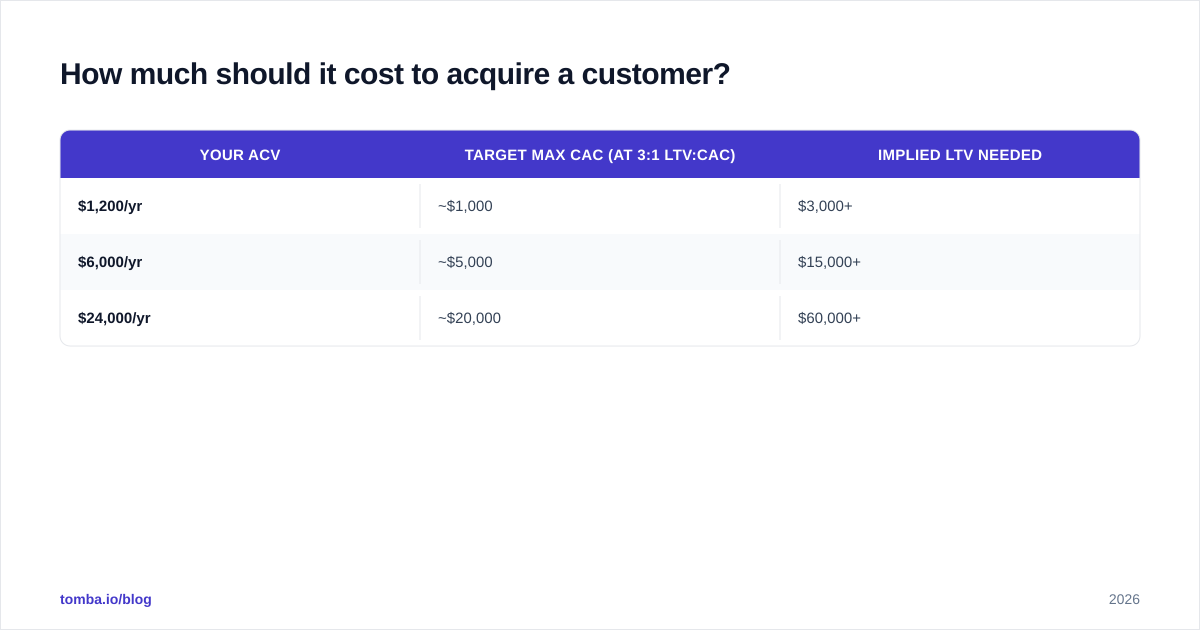
It depends entirely on what a customer is worth to you — there is no universal "good" CAC. A $300 CAC is fantastic for a $5,000 contract and catastrophic for a $99 one. The only honest benchmark is relative to LTV and payback.
Work backward from your unit economics:
| Your ACV | Target max CAC (at 3:1 LTV:CAC) | Implied LTV needed |
|---|---|---|
| $1,200/yr | ~$1,000 | $3,000+ |
| $6,000/yr | ~$5,000 | $15,000+ |
| $24,000/yr | ~$20,000 | $60,000+ |
(These assume customers stay roughly 2.5–3 years at healthy margins — adjust for your real retention.)
Three levers move CAC in your favor:
- Raise conversion rates. A funnel that converts 4% instead of 2% halves your CAC overnight without spending another dollar on traffic. This is almost always the cheapest win.
- Increase LTV. Reduce churn, expand accounts, and raise prices where the market allows. Higher LTV lets you out-spend competitors on acquisition and still profit.
- Lower input costs. Cheaper, more accurate data; better-targeted ads; tighter ICP. Small efficiency gains compound across thousands of touches.
Notice that two of the three levers have nothing to do with spending more. Most teams reach for "bigger budget" first when "better funnel" is sitting right there, cheaper and more durable.
What's the fastest way to start acquiring customers predictably?#
Pick one channel, build a tight target list, and run a clean, measured outbound motion for 90 days before you judge it. Predictability comes from volume plus consistency, not from a single brilliant campaign.
A concrete 30-day starting plan:
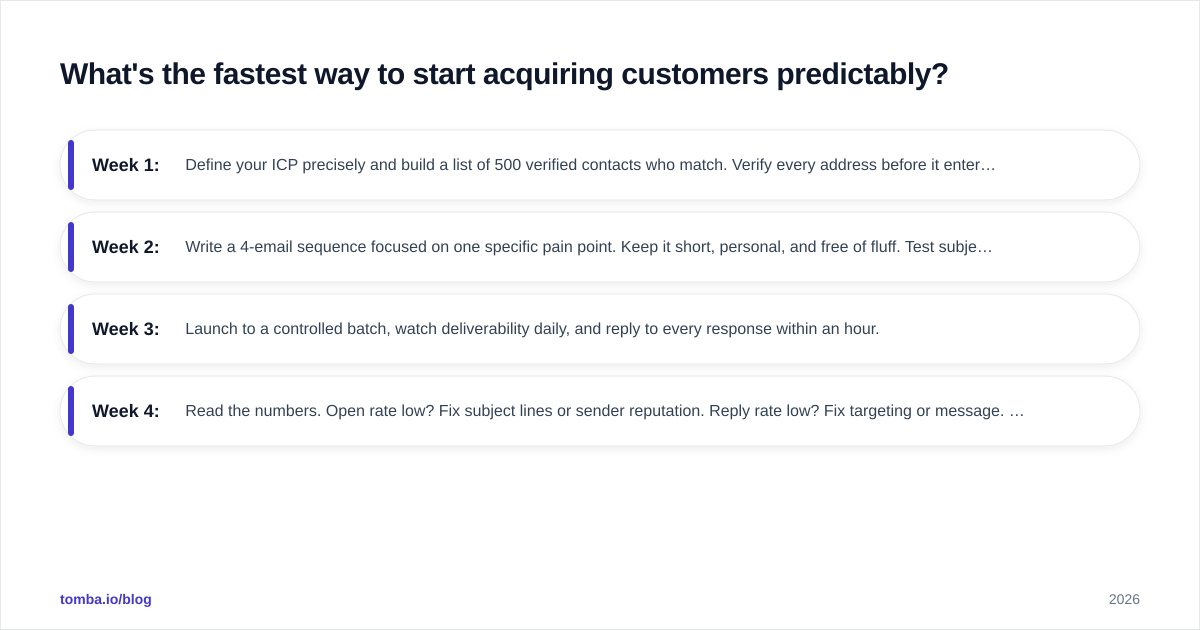
- Week 1: Define your ICP precisely and build a list of 500 verified contacts who match. Verify every address before it enters your tool.
- Week 2: Write a 4-email sequence focused on one specific pain point. Keep it short, personal, and free of fluff. Test subject lines.
- Week 3: Launch to a controlled batch, watch deliverability daily, and reply to every response within an hour.
- Week 4: Read the numbers. Open rate low? Fix subject lines or sender reputation. Reply rate low? Fix targeting or message. Iterate, don't abandon.
The teams that win at acquisition are the ones that treat it as a system to refine, not a lottery to play. Measure relentlessly, fix the weakest stage, and protect your data quality like it's the foundation it is.
Ready to lower your CAC at the source?#
The cheapest improvement to your acquisition cost happens before you ever hit send: reaching real people at real addresses. Tomba's Email Finder sources verified professional emails by name, company, or domain so your sequences land in inboxes instead of bouncing into spam — protecting both your sender reputation and your CAC. Start free with 25 searches a month, then scale on the Starter plan at $49/mo as your pipeline grows. Check current Tomba pricing to match a plan to your acquisition volume, and build your funnel on data you can actually trust.
// get started
Find, verify and enrich your first contacts today
Start on the free plan with 25 searches a month, then scale when your team is ready.
Free plan · No credit card required · GDPR & CCPA
// about the author