How to Build Actionable Buyer Personas in 2026 (Data-Led)
Most buyer personas are fiction. Here's how to build actionable buyer personas in 2026 from real data, signals, and enrichment — so your team targets the right accounts.
TL;DR
- A buyer persona is only actionable when every attribute maps to a filter you can search, score, or trigger on — not a backstory nobody uses.
- Build personas from three data layers: firmographic (who they are), behavioral (what they do), and contextual (why now).
- Validate personas against closed-won and closed-lost deals, not internal opinion. The data usually contradicts the whiteboard.
- Enrichment turns a thin persona into a targetable list: job title, seniority, tech stack, company size, and verified contact details.
- Refresh personas quarterly. Roles, tools, and triggers shift faster than your slide deck does.
What is an actionable buyer persona?#
An actionable buyer persona is a semi-fictional profile of your ideal buyer where every trait can be turned into a query, a score, or a trigger. That's the whole distinction. A normal persona says "Marketing Mary cares about brand and hates spreadsheets." An actionable persona says "VP of Marketing, 50–500 employees, uses HubSpot, hired a demand-gen lead in the last 90 days." One is a character sketch. The other is a target list waiting to be pulled.
Think of it like the difference between describing a house you'd like to live in versus handing a real-estate agent a search filter: 3 beds, under $600k, within 2 miles of a train station, listed this month. The first gets you a nice conversation. The second gets you viewings on Saturday.
Most teams have the first kind. They built personas in a workshop, gave them alliterative names, printed them on foam board, and never looked again. According to HubSpot's research on buyer personas, companies that use personas in a structured way see measurably better targeting — but only when those personas drive real decisions instead of decorating a wiki.
Why do most buyer personas fail?#
They fail because they're built from imagination, not evidence. Three failure modes show up again and again:
They describe demographics nobody can act on. "Sarah is 38, drinks oat-milk lattes, listens to true-crime podcasts." None of that helps a rep decide who to email on Tuesday. If a trait can't become a filter in your CRM, your prospecting tool, or your ad platform, it's noise.
They're never validated against real deals. Teams guess who the buyer is instead of pulling the last 50 closed-won accounts and asking, "What did these actually have in common?" The answer is frequently uncomfortable — your real best-fit buyer is a segment you've been ignoring.
They go stale. A persona built in 2023 assumes a tech stack, a budget climate, and a set of job titles that may have shifted. "Head of Growth" was everywhere three years ago; now the same work sits under "VP of Revenue" or "Demand Gen Lead." Stale titles mean wasted email finder credits and bounced sends.
The fix isn't more creativity. It's grounding every attribute in data you can query and re-pull on demand.
What data makes a buyer persona actionable?#
Three layers. Each answers a different question, and you need all three.
Firmographic layer — who they are#
This is the company-level filter: industry, employee count, revenue range, geography, funding stage, and tech stack. It's the coarsest filter and the easiest to source. You can pull most of it from a B2B database or enrich it onto an existing list. Firmographics define your total addressable market and let you cut it into segments.
Behavioral layer — what they do#
Behavior is what separates a name on a list from a buyer with intent. Did they visit your pricing page three times this week? Open the last two emails? Star a competitor on GitHub? Behavioral data is the difference between "fits the profile" and "fits the profile and is moving." This is where intent signals and engagement history live.
Contextual layer — why now#
Context is the trigger. A new VP just started. The company raised a Series B. They posted a job opening for a role your product supports. They switched off a competitor's tool. These "why now" events are the highest-leverage data because they tell you when a good-fit account becomes a ready account. You can read more about how these qualify a lead in the definition of a marketing qualified lead.
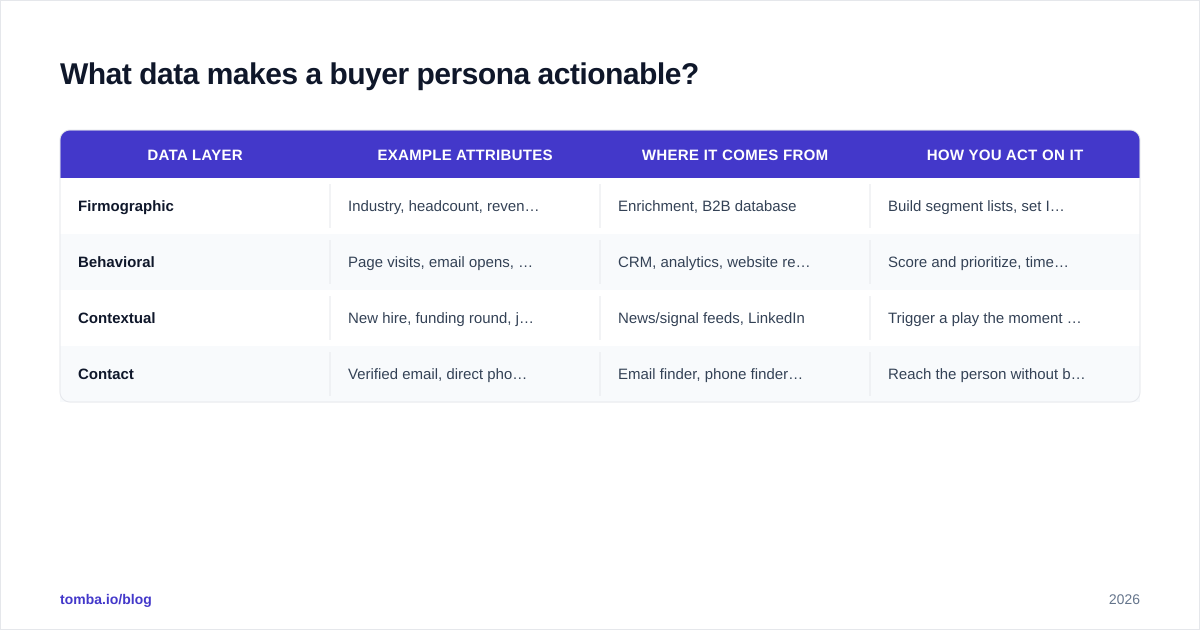
| Data layer | Example attributes | Where it comes from | How you act on it |
|---|---|---|---|
| Firmographic | Industry, headcount, revenue, region, tech stack | Enrichment, B2B database | Build segment lists, set ICP filters |
| Behavioral | Page visits, email opens, content downloads, product usage | CRM, analytics, website reveal | Score and prioritize, time outreach |
| Contextual | New hire, funding round, job posting, tool switch | News/signal feeds, LinkedIn | Trigger a play the moment it fires |
| Contact | Verified email, direct phone, seniority, role | Email finder, phone finder, verifier | Reach the person without bouncing |
The fourth row matters more than teams admit. A perfect persona with no verified contact path is a target you can see but can't touch. That's where a tool like data enrichment closes the gap — it appends the verified email, the direct phone, and the seniority so the persona becomes reachable, not just describable.
How do you build an actionable buyer persona step by step?#
Here's the process I'd run from scratch. It takes a day or two of focused work, not a week-long workshop.
Step 1 — Mine your closed-won deals#
Export your last 30–50 won deals. For each, record company size, industry, the title of the economic buyer, the title of the champion, the trigger that started the deal, and how long it took to close. Patterns emerge fast. You'll usually find your real best-fit segment is narrower — and different — than the one in your pitch deck.
Step 2 — Mine your closed-lost and churned deals#
Equally important: who looked like a fit but didn't buy, or bought and left? These negative signals sharpen the persona's edges. If every churned account was under 20 employees, that's a disqualifier you can encode.
Step 3 — Interview five real customers#
Numbers tell you what; conversations tell you why. Ask about the problem before they bought, the alternatives they weighed, and the moment they decided. You're listening for the language they use and the trigger that made the problem urgent. Five good interviews beat fifty survey responses.
Step 4 — Translate every insight into a filter#
This is the step teams skip. For each trait, write the exact filter. "Mid-market" becomes "100–999 employees." "Tech-forward" becomes "uses Snowflake or BigQuery." "Recently funded" becomes "raised in the last 6 months." If you can't write the filter, the trait isn't ready.
Step 5 — Enrich and build the target list#
Now turn the persona into a list. Use domain search to pull the right contacts at companies that match your firmographic filters, then verify the addresses before anyone sends. A persona that produces a clean, verified list of 500 in-segment contacts has earned its keep.

Step 6 — Score and prioritize#
Not every account in the list is equal. Layer your behavioral and contextual signals on top to rank them. A firmographic match with three intent signals goes to the top of the queue; a match with none waits. This is where personas connect to pipeline.
How many buyer personas should you have?#
Fewer than you think. Most B2B companies need three to five, not fifteen. Each persona should map to a distinct combination of pain, buying process, and message. If two personas would receive the same email and the same demo, they're one persona.
A common structure for a single deal:
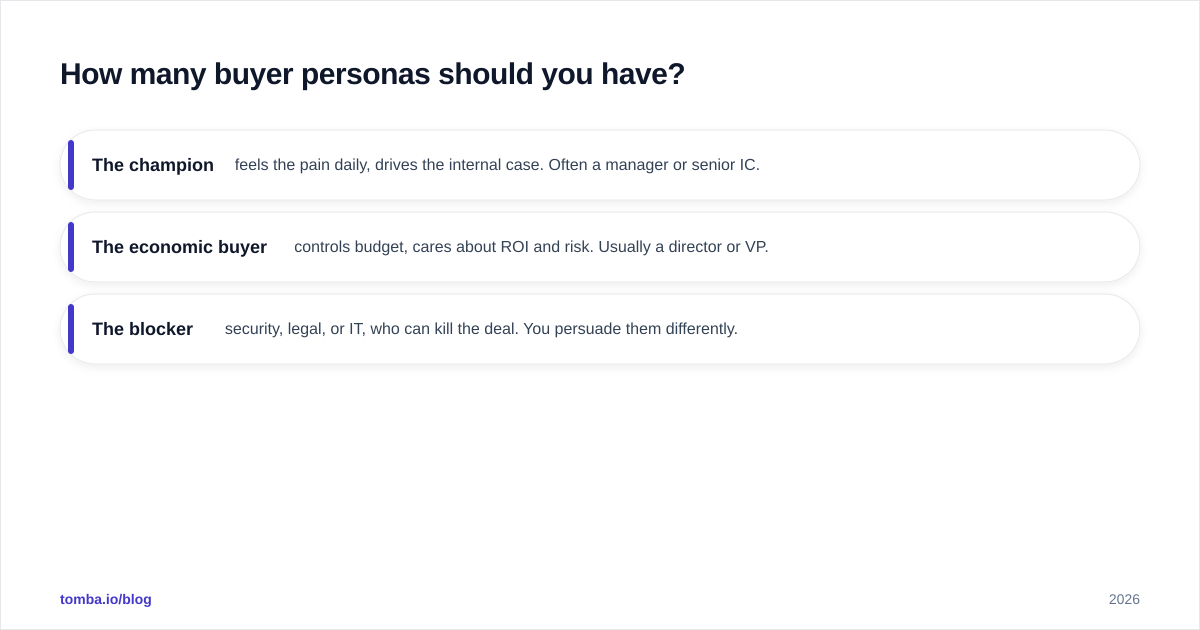
- The champion — feels the pain daily, drives the internal case. Often a manager or senior IC.
- The economic buyer — controls budget, cares about ROI and risk. Usually a director or VP.
- The blocker — security, legal, or IT, who can kill the deal. You persuade them differently.
These aren't separate "personas" in the targeting sense so much as roles within one buying committee. Gartner's research on B2B buying puts the typical buying group at six to ten people. Your personas should reflect that committee, not pretend a single hero makes the call.
Resist the urge to spin up a new persona for every edge case. Persona sprawl is how you end up with documents nobody maintains. Three sharp, validated personas beat ten vague ones.
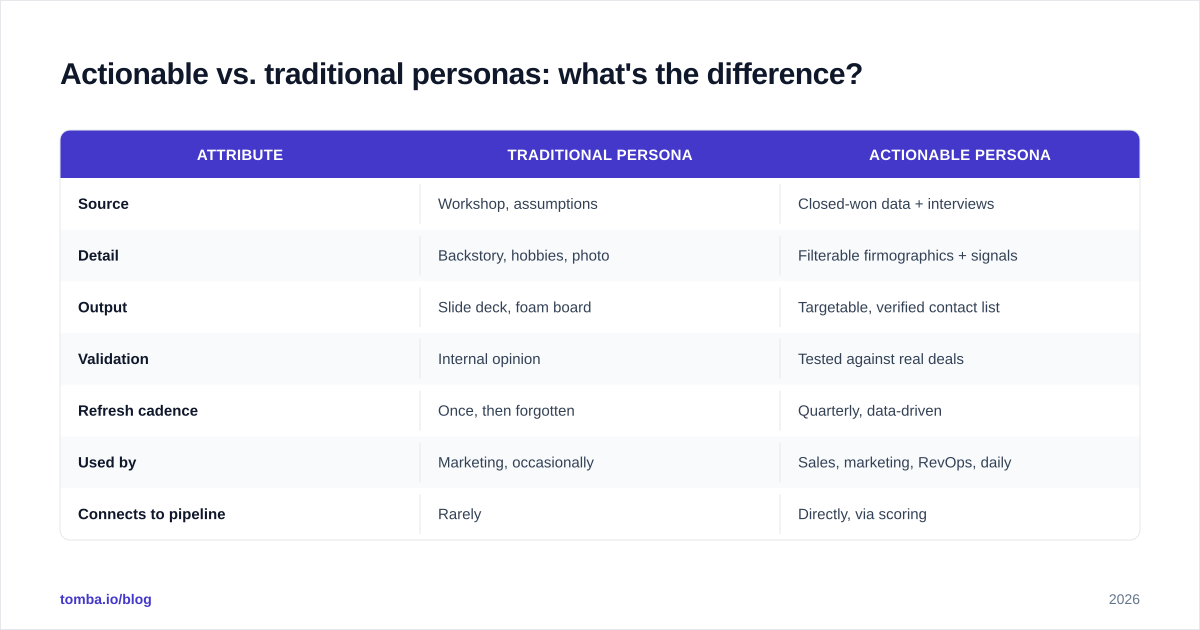
Actionable vs. traditional personas: what's the difference?#
| Attribute | Traditional persona | Actionable persona |
|---|---|---|
| Source | Workshop, assumptions | Closed-won data + interviews |
| Detail | Backstory, hobbies, photo | Filterable firmographics + signals |
| Output | Slide deck, foam board | Targetable, verified contact list |
| Validation | Internal opinion | Tested against real deals |
| Refresh cadence | Once, then forgotten | Quarterly, data-driven |
| Used by | Marketing, occasionally | Sales, marketing, RevOps, daily |
| Connects to pipeline | Rarely | Directly, via scoring |
The traditional version isn't worthless — empathy matters, and a vivid persona helps copywriters write like a human. But empathy without filters doesn't fill a pipeline. The actionable version keeps the human insight and adds the machinery to act on it. You can sanity-check vendor approaches to this on a review site like G2 before committing to any tooling.
How do you keep buyer personas from going stale?#
Treat them like a living dataset, not a finished artifact. Three habits keep them fresh:
Re-mine closed-won every quarter. Your best-fit segment drifts as your product and market change. A quarterly pull catches the drift early. If a new industry started winning, your persona should reflect it before your competitors notice.
Watch your bounce and reply rates by segment. If outreach to a persona suddenly bounces more, titles may have shifted or the companies may have reorganized. Keep your lists clean with an email verifier so a data-quality problem doesn't masquerade as a persona problem.
Audit the triggers. Contextual signals decay fastest. A funding-round trigger that worked in a hot market may mean nothing in a tight one. Review which triggers still correlate with closed deals and retire the ones that don't.
A persona you revisit four times a year stays a tool. A persona you build once becomes a relic — accurate the day you made it, slightly wrong a month later, and actively misleading by next year.
What tools help you operationalize buyer personas?#
You need three capabilities: a way to define segments, a way to find and verify contacts in those segments, and a way to enrich what you already have. The first lives in your CRM or a B2B data platform. The second and third are where an email-finding and enrichment stack earns its place.
The workflow looks like this. Define the firmographic filter. Use domain search to surface the right roles at matching companies. Run every address through verification so your sender reputation survives. Enrich the contacts with seniority, direct phone, and tech-stack data so reps can prioritize. Then push the scored list into your sequencing tool. Each step is a filter applied to a persona — which is exactly what "actionable" means.
If you're building or rebuilding your personas this quarter, start by turning them into a real, verified target list. Tomba's Email Finder lets you go from a firmographic profile to verified, in-segment contacts — by domain, by name, or by company — so your beautifully validated persona doesn't die on a slide. Pair it with verification and enrichment, check the Tomba pricing (a free tier covers 25 searches a month, with Starter at $49/mo), and ship a persona your reps can actually act on tomorrow morning.
Get the Tomba newsletter
Practical outbound tactics and product updates — once every two weeks.
About the author