11 Best ActiveCampaign Alternatives for 2026 (Ranked & Compared)
ActiveCampaign is powerful but pricing scales fast and the learning curve is real. Here are 11 ActiveCampaign alternatives compared on price, automation depth, and CRM fit for 2026.
ActiveCampaign earned its reputation as one of the most capable marketing automation platforms on the market. But "capable" and "right for you" are not the same thing. As your list grows, the bill climbs faster than you expect, and the automation builder that looks elegant in a demo can feel like a part-time job once you're maintaining 40 active workflows.
If you're reading this, you've probably already felt one of those pinch points. This guide breaks down the 11 best ActiveCampaign alternatives for 2026 — what each does well, where it falls short, and which type of team it actually fits.
TL;DR#
- Best for small businesses on a budget: Brevo and MailerLite deliver core automation at a fraction of ActiveCampaign's per-contact cost.
- Best for B2B sales + marketing alignment: HubSpot if budget allows; GetResponse if it doesn't.
- Best for e-commerce: Klaviyo and Omnisend are built around store data ActiveCampaign treats as an add-on.
- Best for developers/scale: Customer.io and Mailchimp's API-first tiers.
- The hidden cost nobody mentions: your automations are only as good as your list data — bad emails wreck deliverability on every platform. Clean your data with an email verifier before you migrate.
Why look for an ActiveCampaign alternative at all?#
Three reasons come up again and again.
Pricing that scales with contacts, not value. ActiveCampaign bills by contact count and feature tier. A list that doubles can more than double your bill, even if half those contacts never open an email. Teams routinely discover they're paying for inflated lists full of stale or invalid addresses.
Complexity creep. The automation builder is genuinely powerful, which is exactly why it gets overwhelming. Multi-branch workflows, conditional logic, and goal tracking are great until you inherit someone else's spaghetti and can't tell what fires when.
Feature mismatch. If you run a Shopify store, you want native revenue attribution and abandoned-cart flows that read store events out of the box. If you're a developer, you want a clean API and event-driven triggers. ActiveCampaign is a generalist, and generalists lose to specialists on the edges.
How should you evaluate an ActiveCampaign alternative?#
Don't start with the feature list. Start with the framework below — it sorts tools by the job you actually need done, so you don't overpay for capabilities you'll never switch on.
Score any candidate against five dimensions:
- Total cost at your real contact count — not the headline starter price, the price at 25,000 contacts.
- Automation depth vs. ease — can a non-technical marketer build and audit a workflow without a training course?
- Native integrations — does it read events from your store, CRM, or product without a
Zapier patch? 4. Deliverability tooling — does it help you protect sender reputation, or just send and hope? 5. Support and migration help — will someone move your existing automations, or are you on your own?
What are the best ActiveCampaign alternatives in 2026?#
Here's the shortlist, grouped by who they're for.
1. HubSpot — best all-in-one for B2B#
HubSpot is the closest thing to a true ActiveCampaign replacement that also gives you a real CRM, not a contact list pretending to be one. Marketing, sales, and service share one record. The trade-off is price: the Marketing Hub jumps sharply once you need advanced automation. If your sales and marketing teams are fighting over data, the HubSpot integration ecosystem and unified reporting justify it. See their published tiers at hubspot.com.
2. Brevo (formerly Sendinblue) — best value automation#
Brevo bills by email volume, not contact count — a structural advantage if you have a large but lightly-mailed list. You get automation, SMS, a basic CRM, and transactional email under one roof. The automation builder is less deep than ActiveCampaign's, but for 80% of use cases it's more than enough at a third of the cost.
3. Klaviyo — best for e-commerce#
Klaviyo is built for stores. Revenue attribution, predictive analytics, and abandoned-cart flows are first-class citizens, not bolt-ons. If most of your revenue runs through Shopify, WooCommerce, or BigCommerce, Klaviyo will out-convert ActiveCampaign because it understands product and purchase events natively.
4. GetResponse — best budget all-rounder#
GetResponse bundles email, automation, landing pages, and even webinars. It's the value pick for solopreneurs and small teams who want one bill instead of five tools. Automation is solid for the price, though large enterprises will outgrow it.
5. MailerLite — best for simplicity#
If ActiveCampaign overwhelmed you, MailerLite is the antidote. Clean interface, generous free tier, and just enough automation. It's deliberately not trying to be a CRM, and that focus shows.
6. Mailchimp — best brand-recognition + API#
Mailchimp is the default many teams already know. Its higher tiers offer respectable automation and a strong API. Watch the pricing at scale, which has historically been a sore point.
7. Customer.io — best for developers#
Event-driven, API-first, and built for product-led companies that trigger messages off in-app behavior. Marketers can use it, but it shines when engineers wire it into the product.
8. Omnisend — best e-commerce runner-up#
Like Klaviyo but friendlier on the wallet, with strong SMS and email automation aimed squarely at growing stores.
9. ConvertKit (Kit) — best for creators#
Newsletters, digital products, and audience monetization. If you're a creator rather than a B2B marketer, this is your lane.
10. Drip — best for mid-market e-commerce#
A focused e-commerce automation platform with strong segmentation, sitting between MailerLite's simplicity and Klaviyo's depth.
11. Encharge — best for SaaS onboarding#
Behavior-based email built for SaaS lifecycle and onboarding flows, with a visual builder that's easier to reason about than most.
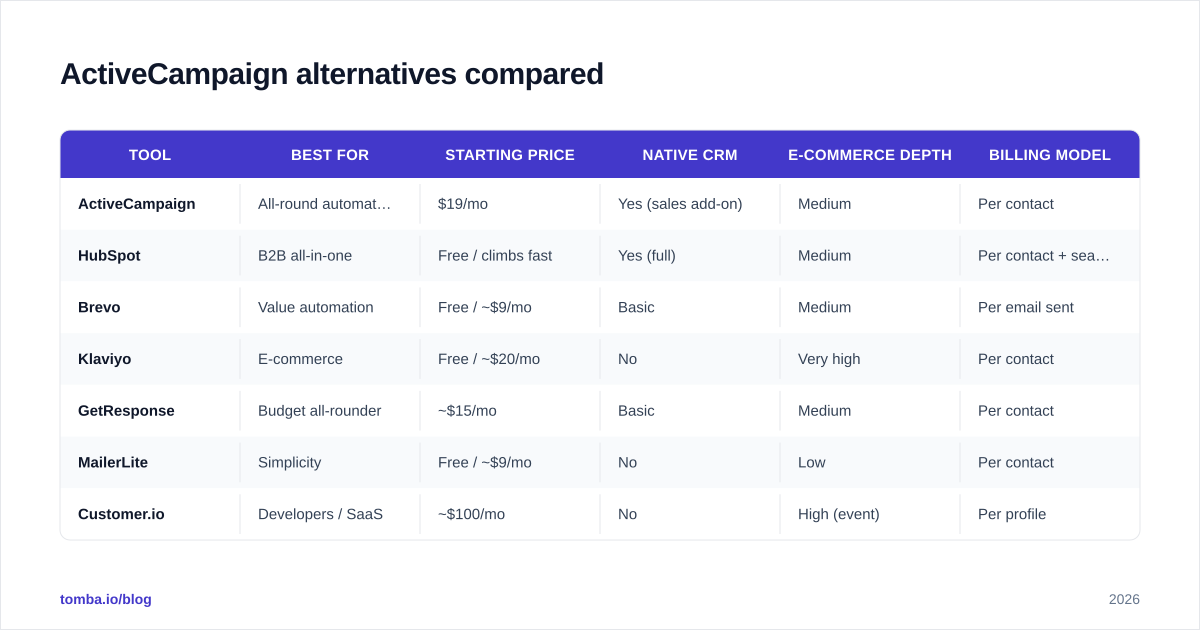
ActiveCampaign alternatives compared#
| Tool | Best for | Starting price | Native CRM | E-commerce depth | Billing model |
|---|---|---|---|---|---|
| ActiveCampaign | All-round automation | $19/mo | Yes (sales add-on) | Medium | Per contact |
| HubSpot | B2B all-in-one | Free / climbs fast | Yes (full) | Medium | Per contact + seats |
| Brevo | Value automation | Free / ~$9/mo | Basic | Medium | Per email sent |
| Klaviyo | E-commerce | Free / ~$20/mo | No | Very high | Per contact |
| GetResponse | Budget all-rounder | ~$15/mo | Basic | Medium | Per contact |
| MailerLite | Simplicity | Free / ~$9/mo | No | Low | Per contact |
| Customer.io | Developers / SaaS | ~$100/mo | No | High (event) | Per profile |
Prices are indicative entry points for 2026 and change frequently — always confirm at your real contact volume on the vendor's own pricing page. Cross-reference verified user reviews on G2 before committing.
Is HubSpot a better choice than ActiveCampaign?#
It depends on whether you need a CRM or an email engine. If your pain is "marketing and sales don't share data," HubSpot wins because the contact record is genuinely unified across teams. If your pain is "I just want great automated email without a sales platform attached," HubSpot is overkill and you'll pay for seats you don't use. ActiveCampaign — or Brevo — is the leaner choice there.
What's the cheapest ActiveCampaign alternative that's actually good?#
Brevo and MailerLite are the two that consistently deliver real value at the low end. Brevo's email-volume billing is the structural win for big-list, low-frequency senders; MailerLite is the pick if you want the gentlest learning curve. Both have free tiers worth testing before you spend a dollar.
The mistake that breaks every platform migration#
Switching platforms won't fix your deliverability if you carry bad data across. Every tool on this list lives or dies by the quality of your list. Invalid addresses trigger hard bounces, spam traps tank your email deliverability, and your shiny new automation flows land in spam regardless of which logo is on the dashboard.
Before you migrate, do two things:
- Verify the list you're bringing over. Strip dead, role-based, and risky addresses. A clean list also shrinks your contact count — which, on per-contact billing, directly lowers your new bill.
- Enrich the contacts worth keeping. Fill in missing job titles, companies, and verified emails so your segmentation actually has data to work with. Data enrichment turns a thin list into one you can personalize against.
This is also where many teams discover their list was bloated by 20–30% with addresses they were paying to store and never reaching. Cleaning first is the rare migration step that pays for itself immediately.
How do you migrate without losing your automations?#
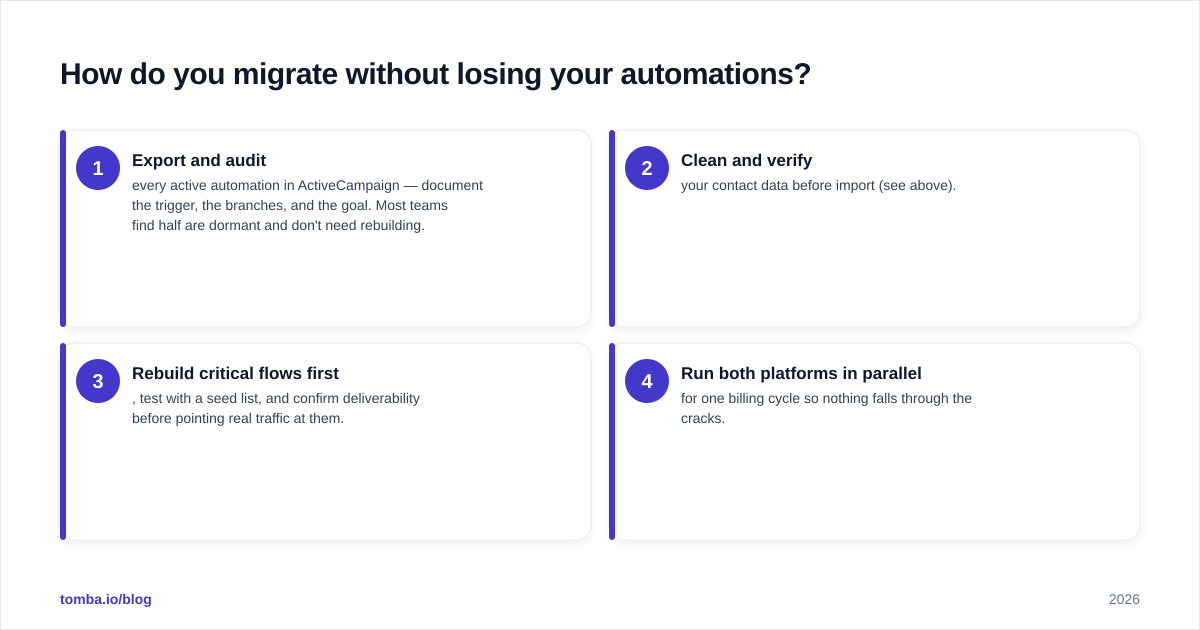
Plan it in four steps:
- Export and audit every active automation in ActiveCampaign — document the trigger, the branches, and the goal. Most teams find half are dormant and don't need rebuilding.
- Clean and verify your contact data before import (see above).
- Rebuild critical flows first, test with a seed list, and confirm deliverability before pointing real traffic at them.
- Run both platforms in parallel for one billing cycle so nothing falls through the cracks.
Don't try to recreate every legacy workflow on day one. Migration is the best chance you'll ever get to delete the ones that never worked.
Which ActiveCampaign alternative should you pick?#
- B2B with sales + marketing alignment needs: HubSpot.
- Tight budget, real automation: Brevo or GetResponse.
- E-commerce: Klaviyo (premium) or Omnisend (value).
- You found ActiveCampaign too complex: MailerLite.
- Developer / SaaS, event-driven: Customer.io or Encharge.
Whatever you choose, the platform is only half the equation. The other half is the quality of the people you're emailing.
Build a clean, verified list before you switch#
The fastest way to lower your new platform's bill and lift your open rates is to feed it accurate contacts. Use Tomba's Email Finder to source verified, professional email addresses by name, domain, or company — then verify and enrich them so every contact you migrate is one you can actually reach. Tomba's Free tier gives you 25 searches a month to test it, with paid plans starting at $49/mo when you're ready to scale. Don't pour bad data into a better tool — start clean, and let the automation do its job.
// get started
Find, verify and enrich your first contacts today
Start on the free plan with 25 searches a month, then scale when your team is ready.
Free plan · No credit card required · GDPR & CCPA
// about the author