ActiveCampaign vs HubSpot 2026: Which CRM Wins for B2B?
ActiveCampaign vs HubSpot in 2026: a no-fluff breakdown of pricing, automation depth, CRM features, and which platform actually fits your B2B revenue team.
Choosing between ActiveCampaign and HubSpot is really a choice between two philosophies: a deep, affordable automation engine versus an all-in-one revenue platform that scales with your headcount and your budget. Both are excellent. Neither is right for everyone.
This guide cuts through the marketing pages and shows you exactly where each tool wins, what they actually cost in 2026, and how to decide without a 14-day trial-induced panic.
TL;DR — ActiveCampaign vs HubSpot at a glance#
- Pick ActiveCampaign if email marketing automation is your core need, your team is lean, and you want enterprise-grade workflows at SMB pricing.
- Pick HubSpot if you want one platform for marketing, sales, service, and CMS — and you have the budget to grow into it.
- Pricing reality: ActiveCampaign starts around $15/mo; HubSpot's free CRM is genuinely useful but paid Marketing/Sales Hubs climb fast, into thousands per month at scale.
- Automation depth goes to ActiveCampaign; ecosystem, reporting, and ease of onboarding go to HubSpot.
- Neither tool finds or verifies contact data well — you'll still need a dedicated email finder to feed clean leads into either CRM.
What is ActiveCampaign and who is it for?#
ActiveCampaign is a marketing automation and email platform that grew a lightweight CRM on top. Its reputation is built on one thing: automation workflows that are genuinely powerful without an enterprise price tag.
You build customer journeys on a visual canvas — branching logic, conditional waits, lead scoring, predictive sending, and split tests — and the depth available on a mid-tier plan would cost three times more elsewhere. For an e-commerce brand or a B2B team whose engine is email nurture, that depth is the entire value proposition.
The trade-off: the native CRM is functional but not the reason anyone buys ActiveCampaign. Sales-heavy orgs that live inside a pipeline all day often find it thinner than they'd like.
What is HubSpot and who is it for?#
HubSpot is an all-in-one customer platform — Marketing Hub, Sales Hub, Service Hub, Content Hub, and Operations Hub — sitting on a shared CRM core. The pitch is consolidation: one source of truth, one login, one reporting layer across every team that touches a customer.
The free CRM is the famous on-ramp. It's legitimately good and costs nothing, which is how HubSpot lands in so many startups. The catch arrives later: the features that make HubSpot HubSpot — advanced automation, custom reporting, removing branding, higher contact tiers — live in the paid Professional and Enterprise plans, and those scale with both seats and marketing contacts.
If you want sales, marketing, and support working off the same record and you can fund it, HubSpot's ecosystem and onboarding are hard to beat. You can read their own HubSpot product overview to see how the hubs stack.
ActiveCampaign vs HubSpot: the head-to-head comparison#
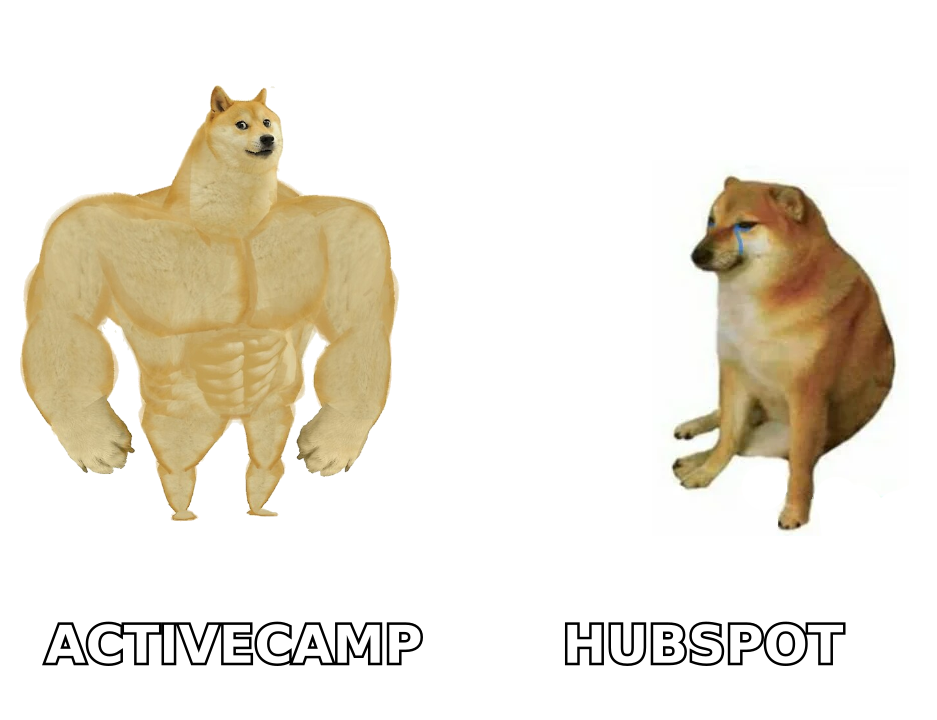
Here's the practical breakdown across the dimensions that actually drive the decision.
| Dimension | ActiveCampaign | HubSpot |
|---|---|---|
| Entry price | ~$15/mo (Starter) | Free CRM; paid Marketing/Sales Hub from ~$15–20/seat, scaling fast |
| Free tier | 14-day trial, no permanent free plan | Permanent free CRM with limited features |
| Automation depth | Best-in-class, deep branching logic | Strong, simpler to build, gated to higher tiers |
| Native CRM strength | Light, email-centric | Robust, full sales pipeline |
| Reporting & dashboards | Functional, improving | Excellent, highly customizable |
| Ecosystem / app marketplace | ~900+ integrations | 1,700+ integrations, larger community |
| Onboarding ease | Moderate learning curve | Polished, academy-backed |
| Best fit | Email-led SMB & mid-market | Multi-team, scaling orgs |
The pattern is clear: ActiveCampaign rewards teams who want maximum automation per dollar, while HubSpot rewards teams who want one consolidated platform and will pay for the breadth.
Is ActiveCampaign cheaper than HubSpot?#
Yes — almost always, and especially as you scale. This is the single biggest differentiator.
ActiveCampaign prices on contacts and feature tier, but its automation depth is available early and cheaply. HubSpot's pricing compounds in two directions at once: paid seats and marketing-contact tiers, plus the jump from Professional to Enterprise to unlock the reporting and automation many teams assumed was standard.
A growing B2B company can run sophisticated nurture sequences on ActiveCampaign for a few hundred dollars a month. The equivalent capability on HubSpot Marketing Hub Professional, once contact counts climb, routinely lands in the thousands. Validate current numbers against the live HubSpot pricing page and ActiveCampaign's own tiers before you commit — both vendors adjust frequently.
That said, "cheaper" isn't "better value" for everyone. If HubSpot replaces four separate tools, its consolidated cost can win on total spend even when the sticker price is higher.
Which has better marketing automation?#
ActiveCampaign, on raw depth. HubSpot, on ease and integration.
ActiveCampaign's workflow builder lets you nest conditions, combine event and behavioral triggers, run goals, and apply predictive features in ways power users love. If your competitive edge is a finely tuned lifecycle program, this is the tool that won't box you in.
HubSpot's automation is genuinely capable and noticeably easier to learn, but the most advanced workflows sit behind Professional and Enterprise tiers. Where HubSpot pulls ahead is context: because automation lives on the same record as your sales and service data, triggering a workflow off a deal stage or a support ticket is native, not a workaround.
A simple rule of thumb:
- Automation is your primary growth lever → ActiveCampaign.
- Automation is one of many things you need unified → HubSpot.
How do they handle CRM and sales pipeline?#
This flips the script — HubSpot is the stronger CRM by a clear margin.
HubSpot was built outward from a CRM, so deal pipelines, task queues, sequences, call logging, meeting links, and quote tools feel first-class. Sales reps who spend their day in the pipeline get a purpose-built home, and Sales Hub's reporting gives leaders the forecasting view ActiveCampaign can't match.
ActiveCampaign's CRM (Deals) is fine for lightweight pipeline tracking tied to email automation, but it isn't where a dedicated SDR team wants to live. If your priority is outbound sales automation and pipeline visibility over nurture email, that tilts the decision toward HubSpot — or toward a specialized sales-engagement tool alongside ActiveCampaign.
What about integrations and data quality?#
Both connect to the tools you already use — HubSpot's marketplace is larger (1,700+ apps and a bigger community), while ActiveCampaign's ~900+ integrations cover the essentials well. If a clean two-way sync with your stack matters, check the Tomba HubSpot integration and confirm both platforms support your critical apps natively before you sign.
But here's the gap neither vendor will highlight: a CRM is only as good as the data inside it. Both ActiveCampaign and HubSpot are systems of record — they store and act on contacts, they don't source or clean them. Bad emails still bounce. Stale records still rot. Duplicate leads still pollute your reporting.
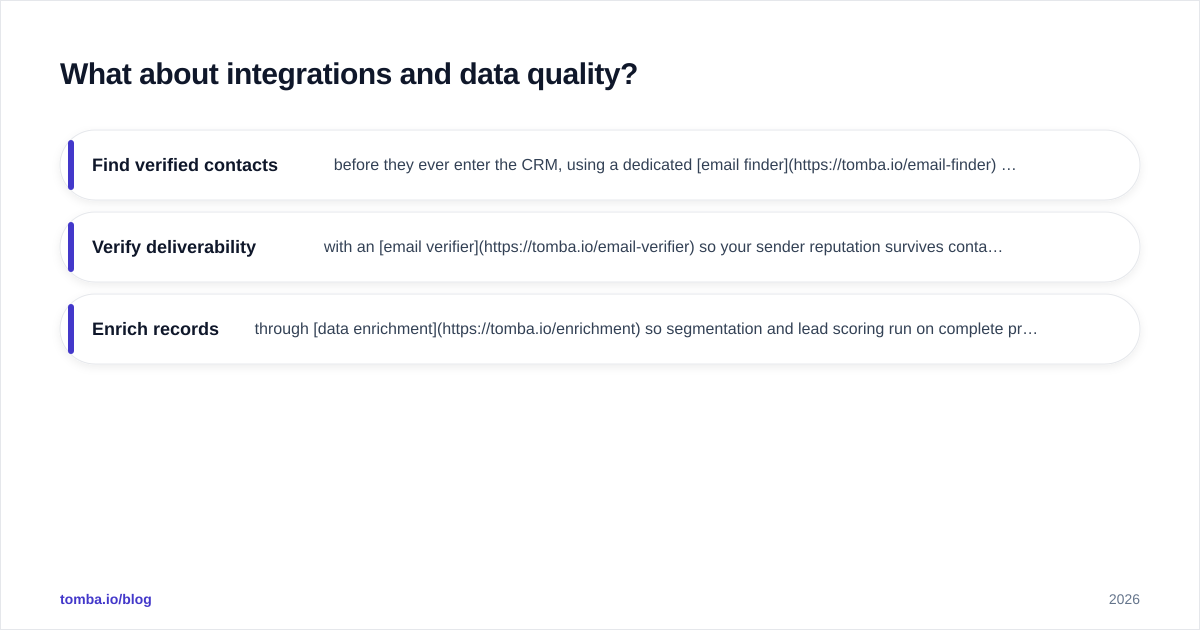
That's why high-performing teams put a data layer in front of whichever platform they pick:
- Find verified contacts before they ever enter the CRM, using a dedicated email finder keyed off domain or name.
- Verify deliverability with an email verifier so your sender reputation survives contact with a HubSpot or ActiveCampaign send.
- Enrich records through data enrichment so segmentation and lead scoring run on complete profiles, not half-empty rows.
Garbage in, garbage automated. The fanciest workflow can't fix a wrong email address.
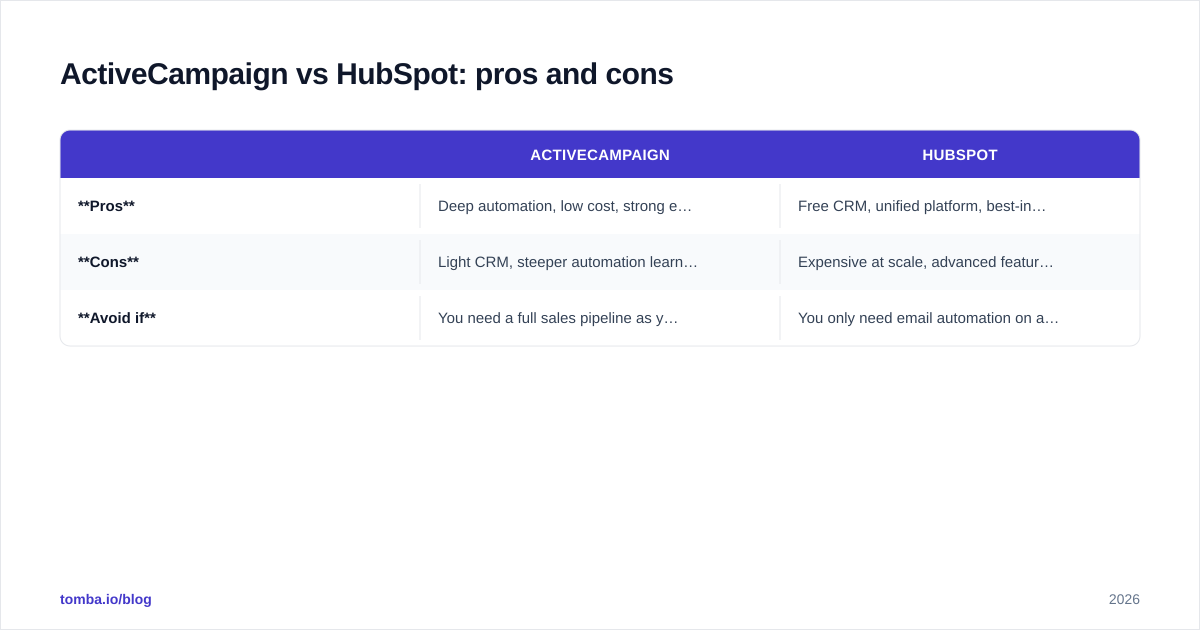
ActiveCampaign vs HubSpot: pros and cons#
| ActiveCampaign | HubSpot | |
|---|---|---|
| Pros | Deep automation, low cost, strong email deliverability, fast time-to-value for nurture | Free CRM, unified platform, best-in-class reporting, huge ecosystem, top onboarding |
| Cons | Light CRM, steeper automation learning curve, fewer native reports | Expensive at scale, advanced features gated, can be overkill for email-only teams |
| Avoid if | You need a full sales pipeline as your core | You only need email automation on a budget |
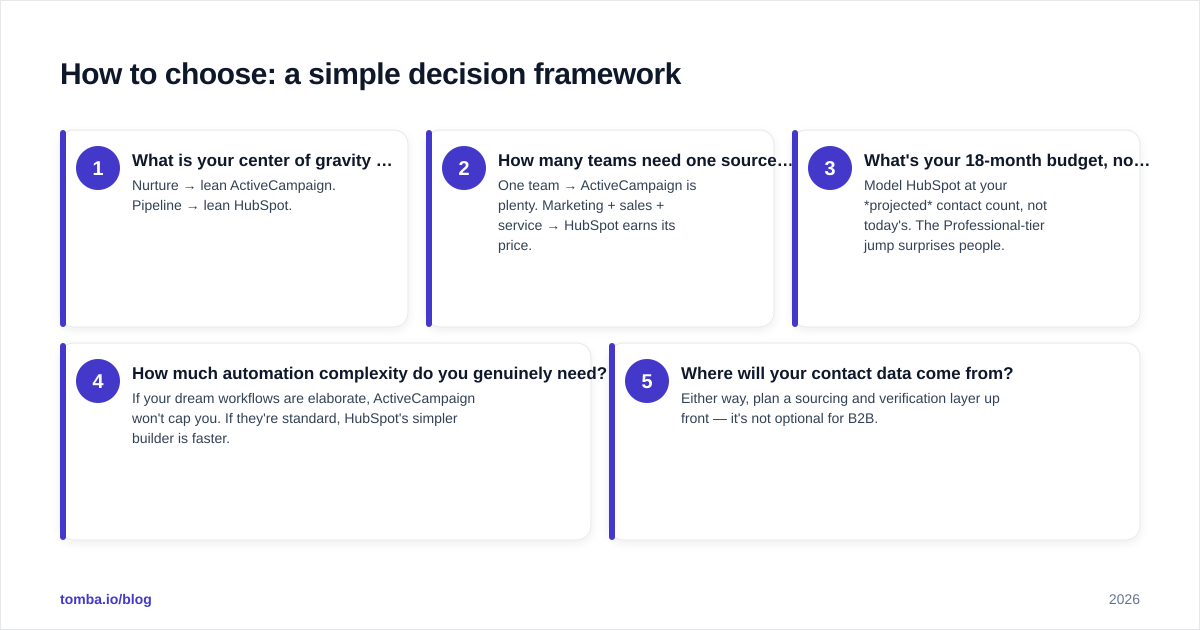
How to choose: a simple decision framework#
Answer these in order and the winner usually picks itself:
- What is your center of gravity — email nurture or sales pipeline? Nurture → lean ActiveCampaign. Pipeline → lean HubSpot.
- How many teams need one source of truth? One team → ActiveCampaign is plenty. Marketing + sales + service → HubSpot earns its price.
- What's your 18-month budget, not your launch budget? Model HubSpot at your projected contact count, not today's. The Professional-tier jump surprises people.
- How much automation complexity do you genuinely need? If your dream workflows are elaborate, ActiveCampaign won't cap you. If they're standard, HubSpot's simpler builder is faster.
- Where will your contact data come from? Either way, plan a sourcing and verification layer up front — it's not optional for B2B.
For independent user sentiment beyond the vendor sites, cross-reference the category on G2 where both platforms carry thousands of reviews.
If you're still torn after this framework, that's a signal you're comparing on features instead of fit. Re-anchor on question one — center of gravity — and the noise clears.
The bottom line#
ActiveCampaign wins on automation depth and price-to-power. HubSpot wins on platform breadth, CRM strength, and reporting. There's no universal winner — only the right fit for your team's center of gravity and budget trajectory.
Whichever you choose, remember the part the comparison pages skip: both platforms run on the contact data you feed them. Before your first workflow fires or your first deal advances, make sure the emails are real, current, and complete.
Start by filling your pipeline with verified, accurate contacts. Tomba's Email Finder locates professional email addresses by domain, name, or company, and validates them so they actually land — feeding clean data straight into ActiveCampaign or HubSpot. Try it on the free tier (25 searches/month), and scale up on the Starter plan at $49/mo when your outbound engine is humming. The best CRM in the world can't email a contact that doesn't exist — so fix the data first, then let your automation do the rest.
// get started
Find, verify and enrich your first contacts today
Start on the free plan with 25 searches a month, then scale when your team is ready.
Free plan · No credit card required · GDPR & CCPA
// about the author