ActiveCampaign vs Ontraport 2026: Full Feature Comparison
ActiveCampaign vs Ontraport: an honest 2026 breakdown of pricing, automation depth, CRM features, and which platform fits your B2B team best.
Choosing between ActiveCampaign and Ontraport is really a choice between two philosophies of marketing automation. One is a best-in-class email engine that grew into a CRM. The other is an all-in-one business operating system that bundles CRM, payments, landing pages, and membership sites under one roof. Picking wrong means either paying for tools you never touch or stitching together apps you wish came built in.
This breakdown cuts through the marketing copy on both sides and looks at what actually matters when you run outbound and nurture campaigns at scale in 2026: automation depth, CRM usability, deliverability, pricing at real seat counts, and the data quality feeding the whole machine.
TL;DR: ActiveCampaign vs Ontraport at a glance#
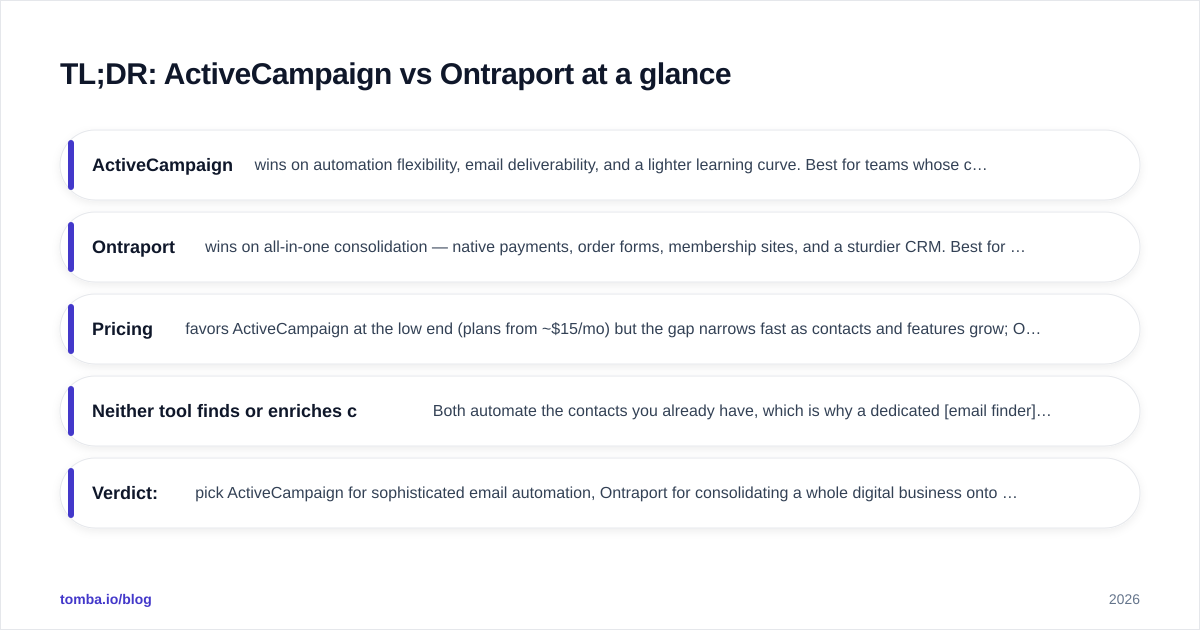
- ActiveCampaign wins on automation flexibility, email deliverability, and a lighter learning curve. Best for teams whose center of gravity is email marketing and lifecycle nurture.
- Ontraport wins on all-in-one consolidation — native payments, order forms, membership sites, and a sturdier CRM. Best for course creators, coaches, and SMBs who want to replace five tools with one.
- Pricing favors ActiveCampaign at the low end (plans from
$15/mo) but the gap narrows fast as contacts and features grow; Ontraport starts higher ($24/mo) but folds in functionality you'd pay extra for elsewhere. - Neither tool finds or enriches contacts for you. Both automate the contacts you already have, which is why a dedicated email finder sits upstream of either platform.
- Verdict: pick ActiveCampaign for sophisticated email automation, Ontraport for consolidating a whole digital business onto one bill.
What is ActiveCampaign?#
ActiveCampaign launched in 2003 as an email marketing tool and spent two decades turning into what it now calls a "customer experience automation" platform. At its core it is still the strongest visual automation builder in the mid-market: you drag triggers, conditions, waits, and actions onto a canvas and branch contacts down paths based on behavior, tags, and custom fields.
The CRM is bolted on top and is genuinely useful for small sales teams — pipelines, deal scoring, task automation — but it is clearly the younger sibling to the email engine. Where ActiveCampaign shines is the granularity of its automations and its consistently high inbox placement. You can read more about why that matters in any guide to email deliverability, because deliverability is the difference between an automation that prints revenue and one that lands in spam.
You can see the platform's full plan structure on the ActiveCampaign site before committing.
What is Ontraport?#
Ontraport is an all-in-one business platform built for SMBs, coaches, course creators, and service businesses that don't want a stack of disconnected tools. Where ActiveCampaign assumes you'll bring your own checkout, membership platform, and landing-page builder, Ontraport ships all of them natively.
That means a single Ontraport account can run your CRM, send your broadcasts and automated sequences, host your order forms, process recurring payments, gate a membership site, and report on the whole funnel — without Zapier glue between systems. The trade-off is that each individual module is "very good" rather than "best in class." Its automation builder is capable but less fluid than ActiveCampaign's, and its email editor feels more utilitarian.
For a business that values one login and one invoice over having the sharpest tool in each category, that consolidation is the entire pitch. You can confirm the current tiers on the Ontraport pricing page.
ActiveCampaign vs Ontraport: how do they compare?#
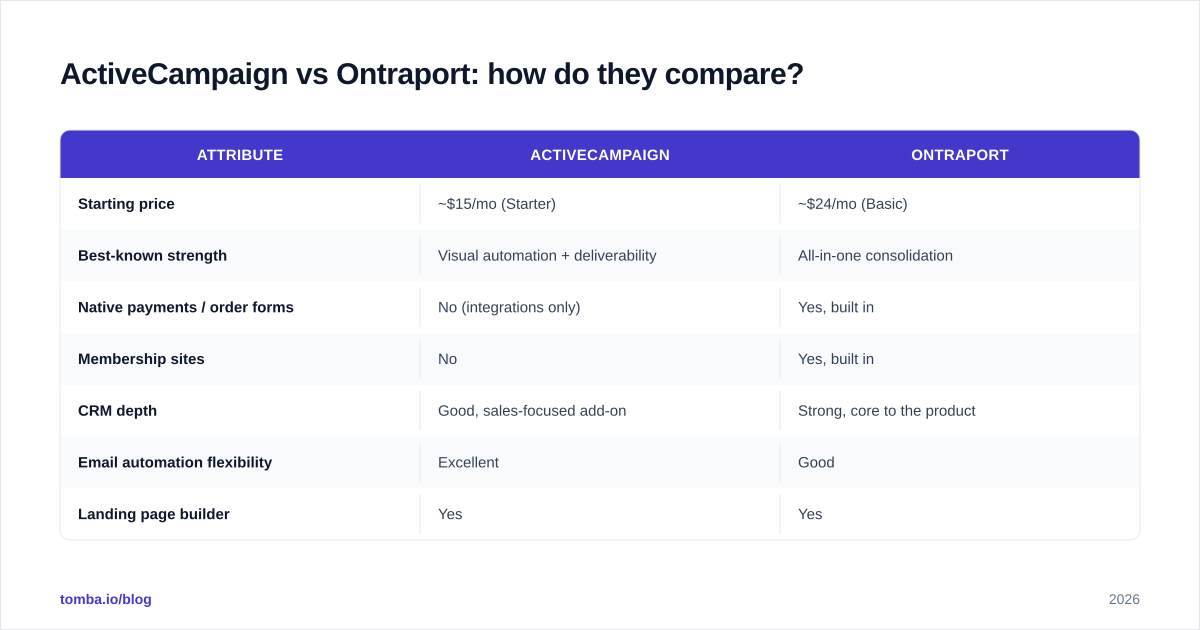
Here's the head-to-head on the attributes that decide most evaluations. Pricing reflects published entry tiers in 2026 and scales with contact volume on both platforms.
| Attribute | ActiveCampaign | Ontraport |
|---|---|---|
| Starting price | ~$15/mo (Starter) | ~$24/mo (Basic) |
| Best-known strength | Visual automation + deliverability | All-in-one consolidation |
| Native payments / order forms | No (integrations only) | Yes, built in |
| Membership sites | No | Yes, built in |
| CRM depth | Good, sales-focused add-on | Strong, core to the product |
| Email automation flexibility | Excellent | Good |
| Landing page builder | Yes | Yes |
| Learning curve | Moderate | Steeper |
| Free tier | 14-day trial | 14-day trial |
| Ideal user | Email-led B2B & ecommerce | Coaches, creators, SMB services |
The pattern is clear: ActiveCampaign is the specialist that does email automation better than almost anyone, while Ontraport is the generalist that replaces several subscriptions. Neither is objectively "better" — they're optimized for different buyers.
Is ActiveCampaign better than Ontraport for automation?#
For pure automation flexibility, yes — ActiveCampaign is better.
Think of automation builders like cooking. Ontraport is a well-stocked meal-kit service: the ingredients are pre-portioned and the recipe works, but you follow the path it gives you. ActiveCampaign is a fully equipped kitchen: more steps to learn, but you can build any dish you can imagine.
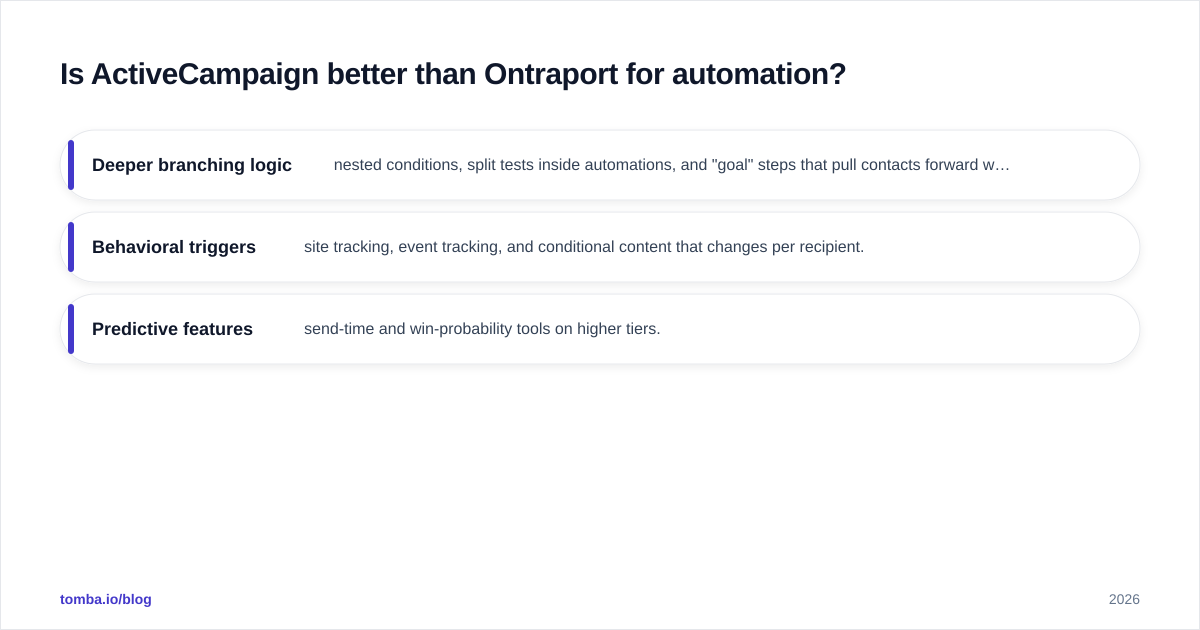
Concretely, ActiveCampaign gives you:
- Deeper branching logic — nested conditions, split tests inside automations, and "goal" steps that pull contacts forward when they convert.
- Behavioral triggers — site tracking, event tracking, and conditional content that changes per recipient.
- Predictive features — send-time and win-probability tools on higher tiers.
Ontraport's automation (called "Campaigns") is visually clean and easier for a non-technical owner to grasp, but it caps out earlier when your logic gets complicated. If your nurture sequences involve a dozen branches, lead-score thresholds, and re-engagement loops, ActiveCampaign handles it with less friction. For a primer on the broader category, see this overview of sales automation.
Where Ontraport claws back points is automating transactions, not just emails. Because payments and order forms are native, you can trigger a sequence the instant a card is charged or a subscription lapses — no webhook plumbing required. ActiveCampaign needs an integration for that.
Which has the better CRM and pipeline?#
Ontraport has the more mature CRM; ActiveCampaign has the more sales-rep-friendly one.
Ontraport was built around contact records from day one, so its database, custom objects, and reporting feel cohesive. It's comfortable holding the full customer lifecycle — lead, buyer, member, renewal — in one record. That makes it a stronger fit when the CRM is the backbone of the business.
ActiveCampaign's CRM is newer and lighter, but its pipeline view, deal automation, and task reminders are exactly what a small B2B sales team wants without the bloat. If your reps live in the pipeline all day, ActiveCampaign feels less like an afterthought than the spec sheet suggests.
Either way, your CRM is only as good as the data inside it. A pipeline full of stale or unverified contacts produces garbage automation. That's why teams pair either platform with an email verifier and ongoing data enrichment — the automation is the engine, but clean records are the fuel. You can compare both tools' migration realities and integration options on the G2 marketing automation category before you commit budget.
How do they handle deliverability?#
ActiveCampaign has the stronger deliverability reputation, and for an email-led business that single factor can outweigh everything else.
Deliverability is like a credit score for your sending domain — it's built slowly through good behavior and wrecked quickly by bad lists. ActiveCampaign invests heavily in shared-IP reputation management, authentication guidance, and list-hygiene nudges, and independent inbox-placement tests have historically favored it.
Ontraport's deliverability is solid but its real risk is behavioral: because it's so easy to blast broadcasts to your entire database, undisciplined senders torch their own reputation faster. The tool isn't the problem — the temptation is.
Two habits protect your sender reputation on either platform:
- Verify before you send. Bounces above 2-3% signal spam filters to throttle you. Run new lists through verification first.
- Segment ruthlessly. Send to engaged contacts, suppress the dead weight, and your sender reputation climbs.
Neither platform finds or cleans contacts for you — they assume your list is already good. Garbage in, spam folder out.
What does ActiveCampaign vs Ontraport cost in practice?#
Sticker prices mislead because both platforms charge by contact volume and gate features behind tiers.
ActiveCampaign looks cheaper at the entry point, but its most-wanted features — predictive sending, advanced CRM, attribution — live on Plus, Professional, and Enterprise tiers. As your contact count climbs past 25,000, the monthly bill grows meaningfully.
Ontraport starts higher but the math changes when you account for what you'd otherwise buy separately. If Ontraport replaces a $50/mo checkout tool, a $40/mo membership platform, and a $30/mo landing-page builder, its higher base price is a net saving.
| Scenario | Lean toward |
|---|---|
| Email marketing is your core channel | ActiveCampaign |
| You sell courses, coaching, or memberships | Ontraport |
| You already own checkout + LMS tools | ActiveCampaign |
| You want one vendor, one invoice | Ontraport |
| You need the deepest automation logic | ActiveCampaign |
| Small team, non-technical owner | Ontraport |
Run the real numbers at your actual contact count and feature checklist — not the headline price — before deciding.
Who should choose which?#
Choose ActiveCampaign if email is your primary growth lever, you want the most flexible automation builder in the mid-market, deliverability is mission-critical, and you're comfortable bringing your own checkout and membership tools. It's the better pick for most B2B SaaS, agencies, and ecommerce brands running sophisticated lifecycle marketing.
Choose Ontraport if you're a coach, course creator, consultant, or SMB service business that wants to run the entire operation — CRM, email, payments, memberships, reporting — from one platform with one bill, and you value consolidation over having the single sharpest tool in each category.
A useful tiebreaker: count how many other subscriptions each option would let you cancel. If the answer for Ontraport is three or more, its higher price is often the cheaper path. If you're already invested in a checkout platform and an LMS, that consolidation argument evaporates and ActiveCampaign's automation edge wins.
The piece both platforms are missing#
Here's what no marketing-automation comparison admits: both ActiveCampaign and Ontraport are activation tools, not acquisition tools. They are brilliant at nurturing, scoring, and converting contacts you already have. Neither one fills the top of your funnel.
That gap is where most automation investments quietly underperform. You can build the most elegant 14-branch sequence in ActiveCampaign or the slickest Ontraport order-form funnel, but if it's pointed at a thin or stale list, you're automating a leaky bucket. The highest-leverage move is usually upstream: feeding either platform a steady supply of accurate, verified B2B contacts.
That's the role of Tomba's Email Finder. Find verified professional email addresses by domain, name, or company, verify them before they ever touch your sequences, and push clean records straight into ActiveCampaign or Ontraport through standard integrations. Tomba's pricing starts free with 25 searches a month and scales to $49/mo on Starter — a fraction of either automation platform, and the input that decides whether all that automation actually converts. Whichever side of the ActiveCampaign vs Ontraport decision you land on, start by making sure the contacts flowing in are real.
// get started
Find, verify and enrich your first contacts today
Start on the free plan with 25 searches a month, then scale when your team is ready.
Free plan · No credit card required · GDPR & CCPA
// about the author