ActiveCampaign vs Salesforce: 2026 CRM Showdown
ActiveCampaign vs Salesforce in 2026: pricing, automation, CRM depth, and which platform actually fits your team size and budget. A neutral, hands-on breakdown.
TL;DR
- ActiveCampaign wins on price, ease of setup, and email/marketing automation. Plans start around $15/mo and a non-technical team can launch campaigns in a day.
- Salesforce wins on CRM depth, customization, reporting, and ecosystem. Sales Cloud starts at $25/user/mo but real deployments land far higher once you add seats and add-ons.
- Pick ActiveCampaign if you're an SMB whose growth engine is email nurture and lightweight pipeline tracking.
- Pick Salesforce if you run a complex sales org with multiple teams, custom objects, and forecasting needs.
- Neither tool finds or verifies contact data — you still need a dedicated source like an email finder to fill the top of the funnel.
What's the core difference between ActiveCampaign and Salesforce?#
The one-line answer: ActiveCampaign is a marketing-automation platform that added a CRM; Salesforce is a CRM platform that added everything else.
Think of it like kitchens. ActiveCampaign is a well-equipped home kitchen — you can cook excellent meals tonight without a manual. Salesforce is a commercial kitchen — it can serve a thousand covers a night, but you need trained staff and a build-out before the first plate goes out.
That origin difference explains almost every trade-off below. ActiveCampaign optimizes for fast, automated customer communication. Salesforce optimizes for modeling your entire revenue process as data you can customize, report on, and scale.
How do ActiveCampaign and Salesforce compare on pricing?#
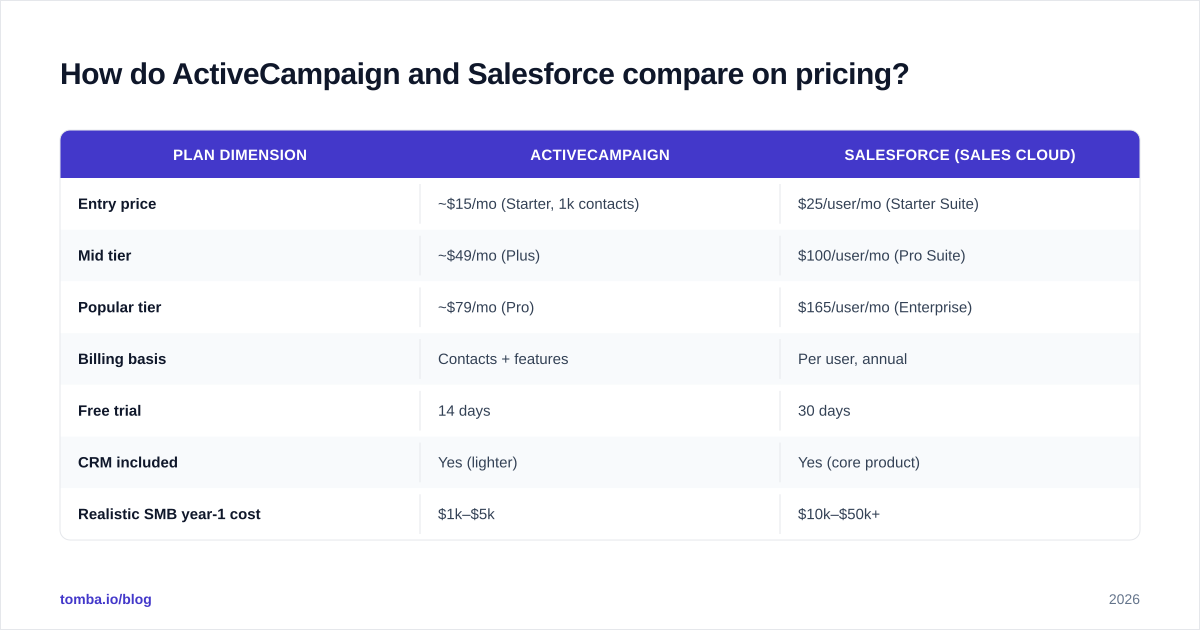
Pricing is where the two platforms feel like they live in different universes. ActiveCampaign charges primarily by contacts and feature tier. Salesforce charges per user, per month, billed annually, with capabilities gated behind editions.
| Plan dimension | ActiveCampaign | Salesforce (Sales Cloud) |
|---|---|---|
| Entry price | ~$15/mo (Starter, 1k contacts) | $25/user/mo (Starter Suite) |
| Mid tier | ~$49/mo (Plus) | $100/user/mo (Pro Suite) |
| Popular tier | ~$79/mo (Pro) | $165/user/mo (Enterprise) |
| Billing basis | Contacts + features | Per user, annual |
| Free trial | 14 days | 30 days |
| CRM included | Yes (lighter) | Yes (core product) |
| Realistic SMB year-1 cost | $1k–$5k | $10k–$50k+ |
Two honest caveats. First, ActiveCampaign costs climb as your contact list grows — a 100k-contact list on a Pro plan is no longer cheap. Second, Salesforce's sticker price understates reality: implementation, admin time, and add-ons (CPQ, Marketing Cloud, extra API calls) routinely double the per-seat number. Always model total cost, not list price.
Which platform has better automation?#
It depends on what you're automating.
For marketing and lifecycle automation — welcome series, abandoned-cart flows, lead scoring, conditional email branches — ActiveCampaign is genuinely best-in-class for its price. The visual automation builder is approachable, and you can ship a multi-step nurture without a developer. This is the product's center of gravity.
For sales-process and operational automation — territory assignment, approval workflows, multi-object triggers, complex validation — Salesforce Flow is far more powerful. It can orchestrate logic across custom objects that ActiveCampaign simply doesn't model.
A simple rule: if the automation is mostly "send the right message at the right time," ActiveCampaign edges it. If the automation is "enforce how our revenue org operates," Salesforce wins. Many teams eventually want both, which is why integrations between marketing and CRM tools, or a dedicated sales automation layer, matter so much.
How deep is the CRM in each tool?#
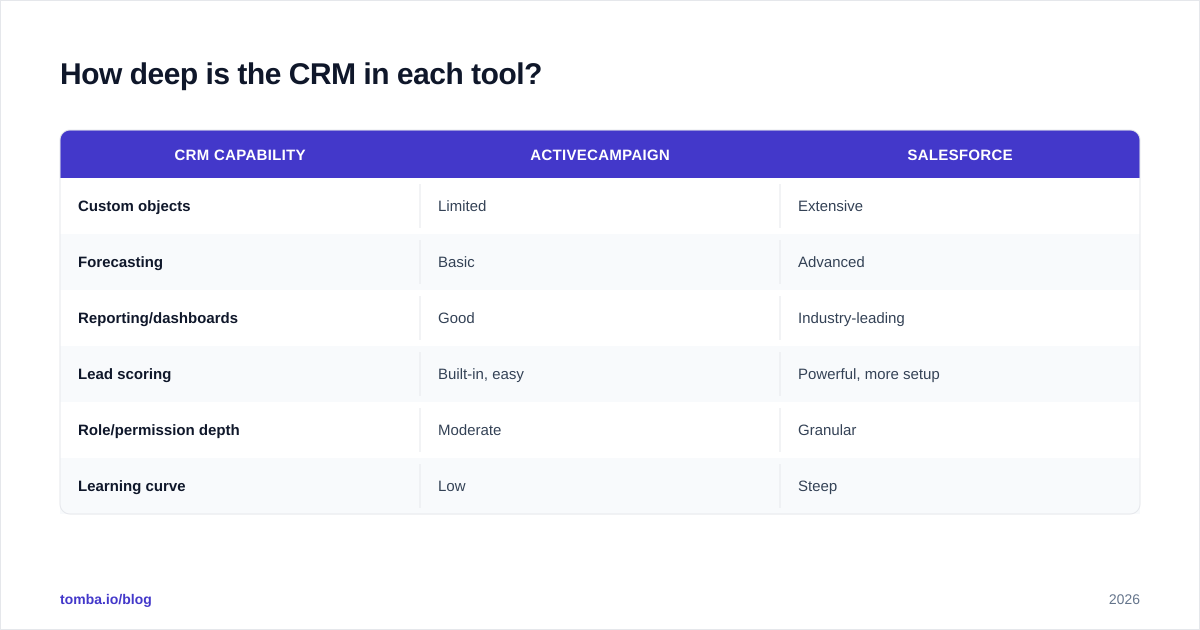
This is Salesforce's home turf. Its CRM supports custom objects, granular permissions, advanced forecasting, opportunity splits, and a reporting engine that analysts build careers around. If your deal flow needs to be sliced by product line, region, segment, and rep with audit trails, Salesforce is built for it.
ActiveCampaign's CRM (in its Plus tier and above) covers pipelines, deal stages, tasks, and basic scoring. It's perfectly serviceable for a founder-led or small sales team tracking a few hundred open deals. But it isn't designed to model an enterprise sales motion, and you'll hit ceilings on reporting and customization faster.
| CRM capability | ActiveCampaign | Salesforce |
|---|---|---|
| Custom objects | Limited | Extensive |
| Forecasting | Basic | Advanced |
| Reporting/dashboards | Good | Industry-leading |
| Lead scoring | Built-in, easy | Powerful, more setup |
| Role/permission depth | Moderate | Granular |
| Learning curve | Low | Steep |
Is ActiveCampaign better than Salesforce for email marketing?#
Yes — for most teams, ActiveCampaign is the stronger pure email-marketing tool out of the box. Segmentation, deliverability tooling, A/B testing, and template design are native and polished. Salesforce can match and exceed this, but typically only once you add Marketing Cloud (formerly Pardot for B2B), which is a separate, pricier product with its own learning curve.
So the framing matters. "Salesforce for email marketing" usually means "Salesforce plus a marketing add-on." If email nurture is your primary channel and you want one bill, ActiveCampaign is the cleaner answer. Whichever you choose, protect your sender email deliverability — the platform doesn't fix a poor list or an unwarmed domain.
Who should choose ActiveCampaign?#
Choose ActiveCampaign if you recognize yourself here:
- You're an SMB, ecommerce brand, or B2B team under ~50 people.
- Email and lifecycle automation drive most of your revenue.
- You want to launch without hiring an admin or consultant.
- Your sales process is linear and your pipeline is measured in hundreds, not tens of thousands, of deals.
- Budget predictability matters more than infinite customization.
ActiveCampaign's value is time to value. You can be sending segmented, automated campaigns the same week you sign up.
Who should choose Salesforce?#
Choose Salesforce if:
- You have multiple sales teams, segments, or product lines to model.
- You need advanced forecasting, custom objects, and board-grade reporting.
- You'll invest in (or already have) admin and ops resources.
- You want a deep app ecosystem via AppExchange and tight enterprise integrations.
- Your revenue operations function needs a single source of truth across the whole funnel.
Salesforce is an investment in a platform, not just a tool. Teams that commit to it — and staff it properly — get a system that scales for a decade. Teams that buy it and underuse it pay enterprise prices for a glorified contact list.
What do both platforms NOT do?#
Here's the gap nobody mentions in the sales demos: neither ActiveCampaign nor Salesforce generates net-new contact data. They are systems of record and engagement. They store, score, and message the contacts you already have. They don't find a prospect's verified work email or surface accounts you haven't met yet.
That means the quality of everything downstream — your automations, your forecasts, your nurture rates — is capped by the quality of the data entering the top of the funnel. Garbage in, expensive garbage out. This is why most high-performing GTM stacks pair their CRM or automation platform with a dedicated prospecting and enrichment layer:
- A domain search tool to pull verified contacts at target accounts.
- An email verifier to scrub lists before they ever touch your sender reputation.
- Data enrichment to fill missing fields on records already in your CRM.
You can compare both platforms' own published plans on the Salesforce pricing page and ActiveCampaign's site, and cross-check real-user reviews on G2 before committing — but budget for a data source regardless of which CRM you pick.
ActiveCampaign vs Salesforce: the verdict#
There's no universal winner — there's a winner for your stage.
- Early to mid-stage, automation-led teams: ActiveCampaign delivers 80% of what you need at 20% of the cost and complexity.
- Scaling, multi-team, customization-heavy orgs: Salesforce is worth the price and the effort, provided you resource it.
A practical migration path many companies follow: start on ActiveCampaign, prove the motion, then graduate to Salesforce when org complexity — not vanity — demands it. Don't buy enterprise software to solve an SMB problem, and don't outgrow a lightweight tool and blame it for ceilings it was never built to clear.
Fill the top of your funnel before you pick a CRM#
Whichever platform you land on, it's only as good as the contacts inside it. Before you migrate lists or build a single automation, make sure those records are real, reachable, and complete. Tomba's Email Finder lets you find and verify professional email addresses by name, company, or domain — so the leads flowing into ActiveCampaign or Salesforce are accurate from day one. Start free with 25 searches a month, then scale on a Tomba plan ($49/mo Starter) as your pipeline grows. Pick the CRM that fits your stage — and feed it data worth automating.
Ready to find emails that actually work?
Join 150,000+ professionals who stopped guessing and started sending. Free credits on signup — no credit card required.
Get the Tomba newsletter
Practical outbound tactics and product updates — once every two weeks.
About the author