ActiveCampaign vs Zoho CRM 2026: Which One Should You Pick?
ActiveCampaign vs Zoho CRM compared on pricing, automation, CRM depth, and data quality so you can pick the right platform for your 2026 GTM stack.
Choosing between ActiveCampaign and Zoho CRM is really a choice between two philosophies: a marketing-automation engine that grew a CRM, versus a full business suite that bundles a CRM with everything else you run. Picking the wrong one means paying for power you never use — or hitting a wall the moment your sales motion gets complex.
TL;DR#
- ActiveCampaign is the stronger choice if email marketing automation, lifecycle nurturing, and visual customer journeys are the core of your go-to-market motion.
- Zoho CRM is the stronger choice if you want a true sales pipeline, deep customization, and a low-cost on-ramp into a 50+ app business ecosystem.
- On raw pricing, Zoho CRM starts cheaper per seat; ActiveCampaign pricing scales with contact count, which can surprise high-volume senders.
- Both tools are only as good as the contact data you feed them — neither finds or verifies B2B emails for you, so you'll still need a dedicated email finder.
- Skip to the comparison table if you just want the numbers.
What is ActiveCampaign?#
ActiveCampaign is a marketing automation platform with a built-in CRM bolted on. Its reputation was earned on one thing: visual automation. You drag triggers, conditions, and actions onto a canvas and build customer journeys that fire based on email opens, page visits, tags, deal stages, or custom events.
Think of it like a model railway set. The track (your automation) is laid out visually, and contacts are the trains — they switch lanes automatically based on what they do. That's where ActiveCampaign shines: nurturing leads, segmenting by behavior, and triggering the right message at the right moment.
The "Sales" product adds a pipeline, lead scoring, and basic deal management. It's competent, but it has always felt like a companion to the marketing engine rather than the main event.
What is Zoho CRM?#
Zoho CRM is a sales-first customer relationship management platform and the flagship of the broader Zoho ecosystem (Books, Desk, Campaigns, Projects, and dozens more apps). Where ActiveCampaign starts from email, Zoho starts from the deal.
You get a configurable sales pipeline, workflow rules, a built-in AI assistant called Zia, territory management, and a level of customization that lets you reshape modules, fields, and layouts to match almost any sales process. If you've ever outgrown a simple CRM because it couldn't model your business, Zoho is built for exactly that scenario. For a refresher on what a CRM is supposed to do at its core, the fundamentals matter here.
The trade-off: Zoho's native email marketing is weaker than ActiveCampaign's. You often pair it with Zoho Campaigns or Zoho Marketing Automation, which means more moving parts.
How do ActiveCampaign and Zoho CRM compare side by side?#
Here's the head-to-head on the attributes most teams actually evaluate.
| Attribute | ActiveCampaign | Zoho CRM |
|---|---|---|
| Primary strength | Email & marketing automation | Sales pipeline & customization |
| Entry price (billed annually) | ~$15/mo (Starter, contact-based) | ~$14/user/mo (Standard) |
| Pricing model | Per contact count | Per user/seat |
| Free tier | No (14-day trial) | Yes (up to 3 users) |
| Visual automation builder | Best-in-class | Good (Blueprint + Workflows) |
| Native sales pipeline | Basic | Advanced |
| AI assistant | Predictive sending, AI content | Zia (prediction, anomaly, scoring) |
| Ecosystem | Marketing-focused integrations | 50+ Zoho apps + marketplace |
| Best for | Lifecycle marketing, e-commerce | B2B sales teams, SMB to mid-market |
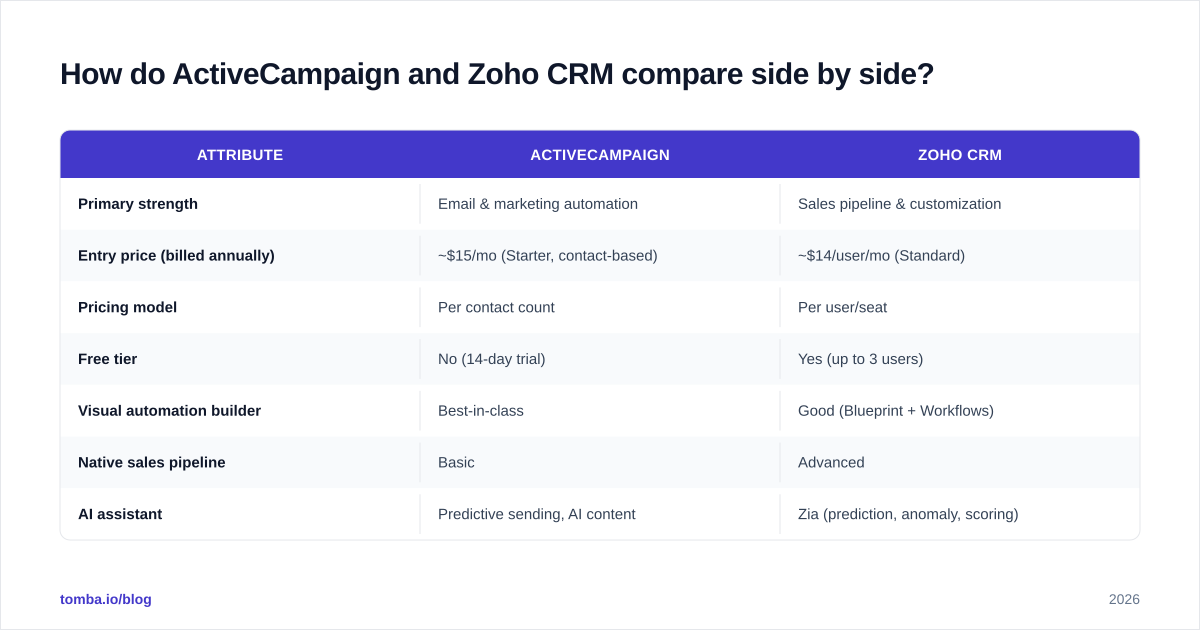
Pricing on both platforms shifts with tiers and add-ons, so confirm current numbers on the ActiveCampaign pricing page and the Zoho CRM site before you commit. The structural difference is what matters: ActiveCampaign bills by how many contacts you store, Zoho bills by how many salespeople use it.
Is ActiveCampaign better than Zoho CRM for automation?#
For marketing automation, yes. For sales process automation, it's closer than the marketing crowd admits.
ActiveCampaign's canvas is more intuitive for multi-branch email journeys. If you want a welcome series that splits based on whether someone clicked a pricing link, then re-engages cold contacts after 30 days of silence, ActiveCampaign lets you build that in an afternoon. Its behavioral triggers and tag-based segmentation are genuinely best-in-class.
Zoho counters with Blueprint, a feature that enforces your sales process step by step — reps literally can't skip a stage or forget a required field. Combined with Workflow Rules and Zia's predictive scoring, Zoho automates the internal mechanics of selling better than ActiveCampaign does. You can read more about how sales automation is supposed to reduce manual busywork rather than just sending more email.
So the honest answer: ActiveCampaign automates the conversation with the customer; Zoho automates the work your reps do behind the scenes. Few teams need both at world-class level, which is exactly why the decision usually comes down to your dominant motion.
Which one has better pricing and value?#
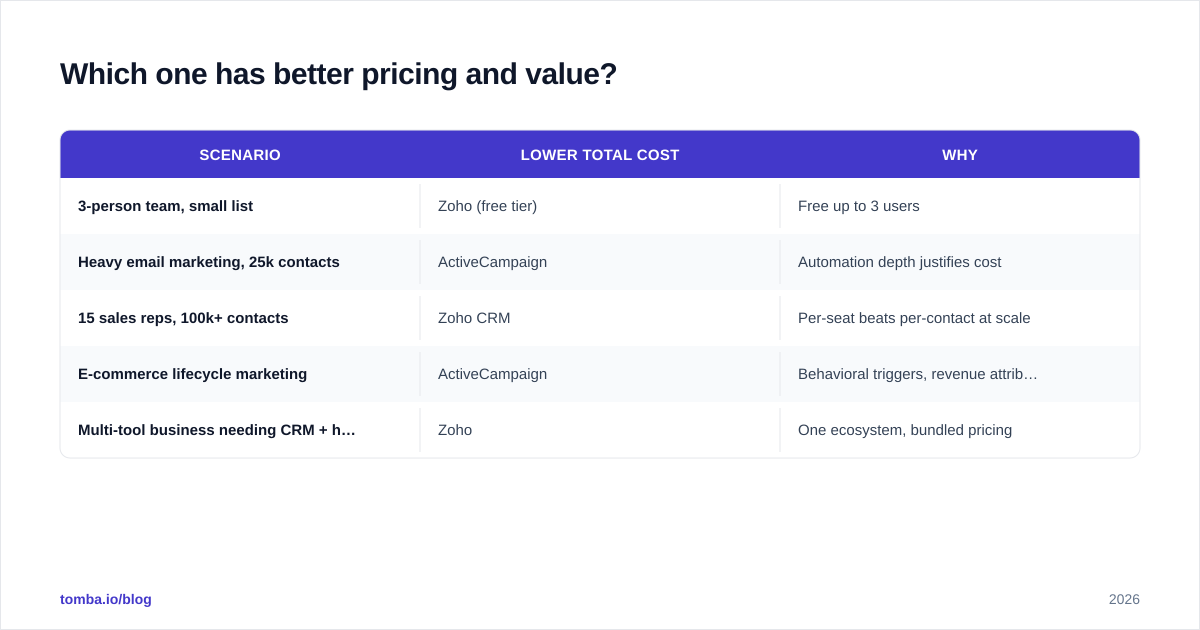
Zoho CRM wins on predictable per-seat cost; ActiveCampaign wins on automation depth per dollar — until your list grows.
Here's the trap most buyers miss. ActiveCampaign's contact-based pricing looks cheap at 1,000 contacts and gets expensive fast at 50,000+, because you pay for every contact whether they're engaged or not. Zoho's per-user model stays flat regardless of database size, which is why high-volume B2B teams with large CRMs often find Zoho dramatically cheaper at scale.
| Scenario | Lower total cost | Why |
|---|---|---|
| 3-person team, small list | Zoho (free tier) | Free up to 3 users |
| Heavy email marketing, 25k contacts | ActiveCampaign | Automation depth justifies cost |
| 15 sales reps, 100k+ contacts | Zoho CRM | Per-seat beats per-contact at scale |
| E-commerce lifecycle marketing | ActiveCampaign | Behavioral triggers, revenue attribution |
| Multi-tool business needing CRM + helpdesk + books | Zoho | One ecosystem, bundled pricing |
If you want a sense of how transparent, tiered pricing should look, the Tomba pricing page is a useful reference point — flat tiers, a free entry, no per-contact surprises.
How good is the data quality in each platform?#
This is the part vendors quietly skip: neither ActiveCampaign nor Zoho CRM finds, enriches, or verifies your contact data for you. They store and act on whatever you import. Garbage in, automated garbage out — at scale.
Zoho includes light data-validation rules and deduplication, and Zia can flag anomalies. ActiveCampaign offers basic email validation on form fills. But neither will tell you that john@oldcompany.com bounced three months ago because John changed jobs, and neither will append a verified work email for a lead who only gave you a personal Gmail.
That gap is where a dedicated data layer earns its keep. Before contacts ever hit your CRM, you want them found, verified, and enriched:
- Use an email verifier to strip invalid and risky addresses so your ActiveCampaign sender reputation doesn't tank.
- Use data enrichment to fill in job titles, company size, and LinkedIn profiles that power Zoho's segmentation and scoring.
- Use domain search to pull every reachable contact at a target company before you build an account in either CRM.
Treat your CRM as the destination, not the data source. A list-cleaning and enrichment step in front of it protects deliverability and keeps your automation firing on accurate signals.
Which platform should you actually choose?#
Match the tool to your center of gravity.
Choose ActiveCampaign if:
- Email marketing and lifecycle nurturing drive most of your revenue.
- You run e-commerce or content funnels with behavioral segmentation.
- Your team is marketing-led and the "CRM" is a supporting actor.
- You value the most intuitive visual automation builder on the market.
Choose Zoho CRM if:
- You have a defined sales team working a real pipeline.
- You need heavy customization — custom modules, fields, layouts, territories.
- You want a low, predictable per-seat cost that doesn't balloon with list size.
- You're likely to adopt other apps (helpdesk, finance, projects) in one ecosystem.
Consider neither as a standalone if: your bottleneck is finding qualified contacts in the first place. A CRM organizes relationships you already have; it doesn't generate new ones. Pair whichever platform you choose with a prospecting and verification workflow.
What about migrating from one to the other?#
Migration between these two is common and survivable, but plan for friction.
Moving from ActiveCampaign to Zoho CRM usually means rebuilding automations from scratch — the logic doesn't transfer, only the contact and tag data. Export contacts as CSV, map tags to Zoho fields or modules, and rebuild journeys as Workflow Rules and Blueprints.
Moving from Zoho to ActiveCampaign is easier for the contact data but you'll lose pipeline structure; ActiveCampaign's deals are simpler, so complex multi-pipeline setups need to be flattened.
In both directions, migration is the perfect moment to clean house. Run your export through an email verifier and dedupe before importing — there's no point paying to store dead contacts in a new system. Tools like Tomba's bulk email finder can also re-find updated addresses for stale records during the move.
For unbiased user sentiment on both platforms during evaluation, check current reviews on G2 — pay attention to recent reviews from companies your size, not just the aggregate star rating.
How do the AI features stack up?#
Both lean into AI, but for different jobs.
Zoho's Zia is sales-oriented: lead and deal prediction, best-time-to-contact suggestions, anomaly detection in your numbers, and workflow recommendations. It's woven into the selling workflow. ActiveCampaign's AI focuses on the message: predictive sending (when each contact is most likely to open), AI-assisted content generation, and win-probability scoring on deals.
If your KPI is reply rate and pipeline velocity, Zia's scoring is more directly useful. If your KPI is email engagement and revenue per send, ActiveCampaign's predictive layer pays off faster. As with automation, the AI is only as smart as the data — accurate firmographics and verified contacts make every prediction sharper. Strong response rates start with reaching real, reachable people.
The verdict#
There's no universal winner — there's a winner for your motion. ActiveCampaign is the better marketing automation platform with a passable CRM. Zoho CRM is the better sales CRM with passable marketing. Marketing-led teams and e-commerce should lean ActiveCampaign; sales-led B2B teams and anyone who values customization and per-seat pricing should lean Zoho.
But both share the same blind spot, and it's the one that quietly caps your results: contact data. A polished automation that fires at a bounced address is wasted budget. A perfectly customized pipeline full of stale leads is just an expensive spreadsheet.
That's where Tomba's Email Finder fits into your stack — regardless of which CRM you choose. Find verified professional emails by name, domain, or company, enrich them with job titles and company data, and push clean, deliverable contacts straight into ActiveCampaign or Zoho CRM. Start free with 25 searches a month, and feed your automation engine the one thing it can't generate on its own: accurate data. See the plans and stop letting bad contacts throttle good software.
// get started
Find, verify and enrich your first contacts today
Start on the free plan with 25 searches a month, then scale when your team is ready.
Free plan · No credit card required · GDPR & CCPA
// about the author