ACV in SaaS: How to Calculate Annual Contract Value (2026)
ACV is the SaaS metric that tells you what a customer is really worth per year. Here's how to calculate it, why it differs from ARR and TCV, and how to grow it in 2026.
TL;DR
- ACV (Annual Contract Value) is the average yearly revenue you earn from a single customer contract, normalized to a 12-month period.
- ACV is not ARR, not TCV, and not MRR — confusing them wrecks your forecasting and your board deck.
- Formula in its simplest form: ACV = Total Contract Value ÷ Contract Term (in years), with one-time fees usually excluded.
- A healthy acv saas strategy pairs the metric with sales efficiency math (CAC payback, magic number) — the number alone tells you almost nothing.
- You grow ACV through tiering, expansion, multi-year deals, and better targeting — and better targeting starts with cleaner contact data.
What does ACV mean in SaaS?#
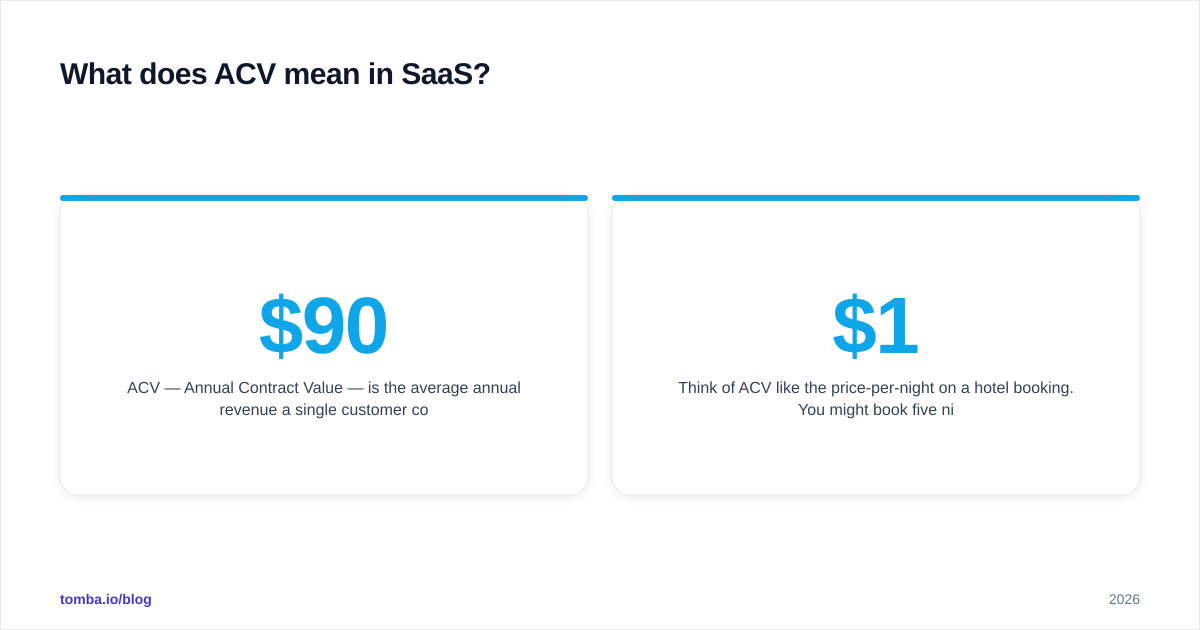
ACV — Annual Contract Value — is the average annual revenue a single customer contract generates over its lifetime. If a customer signs a three-year deal worth $90,000 total, the ACV is $30,000 per year, even though you might have billed the whole amount differently.
Think of ACV like the price-per-night on a hotel booking. You might book five nights for $1,000, but the rate that lets you compare hotels fairly is $200 a night. Total spend tells you the size of the trip; the nightly rate tells you the value of the offer. ACV is the nightly rate of your SaaS contracts — the normalized number that lets you compare a 12-month logo against a 36-month logo without fooling yourself.
In an acv saas context, this metric becomes the spine of go-to-market planning. It feeds quota setting, territory design, sales compensation, and the segmentation that decides whether a deal goes to an SMB rep or an enterprise account executive. Get it wrong and every downstream model inherits the error.
ACV is most useful for companies with annual or multi-year contracts — the classic B2B subscription shape. If you run pure month-to-month consumer billing, MRR and ARR will serve you better and ACV becomes a vanity calculation.
How do you calculate annual contract value?#
The core formula is short:
ACV = Total Contract Value (TCV) ÷ Contract Term in YearsMost teams exclude one-time charges — implementation fees, onboarding, professional services — because those don't recur and would inflate the "annual" picture. So a more precise version looks like this:
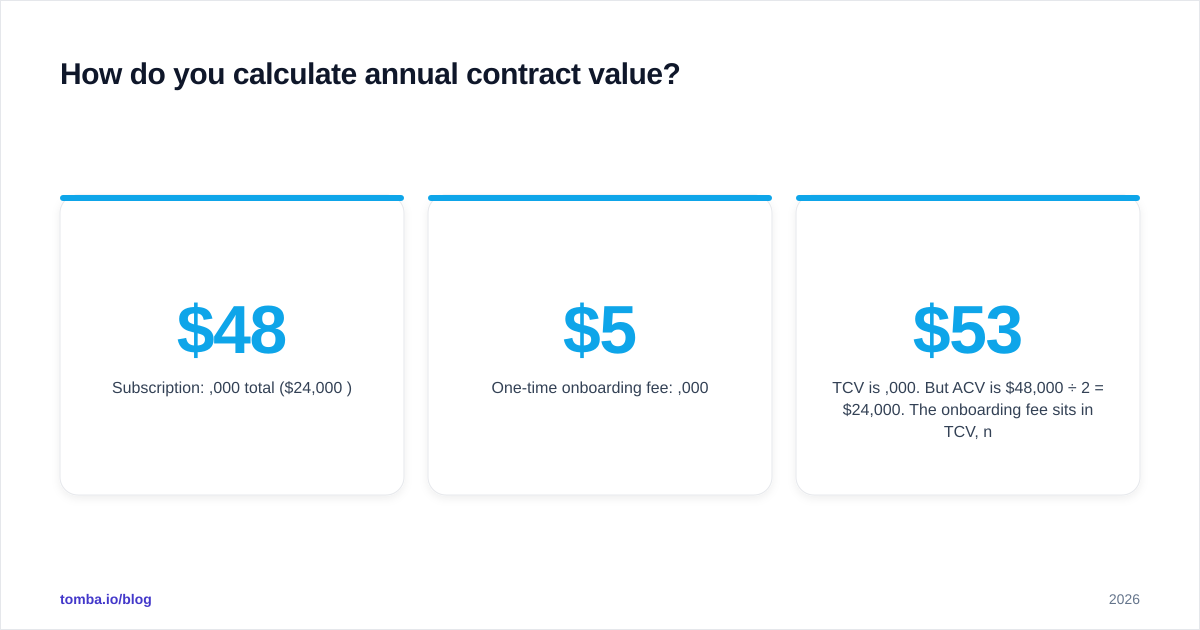
ACV = (TCV − one-time fees) ÷ Contract Term in YearsWorked example. A customer signs a 2-year contract:
- Subscription: $48,000 total ($24,000/year)
- One-time onboarding fee: $5,000
TCV is $53,000. But ACV is $48,000 ÷ 2 = $24,000. The onboarding fee sits in TCV, not ACV.
Blended / portfolio ACV. To find the average ACV across your customer base, sum the annualized value of all active contracts and divide by the number of customers:
Average ACV = Total annualized contract revenue ÷ Number of customersThis blended figure is what shows up in board decks and investor updates. Track both: the per-deal ACV tells reps what a "good" deal looks like; the blended ACV tells leadership whether the business is moving upmarket or down.
One trap worth naming: discounts and ramp deals. If year one is discounted and year two jumps to list price, a naive ACV averages them — which is fine for reporting, but dangerous if a rep quotes the averaged number to a renewal-year customer expecting the discount to continue. Model ramped contracts year by year, then annualize.
ACV vs ARR vs TCV vs MRR: what's the difference?#
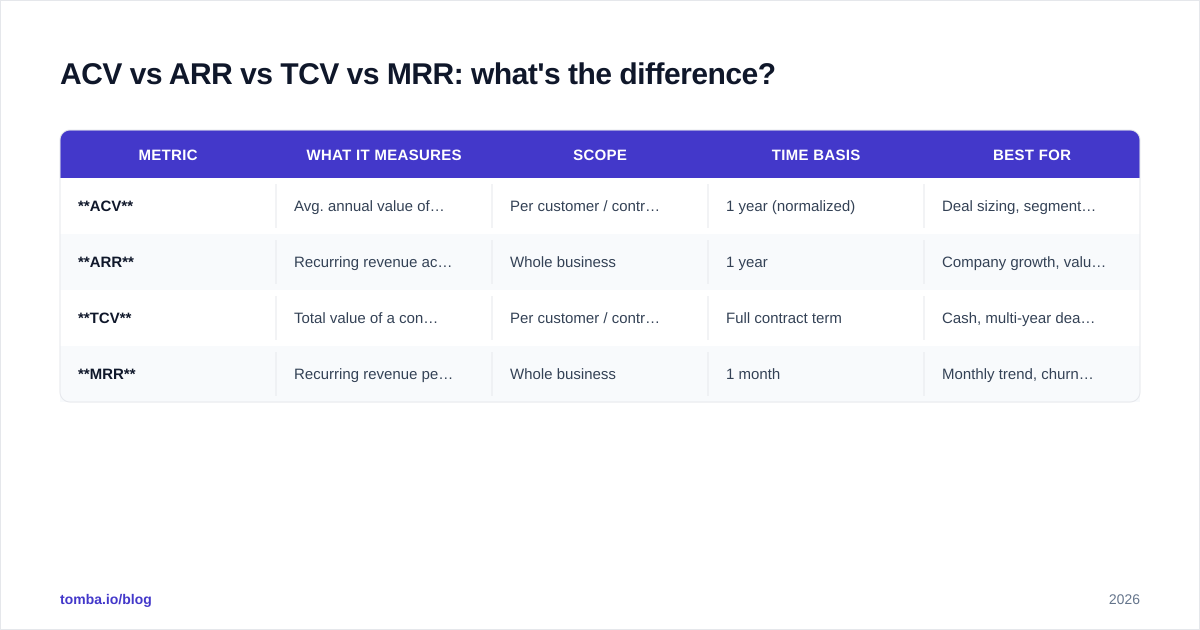
This is where most SaaS founders and new RevOps hires trip. The four metrics describe overlapping but distinct things, and using them interchangeably is how forecasts drift.
| Metric | What it measures | Scope | Time basis | Best for |
|---|---|---|---|---|
| ACV | Avg. annual value of one contract | Per customer / contract | 1 year (normalized) | Deal sizing, segmentation, comp |
| ARR | Recurring revenue across all customers | Whole business | 1 year | Company growth, valuation |
| TCV | Total value of a contract, all years | Per customer / contract | Full contract term | Cash, multi-year deal size |
| MRR | Recurring revenue per month | Whole business | 1 month | Monthly trend, churn watch |
A quick way to keep them straight:
- ACV is per-contract and annual. "What's this customer worth per year?"
- TCV is per-contract and lifetime. "What's this customer worth in total?"
- ARR is company-wide and annual. "What's our recurring run rate?"
- MRR is company-wide and monthly. ARR ÷ 12, roughly.
The most common confusion is ACV vs TCV. A three-year, $300,000 deal has a TCV of $300,000 but an ACV of $100,000. Sales reps love quoting TCV because it sounds bigger; finance needs ACV because it reflects the recurring engine. Both are right for their purpose — just label them clearly.

ARR vs ACV trips people up at scale. ARR is the sum of all your annualized recurring revenue. If you have 100 customers each with a $24,000 ACV, your ARR is roughly $2.4M (assuming no churn mid-year). ACV is the building block; ARR is the building. For a deeper grounding in how these roll up into go-to-market planning, the discipline of revenue operations exists precisely to keep these definitions consistent across sales, finance, and marketing.
Is a high ACV always better?#
No — and this is the most important misconception to kill. A high ACV is a means, not an end. What matters is ACV relative to acquisition cost and sales-cycle length.
A $5,000 ACV product that closes in 14 days with a self-serve motion can be far healthier than a $150,000 ACV deal that takes nine months, three sales engineers, and a procurement gauntlet. The right question isn't "is ACV high?" — it's "is ACV high enough to justify the way we sell it?"
Two efficiency checks tie ACV to reality:
- CAC payback period = CAC ÷ (ACV × gross margin %) → how many months to recoup acquisition cost. Under 12 months is strong for most SaaS; under 18 is acceptable.
- LTV:CAC ratio → lifetime value vs cost to acquire. A common benchmark is 3:1 or better, a heuristic popularized by investors and reiterated across SaaS metric literature like HubSpot's SaaS metrics guides.
If your ACV is climbing but CAC payback is stretching past 18 months, you're not building a healthier business — you're buying revenue at a worse and worse price. The metric is only as good as the unit economics around it.
There's also a motion-fit dimension. Pushing reps to chase only large-ACV enterprise deals can starve a self-serve funnel that quietly compounds. Many of the best SaaS companies run a barbell: high-volume low-ACV at one end, low-volume high-ACV at the other, and a deliberate plan for which customers graduate between them.

How do you increase ACV in SaaS?#
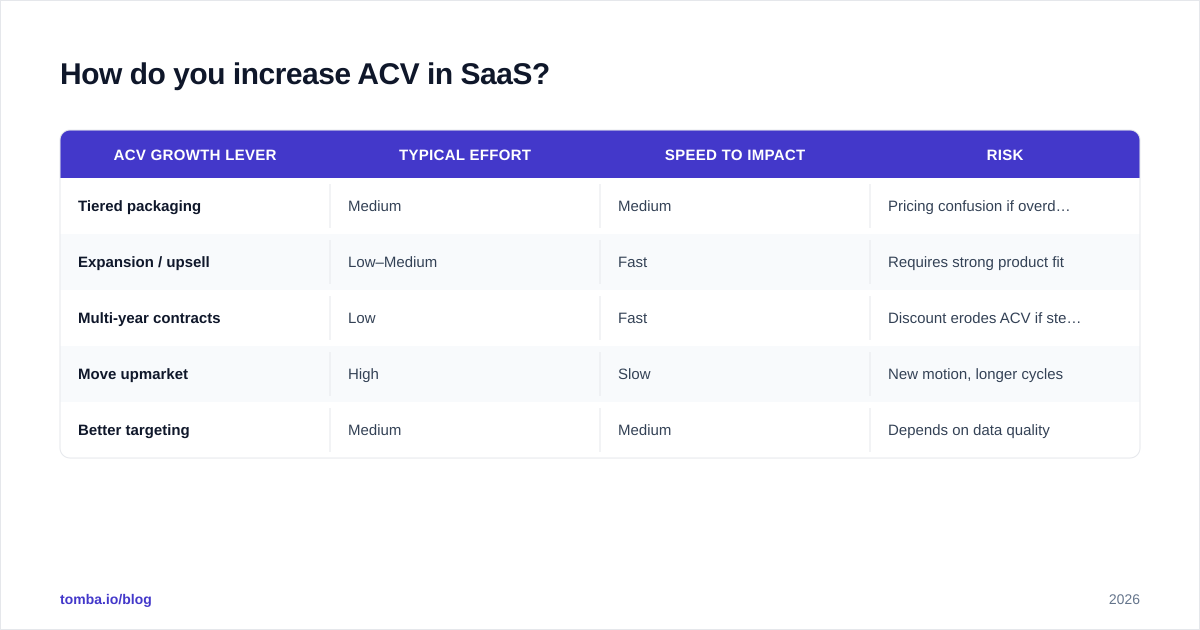
Growing ACV is a product, packaging, and go-to-market problem — not a pricing-page tweak. The levers that actually move it:
1. Tiered and value-based packaging. Structure plans so growing customers naturally climb. Usage-based and seat-based components let ACV expand with the customer's own success rather than a hard renegotiation.
2. Expansion revenue (upsell and cross-sell). The cheapest ACV growth comes from existing accounts. Net revenue retention above 110% means your installed base grows ACV on its own. Add-on modules, premium support, and higher usage tiers all compound.
3. Multi-year contracts. Longer terms stabilize ACV and lift TCV, often in exchange for a modest discount. They also reduce churn risk — a fair trade when your retention is strong.
4. Move upmarket deliberately. Larger companies carry larger ACVs because they have more seats, more compliance needs, and bigger budgets. But upmarket motion demands security reviews, SSO, and an enterprise sales process. Don't half-commit.
5. Target better-fit accounts. This is the lever most teams underplay. A rep working a list of poorly-qualified, low-budget prospects will close low-ACV deals no matter how good the packaging is. Feeding the pipeline with accounts that match your ideal customer profile — right industry, right headcount, right tech stack — raises average deal size before a single call happens.
That last point is where data quality quietly decides your ACV. If your outbound list is full of stale contacts and guessed email addresses, reps waste cycles on accounts that were never going to convert at a healthy value. Enriching your target list with verified firmographic and contact data — through a data enrichment workflow — means more of your selling time lands on accounts capable of a real ACV. Reaching the right decision-maker in the first place often starts with a reliable email finder so reps aren't burning the week hunting for a valid address.
| ACV growth lever | Typical effort | Speed to impact | Risk |
|---|---|---|---|
| Tiered packaging | Medium | Medium | Pricing confusion if overdone |
| Expansion / upsell | Low–Medium | Fast | Requires strong product fit |
| Multi-year contracts | Low | Fast | Discount erodes ACV if steep |
| Move upmarket | High | Slow | New motion, longer cycles |
| Better targeting | Medium | Medium | Depends on data quality |
What ACV benchmarks should you expect in 2026?#
Benchmarks vary wildly by segment, so treat any single number with suspicion. As a rough orientation:
- SMB-focused SaaS: ACV often sits in the $1,000–$10,000 range, with fast, low-touch sales cycles.
- Mid-market: roughly $10,000–$50,000, blended sales motion.
- Enterprise: $50,000 to several hundred thousand, long cycles, multiple stakeholders.
What matters more than hitting a specific number is the trend and the ratios. Is your blended ACV rising quarter over quarter? Is CAC payback holding or improving as ACV grows? Are expansion dollars contributing a growing share? Analyst firms like Gartner and the broader SaaS-metrics community consistently emphasize the combination of growth and efficiency over any single headline figure — and platforms such as Salesforce build their reporting around exactly these linked metrics.
A practical reporting cadence: review per-deal ACV weekly in pipeline reviews, blended ACV monthly with finance, and ACV-by-segment quarterly to catch whether your mix is drifting in a direction you didn't choose.
How does ACV connect to your sales process?#
ACV should shape the shape of your selling, not just the scoreboard. A few concrete connections:
- Segmentation and routing. Define ACV bands and route leads accordingly. A $3,000 expected ACV deal shouldn't consume an enterprise AE's time; a $120,000 opportunity shouldn't be left to self-serve checkout.
- Compensation. Tie quotas to new ACV (and expansion ACV separately) so reps aren't rewarded for inflating TCV with long terms that hurt cash or retention.
- Forecasting. Weight your pipeline by ACV band and historical win rate per band. Aggregate TCV forecasts hide the recurring-revenue signal your board actually cares about.
- Pipeline coverage. If your average ACV is $25,000 and a rep needs $500,000 in new ACV per year, you can work backward to the number of qualified opportunities required — and therefore the volume of accurate contact data the top of funnel must supply.
This is the quiet throughline: ACV is downstream of who you talk to. Clean targeting raises average deal value; messy targeting drags it down regardless of how sharp your packaging is.
Common ACV mistakes to avoid#
- Mixing in one-time fees. Onboarding and services belong in TCV, not ACV. Including them overstates recurring health.
- Quoting TCV as ACV. A $300K three-year deal is $100K ACV. Label it correctly or your forecast inflates 3x.
- Ignoring ramp. Discounted year-one contracts need year-by-year modeling before you annualize.
- Chasing ACV blind to CAC. A bigger number bought at a worse payback period is not progress.
- Letting data rot. Stale prospect lists quietly cap your average ACV by routing reps to low-fit accounts.
Put better data behind your ACV#
ACV tells you what a customer is worth per year — but you only earn high-ACV deals if your reps spend their time on the right accounts with the right contacts. That's a data problem before it's a sales problem.
Tomba's Email Finder helps your team reach verified decision-makers at the companies that actually fit your ideal customer profile, so prospecting time converts into pipeline that can carry a healthy annual contract value. Pair it with enrichment to fill in firmographics, and your reps stop guessing and start closing better-fit deals. Plans start with a free tier (25 searches/month) and scale to Starter at $49/mo — see full Tomba pricing to match a plan to your outbound volume. Feed your funnel the right contacts, and watch your blended ACV follow.
// get started
Find, verify and enrich your first contacts today
Start on the free plan with 25 searches a month, then scale when your team is ready.
Free plan · No credit card required · GDPR & CCPA
// about the author