ACV vs TCV: How to Read SaaS Contract Value Metrics in 2026
ACV and TCV both measure contract value, but they answer different questions. Here's how to calculate each, when to use which, and where teams get burned.
TL;DR
- ACV (Annual Contract Value) normalizes a contract to a single year. TCV (Total Contract Value) sums everything the deal is worth across its full term, including one-time fees.
- Use ACV to compare deals of different lengths, model recurring revenue, and set quota. Use TCV to understand cash commitment, total customer worth, and multi-year upside.
- A 3-year, $120K deal is $40K ACV but $120K TCV. Same contract, two very different headline numbers — which is why people game them.
- Neither metric counts churn, discounts applied mid-term, or usage overages well on its own. Pair them with ARR, MRR, and net revenue retention.
- Reporting clean ACV and TCV starts with clean account data. Garbage contacts and duplicate accounts wreck every downstream revenue metric.
What is the difference between ACV and TCV?#
Short answer: ACV measures value per year, TCV measures value across the entire contract. They diverge the moment a deal runs longer than 12 months or includes any non-recurring charge.
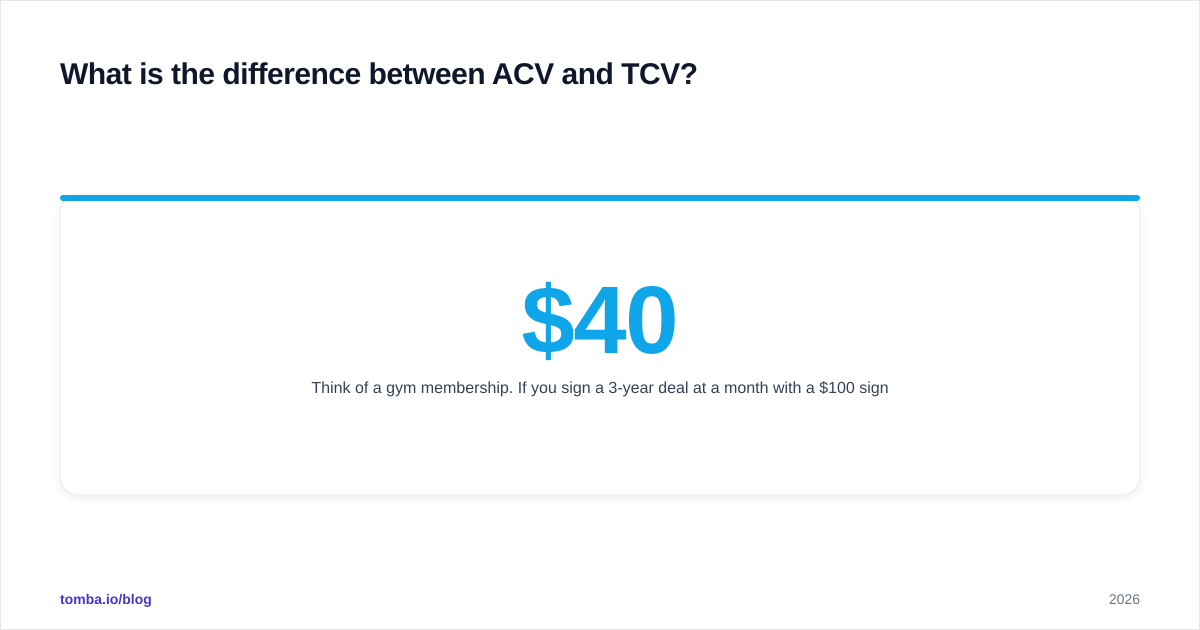
Think of a gym membership. If you sign a 3-year deal at $40 a month with a $100 sign-up fee, the total you'll pay the gym is $1,540 — that's the TCV. But the gym's sales rep, who is comparing you against members on 1-year and 2-year plans, wants a normalized figure: roughly $480 of recurring value per year. That's closer to ACV. One number tells you the lifetime commitment; the other tells you the annualized run rate.
In SaaS, the same logic governs how finance, sales, and RevOps read a deal. The contract is identical. The metric you pick changes the story you tell your board, your reps, and your investors.
This is also where definitions get slippery. There's no accounting standard that forces everyone to calculate ACV the same way. Some teams include one-time fees in ACV; most don't. Some include the implementation fee in year one's ACV and not subsequent years. Before you compare your ACV to a competitor's or a benchmark report's, confirm you're measuring the same thing.
How do you calculate ACV and TCV?#
TCV is the easier of the two. Add up every dollar a customer is contractually obligated to pay across the full term: recurring subscription fees, one-time setup or onboarding fees, professional services, and any committed overages.
TCV = (recurring fee per period × number of periods) + one-time feesExample: a customer signs a 3-year SaaS contract at $3,000/month with a $5,000 onboarding fee.
TCV = ($3,000 × 36) + $5,000 = $108,000 + $5,000 = $113,000ACV normalizes that to a year. The cleanest definition strips out one-time fees and divides the recurring value by the number of years:
ACV = total recurring contract value ÷ number of yearsUsing the same deal:
ACV = $108,000 ÷ 3 = $36,000So this single contract is $113,000 TCV and $36,000 ACV. Both are correct. They answer different questions.
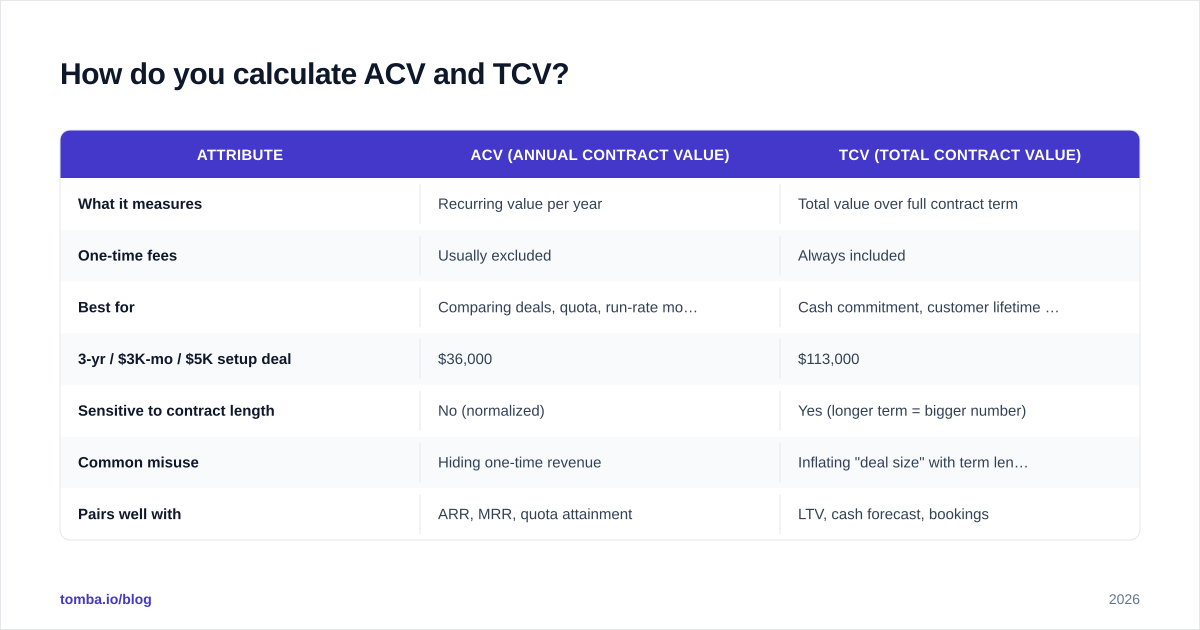
| Attribute | ACV (Annual Contract Value) | TCV (Total Contract Value) |
|---|---|---|
| What it measures | Recurring value per year | Total value over full contract term |
| One-time fees | Usually excluded | Always included |
| Best for | Comparing deals, quota, run-rate modeling | Cash commitment, customer lifetime worth |
| 3-yr / $3K-mo / $5K setup deal | $36,000 | $113,000 |
| Sensitive to contract length | No (normalized) | Yes (longer term = bigger number) |
| Common misuse | Hiding one-time revenue | Inflating "deal size" with term length |
| Pairs well with | ARR, MRR, quota attainment | LTV, cash forecast, bookings |
Watch the edge cases. A multi-year deal with annual price escalators (say 5% year over year) doesn't have one flat ACV — you either report a blended average or the year-one figure, and you should label which. Usage-based and consumption contracts are worse: with no fixed commitment, your "contract value" is a forecast, not a fact. Flag those deals separately so they don't pollute your committed-revenue numbers.

When should you use ACV vs TCV?#
Use ACV when you need to compare apples to apples; use TCV when you need to understand total commitment. Here's how that plays out by function.
Sales leadership. ACV is the fairer basis for quota and rep comparison. If one rep closes three 1-year deals and another closes one 3-year deal of the same annual value, TCV makes the second rep look 3x better when they're producing the same annual run rate. ACV neutralizes that. Most well-run revenue operations teams set quota on ACV or new ARR precisely to avoid rewarding term-stuffing.
Finance and cash planning. TCV wins here. A signed 3-year contract represents real contractual obligation, and TCV tells you the ceiling of what that customer will pay. For cash forecasting, runway math, and understanding the value of your booked backlog, total contract value is the honest number.
Board and investor reporting. Usually ARR, with ACV as a supporting detail. Investors care about predictable, recurring run-rate revenue. TCV can look impressive in a pitch deck, but a sophisticated investor will immediately ask, "Over what term?" — because a $10M TCV spread over five years is a $2M annual business.
Customer success and expansion. ACV is the baseline for measuring expansion and net revenue retention. You want to know whether this account's annual value grew or shrank year over year. TCV, being a lump sum across the term, obscures that trend.
Rule of thumb: if the question is "how big is this customer right now," use ACV. If the question is "how much will this customer pay us in total," use TCV.
Why do ACV and TCV get manipulated?#
Because the same contract can headline as a small or large number depending on which metric you choose — and people optimize for whatever they're measured on.
The classic distortion is term-stuffing for TCV. A rep pushes a customer into a 5-year deal not because it serves the customer, but because it quintuples the TCV that shows up on the leaderboard. The annual value didn't change. The commitment risk to the customer went up. The headline got prettier.
The opposite trick is hiding services revenue in TCV while quoting ACV externally. If a deal has a huge one-time implementation fee, reporting only ACV makes the recurring business look cleaner than the cash actually is — useful when you want investors to believe more of your revenue is recurring than it really is.
A third issue is inconsistent one-time-fee treatment. If half your team folds onboarding fees into year-one ACV and the other half doesn't, your "average ACV" is noise. This is less malice than sloppiness, but it corrupts benchmarking just as badly.
The defense is boring and effective: write down your definitions, apply them consistently, and always report ACV and TCV together with the contract term visible. A number without its definition is a rumor. As HubSpot's sales metrics guidance and Salesforce's revenue reporting documentation both stress, the metric only means something when everyone calculates it the same way.

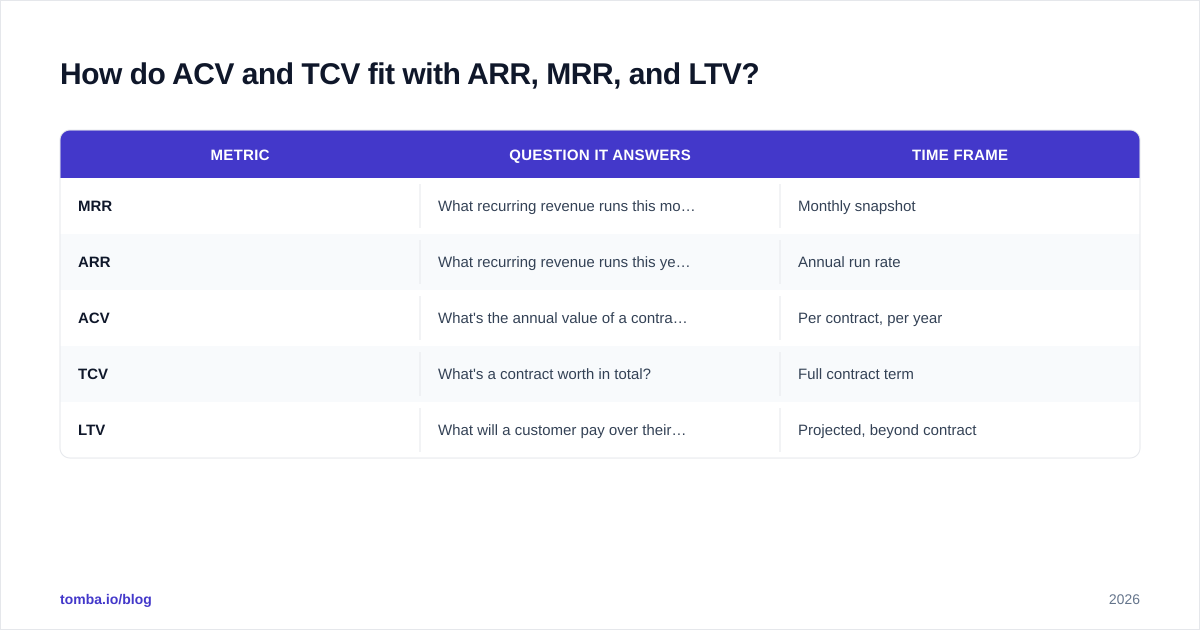
How do ACV and TCV fit with ARR, MRR, and LTV?#
They're complementary, not competing. Contract-value metrics describe what's signed; recurring-revenue metrics describe what's running; lifetime metrics describe what's projected.
| Metric | Question it answers | Time frame |
|---|---|---|
| MRR | What recurring revenue runs this month? | Monthly snapshot |
| ARR | What recurring revenue runs this year? | Annual run rate |
| ACV | What's the annual value of a contract? | Per contract, per year |
| TCV | What's a contract worth in total? | Full contract term |
| LTV | What will a customer pay over their lifetime? | Projected, beyond contract |
The key distinctions:
- ARR vs ACV. ARR is a company-wide run rate across all customers; ACV is a per-contract figure. Summing ACV across active recurring contracts gets you close to ARR, but ARR typically excludes one-time fees entirely and only counts recurring revenue. They're cousins, not twins.
- TCV vs LTV. TCV is contractual and known — it's what the signed paper says. LTV is a forecast that includes expected renewals, expansion, and churn beyond the current term. TCV is a floor; LTV is a bet.
- MRR is the heartbeat. It's the most granular recurring figure and the one that moves first when a customer expands, contracts, or churns.
Use them as a stack: MRR and ARR for run-rate health, ACV for deal comparison and quota, TCV for cash commitment, LTV for unit economics and CAC payback. No single number runs a SaaS business.
What data do you need to report ACV and TCV accurately?#
Clean, deduplicated account and contract data — because every contract-value metric inherits the quality of the records underneath it. This is the part RevOps teams underestimate.
If the same customer exists as three records in your CRM, your per-account ACV is wrong and your account count is inflated. If a renewal is logged as a brand-new contract, your new-vs-expansion split breaks. If contact and company data is stale, the deals you're modeling are attached to people who left months ago. The metric math is trivial; the data hygiene is where reporting actually fails.
A few practices that keep contract-value reporting honest:
- One source of truth for contract terms. Store start date, end date, recurring amount, and one-time fees as structured fields — not buried in a notes blob a human has to interpret.
- Deduplicate accounts ruthlessly. Merge duplicate company records before you aggregate ACV. A clean B2B database and disciplined data enrichment keep account-level rollups trustworthy.
- Separate recurring from one-time at entry. Tag every line item so ACV can exclude one-time fees automatically instead of relying on someone remembering to subtract them.
- Keep the people behind the accounts current. Expansion and renewal forecasting depend on reaching the right buyers. When champions change jobs, you need to find emails for the new decision-makers fast — stale contact data silently kills renewals before the ACV math ever matters.
Solid pipeline reporting also depends on the upstream funnel being real. If your top-of-funnel contacts are unverified, the deals feeding your ACV and TCV forecasts are built on sand. That's why verification — confirming the buyer's address is valid before a deal ever enters the pipeline — belongs in the same conversation as contract-value metrics. You can read more on how Tomba sources and validates records on the data sources page.
ACV vs TCV: quick decision guide#
- Comparing reps or deals of different lengths? → ACV.
- Forecasting cash or backlog value? → TCV.
- Reporting run-rate to the board? → ARR, with ACV as support.
- Measuring expansion and retention? → ACV year over year.
- Pitching total customer commitment? → TCV, but always state the term.
- Modeling unit economics and CAC payback? → LTV, built on top of ACV.
The mistake to avoid is treating either number as the single truth. ACV without TCV hides multi-year upside and cash commitment. TCV without ACV inflates deal size and hides short run-rate. Report both, label your one-time-fee treatment, and show the contract term. Per Gartner's broader guidance on revenue and growth analytics, the discipline isn't picking the perfect metric — it's defining your metrics consistently and refusing to let any one of them stand alone.
Build accurate pipeline data before you measure contract value#
Every ACV and TCV figure is only as trustworthy as the accounts and contacts feeding it. If your pipeline is full of duplicate companies, stale buyers, and unverified emails, your contract-value reporting is fiction with decimal points.
Start the funnel clean. Use the Tomba Email Finder to find verified, professional email addresses for the decision-makers behind every account — by name, company, or domain — so the deals you forecast are attached to real, reachable buyers. Pair it with Tomba's email verifier to confirm deliverability before a record ever enters your CRM, and check Tomba pricing (free tier with 25 searches/month, paid plans from $49/mo) to find the fit for your team. Clean inputs, honest metrics — that's the whole game.
Ready to find emails that actually work?
Join 150,000+ professionals who stopped guessing and started sending. Free credits on signup — no credit card required.
Get the Tomba newsletter
Practical outbound tactics and product updates — once every two weeks.
About the author