Adaptio vs Agile Education Marketing: 2026 Strategy Guide
Adaptio and Agile promise faster, smarter education marketing — but they solve different problems. Here's how the two frameworks compare and when to use each.
Education marketers in 2026 are stuck choosing between two competing ways to run enrollment campaigns: the Adaptio model, built around continuous data-driven adaptation, and the Agile model, borrowed from software teams and built around fast iterative sprints. They sound similar. They are not. Picking the wrong one wastes a recruitment cycle you don't get back.
TL;DR#
- Agile education marketing organizes work into short sprints with fixed rituals (standups, retros, backlogs). It optimizes team velocity and is best when your bottleneck is execution speed and coordination.
- Adaptio is a data-adaptive model that reallocates budget, channels, and messaging in near real time based on signal. It optimizes outcome responsiveness and is best when your bottleneck is knowing what actually works.
- Agile needs disciplined people and clear ceremonies; Adaptio needs clean data pipelines and reliable contact records.
- For most mid-sized institutions, the winning move is hybrid: run Agile as the operating cadence, layer Adaptio's signal loop on top.
- Neither framework finds you students. Both depend on accurate prospect and parent contact data feeding the top of the funnel.
What is Agile education marketing?#
Agile education marketing is the application of software-style Agile to recruitment and brand campaigns. Think of it like a restaurant kitchen running on tickets: work is broken into small orders, the team pulls from a prioritized queue, and every shift ends with a quick review of what went out and what got sent back. Technically, it's a project-management discipline — sprints (usually two weeks), a backlog of campaign tasks, daily standups, and retrospectives.
The promise is throughput. Instead of one giant "fall enrollment campaign" that ships in September, your team ships landing pages, ad sets, email sequences, and open-house invites in continuous two-week increments. You learn faster because you launch more often.
Agile's roots are well documented in the original Agile Manifesto, and most marketing teams adapt it through frameworks like Scrum or Kanban. The strength is coordination: when a 12-person enrollment marketing team needs to move in sync, Agile rituals keep everyone aligned.
The weakness is that Agile tells you how to organize work, not what work is right. A team can sprint flawlessly toward the wrong audience.
What is Adaptio?#
Adaptio is an outcome-adaptive marketing model: the system continuously reads performance signal and reallocates spend, channels, creative, and audience targeting toward whatever is converting right now. If Agile is the kitchen workflow, Adaptio is the thermostat — it senses the room and adjusts heat without waiting for the next scheduled meeting.
In an education context, Adaptio looks like this: a prospective-student campaign runs across paid search, social, and email. Mid-week, Adaptio detects that transfer students from community colleges are converting at triple the rate of high-school seniors on one specific message. It shifts budget and personalizes follow-up automatically, before a human would have caught it in a sprint retro.
Adaptio depends on three things being true:
- Clean signal — accurate tracking from first touch to enrollment.
- Reliable contact data — you can't adapt outreach if your prospect records are stale or unverified.
- A feedback loop short enough to act on.
When those hold, Adaptio outperforms because it removes the lag between "the data changed" and "we responded." When they don't, Adaptio amplifies noise.
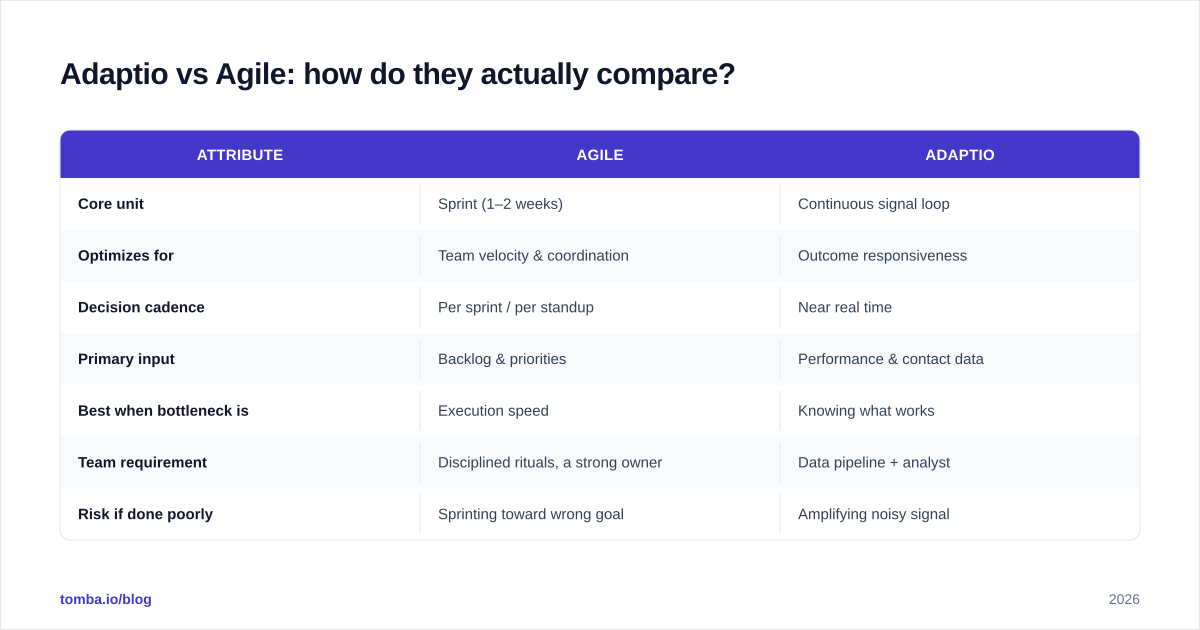
Adaptio vs Agile: how do they actually compare?#
Here's the side-by-side most education marketing leads are looking for.
| Attribute | Agile | Adaptio |
|---|---|---|
| Core unit | Sprint (1–2 weeks) | Continuous signal loop |
| Optimizes for | Team velocity & coordination | Outcome responsiveness |
| Decision cadence | Per sprint / per standup | Near real time |
| Primary input | Backlog & priorities | Performance & contact data |
| Best when bottleneck is | Execution speed | Knowing what works |
| Team requirement | Disciplined rituals, a strong owner | Data pipeline + analyst |
| Risk if done poorly | Sprinting toward wrong goal | Amplifying noisy signal |
| Tooling weight | Light (board + cadence) | Heavy (data + automation) |
| Ramp time | 2–4 weeks | 1–2 quarters |
| Cost to run | Mostly people time | People + data + martech spend |
The honest summary: Agile fixes a coordination problem; Adaptio fixes a knowing problem. Most teams self-diagnose the wrong one. If your campaigns are good but slow to ship, you need Agile. If your campaigns ship fine but you can't tell why some convert and some don't, you need Adaptio.
Is Adaptio better than Agile for student enrollment?#
Not universally — it depends on your enrollment funnel maturity. For early-stage or small programs, Agile usually wins first because you need execution muscle before you need adaptive intelligence. You can't adapt campaigns you aren't even shipping yet.
For institutions running mature, multi-channel recruitment across undergraduate, graduate, and continuing-education audiences, Adaptio tends to pull ahead. At that scale the cost of slow reallocation is enormous: a single misallocated week in peak application season can mean dozens of lost enrollments.
Industry analysts have tracked this shift toward adaptive, data-driven marketing operations for years; Gartner's marketing research and peer reviews on G2 consistently show that responsiveness — not just output volume — separates high-performing marketing orgs. The catch is that adaptive systems are only as good as the data underneath them.
That's the part most "Adaptio vs Agile" debates skip. Both frameworks assume your top-of-funnel contact data is accurate. In education, where prospect lists come from inquiry forms, college fairs, third-party lead vendors, and stale CRM records, that assumption is rarely safe. If 20% of your prospect emails bounce, neither sprinting nor adapting saves the campaign.
This is where verified data feeds matter. Running a campaign list through an email verifier before you launch — Agile sprint or Adaptio loop — protects deliverability and keeps your conversion signal clean enough to actually adapt on. If you build prospect lists from program-relevant institutions or employer partners, a domain search gives you the contact patterns to do it at scale.
When should an education marketing team use each?#
Use this decision flow rather than picking a tribe.
Choose Agile when:
- Your team is mid-sized (6–15 people) and coordination is breaking down.
- Campaigns are high quality but ship too slowly.
- Leadership wants predictable, reviewable output every two weeks.
- You're standing up a new recruitment program from scratch.
Choose Adaptio when:
- You have reliable end-to-end tracking from inquiry to enrollment.
- You run enough volume that small reallocations move real numbers.
- You have (or can hire) an analyst to own the signal loop.
- Your messaging-to-audience fit changes quickly across cycles.
Run both (the realistic answer) when:
- You're an established institution with multiple audiences.
- Use Agile as the operating cadence — sprints, standups, backlog.
- Layer Adaptio as the steering layer — let data reallocate within and across sprints.
This hybrid is what most high-performing 2026 enrollment teams actually run. Agile gives the team rhythm and accountability; Adaptio makes sure that rhythm is pointed at the right audience. The two are not rivals so much as different altitudes of the same operation.
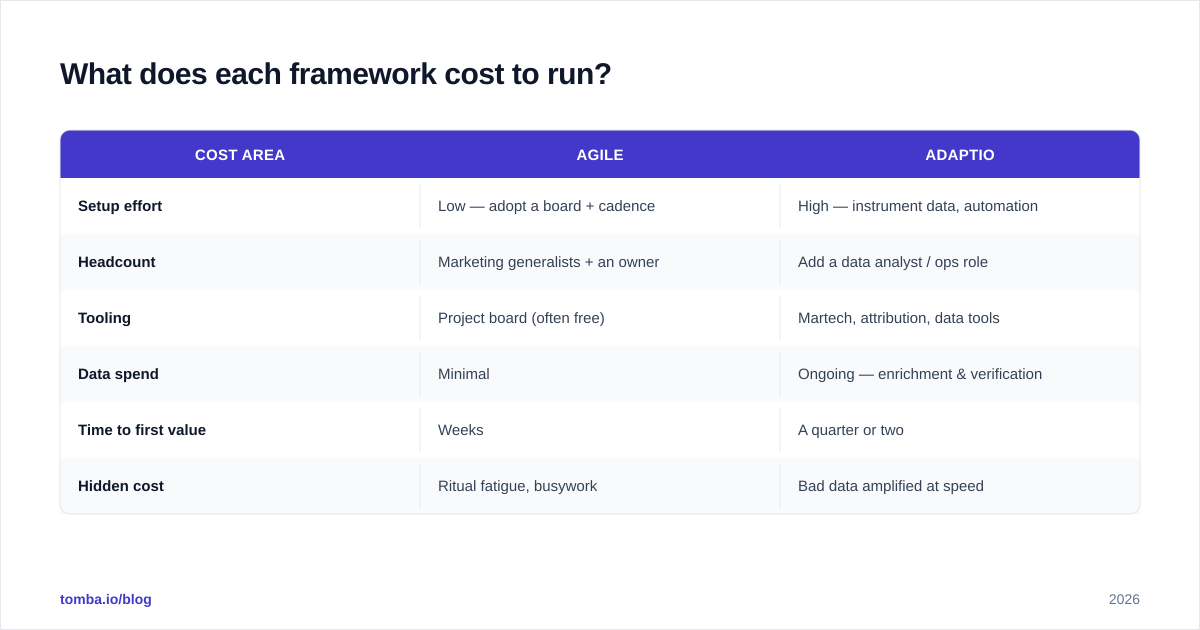
What does each framework cost to run?#
Cost is where the "vs" gets real, because the two models spend on different things.
| Cost area | Agile | Adaptio |
|---|---|---|
| Setup effort | Low — adopt a board + cadence | High — instrument data, automation |
| Headcount | Marketing generalists + an owner | Add a data analyst / ops role |
| Tooling | Project board (often free) | Martech, attribution, data tools |
| Data spend | Minimal | Ongoing — enrichment & verification |
| Time to first value | Weeks | A quarter or two |
| Hidden cost | Ritual fatigue, busywork | Bad data amplified at speed |
Agile is cheap to start and expensive to sustain if the rituals become theater. Adaptio is expensive to start and expensive to feed, but the payoff compounds — every cycle the loop gets smarter.
One cost both frameworks share and both teams underestimate: keeping prospect data fresh. Education contact data decays fast as students change emails, graduate, and switch institutions. Whether you're sprinting or adapting, you'll spend on contact discovery and verification either way. Building that into your budget from day one — rather than discovering it when a campaign craters — is the difference between a framework that works and one that looks good on a slide. Compare what that data layer costs against your martech stack on the Tomba pricing page so it's a line item, not a surprise.
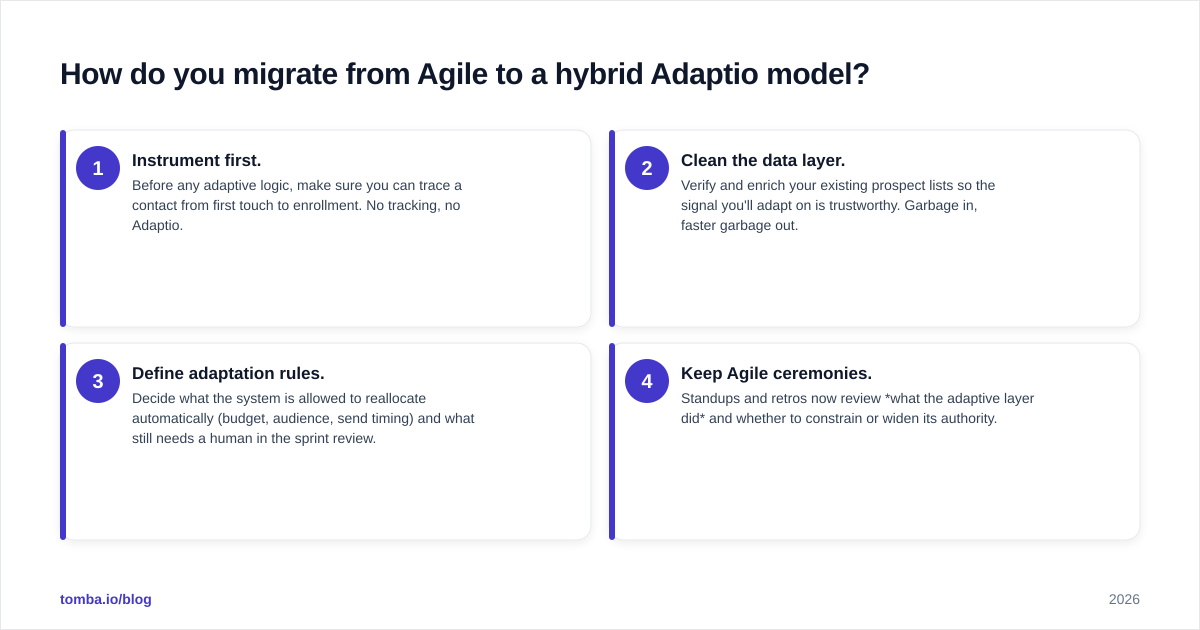
How do you migrate from Agile to a hybrid Adaptio model?#
You don't rip out Agile. You graft Adaptio onto it in four steps.
- Instrument first. Before any adaptive logic, make sure you can trace a contact from first touch to enrollment. No tracking, no Adaptio.
- Clean the data layer. Verify and enrich your existing prospect lists so the signal you'll adapt on is trustworthy. Garbage in, faster garbage out.
- Define adaptation rules. Decide what the system is allowed to reallocate automatically (budget, audience, send timing) and what still needs a human in the sprint review.
- Keep Agile ceremonies. Standups and retros now review what the adaptive layer did and whether to constrain or widen its authority.
Done in that order, you keep Agile's discipline while gaining Adaptio's responsiveness — and you avoid the classic failure where a team flips on automation over dirty data and erodes trust in the whole program. For broader context on how adaptive operations fit modern go-to-market, HubSpot's research library is a solid neutral reference on data-driven campaign design.
The bottom line on Adaptio vs Agile#
Agile and Adaptio answer different questions. Agile answers "how do we ship enrollment work reliably?" Adaptio answers "how do we know what to ship and respond before the cycle ends?" The strongest 2026 education marketing teams stop treating it as a choice and run Agile as the heartbeat with Adaptio as the nervous system.
But both frameworks rest on the same foundation: accurate, verified contact data at the top of the funnel. A flawless sprint or a perfectly tuned adaptive loop still fails if half your prospect emails bounce. Start there.
Build that foundation with the Tomba Email Finder. Find and verify accurate professional and institutional email addresses by name, company, or domain — so whether you run Agile, Adaptio, or both, your enrollment campaigns launch on clean data instead of guesswork. Start free with 25 searches a month and scale into the Tomba plans as your funnel grows.
// get started
Find, verify and enrich your first contacts today
Start on the free plan with 25 searches a month, then scale when your team is ready.
Free plan · No credit card required · GDPR & CCPA
// about the author