Adaptio vs Altss 2026: Which Sales Intelligence Tool Wins?
A neutral, side-by-side look at Adaptio vs Altss in 2026 — data accuracy, coverage, pricing models, and which sales intelligence tool fits your prospecting stack.
TL;DR
- Adaptio leans into AI-driven, signal-based prospecting — it wants to tell you who to contact and when, using intent and behavioral signals layered on top of contact data.
- Altss positions itself as an AI lead-generation and contact-discovery engine, emphasizing real-time sourcing of verified emails and direct dials rather than a static database.
- Neither publishes flat, transparent self-serve pricing the way most email finders do; both lean toward demo-and-quote sales motions, which matters if you're a small team.
- If your bottleneck is verified email addresses at a predictable price, a focused email finder like Tomba Email Finder is often a cleaner, cheaper fit than a full intelligence suite.
- Pick Adaptio for intent-led targeting, Altss for AI-sourced fresh contacts, and a dedicated finder/verifier when accuracy-per-dollar is the whole game.
What are Adaptio and Altss?#
Adaptio and Altss both sit in the broad sales intelligence category, but they solve slightly different parts of the prospecting problem.
Adaptio markets itself as an AI sales-intelligence layer. The pitch is less "here's a giant database" and more "here's who's worth contacting right now." It blends firmographic and contact data with behavioral and intent signals, then ranks or routes accounts so reps spend time on the warmest opportunities. Think of it as a GPS that not only knows every road but reroutes you toward the prospects most likely to convert.
Altss describes itself as an AI-powered lead-generation and contact-discovery tool. Rather than relying solely on a pre-built database that ages the moment it's scraped, Altss emphasizes sourcing contacts — emails and phone numbers — closer to real time. The promise is fresher data and fewer dead records, especially for hard-to-reach decision makers.
The honest caveat up front: both tools are newer and more niche than incumbents like ZoomInfo or Apollo, and neither publishes the kind of transparent, self-serve pricing page you'd get from a standalone finder. So a fair Adaptio vs Altss comparison has to weigh capability against opacity — you'll likely sit through a demo before you see a number from either.
How do Adaptio and Altss differ at a glance?#
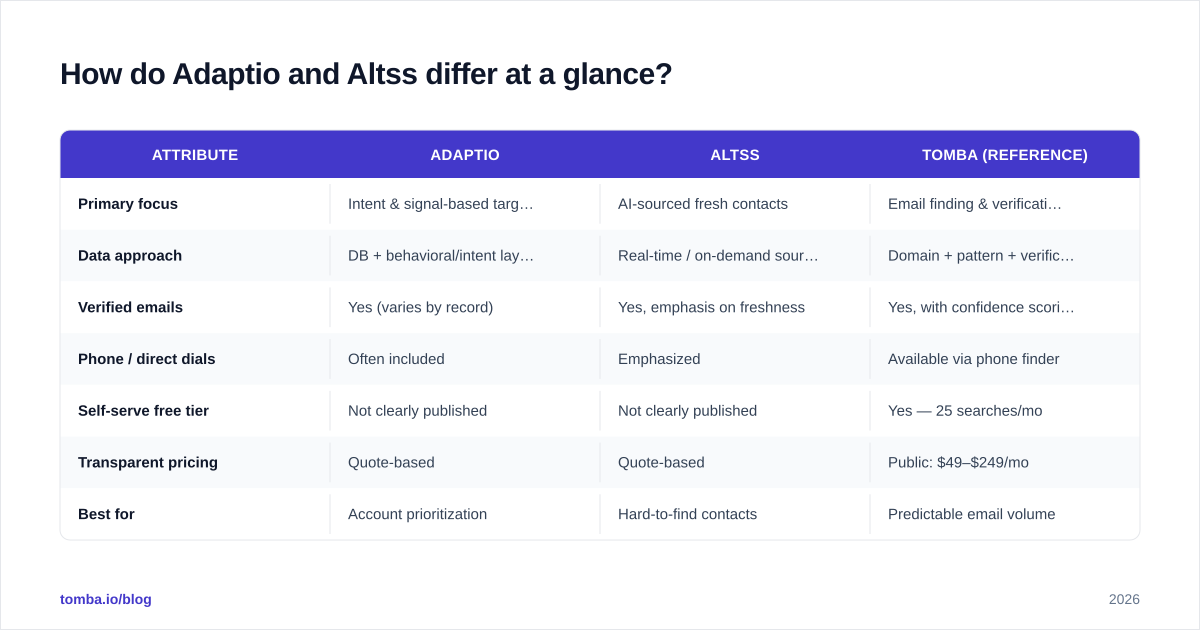
Here's the high-level split before we get into specifics. Where a vendor doesn't publish a figure, the table says so rather than inventing one — treat anything marked "quote-based" as a prompt to ask during a demo.
| Attribute | Adaptio | Altss | Tomba (reference) |
|---|---|---|---|
| Primary focus | Intent & signal-based targeting | AI-sourced fresh contacts | Email finding & verification |
| Data approach | DB + behavioral/intent layer | Real-time / on-demand sourcing | Domain + pattern + verification |
| Verified emails | Yes (varies by record) | Yes, emphasis on freshness | Yes, with confidence scoring |
| Phone / direct dials | Often included | Emphasized | Available via phone finder |
| Self-serve free tier | Not clearly published | Not clearly published | Yes — 25 searches/mo |
| Transparent pricing | Quote-based | Quote-based | Public: $49–$249/mo |
| Best for | Account prioritization | Hard-to-find contacts | Predictable email volume |
| API access | Typically enterprise | Varies by plan | Public API on all paid tiers |
The pattern is clear: both Adaptio and Altss bundle intelligence and data into a sales-motion product, while a focused tool exposes the underlying capability — find, verify, enrich — at a published price. If you already know who you want to reach and just need their address confirmed, you're paying for layers you won't use.
Which has better data accuracy?#
Accuracy is the only metric that survives a quarter. A flashy intent score is worthless if the email under it bounces, and "10 million contacts" means nothing if a third are stale.

Adaptio's accuracy story is tied to its signal layer. Because it leans on intent and engagement data, the value is in prioritization — surfacing accounts that are actually in-market. The contact records themselves are only as good as the sources feeding them, and like most aggregators, quality varies by region and seniority. Senior European contacts in particular tend to be thinner across most providers, and Adaptio is no exception.
Altss makes freshness its headline. By sourcing contacts closer to query time rather than serving a record scraped months ago, it aims to reduce the decay problem that plagues static databases. In practice, "real-time sourcing" still depends on verification — a freshly found email that nobody checked is just a fast guess. The right question to ask Altss in a demo is: what's your verified-deliverable rate, and do you re-verify at export?
This is where a dedicated email verifier earns its keep regardless of which tool you choose. Running any exported list — Adaptio's, Altss's, or your own — through SMTP-level verification before a campaign is the single highest-ROI habit in outbound. It catches the catch-all domains, role accounts, and dead mailboxes that quietly torch your sender reputation. If you want to understand where the underlying records come from, Tomba documents its data sources openly, which is more transparency than most intelligence suites offer.

The takeaway: neither Adaptio nor Altss should be trusted to send blind. Verify at the boundary, every time.
How do Adaptio and Altss handle pricing?#
This is the section where both tools get uncomfortable, and it's the most important one for a small team.
Neither Adaptio nor Altss publishes a clean, self-serve pricing table at the time of writing. Both steer prospects toward a demo and a custom quote. That model works fine for enterprises with a procurement budget, but it has real costs for everyone else:
- No price anchoring. You can't tell if you're getting a fair deal without shopping multiple quotes.
- Annual commitments. Quote-based tools frequently push 12-month contracts, which is a heavy bet on a tool you've barely used.
- Credit opacity. "Unlimited" rarely means unlimited; ask exactly what counts as a credit and what happens at the cap.
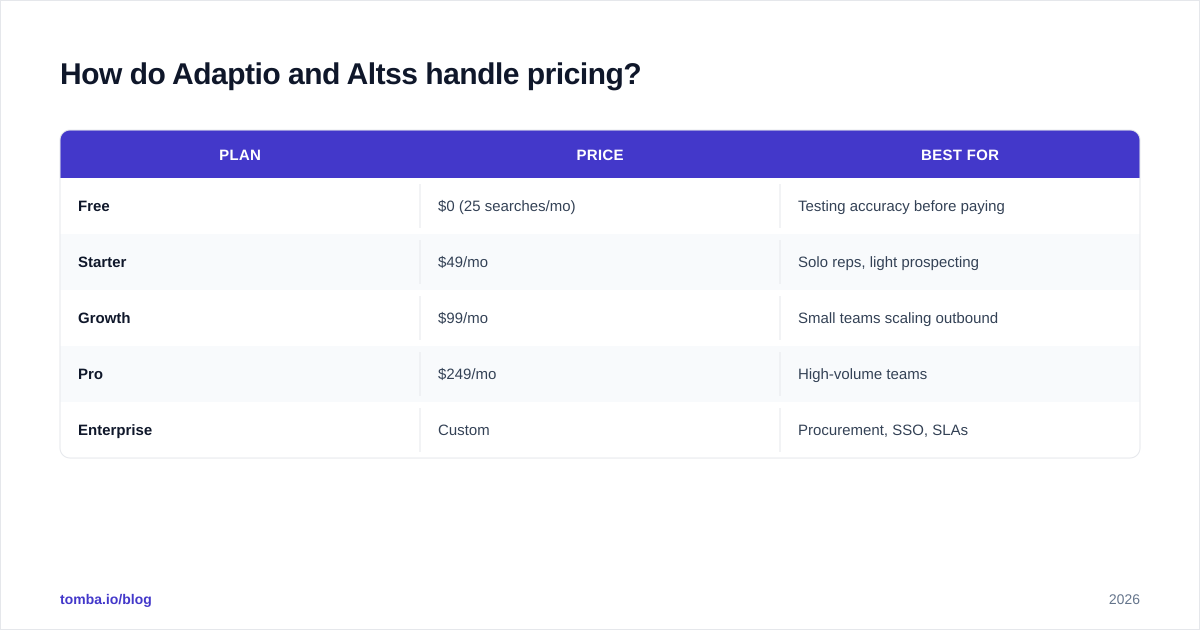
Contrast that with transparent, published Tomba pricing, which you can read in ten seconds:
| Plan | Price | Best for |
|---|---|---|
| Free | $0 (25 searches/mo) | Testing accuracy before paying |
| Starter | $49/mo | Solo reps, light prospecting |
| Growth | $99/mo | Small teams scaling outbound |
| Pro | $249/mo | High-volume teams |
| Enterprise | Custom | Procurement, SSO, SLAs |
The point isn't that Adaptio and Altss are overpriced — they may be excellent value for the right buyer. The point is you can't know without entering a sales cycle, and that friction is itself a cost. If you're a founder or a two-person SDR team, a published price you can start on today removes a week of back-and-forth.
Which tool fits which team?#
Mapping tools to team shapes is more useful than crowning a winner. Here's a practical breakdown.
Choose Adaptio if:
- You run account-based outbound and want to prioritize a known universe rather than expand it.
- Intent and engagement signals genuinely change which accounts your reps touch first.
- You have a RevOps function that can operationalize scores into routing and sequencing.
- Budget for a quote-based intelligence platform is approved.
Choose Altss if:
- Your core pain is finding hard-to-reach contacts, not ranking ones you already have.
- Data freshness is your recurring complaint with existing providers.
- You value AI-assisted sourcing and are comfortable verifying output downstream.
- You can absorb a demo-and-quote sales motion.
Choose a focused finder + verifier (like Tomba) if:
- Your bottleneck is verified email volume at a predictable monthly cost.
- You want to start today on a free tier and see real accuracy before committing.
- You need a clean domain search to pull every contact at a target company, plus an API to wire it into your own workflow.
- You'd rather buy the capability than a full suite you'll half-use.
A surprising number of teams discover, after a long evaluation, that they didn't need an intelligence platform at all — they needed reliable addresses and a way to confirm them. If that's you, the suite is a tax.
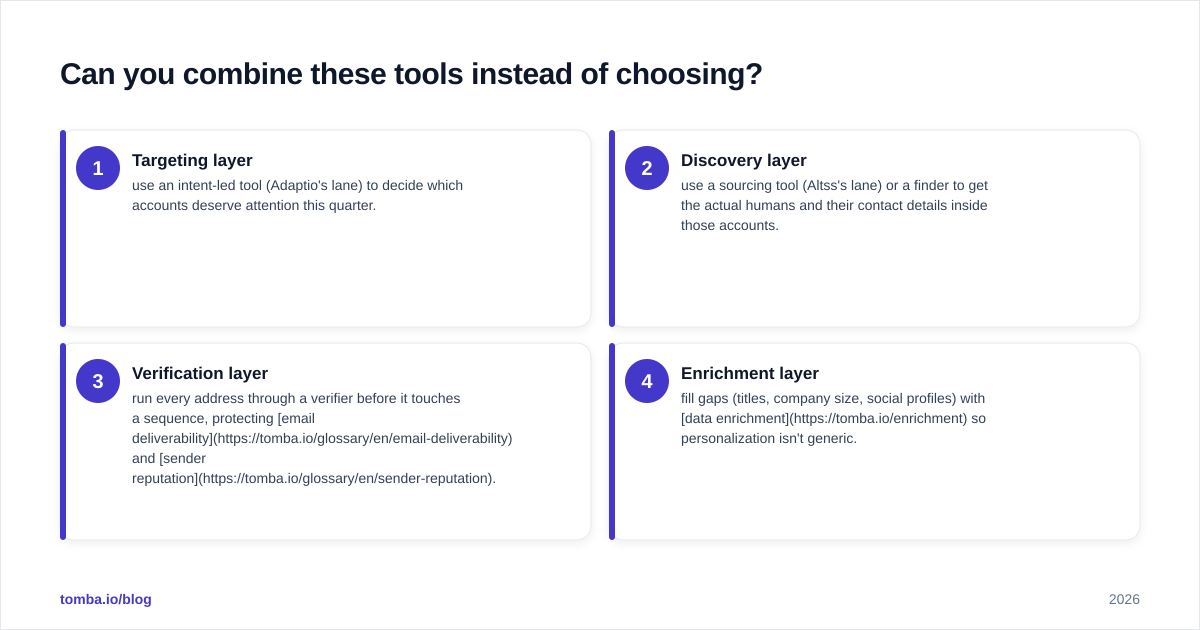
Can you combine these tools instead of choosing?#
Yes, and for many teams that's the smart answer. These categories aren't mutually exclusive.
A common stack looks like this:
- Targeting layer — use an intent-led tool (Adaptio's lane) to decide which accounts deserve attention this quarter.
- Discovery layer — use a sourcing tool (Altss's lane) or a finder to get the actual humans and their contact details inside those accounts.
- Verification layer — run every address through a verifier before it touches a sequence, protecting email deliverability and sender reputation.
- Enrichment layer — fill gaps (titles, company size, social profiles) with data enrichment so personalization isn't generic.
The mistake is paying enterprise suite prices for all four layers when you only need one or two well. Tools like Tomba deliberately unbundle steps 2–4 so you can attach them to whatever targeting brain you prefer — including Adaptio or Altss. The Tomba API makes that integration straightforward for engineering-minded teams.
What about integrations and workflow fit?#
A tool's data is only useful where your reps already live: the CRM, the sequencer, the spreadsheet.
Both Adaptio and Altss offer integrations, but as with newer platforms, breadth varies and the long tail (niche CRMs, no-code tools) may require their API or a middleware step. Before committing, list your non-negotiable destinations — HubSpot, Salesforce, your sequencer — and confirm each is native, not "via Zapier with caveats."
When you evaluate, check independent reviews on G2 and Capterra for integration complaints specifically; that's where teams vent about the gaps a sales demo glosses over. Look for recent reviews — a 2024 complaint may have been fixed, and a 2024 rave may predate a pricing change.
For teams that work primarily in spreadsheets or want zero-setup access, lighter touchpoints matter: a browser extension, a Sheets add-on, or a bulk email finder for one-off list builds. Suites tend to assume you'll adopt their whole workflow; standalone tools tend to meet you where you already are. Neither is wrong — it depends on whether you're standardizing a team or equipping an individual.
Adaptio vs Altss: the honest verdict#
There's no universal winner, and any post that declares one is selling something.
- Adaptio wins when prioritization is the problem — you have a universe of accounts and need to know where to spend finite rep hours. Its signal layer is the differentiator, and you should pressure-test exactly which signals it sources and how actionable they are.
- Altss wins when discovery is the problem — you keep hitting stale or missing contacts and want fresher, AI-sourced data. Pressure-test its verified-deliverable rate and whether freshness holds up in your target geographies.
- Both share the same friction: opaque, quote-based pricing that favors larger buyers and slows down small teams.
And the option neither vendor will mention: for a large share of outbound teams, the real job is just find the email, confirm it's real, send. That doesn't require a platform. It requires an accurate finder, a strict verifier, and a price you can read without booking a call.
If that describes you, start with Tomba Email Finder. You get find-by-domain, find-by-name, and company-wide email finder lookups with built-in confidence scoring, a free tier of 25 searches a month so you can benchmark accuracy against any quote you get from Adaptio or Altss, and published plans from $49/mo with no demo required. Run a list through it today, verify the results, and let the bounce rate — not the sales pitch — decide. Whichever targeting brain you pair it with, clean, verified data is the layer that makes everything above it work.
Get the Tomba newsletter
Practical outbound tactics and product updates — once every two weeks.
About the author