Adaptio vs Ampliz 2026: B2B Data Platform Comparison
Adaptio and Ampliz both promise clean B2B contact data — but they target different buyers. Here is the honest 2026 breakdown of pricing, accuracy, coverage, and the cheaper path that beats both.
Picking a B2B data vendor is mostly an argument about trust: you are paying for records you cannot personally verify, and the bill arrives whether the data was right or not. Adaptio and Ampliz both sell that trust to sales and marketing teams, but they were built for different jobs. This guide breaks down where each one actually earns its price — and where a leaner stack does the same work for less.
TL;DR#
- Ampliz is strongest for healthcare and APAC/global account data, with a human-verification layer that appeals to teams selling into hospitals, clinics, and life sciences.
- Adaptio positions itself around adaptive, intent-aware prospecting and workflow automation rather than a single vertical, making it a better fit for generalist outbound teams.
- Neither tool publishes fully transparent per-seat pricing; both run sales-led quotes, so your real cost depends on volume and negotiation.
- For most teams, the bottleneck is not "which big platform" — it is verified emails at a predictable price, which a focused finder like Tomba Email Finder delivers without an enterprise contract.
- Use the decision framework below to match the tool to your motion before you ever book a demo.
What are Adaptio and Ampliz?#
Both are B2B data and intelligence platforms, but they answer different questions.
Ampliz is a B2B contact and company intelligence provider best known for its healthcare database (physicians, hospitals, decision-makers) and its global/APAC coverage, where many US-centric tools thin out. It leans on a "data concierge" model — you can request custom lists that a team verifies before delivery. That human layer is the pitch, and it is genuinely useful when you are selling into regulated, hard-to-reach segments.
Adaptio markets itself less as a static database and more as an adaptive prospecting layer: contact data plus signals, scoring, and workflow tooling intended to keep your outreach pointed at accounts that are actually in-market. The promise is less "here is a list" and more "here is who to work next."
The practical difference: Ampliz sells you coverage and verification in specific verticals; Adaptio sells you prioritization and workflow across general B2B. Your buying decision should start with which of those problems is actually costing you pipeline.
How do Adaptio and Ampliz compare head-to-head?#
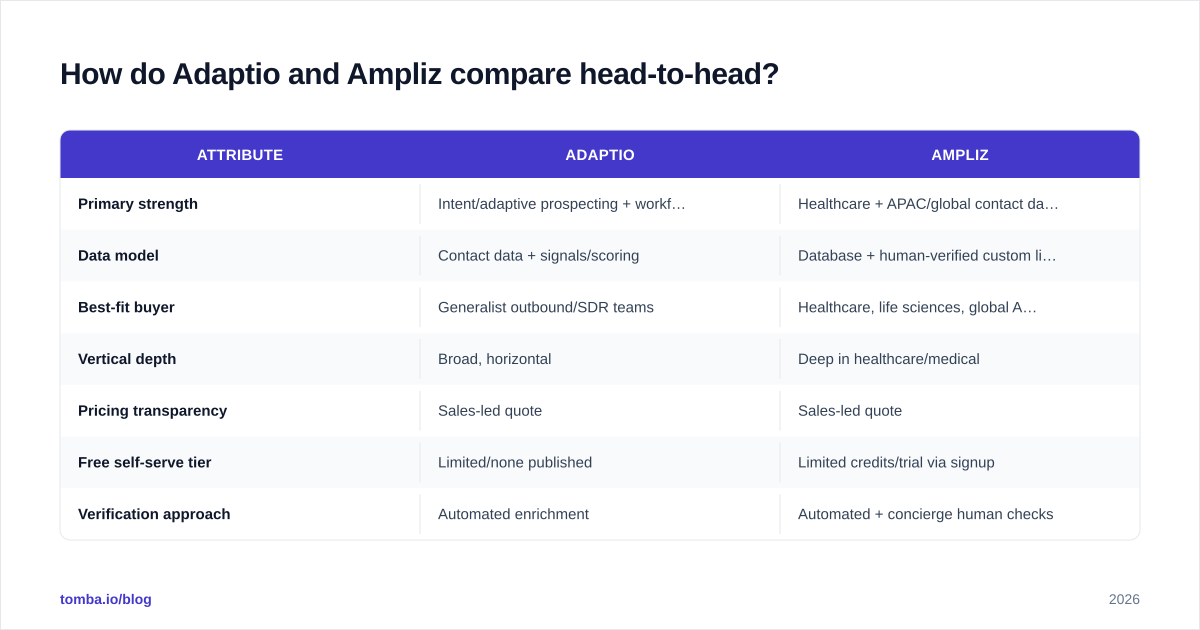
Here is the side-by-side. Treat pricing rows as directional — both vendors quote per deal, and published numbers move.
| Attribute | Adaptio | Ampliz |
|---|---|---|
| Primary strength | Intent/adaptive prospecting + workflow | Healthcare + APAC/global contact data |
| Data model | Contact data + signals/scoring | Database + human-verified custom lists |
| Best-fit buyer | Generalist outbound/SDR teams | Healthcare, life sciences, global ABM |
| Vertical depth | Broad, horizontal | Deep in healthcare/medical |
| Pricing transparency | Sales-led quote | Sales-led quote |
| Free self-serve tier | Limited/none published | Limited credits/trial via signup |
| Verification approach | Automated enrichment | Automated + concierge human checks |
| Typical commitment | Annual-leaning | Annual or custom list buys |
The honest read: if your ICP lives inside hospitals and health systems, Ampliz's specialization is hard to replicate with a horizontal tool. If you sell broadly and want help deciding who to contact first, Adaptio's workflow angle is more relevant. Neither is a slam dunk for a small team that just needs accurate emails on demand.

Which has better data accuracy?#
Accuracy is the only metric that matters, and it is the one vendors describe most vaguely.
Ampliz's edge is its concierge verification for niche lists — when a human checks a physician's affiliation before the record ships, bounce rates in that segment tend to be lower than scraped data. The trade-off is speed and cost: human-verified custom lists are slower to deliver and priced accordingly.
Adaptio relies more on automated enrichment and signal freshness. That scales better and updates faster, but automated pipelines inherit the usual B2B data decay problem: roughly 20–30% of B2B contact data goes stale every year as people change roles. Any vendor claiming "98% accuracy" is quoting a best-case snapshot, not a guarantee on your specific list.
The defensible move, regardless of vendor, is to verify before you send. Run any purchased or enriched list through an independent email verifier so you are validating deliverability at send-time rather than trusting a number on a sales slide. This single step protects your sender reputation more than any vendor's internal accuracy claim. Cross-check vendor reputation on neutral sources like G2 and Capterra before signing — verified user reviews surface bounce complaints faster than a demo will.
How do they handle coverage and verticals?#
Coverage is where these two genuinely diverge.
- Ampliz is the answer when your TAM includes healthcare providers, hospital administrators, or contacts in markets like India, Singapore, and broader APAC, where US-first databases are sparse. See Ampliz's own positioning for the healthcare and global angle.
- Adaptio is the answer when you sell across industries and care more about which of your many possible accounts is showing buying signals this quarter.
If your motion is account-based and global, you may end up wanting both a deep vertical source and a broad signal layer — which is exactly how data budgets balloon. Before you stack two platforms, ask whether a single verified-email workflow plus a focused B2B database covers 80% of the need at a fraction of the combined cost.
What do Adaptio and Ampliz cost in 2026?#
Neither publishes clean self-serve pricing, so budget for a sales conversation.
| Cost factor | What to expect |
|---|---|
| Pricing model | Quote-based, volume-tiered, annual-leaning |
| Onboarding | Demo + custom proposal before access |
| Custom lists (Ampliz) | Priced per record/project for concierge data |
| Signal/workflow tiers (Adaptio) | Bundled into platform seat pricing |
| Hidden cost | Wasted credits on stale records you still pay for |
| Exit friction | Annual contracts reduce flexibility |
The uncomfortable truth about quote-based pricing is that your effective cost-per-valid-contact is unknown until you have already burned credits. A team paying for an enterprise platform but only mailing 2,000 contacts a month is overpaying dramatically.
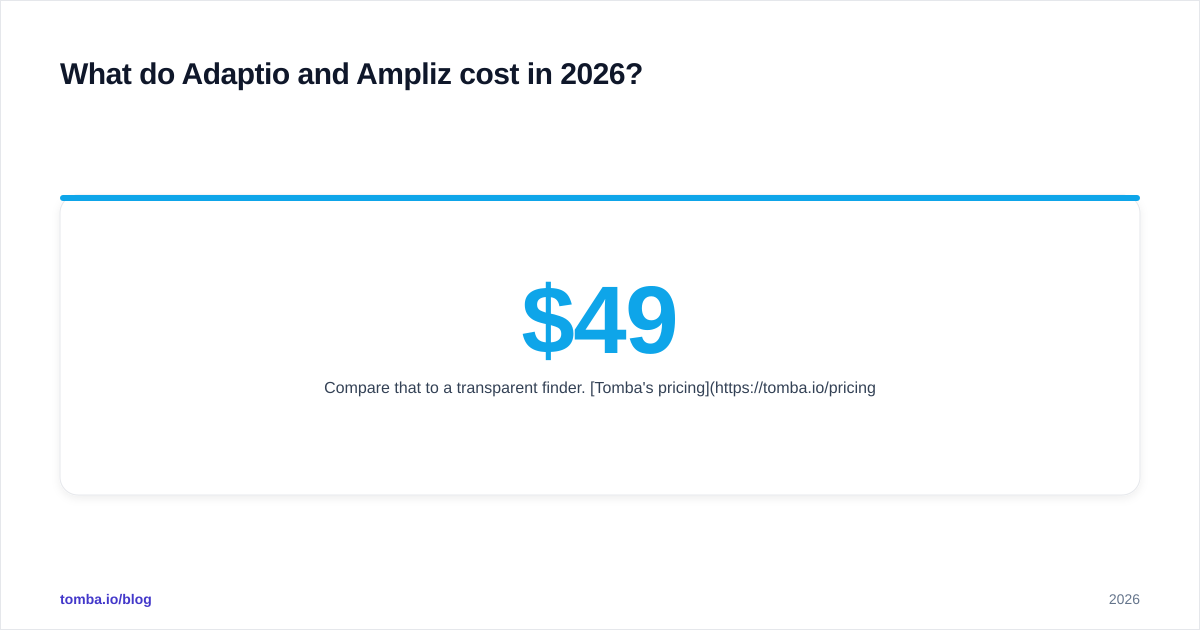
Compare that to a transparent finder. Tomba's pricing is public: a Free tier (25 searches/mo), Starter at $49/mo, Growth at $99/mo, and Pro at $249/mo. You know your unit economics before you commit — no demo required to learn the number.
When should you choose a focused email finder instead?#
Choose a focused finder when your actual problem is "I have a list of target companies and need accurate, verified contacts" — not "I need a strategic intelligence platform."
A surprising share of teams buy a heavyweight data platform to solve what is really a finding-and-verifying problem. The signals dashboards go unused; the SDRs just want reachable inboxes. In that case the platform is overhead, not leverage.
This is where a domain search plus verification workflow wins on simplicity:
- Feed a target domain and get the company's email pattern and known contacts.
- Find the specific decision-maker by name and role.
- Verify each address for deliverability before it enters your sequence.
- Enrich with firmographics only where the deal size justifies it via data enrichment.
You get the 90% of value — reachable, verified contacts — without an annual enterprise commitment or a quarterly negotiation.
Adaptio vs Ampliz: which should you pick?#
Here is the decision in plain terms:
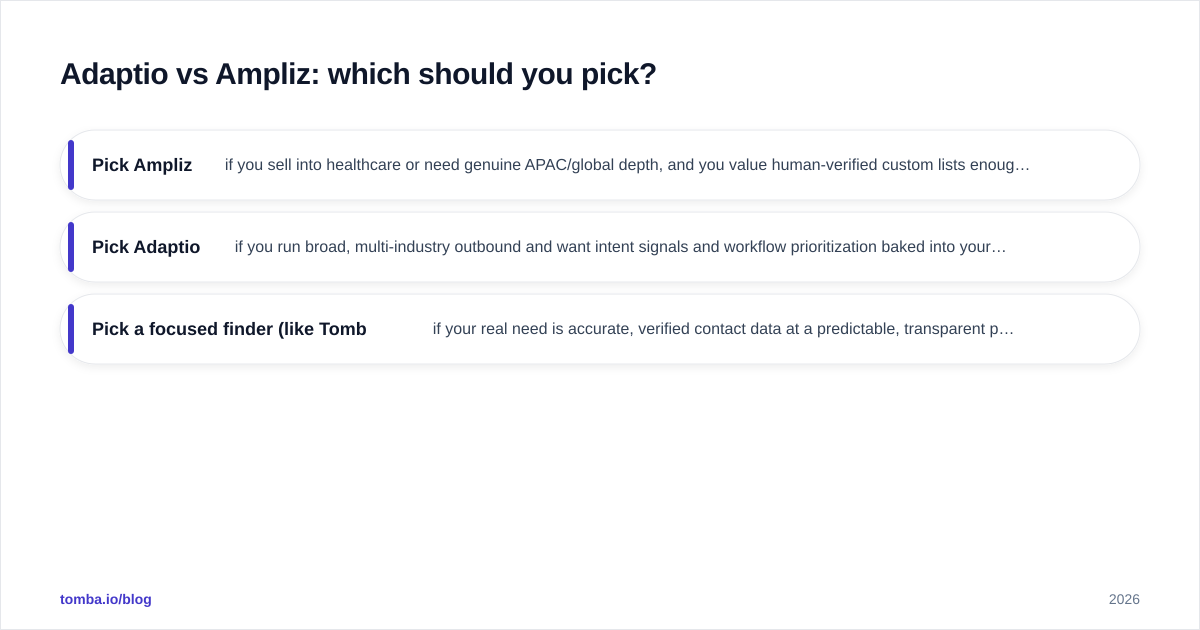
- Pick Ampliz if you sell into healthcare or need genuine APAC/global depth, and you value human-verified custom lists enough to accept slower delivery and quote-based pricing.
- Pick Adaptio if you run broad, multi-industry outbound and want intent signals and workflow prioritization baked into your data layer.
- Pick a focused finder (like Tomba) if your real need is accurate, verified contact data at a predictable, transparent price — which describes most SMB and mid-market sales teams.
The trap to avoid is buying a strategic platform to solve a tactical problem. If you cannot point to a specific workflow — vertical verification, intent scoring — that only a full platform provides, you are likely paying for capability you will not use.
A pragmatic 2026 stack for most teams looks like this: a transparent finder for sourcing and verifying contacts, a CRM you already own, and a vertical or intent vendor added only when a proven gap justifies the spend. Start lean, measure cost-per-meeting, and let evidence — not a demo — drive the upgrade.
Frequently asked questions#
Is Adaptio or Ampliz more accurate? For niche verticals like healthcare, Ampliz's concierge verification tends to produce lower bounce rates; Adaptio's automated enrichment scales faster but inherits normal B2B data decay. Verify either vendor's output independently before sending.
Do they offer free trials? Ampliz typically offers limited trial credits via signup; Adaptio is more demo-led. Both gate full access behind a sales conversation, so confirm trial terms directly.
What is the cheapest reliable alternative? A transparent email finder with public pricing — find the contact, verify deliverability, enrich only when the deal justifies it. That covers most teams' needs without an enterprise contract.
The bottom line#
Adaptio and Ampliz are good at specific jobs — Adaptio at adaptive, signal-driven prospecting, Ampliz at deep healthcare and global coverage. But both ask you to commit to quote-based, platform-scale spending before you know your true cost-per-valid-contact. For the majority of teams whose real need is reachable, verified contacts on demand, that is overkill.
Start with the workflow, not the logo. If you mostly need to find and verify professional emails at a price you can predict, try Tomba Email Finder — start free with 25 searches a month, scale to $49/mo when you are ready, and keep your data spend tied directly to the contacts you actually use. Prove the motion first; add a heavyweight platform only when a real gap demands it.
Ready to find emails that actually work?
Join 150,000+ professionals who stopped guessing and started sending. Free credits on signup — no credit card required.
Get the Tomba newsletter
Practical outbound tactics and product updates — once every two weeks.
About the author