Adaptio vs Archetype Data (2026): Which GTM Data Platform Wins?
A neutral, side-by-side breakdown of Adaptio vs Archetype Data in 2026 — what each GTM data platform does well, where they fall short, and how to pick the right fit for your revenue team.
TL;DR
- Adaptio and Archetype Data are both 2026-era GTM data platforms, but they solve different halves of the problem: Adaptio leans toward account scoring and signal orchestration, while Archetype Data leans toward firmographic and ICP modeling.
- Neither is a drop-in replacement for a dedicated contact-finding layer — both expect you to plug in an email and phone source to actually reach the people they surface.
- Pricing for both is quote-based and seat-plus-usage, so your real cost depends on data volume and integrations, not a sticker price.
- Pick Adaptio if your bottleneck is prioritization (too many accounts, no clear order). Pick Archetype Data if your bottleneck is targeting (you don't yet know who your ideal customer is).
- Whichever you choose, you still need verified contact data at the bottom of the funnel — that's where a tool like the Tomba Email Finder closes the loop.
What are Adaptio and Archetype Data?#
Think of your go-to-market motion like a fishing trip. Archetype Data tells you which lake to fish in and what the fish look like. Adaptio tells you which spot in the lake is biting right now. Both are useful. Neither hands you the rod.
In plain terms, both products sit in the B2B data and intelligence layer of the modern sales stack. They ingest firmographic, technographic, and behavioral signals, then output a prioritized view of accounts your team should work. The difference is emphasis:
- Adaptio positions itself around signal orchestration and account scoring — pulling intent, product usage, and engagement signals into a ranked worklist for reps and SDRs.
- Archetype Data positions itself around ICP modeling and firmographic enrichment — helping you define, refine, and expand the universe of companies that look like your best customers.
If you've evaluated platforms like 6sense or Demandbase, you'll recognize the category. (For context on the broader space, Gartner and G2 both maintain useful category overviews of account intelligence and GTM platforms.)
How do Adaptio and Archetype Data differ at a glance?#
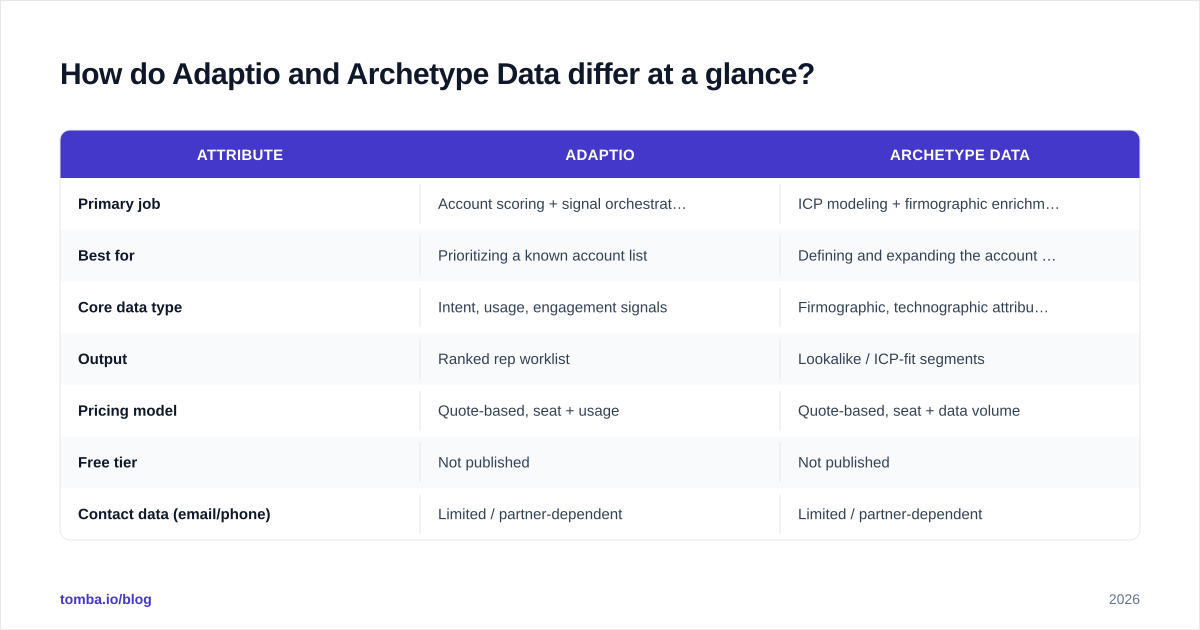
Here's the honest, attribute-by-attribute comparison. Where a vendor publishes quote-based pricing only, that's noted rather than invented — confirm current numbers directly with each vendor before you sign.
| Attribute | Adaptio | Archetype Data |
|---|---|---|
| Primary job | Account scoring + signal orchestration | ICP modeling + firmographic enrichment |
| Best for | Prioritizing a known account list | Defining and expanding the account list |
| Core data type | Intent, usage, engagement signals | Firmographic, technographic attributes |
| Output | Ranked rep worklist | Lookalike / ICP-fit segments |
| Pricing model | Quote-based, seat + usage | Quote-based, seat + data volume |
| Free tier | Not published | Not published |
| Contact data (email/phone) | Limited / partner-dependent | Limited / partner-dependent |
| Typical buyer | RevOps, sales leadership | Marketing, demand gen, RevOps |
| Setup effort | Medium (signal mapping) | Medium (ICP calibration) |
| CRM fit | Salesforce, HubSpot via sync | Salesforce, HubSpot via sync |
The single most important row in that table is the contact-data row. Both platforms are strong at telling you which company and which account, and both are comparatively thin on the verified, deliverable email address you need to actually start a conversation. Keep that in mind — we'll come back to it.
)
Is Adaptio better than Archetype Data for prioritization?#
Yes — if prioritization is genuinely your problem.
Adaptio's design assumes you already have a large, messy universe of accounts and the real pain is order. Which 50 of these 5,000 accounts should an SDR touch this week? It answers that by blending signals — site visits, product-usage telemetry, third-party intent, and engagement history — into a single score that updates as behavior changes.
That dynamic re-ranking is the part teams tend to like. A static list goes stale within days; a signal-driven list reflects what happened yesterday. If your reps routinely complain that they "don't know where to start," that's the symptom Adaptio targets.
Where it gets weaker:
- Garbage in, garbage out. Signal scoring is only as good as the signals you feed it. If your tracking is patchy or your intent provider is noisy, the ranking inherits that noise.
- It assumes you have the list. Adaptio sharpens an existing universe; it's less about discovering net-new accounts you've never heard of.
- Contact activation is a separate step. A ranked account is not a ranked person with a verified email. You still need an enrichment and contact enrichment layer underneath it.
Is Archetype Data better than Adaptio for targeting?#
Yes — if you don't yet trust your definition of an ideal customer.
Archetype Data's center of gravity is the ICP itself. It takes your closed-won and closed-lost history, finds the firmographic and technographic patterns that separate winners from losers, and uses those patterns to score and expand your addressable market. The output isn't "work this account now" — it's "these 1,200 companies look like your best customers, and here's why."
That makes it a natural fit for marketing and demand-gen teams building campaign audiences, and for RevOps teams trying to put discipline around territory and segment design. If your current "ICP" is a vague paragraph in a slide deck, Archetype Data forces it into something measurable.
Where it gets weaker:
- Modeling needs history. Lookalike modeling is shaky if you have very few closed deals to learn from. Early-stage teams may not have enough signal.
- Fit is not timing. A great-fit account that isn't in-market won't convert this quarter. Archetype Data tells you who, not necessarily when — which is the gap Adaptio fills.
- Same contact-data ceiling. Knowing a company is a perfect fit doesn't give you the decision-maker's verified email.
How much do Adaptio and Archetype Data cost in 2026?#
Both run quote-based, land-and-expand pricing rather than published self-serve tiers. In practice that means your cost is driven by three levers:
- Seats — how many reps, SDRs, and ops users touch the platform.
- Data volume — how many accounts/contacts you model, score, or enrich.
- Integrations — CRM sync, intent feeds, and API access often sit in higher tiers.
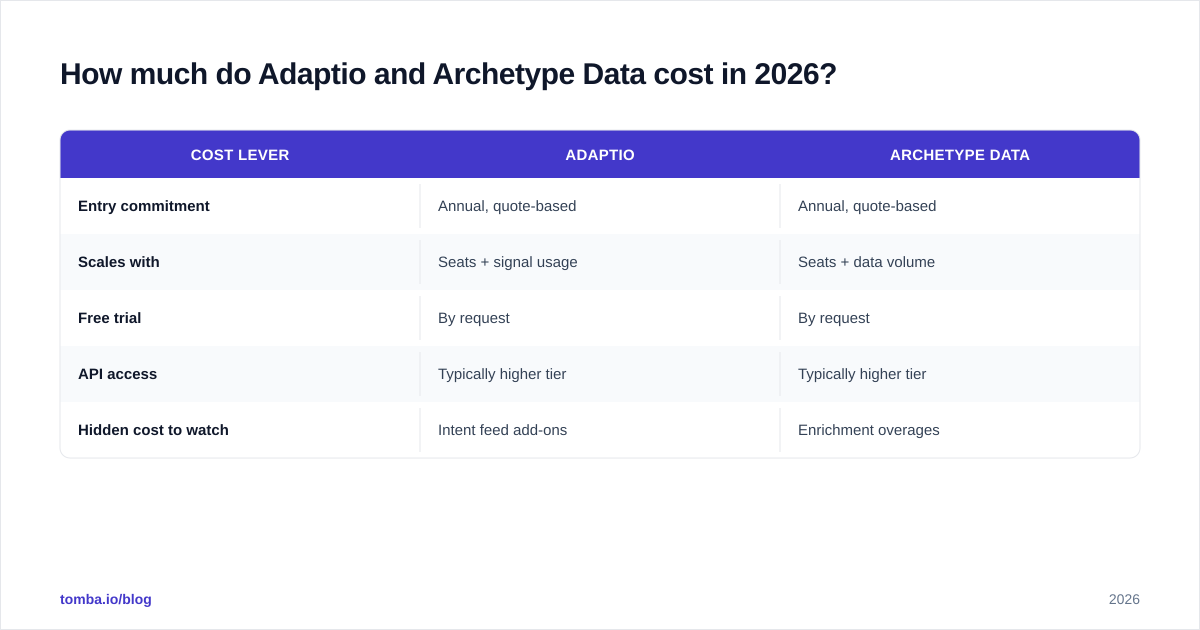
| Cost lever | Adaptio | Archetype Data |
|---|---|---|
| Entry commitment | Annual, quote-based | Annual, quote-based |
| Scales with | Seats + signal usage | Seats + data volume |
| Free trial | By request | By request |
| API access | Typically higher tier | Typically higher tier |
| Hidden cost to watch | Intent feed add-ons | Enrichment overages |
Because neither publishes a transparent ladder, the smart move is to model your total GTM data spend, not just the platform line item. A common mistake: teams buy a premium account-intelligence platform, then discover they're still paying separately for contact data because the platform's email/phone coverage is thin. Budget for that layer up front. For a transparent point of comparison, you can see exactly what a dedicated contact-data tool costs on the Tomba pricing page (free tier with 25 searches/mo, Starter at $49/mo, Growth at $99/mo, Pro at $249/mo).
)
What do Adaptio and Archetype Data both miss?#
The same thing: the verified, deliverable contact record.
Account intelligence platforms are built to answer "which company" and "which account is hot." They are not built to be your system of record for a specific person's current, working email address and direct dial. Most lean on partners or limited bundled data for that last mile — and bundled contact data is frequently the weakest, most stale part of an otherwise strong product.
This matters because deliverability lives or dies on data quality. Sending to a guessed or outdated address tanks your sender reputation and quietly destroys campaign performance. A clean targeting model feeding a dirty contact list is a fast way to land in spam.
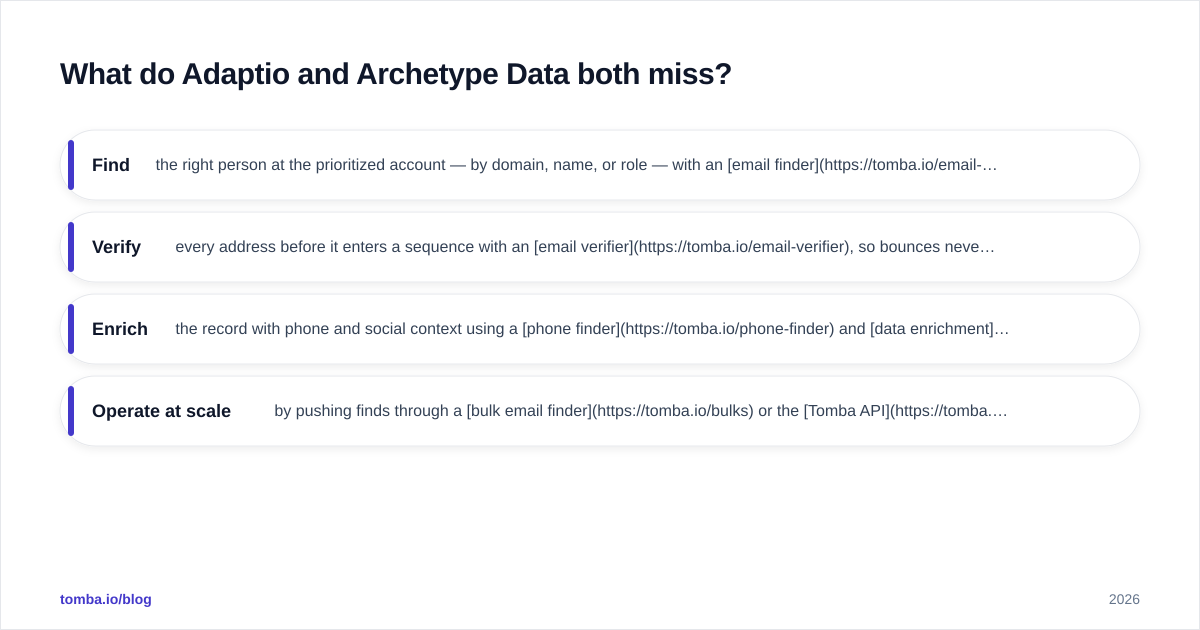
That's why most mature teams treat contact data as its own deliberate layer:
- Find the right person at the prioritized account — by domain, name, or role — with an email finder.
- Verify every address before it enters a sequence with an email verifier, so bounces never touch your sending domain.
- Enrich the record with phone and social context using a phone finder and data enrichment.
- Operate at scale by pushing finds through a bulk email finder or the Tomba API directly into your CRM.
Tools like HubSpot and Salesforce will happily store whatever you put in them — they don't validate the data for you. The validation has to happen before the record lands.
Which should you choose: Adaptio or Archetype Data?#
Decide by naming your actual bottleneck out loud.
- "We have too many accounts and no clear order." → Adaptio. You need signal-driven prioritization more than a new ICP.
- "We're not sure who we should even be selling to." → Archetype Data. You need modeling and targeting before prioritization is meaningful.
- "Both, honestly." → Many teams eventually run an ICP/targeting layer and a scoring/timing layer. If budget forces one first, choose the one that fixes your most expensive mistake: targeting the wrong companies (Archetype) or working the right companies in the wrong order (Adaptio).
- "We just can't reach the people we find." → Neither platform fixes this. Add a dedicated contact-data layer regardless of which intelligence platform you pick.
A useful sequencing framework: get targeting right (who), then timing right (when), then contact right (how to reach). Skipping the third step is the most common reason a well-funded GTM data investment fails to show up in pipeline.
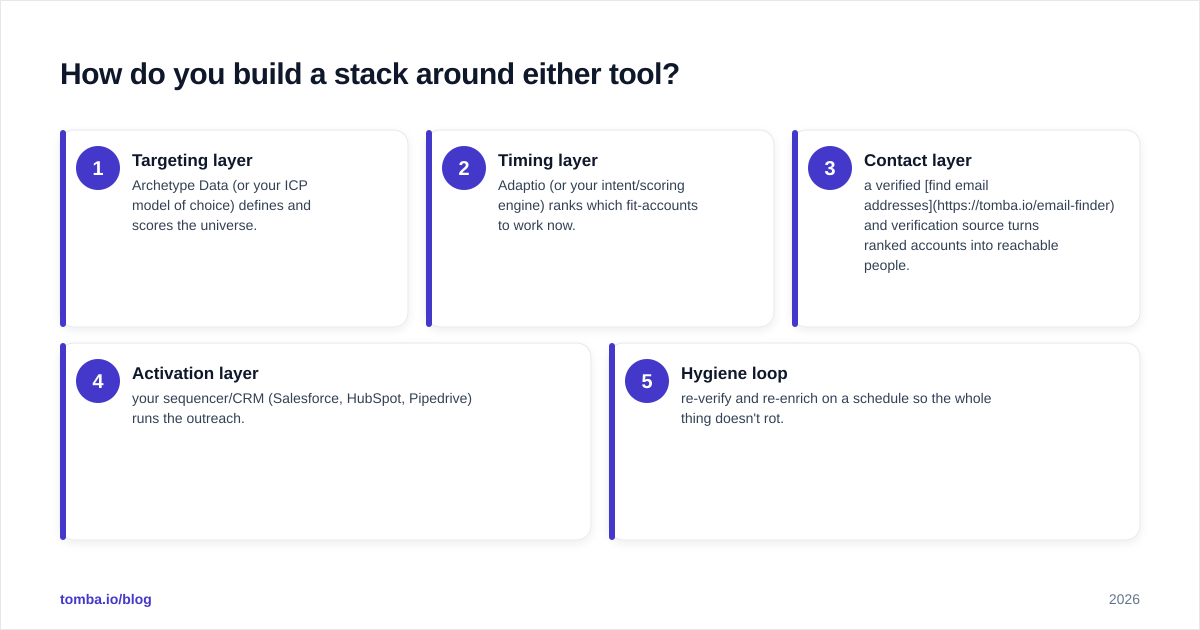
How do you build a stack around either tool?#
A clean reference architecture looks like this:
- Targeting layer — Archetype Data (or your ICP model of choice) defines and scores the universe.
- Timing layer — Adaptio (or your intent/scoring engine) ranks which fit-accounts to work now.
- Contact layer — a verified find email addresses and verification source turns ranked accounts into reachable people.
- Activation layer — your sequencer/CRM (Salesforce, HubSpot, Pipedrive) runs the outreach.
- Hygiene loop — re-verify and re-enrich on a schedule so the whole thing doesn't rot.
The mistake to avoid is buying layers 1 and 2 while neglecting layer 3. That's the equivalent of buying a sports car and forgetting the keys — impressive in the driveway, useless on the road. Whichever intelligence platform you pick, wire in a real contact-data source from day one.
Final verdict and recommendation#
Adaptio and Archetype Data are not really competitors so much as neighbors. Adaptio wins on timing and prioritization; Archetype Data wins on targeting and ICP discipline. The right answer depends on which problem is currently costing you the most pipeline — and many teams will, over time, want both.
But here's the part neither vendor will lead with: the most expensive failure in this category isn't picking the "wrong" intelligence platform. It's surfacing a perfect, in-market account and then having no verified way to reach the human who signs the deal. That's a contact-data problem, and it's solvable today.
Start by closing that gap. The Tomba Email Finder finds professional email addresses by domain, name, or company, pairs with a built-in verifier to keep your bounce rate near zero, and plugs into your CRM through the Tomba API and native integrations — so the accounts Adaptio or Archetype Data hand you actually turn into conversations. Try it free with 25 searches a month, then scale on a transparent plan as your pipeline grows.
Ready to find emails that actually work?
Join 150,000+ professionals who stopped guessing and started sending. Free credits on signup — no credit card required.
Get the Tomba newsletter
Practical outbound tactics and product updates — once every two weeks.
About the author