Adaptio vs BigDBM 2026: B2B Data Provider Comparison
Adaptio and BigDBM both sell B2B data, but they solve different problems. Here's an honest 2026 breakdown of coverage, accuracy, pricing, and fit.
TL;DR
- Adaptio leans toward audience activation and identity-driven targeting — turning data into reachable segments for advertising and outbound. BigDBM is a raw data and identity-graph provider built for scale, API delivery, and enrichment at the record level.
- Pick BigDBM when you need high-volume B2B/B2C records, identity resolution, and intent signals piped into your own systems via API. Pick Adaptio when you want packaged audiences and activation rather than a database to manage yourself.
- Neither platform is a cheap, self-serve email finder. Both are enterprise-leaning and quote-based, so budget and onboarding matter.
- Accuracy depends less on the brand and more on how fresh the data is and whether you verify before you send. Any provider's records decay; a verification layer is non-negotiable.
- For most sales teams that just need accurate work emails on demand, a focused tool like the Tomba Email Finder plus data enrichment covers the job at a fraction of the commitment.
Who are Adaptio and BigDBM?#
The short version: BigDBM is a data supplier, Adaptio is a data activator. They overlap because both sit in the B2B data intelligence stack, but they're solving different ends of the same problem.
BigDBM is a US-focused data provider known for large consumer and business databases, an identity graph that stitches a person to their emails, phones, and devices, and intent data. Its core delivery model is API and bulk file — you bring the data into your CRM, ad platform, or data warehouse and act on it there. If you've evaluated providers on a marketplace like G2, BigDBM shows up in the "marketing data" and "lead intelligence" categories rather than as a point-and-click prospecting app.
Adaptio sits closer to the activation layer. The pitch is less "here is a database to query" and more "here is an audience you can reach." That makes it attractive to demand-gen and advertising teams who want targetable segments without standing up their own data pipeline. The trade-off is that you get less granular, record-level control than a raw data feed gives you.
Why does the distinction matter? Because buying the wrong category is the most expensive mistake here. A team that needed clean records to enrich a CRM but bought an activation product ends up paying for reach it can't audit. A team that needed turnkey audiences but bought a raw feed ends up hiring engineers to make it usable.
How do Adaptio and BigDBM compare on data coverage and accuracy?#
Conclusion first: coverage favors BigDBM at the raw-record level; usability favors Adaptio at the audience level; accuracy favors whoever you verify after.
BigDBM's selling point is volume and identity resolution — hundreds of millions of records across B2B and B2C, with the graph connecting a contact's professional and personal identifiers. That breadth is genuinely useful for enrichment and matching. The catch is the same one every large database faces: a record that was accurate when it was compiled may be stale by the time you use it. People change jobs roughly every two to four years, and B2B email data decays at an estimated 22–30% per year according to widely cited industry figures from vendors like HubSpot.
Adaptio's audience approach hides some of that decay behind aggregated segments, which is convenient until you need to know whether a specific person is still reachable. Aggregation is a feature for advertisers and a limitation for one-to-one outbound.
The honest takeaway: don't buy on coverage claims alone. A provider quoting "500M+ records" is telling you about quantity, not deliverability. The number that actually protects your sender reputation is the percentage of those records that pass a live verification check today. That's why mature teams run every list through an email verifier before the first send, regardless of which data vendor supplied it.
What does each platform cost in 2026?#
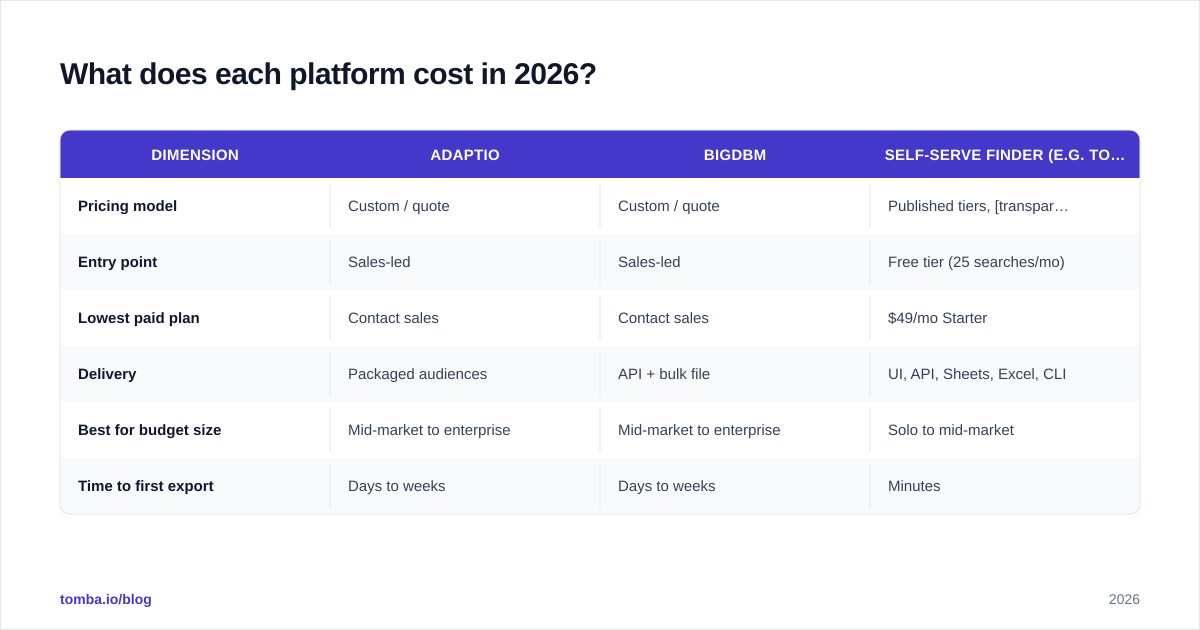
Both Adaptio and BigDBM are quote-based and enterprise-leaning — neither publishes a transparent self-serve price list the way a prospecting tool does. Expect a sales conversation, a minimum commitment, and pricing that scales with volume, data types (B2B vs B2C vs intent), and delivery method (API vs file).
That model is normal for data suppliers, but it has real consequences for buyers:
- Time to value is slower. You're signing a contract and integrating, not swiping a card and exporting a list this afternoon.
- Minimums can be steep. Volume-based deals often assume you'll consume a lot of records, which is wasteful for a team that needs a few thousand verified contacts a month.
- Comparing apples to apples is hard. One vendor's "credit" may be a single field; another's may be a full enriched profile.
| Dimension | Adaptio | BigDBM | Self-serve finder (e.g. Tomba) |
|---|---|---|---|
| Pricing model | Custom / quote | Custom / quote | Published tiers, transparent |
| Entry point | Sales-led | Sales-led | Free tier (25 searches/mo) |
| Lowest paid plan | Contact sales | Contact sales | $49/mo Starter |
| Delivery | Packaged audiences | API + bulk file | UI, API, Sheets, Excel, CLI |
| Best for budget size | Mid-market to enterprise | Mid-market to enterprise | Solo to mid-market |
| Time to first export | Days to weeks | Days to weeks | Minutes |
If your buying committee needs predictable, line-item pricing and a fast start, a tool with published tiers — Tomba's are public, from a free tier through Starter at $49/mo, Growth at $99/mo, and Pro at $249/mo — removes a lot of procurement friction. If you're a large org that consumes data at scale and has engineers to integrate a feed, the enterprise data-supplier model can pencil out.
Which use cases fit Adaptio vs BigDBM?#
Match the tool to the job. Here's where each tends to win.
Choose BigDBM when:
- You're enriching an existing CRM or data warehouse and need record-level fields (firmographics, identifiers, intent) delivered by API.
- You're building an internal scoring or routing system and want raw signals, not packaged segments.
- You operate at a scale where a B2B database feed is cheaper per record than per-search tooling.
- You have technical resources to ingest, dedupe, and maintain the data.
Choose Adaptio when:
- Your primary goal is advertising or demand-gen activation, not one-to-one outbound.
- You want targetable audiences without managing a pipeline.
- Your team is marketing-led and values reach over per-record auditability.
Choose neither (and use a focused finder) when:
- You need a specific person's verified work email right now.
- Your monthly volume is in the thousands, not millions.
- You want transparent pricing and a same-day start.
This is the case most SMB and mid-market sales teams actually fall into. They don't need an identity graph; they need the right email for the 200 accounts on this quarter's list. For that, an on-demand email finder plus a verification pass is faster and cheaper than a data contract.
How should you evaluate any B2B data provider?#
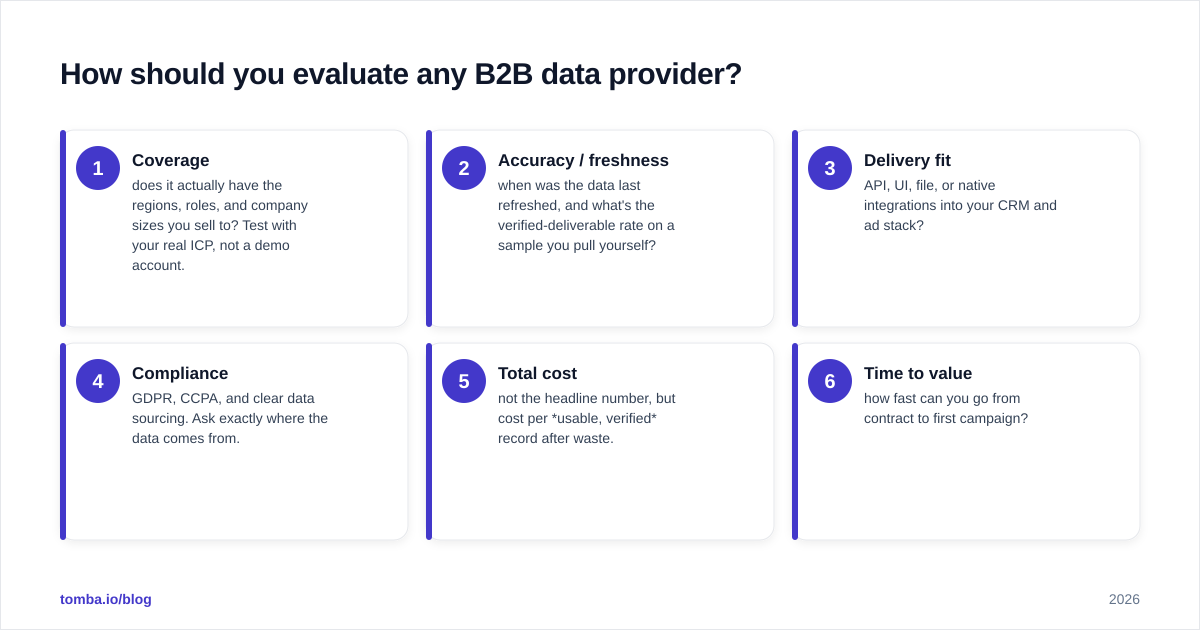
Use a consistent framework so you're comparing the same things across Adaptio, BigDBM, and any alternative. Score each provider 1–5 on these six axes:
- Coverage — does it actually have the regions, roles, and company sizes you sell to? Test with your real ICP, not a demo account.
- Accuracy / freshness — when was the data last refreshed, and what's the verified-deliverable rate on a sample you pull yourself?
- Delivery fit — API, UI, file, or native integrations into your CRM and ad stack?
- Compliance — GDPR, CCPA, and clear data sourcing. Ask exactly where the data comes from.
- Total cost — not the headline number, but cost per usable, verified record after waste.
- Time to value — how fast can you go from contract to first campaign?
The single most overlooked axis is accuracy, because vendors quote coverage and stay quiet about decay. Always run a free sample through a verification check before you sign. Reputable analysts like Gartner consistently flag data quality, not data quantity, as the differentiator in marketing and sales data programs — and transparency about data sources is a fair thing to demand from any vendor.
Adaptio vs BigDBM: side-by-side comparison#
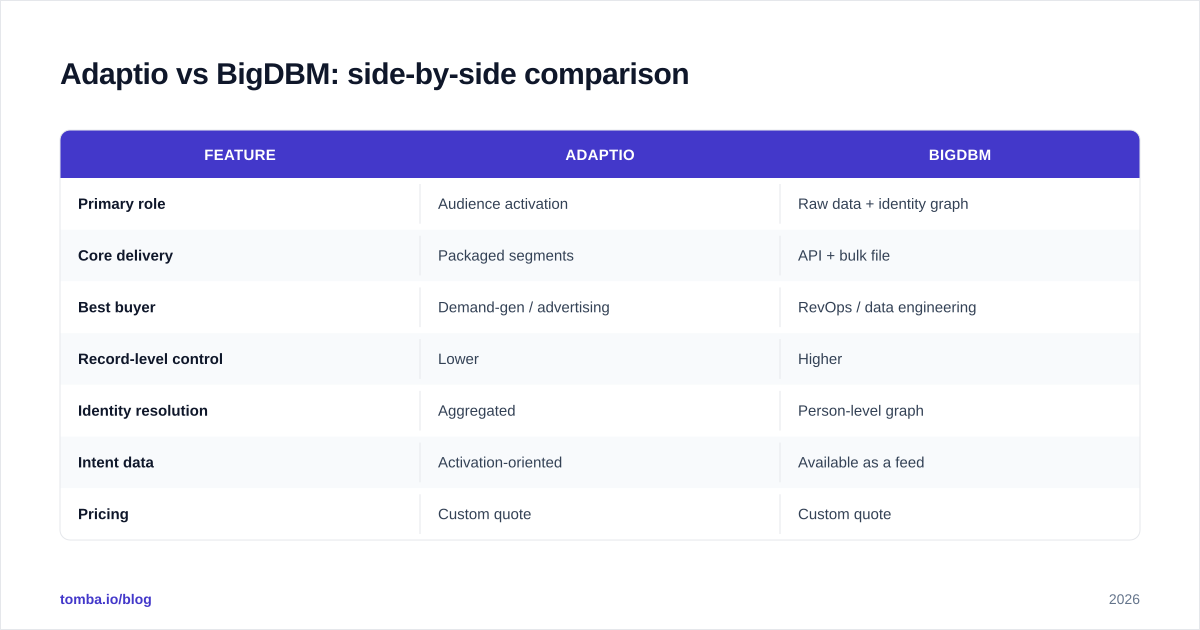
| Feature | Adaptio | BigDBM |
|---|---|---|
| Primary role | Audience activation | Raw data + identity graph |
| Core delivery | Packaged segments | API + bulk file |
| Best buyer | Demand-gen / advertising | RevOps / data engineering |
| Record-level control | Lower | Higher |
| Identity resolution | Aggregated | Person-level graph |
| Intent data | Activation-oriented | Available as a feed |
| Pricing | Custom quote | Custom quote |
| Self-serve free tier | No | No |
| Setup effort | Lower (turnkey) | Higher (integration) |
| Ideal volume | Campaign-scale audiences | High-volume records |
Read this table as "different lanes," not "winner and loser." If a reviewer tells you one is universally better, they're skipping the question that decides it: what are you actually going to do with the data? Activation and enrichment are different jobs.
Where does an email finder fit alongside these platforms?#
Even teams that buy a big data feed still need a precise, on-demand layer — and that's the gap a finder fills.
Think of it like a grocery store versus a spice rack. A bulk data provider is the warehouse: enormous selection, great when you're stocking a whole kitchen, overkill when you just need one ingredient for tonight. An email finder is the spice rack on the counter — you grab exactly what you need, when you need it, and you can check it's fresh before you cook.
In practice, the strongest GTM stacks combine both:
- Use a bulk provider (like BigDBM) or activation layer (like Adaptio) for breadth — large audiences, enrichment fields, intent at scale.
- Use a finder and verifier for precision — the named contacts on this week's target list, validated before outreach.
Tomba covers the precision layer end to end: find an address by name and domain, run domain search to map a whole company, enrich records with data enrichment, and verify everything before it touches your sending domain. It plugs into Sheets, Excel, HubSpot, Salesforce, and Zapier, and it has published pricing, so there's no procurement maze to start.
Frequently asked questions#
Is Adaptio or BigDBM better for cold outbound email? Neither is purpose-built for it. BigDBM can supply records you then verify and send, but you'll manage the pipeline yourself. Adaptio is geared toward activation and advertising. For named-account outbound, a finder plus verifier is usually the faster path.
Do Adaptio and BigDBM publish pricing? No. Both are quote-based. Expect a sales process and likely a volume commitment. If transparent, per-seat or per-credit pricing matters to you, a self-serve tool is a better fit.
How accurate is purchased B2B data? It varies and it decays — plan for roughly 20–30% annual decay on email data. Whatever you buy, verify a live sample before relying on it, and re-verify lists before each campaign to protect deliverability.
Can I replace these platforms with an email finder? If your need is precision contact discovery at modest volume, yes. If you need an identity graph, intent feeds, or campaign-scale audiences, a finder complements rather than replaces them.
The bottom line#
Adaptio vs BigDBM isn't a head-to-head — it's a fork in the road. BigDBM is the choice when you want raw, high-volume data and identity resolution piped into systems you control. Adaptio is the choice when you want packaged, ready-to-activate audiences for marketing. Both are enterprise-leaning, quote-based commitments, so map your real use case and verify a data sample before you sign anything.
But if you're like most sales and RevOps teams reading this, your actual job is narrower: get accurate, verified work emails for the specific people you're trying to reach, without a contract and without a data-engineering project. That's exactly what the Tomba Email Finder is built for — start free with 25 searches a month, find and verify contacts in minutes, and scale up to a transparent paid plan only when you're ready. Try it on your next target list and see how many "purchased" records it catches before they cost you a bounce.
Ready to find emails that actually work?
Join 150,000+ professionals who stopped guessing and started sending. Free credits on signup — no credit card required.
Get the Tomba newsletter
Practical outbound tactics and product updates — once every two weeks.
About the author