Adaptio vs Biscred: Which CRE Data Platform Wins in 2026?
A neutral, hands-on breakdown of Adaptio vs Biscred for commercial real estate prospecting — data depth, AI sourcing, pricing, and which fits your workflow in 2026.
Commercial real estate teams live and die by their data. The broker who reaches the owner first, the analyst who spots the off-market deal, the BD rep who knows which fund is actively deploying — they all depend on a contact database that is current, deep, and searchable. Two platforms keep coming up when CRE teams shop for that database: Adaptio and Biscred.
This is a neutral comparison. Both tools are legitimate, both have real strengths, and neither is a universal winner. Below you'll find what each one actually does, where the data comes from, how they price, and which type of team each one fits. We'll also cover the part most vendors skip: what to do with the contacts after you export them, so your outreach doesn't bounce.
TL;DR — Adaptio vs Biscred at a glance#
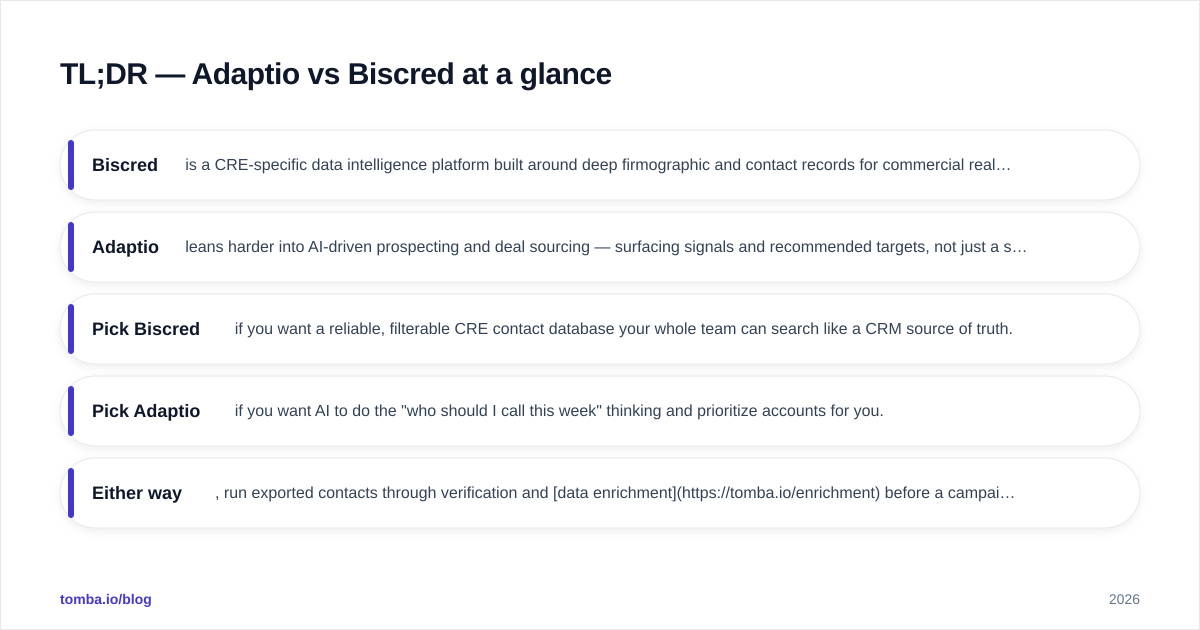
- Biscred is a CRE-specific data intelligence platform built around deep firmographic and contact records for commercial real estate companies, with strong search filters for asset class, role, and geography.
- Adaptio leans harder into AI-driven prospecting and deal sourcing — surfacing signals and recommended targets, not just a static directory you query.
- Pick Biscred if you want a reliable, filterable CRE contact database your whole team can search like a CRM source of truth.
- Pick Adaptio if you want AI to do the "who should I call this week" thinking and prioritize accounts for you.
- Either way, run exported contacts through verification and data enrichment before a campaign — CRE data decays fast, and bounce rates wreck sender reputation.
What is Biscred?#
Biscred is a data platform purpose-built for commercial real estate. Think of it as a specialized directory: instead of a generic B2B database where CRE contacts are buried among dentists and SaaS founders, every record is tagged with the attributes CRE professionals actually filter on — asset class (office, multifamily, industrial, retail), company type (owner, operator, lender, broker, developer), title, and market.
The core promise is precision. If you need every acquisitions VP at multifamily owner-operators in the Southeast, Biscred is designed to return exactly that list with contact details attached. It behaves like a queryable system of record: you define the filters, you get the people.
That focus is also the trade-off. Biscred is a strong lookup tool. It tells you who exists and how to reach them. It does less of the "tell me who to prioritize" work — that judgment stays with you.
What is Adaptio?#
Adaptio approaches the same CRE problem from the AI-prospecting side. Rather than positioning itself purely as a directory you search, it emphasizes surfacing opportunities — using signals, scoring, and recommendations to point you toward accounts and contacts worth pursuing now.
The everyday analogy: Biscred is a phone book with excellent filters; Adaptio is a research assistant that hands you a shortlist and says "start here." Technically, that means Adaptio puts more weight on its modeling and workflow layer — prioritization, list-building automation, and reducing the manual hunting that eats a BD rep's morning.
The trade-off mirrors Biscred's. AI recommendations are only as good as the underlying data and your ability to trust the scoring. When the signals are right, you save hours. When they're off, you spend time second-guessing the shortlist.

Adaptio vs Biscred: side-by-side comparison#
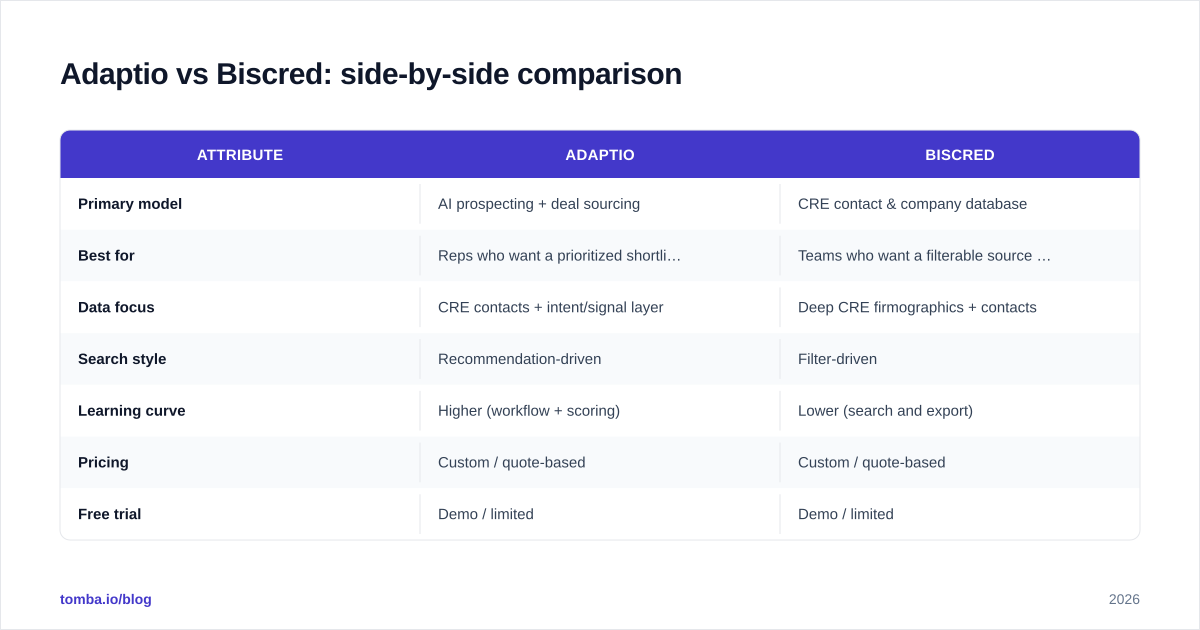
Pricing for CRE data platforms is almost always quote-based and tiered by seats, export volume, and data scope, so treat the pricing row as directional — confirm current numbers directly with each vendor.
| Attribute | Adaptio | Biscred |
|---|---|---|
| Primary model | AI prospecting + deal sourcing | CRE contact & company database |
| Best for | Reps who want a prioritized shortlist | Teams who want a filterable source of truth |
| Data focus | CRE contacts + intent/signal layer | Deep CRE firmographics + contacts |
| Search style | Recommendation-driven | Filter-driven |
| Learning curve | Higher (workflow + scoring) | Lower (search and export) |
| Pricing | Custom / quote-based | Custom / quote-based |
| Free trial | Demo / limited | Demo / limited |
| Export + CRM sync | Yes | Yes |
| Weak spot | Trusting AI prioritization | Less proactive prioritization |
The honest summary: these tools are converging but start from opposite ends. Biscred starts as a database and adds workflow. Adaptio starts as a workflow and leans on data. Your choice depends on whether your bottleneck is finding the right contacts or deciding which ones to chase.
Which has better data coverage and accuracy?#
Neither vendor publishes a third-party-audited accuracy number you can take to the bank, so judge coverage on your actual market, not on marketing claims.
Run the same test on both during trials:
- Pull a list for a niche you know cold — say, industrial developers in a single secondary market.
- Spot-check 25 records against LinkedIn and company sites.
- Count three things: missing people, wrong titles, and stale or invalid emails.
Whichever platform wins your niche wins for you. National coverage averages are close to meaningless if your desk only covers three metros.
One pattern holds for both: contact data ages. People change firms constantly in CRE, and email addresses go dead. Even a fresh export benefits from a verification pass. Push your list through an email verifier before you load a sequence — catching dead addresses before send is the single cheapest way to protect email deliverability.
How do Adaptio and Biscred fit your workflow?#
The data is only half the decision. The other half is how the tool slots into the way your team already works.
If you run a structured outbound team, Biscred's filter-first model maps cleanly onto a repeatable process: define ICP filters, export, enrich, sequence. Everyone searches the same way, so list quality is consistent across reps.
If you have senior closers who hate list-building, Adaptio's recommendation layer can remove the part they resent. The risk is over-reliance: a shortlist is a starting point, not gospel. Smart teams treat AI suggestions as a first draft and apply human judgment on top.
Both export to CRMs and outreach tools, so neither locks you out of your stack. Whatever you pull, plan an enrichment and verification step between "export" and "send." Missing phone numbers can be backfilled with a phone finder, and thin records can be rounded out with firmographic and contact data enrichment so reps aren't dialing into gaps.
What about pricing and contracts?#
Both Adaptio and Biscred operate on the standard CRE-data commercial model: annual contracts, seat-based pricing, and quotes that scale with export limits and data scope. Expect to talk to sales rather than swipe a card.
Questions to ask before signing either:
- Export caps. How many records per month/seat, and what happens when you hit the ceiling?
- Seat minimums. Many CRE platforms have a floor that's painful for a 2-person shop.
- Data refresh cadence. How often are records re-validated? Stale data at any price is expensive.
- Contract length and out clause. Annual lock-in is common; negotiate a pilot if you can.
- What's actually included. Signals, integrations, and API access are often add-ons.
Compare the real quotes against what you'd pay to assemble similar coverage from a general B2B database plus enrichment. For purely CRE-native firmographics, a specialist usually wins. For broader B2B reach beyond real estate, a general-purpose stack is often more flexible and cheaper per contact.
For reference on how transparent, published tiers can look, see Tomba pricing — a free tier with 25 searches a month, Starter at $49/mo, Growth at $99/mo, and Pro at $249/mo. CRE specialists rarely publish numbers like that, which is exactly why you should get quotes in writing and compare cost-per-usable-contact, not headline price.
Adaptio vs Biscred: which should you choose?#
Conclusion first: choose Biscred if your bottleneck is finding the right CRE contacts and you want a dependable, searchable database. Choose Adaptio if your bottleneck is deciding who to pursue and you want AI to prioritize for you.
Quick decision guide:
| If you are… | Lean toward |
|---|---|
| A brokerage building targeted owner lists | Biscred |
| A BD team that wants AI-prioritized targets | Adaptio |
| A small shop watching every dollar | Whichever quote is leaner — push for a pilot |
| A team already strong at list-building | Biscred (data depth) |
| A team weak at list-building | Adaptio (workflow help) |
Don't over-index on the demo polish. Run the 25-record accuracy test on your real market, confirm export caps, and price the contract against your expected usable contacts. The tool that wins on your desk is the right one.
Both platforms are worth trialing if CRE is your world. And whichever you land on, treat the exported data as raw material, not a finished campaign. Cross-check it against authoritative sources, read peer reviews on G2 and Capterra, and ground your understanding of the market in solid fundamentals — even a primer on commercial property helps you ask sharper questions during the sales call.
The step both tools leave to you: verify before you send#
Here's the gap neither Adaptio nor Biscred fully closes. They give you contacts. They don't guarantee those emails will still land tomorrow. CRE professionals move firms constantly, and a bounce rate above a few percent will throttle your domain reputation fast.
That's where a dedicated finder-and-verifier layer earns its keep. Use the Tomba Email Finder to fill in missing addresses your CRE platform didn't have, confirm the format for a target company, and verify deliverability before a single message goes out. It plugs in alongside Adaptio or Biscred rather than replacing them — they tell you who, Tomba helps make sure you can actually reach them. Start free with 25 searches a month, then scale up only when the pipeline justifies it.
Pick the CRE platform that fits your bottleneck, verify everything before you send, and let the data — not the demo — make the call.
// get started
Find, verify and enrich your first contacts today
Start on the free plan with 25 searches a month, then scale when your team is ready.
Free plan · No credit card required · GDPR & CCPA
// about the author