Adaptio vs CapitalConnectorAI: 2026 B2B Tool Comparison
A neutral, hands-on breakdown of Adaptio vs CapitalConnectorAI in 2026 — pricing, data, routing, and which AI sales platform actually fits your pipeline.

Choosing between Adaptio vs CapitalConnectorAI usually comes down to one question: do you need a flexible AI sales workspace that bends to your existing process, or a capital-focused routing engine that pushes qualified opportunities into the right hands fast? Both promise to compress the gap between raw signal and booked revenue, but they solve different halves of the problem.
This comparison is written for revenue teams evaluating either platform in 2026 — not as a sales pitch for either vendor. We will look at data quality, AI routing logic, pricing posture, integrations, and the workflows where each tool earns its seat. Where a dedicated point solution beats both, we will say so.
TL;DR#
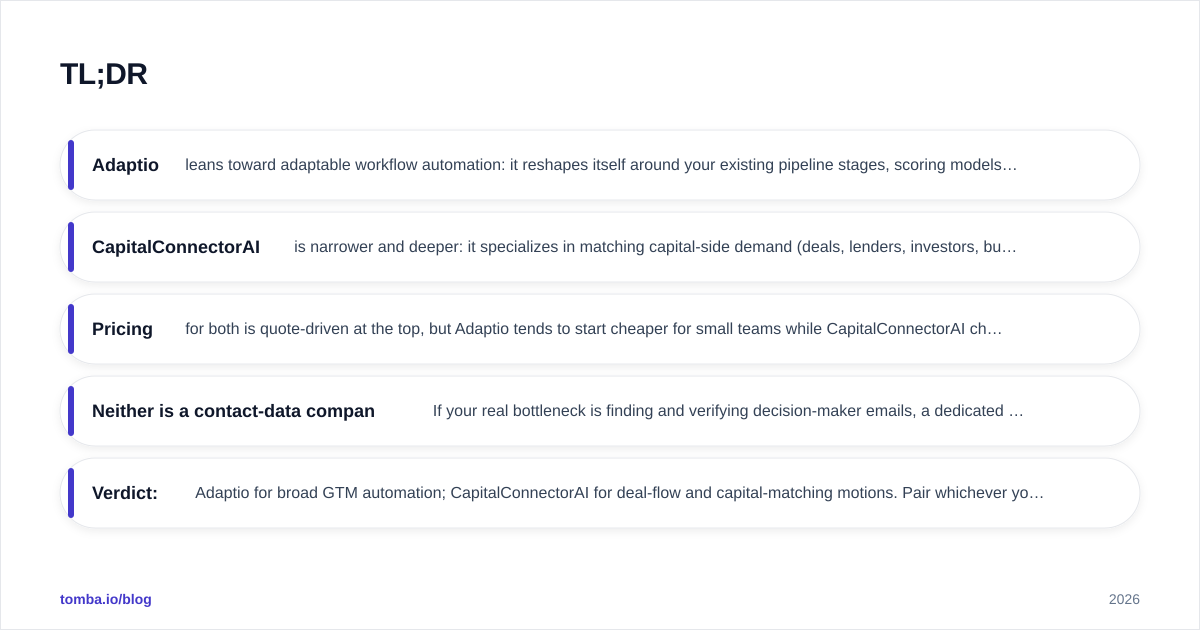
- Adaptio leans toward adaptable workflow automation: it reshapes itself around your existing pipeline stages, scoring models, and rep behavior.
- CapitalConnectorAI is narrower and deeper: it specializes in matching capital-side demand (deals, lenders, investors, buyers) to supply using intent and firmographic signals.
- Pricing for both is quote-driven at the top, but Adaptio tends to start cheaper for small teams while CapitalConnectorAI charges for routing volume and data seats.
- Neither is a contact-data company. If your real bottleneck is finding and verifying decision-maker emails, a dedicated email finder will outperform the contact module bundled into either platform.
- Verdict: Adaptio for broad GTM automation; CapitalConnectorAI for deal-flow and capital-matching motions. Pair whichever you pick with clean enrichment data.
What is Adaptio?#
Adaptio positions itself as an adaptive B2B sales and GTM automation layer. The pitch is that instead of forcing your team into a rigid sequence builder, it learns your pipeline shape and adjusts cadences, lead scoring, and task routing to match how your reps already work.
In practice, that means three things. First, a flexible scoring engine you can retrain on closed-won and closed-lost outcomes. Second, workflow automation that triggers off CRM field changes rather than only off email opens. Third, a recommendation layer that nudges reps toward the next-best action based on historical patterns in your own data.
The strength is breadth. Adaptio touches prospecting, sequencing, pipeline hygiene, and forecasting in one workspace. The trade-off is that breadth dilutes depth — its native contact database and verification are serviceable, not best-in-class, which is why most teams bolt on dedicated data enrichment underneath it.
What is CapitalConnectorAI?#
CapitalConnectorAI is a specialist. It exists to connect capital-side demand and supply — think lenders to borrowers, investors to founders, acquirers to targets, or large buyers to qualified vendors — using AI-driven matching on intent, firmographics, and timing signals.
Where Adaptio is a generalist GTM tool, CapitalConnectorAI is built around a routing graph. It scores both sides of a potential match, predicts likelihood to transact, and pushes the introduction to whichever team or partner is best positioned to close. For deal-flow-heavy businesses — financial services, marketplaces, partner ecosystems, M&A advisory — that focus is the entire value proposition.
The cost of specialization is that CapitalConnectorAI is not a general sales engagement platform. If you want broad cold-email sequencing, social touches, and full-funnel cadence management, you will find the surface area thinner than a horizontal tool. It assumes you already have a way to source and verify the contacts feeding its graph.
Adaptio vs CapitalConnectorAI: how do they compare?#
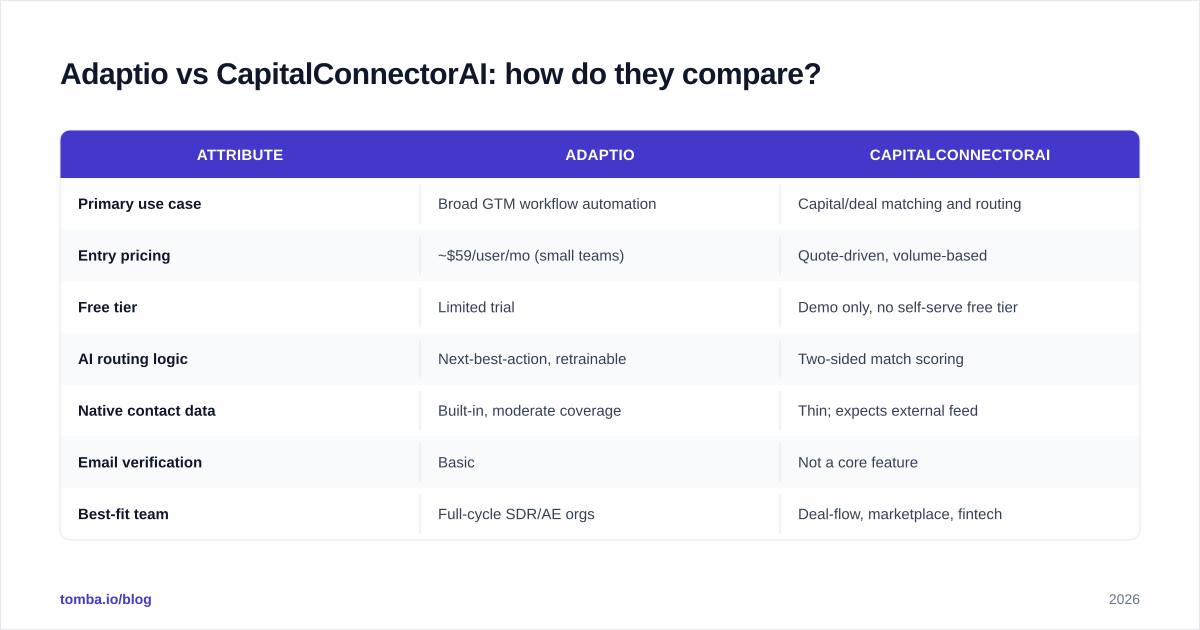
Here is the head-to-head on the attributes that actually move an evaluation. Figures reflect typical published tiers and representative ranges in 2026; confirm current quotes directly with each vendor, since both negotiate at the enterprise level.
| Attribute | Adaptio | CapitalConnectorAI |
|---|---|---|
| Primary use case | Broad GTM workflow automation | Capital/deal matching and routing |
| Entry pricing | ~$59/user/mo (small teams) | Quote-driven, volume-based |
| Free tier | Limited trial | Demo only, no self-serve free tier |
| AI routing logic | Next-best-action, retrainable | Two-sided match scoring |
| Native contact data | Built-in, moderate coverage | Thin; expects external feed |
| Email verification | Basic | Not a core feature |
| Best-fit team | Full-cycle SDR/AE orgs | Deal-flow, marketplace, fintech |
| Forecasting | Native, pipeline-based | Match-conversion focused |
| Setup effort | Medium | Higher (graph configuration) |
The pattern is clear. Adaptio wins on flexibility and out-of-the-box usefulness for a standard outbound or full-cycle team. CapitalConnectorAI wins when the core motion is matching two parties and the value sits in routing accuracy, not cadence volume.

Which has better data and accuracy?#
Neither platform is primarily a data vendor, and that distinction matters more than most buyers expect.
Adaptio's native contact database covers common firmographic fields and a moderate slice of business emails, but coverage thins for niche industries and non-US regions. CapitalConnectorAI barely competes here at all — it is engineered to consume a clean contact and account feed, not to generate one. Feed it stale records and its match quality degrades immediately, because the routing graph is only as good as the entities inside it.
This is the gap most evaluations miss. You can buy the slickest AI routing engine on the market and still stall because half your decision-maker emails bounce. Before you commit to either tool, pressure-test how each handles data hygiene, and budget for a dedicated layer to find and confirm contacts. A focused email verifier catching invalid and catch-all addresses upstream will do more for either platform's output than any internal scoring tweak.
If you want an objective read on how each vendor is perceived on data and support, cross-reference verified buyer reviews on G2 and Capterra rather than relying on vendor case studies alone.
How do pricing and value compare?#
Both vendors keep their headline numbers vague, which is normal for AI sales tooling in 2026. Still, the shape of each pricing model tells you who they are built for.
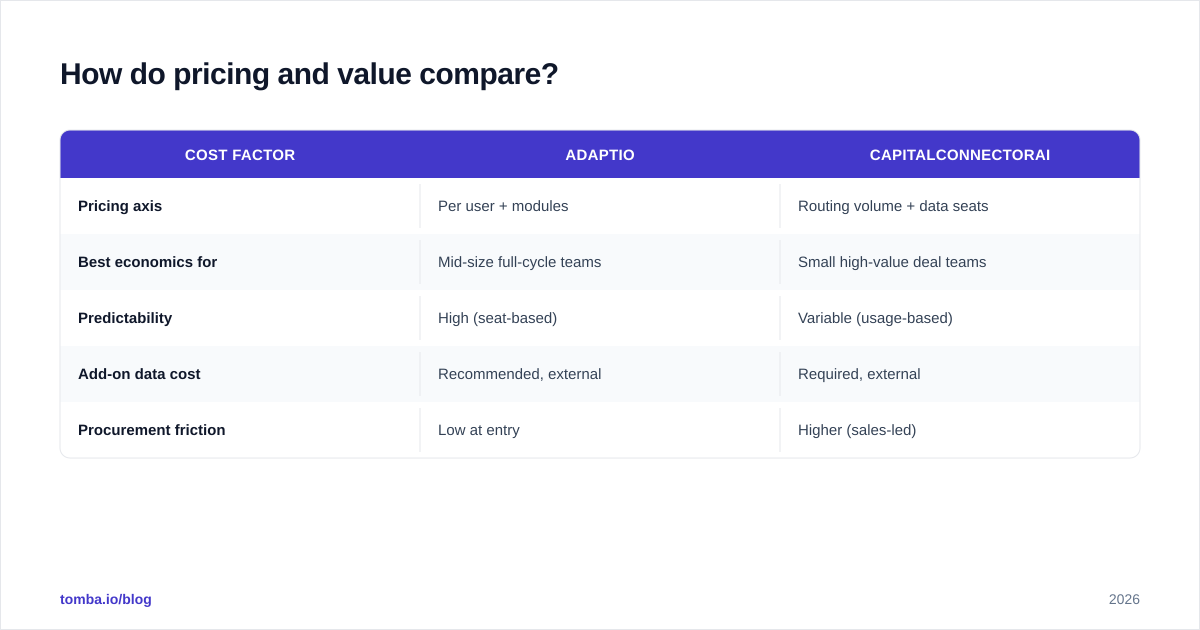
Adaptio uses a per-seat model with a lower entry point, so a five-person team can get started without a procurement cycle. Costs scale with users and with add-on modules like advanced forecasting. CapitalConnectorAI prices on routing volume and data seats — meaning your bill tracks how many matches and introductions flow through the system, not how many reps log in. That favors lean teams handling high-value transactions and penalizes large headcounts running low-value volume.
When you model total cost, remember the hidden line item: contact data. If you are layering enrichment and verification on top — and you should be — factor that in. For reference on what a transparent, predictable data spend looks like, compare against published Tomba pricing, which runs a free tier (25 searches/mo), Starter at $49/mo, Growth at $99/mo, and Pro at $249/mo. Knowing your data floor keeps the platform decision honest.
| Cost factor | Adaptio | CapitalConnectorAI |
|---|---|---|
| Pricing axis | Per user + modules | Routing volume + data seats |
| Best economics for | Mid-size full-cycle teams | Small high-value deal teams |
| Predictability | High (seat-based) | Variable (usage-based) |
| Add-on data cost | Recommended, external | Required, external |
| Procurement friction | Low at entry | Higher (sales-led) |
When should you pick Adaptio?#
Choose Adaptio when your motion is broad and your team is full-cycle. If SDRs prospect, AEs close, and you need one workspace that automates cadences, keeps the pipeline clean, and forecasts off your own historical patterns, Adaptio's adaptability is the selling point.
It also fits teams that have been burned by rigid sequence tools. Because Adaptio molds to existing stages instead of demanding you rebuild your process, adoption tends to be smoother for reps who resist new software. Pair it with a strong domain search workflow to feed verified company contacts into its sequences, and the native-data weakness mostly disappears.
Skip Adaptio if your core business is matching two parties in a transaction. Its generalist design means the routing logic, while solid, is not purpose-built for two-sided deal flow.

When should you pick CapitalConnectorAI?#
Choose CapitalConnectorAI when routing accuracy is the whole game. Fintech lenders, investment marketplaces, partner-referral networks, and M&A teams all live or die on connecting the right demand to the right supply at the right moment. That is exactly what the platform optimizes.
Its two-sided match scoring is genuinely differentiated — it evaluates both parties and predicts transaction likelihood, which a horizontal GTM tool simply does not do. If you currently route deals through spreadsheets, gut feel, or an overloaded ops manager, the lift here is real.
But go in knowing the prerequisites. CapitalConnectorAI assumes you arrive with clean, verified entities. Sourcing and confirming those contacts is on you, so plan to run a dedicated bulk email finder and verification pass before records ever touch the graph. The platform amplifies good data; it cannot rescue bad data.
For a broader market view of where category leaders are heading on AI matching and intent, the analyst coverage at Gartner is a useful sanity check against vendor claims.
What do both tools get wrong?#
Both Adaptio and CapitalConnectorAI share the same blind spot: they treat contact data as a solved problem when it is not. Their bundled finders and verifiers are convenience features, not core competencies, and that shows up as bounced sends, mis-routed introductions, and inflated CRM record counts that flatter your dashboards while quietly wasting rep time.
The fix is architectural, not a feature request. Keep the platform you choose focused on what it does best — workflow or routing — and run a specialist data layer underneath it. Find decision-maker emails with a dedicated finder, verify them before they enter any sequence or graph, and enrich accounts with current firmographics. That separation of concerns is how the strongest revenue teams in 2026 actually operate, regardless of which engagement tool sits on top.
Final verdict: Adaptio vs CapitalConnectorAI#
There is no universal winner — there is a fit. Pick Adaptio if you run a full-cycle sales org and want flexible automation that adapts to your process. Pick CapitalConnectorAI if your business is fundamentally about matching capital-side demand and supply, and routing precision drives your revenue.
What both decisions have in common is the dependency hiding underneath: clean, verified, decision-maker contact data. The platform sets the ceiling on your workflow; your data sets the floor on your results. Get the data layer right and either tool performs far better than its native modules alone would suggest.
If contact discovery and verification are your real bottleneck — and for most teams evaluating these platforms, they are — start with the Tomba Email Finder. Find professional email addresses by domain, name, or company, verify them before they hit your sequences or routing graph, and feed Adaptio or CapitalConnectorAI the accurate records they need to actually convert. Begin on the free tier, prove the lift, and scale the plan that matches your volume.
Ready to find emails that actually work?
Join 150,000+ professionals who stopped guessing and started sending. Free credits on signup — no credit card required.
Get the Tomba newsletter
Practical outbound tactics and product updates — once every two weeks.
About the author