Adaptio vs Datanyze 2026: B2B Sales Intelligence Compared
Adaptio leans on AI-driven account signals; Datanyze built its name on technographics. Here's an honest 2026 breakdown of pricing, data, and fit.
Choosing between Adaptio and Datanyze comes down to one question: do you need fresh buying signals to prioritize accounts, or a technographic lens to find companies running a specific tech stack? They are not the same tool dressed differently, and picking the wrong one wastes a quarter of pipeline.
This is a neutral teardown — where each tool genuinely wins, where it falls short, and how both compare to a leaner stack built around a dedicated B2B database and verified contact data.
TL;DR#
- Adaptio is an AI-driven account intelligence and prioritization layer — it scores and surfaces accounts using intent and engagement signals. Best for teams that already have contacts and need to know who to work next.
- Datanyze is a technographics-first prospecting tool (now part of [
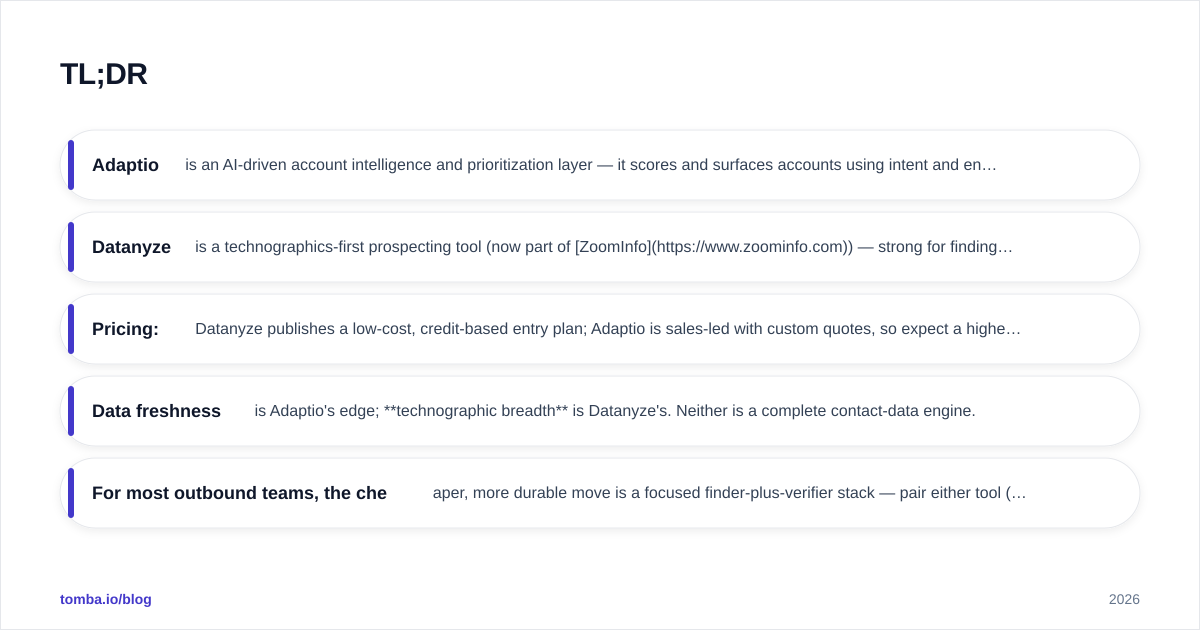
ZoomInfo](https://www.zoominfo.com)) — strong for finding companies by the software they use, lighter on real-time intent.
- Pricing: Datanyze publishes a low-cost, credit-based entry plan; Adaptio is sales-led with custom quotes, so expect a higher floor.
- Data freshness is Adaptio's edge; technographic breadth is Datanyze's. Neither is a complete contact-data engine.
- For most outbound teams, the cheaper, more durable move is a focused finder-plus-verifier stack — pair either tool (or neither) with Tomba's email finder for contact coverage.
What is Adaptio?#
Adaptio is a sales intelligence platform built around the idea that your CRM already holds more opportunity than your reps can see. Instead of handing you a fresh list of cold companies, it watches signals — site engagement, intent spikes, hiring changes, funding events — and ranks the accounts most likely to convert right now.
Think of it like a weather radar for your pipeline. The storm cells (in-market accounts) are already on the map; Adaptio just colors the ones about to hit so your reps stop guessing. Technically, it layers a scoring model over first-party and third-party signals and pushes prioritized accounts back into your workflow.
That makes Adaptio a prioritization tool first and a discovery tool second. It shines when you have volume and need triage, not when you're starting from an empty database.
What is Datanyze?#
Datanyze made its name on technographics — telling you which companies run Shopify, HubSpot, Salesforce, Marketo, or any of thousands of web technologies. If your product integrates with or replaces a specific tool, Datanyze lets you build a list of every company using it.
After its acquisition by ZoomInfo, Datanyze became the lightweight, self-serve entry point into that ecosystem: a Chrome extension that surfaces company and contact details as you browse, plus credit-based access to emails and direct dials. It's pitched at SDRs and small teams who want quick contact lookups without an enterprise contract.
The trade-off: Datanyze's data is broad but not always deep or fresh, and its intent capabilities are thinner than a dedicated signal platform like Adaptio.
Adaptio vs Datanyze: how do they compare?#
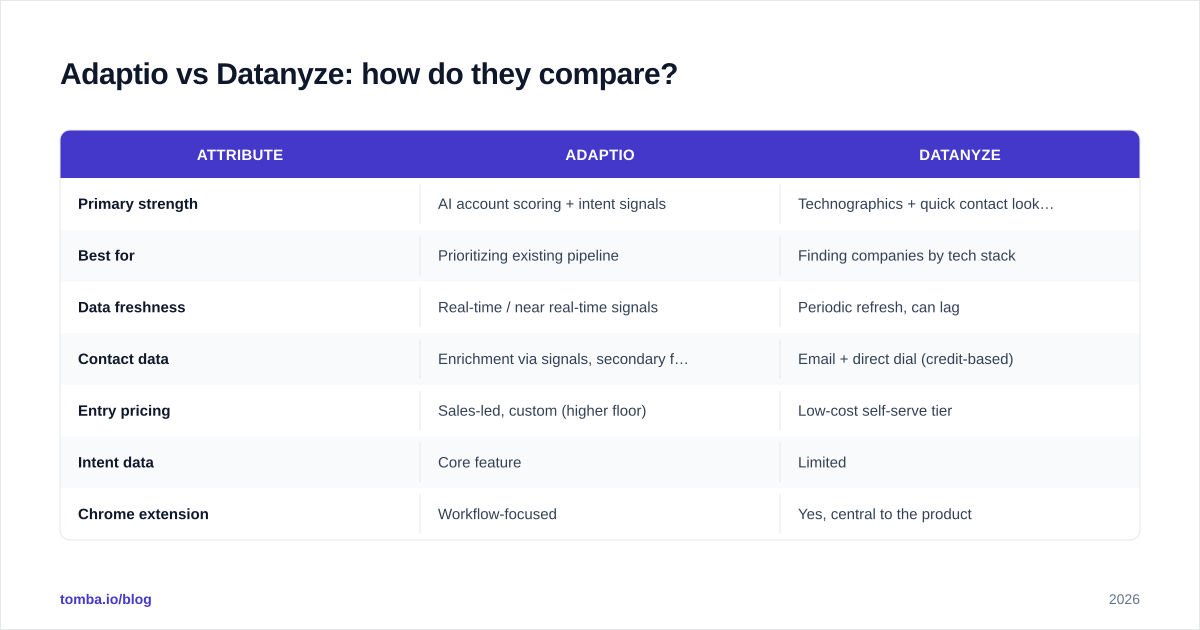
The honest summary: these tools sit at different stages of the funnel. Datanyze helps you build and discover lists; Adaptio helps you prioritize and time outreach against accounts you already track.
| Attribute | Adaptio | Datanyze |
|---|---|---|
| Primary strength | AI account scoring + intent signals | Technographics + quick contact lookups |
| Best for | Prioritizing existing pipeline | Finding companies by tech stack |
| Data freshness | Real-time / near real-time signals | Periodic refresh, can lag |
| Contact data | Enrichment via signals, secondary focus | Email + direct dial (credit-based) |
| Entry pricing | Sales-led, custom (higher floor) | Low-cost self-serve tier |
| Intent data | Core feature | Limited |
| Chrome extension | Workflow-focused | Yes, central to the product |
| Parent ecosystem | Independent | ZoomInfo |
| Learning curve | Steeper (model + setup) | Shallow, plug-and-play |
)
When Adaptio wins#
Pick Adaptio if you have a populated CRM, a defined ICP, and reps drowning in accounts they can't rank. The intent layer earns its keep when timing matters — renewals, competitive displacements, expansion plays. You're paying for signal, not raw records.
When Datanyze wins#
Pick Datanyze if discovery is your bottleneck and technographics are your wedge. "Show me every mid-market company running Magento in North America" is a Datanyze question, not an Adaptio one. The low entry price and browser-first workflow also make it friendly for solo founders and small SDR teams testing outbound.
How accurate and fresh is the data?#
This is where most buyers get burned, so be specific in your evaluation. Account-intelligence tools live or die on two things: coverage (do they have the accounts and contacts you need) and freshness (is the data current enough to act on).
Adaptio's pitch is freshness — signals are only useful if they're timely, so its model leans on recent activity. Datanyze's technographic data is broad but refreshes on a slower cadence, which means a "currently using X" flag can be weeks or months stale by the time you act.
Neither replaces a verification step. Bounced emails and dead direct dials tank sender reputation and waste rep hours regardless of which platform sourced the contact. Run every list through an email verifier before you load a sequence — it's the cheapest insurance in outbound.
When you compare vendors, don't trust the marketing-page accuracy claims. Pull a sample of 100 real target accounts, export contacts from each tool, and verify them independently. The vendor with the higher verified match rate wins, full stop. Third-party review sites like G2 and analyst coverage from Gartner are useful for directional sentiment, but your own sample test is the only number that matters.
How does pricing compare?#
Pricing philosophies differ sharply, and that difference tells you who each tool is built for.
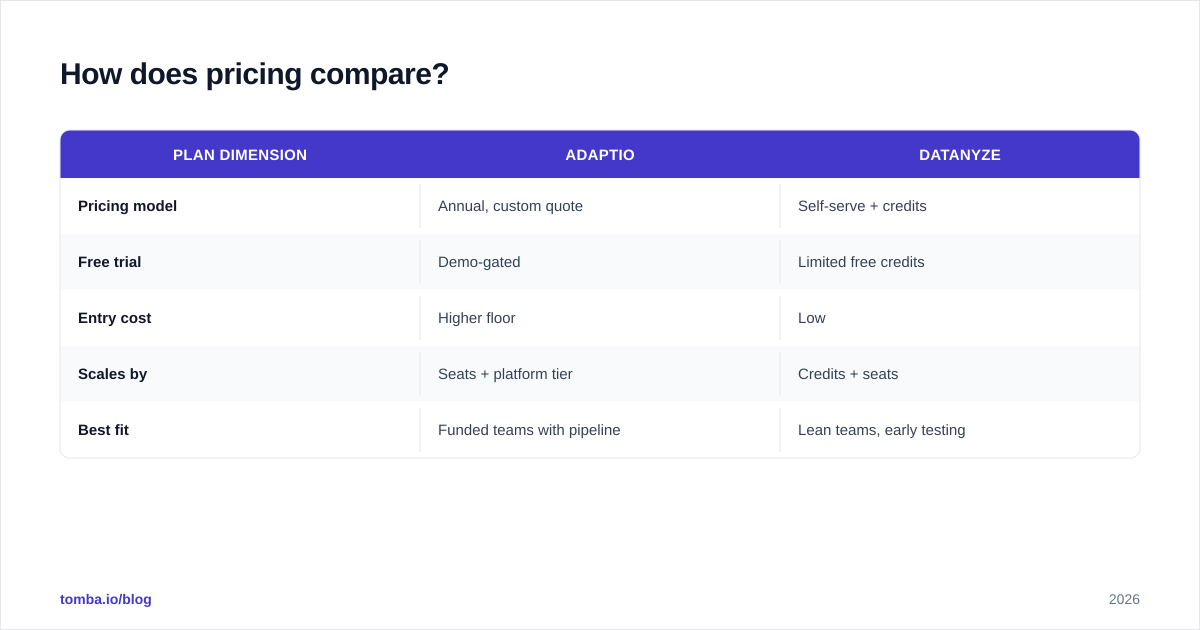
Datanyze leans transactional: a low published entry point with credit-based contact reveals. You can start cheap and scale credits as needed, which suits experimentation. Adaptio is sales-led — expect a demo, a custom quote, and a higher annual floor, because you're buying a platform and a model, not a la carte records.
| Plan dimension | Adaptio | Datanyze |
|---|---|---|
| Pricing model | Annual, custom quote | Self-serve + credits |
| Free trial | Demo-gated | Limited free credits |
| Entry cost | Higher floor | Low |
| Scales by | Seats + platform tier | Credits + seats |
| Best fit | Funded teams with pipeline | Lean teams, early testing |
A practical reality: many teams over-buy intelligence platforms and under-invest in clean contact data. You can spend five figures on intent signals and still fail because half your emails bounce. If budget is tight, a focused stack — a dedicated finder plus verification — often beats a single expensive suite. Compare the math against transparent Tomba pricing: a Free tier at 25 searches/month, Starter at $49/mo, Growth at $99/mo, and Pro at $249/mo, with the email finder, verifier, and data enrichment bundled rather than metered into oblivion.
Which should you choose?#
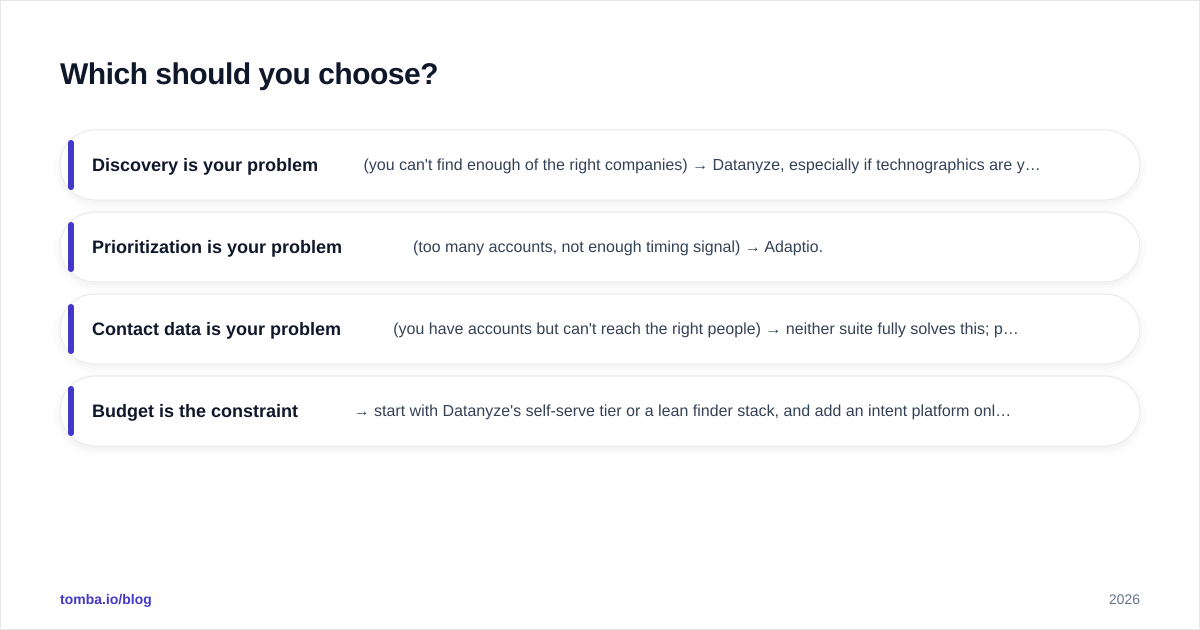
Match the tool to your actual bottleneck, not the flashiest feature list.
- Discovery is your problem (you can't find enough of the right companies) → Datanyze, especially if technographics are your targeting wedge.
- Prioritization is your problem (too many accounts, not enough timing signal) → Adaptio.
- Contact data is your problem (you have accounts but can't reach the right people) → neither suite fully solves this; pair with a dedicated finder and verifier.
- Budget is the constraint → start with Datanyze's self-serve tier or a lean finder stack, and add an intent platform only once volume justifies it.
A common winning setup looks like this: use domain search and an email finder to build and complete your contact lists, verify everything, and only layer an intent tool like Adaptio on top once you have enough pipeline that prioritization — not discovery — is the real constraint. Buying the prioritization layer before you have anything to prioritize is the most common money pit in this category.
What about data hygiene and deliverability?#
Whichever platform you pick, the contacts it gives you decay roughly 2-3% per month as people change jobs. That's not a vendor flaw; it's how B2B data works. The teams that win treat sourced data as a starting point, not gospel.
Three habits separate high-performing outbound teams:
- Verify before you send. Always. A 5% bounce rate is enough to damage domain reputation.
- Re-enrich on a schedule. Refresh stale records quarterly rather than trusting a one-time export.
- Track verified match rate, not raw volume. Ten thousand records mean nothing if only 4,000 are reachable.
This is exactly where a focused tool earns its place alongside — or instead of — a big suite. The signal is only as good as the email behind it.
The bottom line#
Adaptio and Datanyze solve different problems wearing similar marketing language. Adaptio is the better prioritization and timing engine; Datanyze is the better technographic discovery tool with a friendlier price. Most teams don't actually need to choose between them — they need clean, verified contact data first, and an intent layer second.
If your real gap is reaching the right people at your target accounts, start there. Tomba's email finder finds professional addresses by domain, name, or company, backs them with built-in verification, and enriches contacts without locking you into an enterprise contract — so you can spend on signal only after your outreach actually lands. Start free with 25 searches a month and add an intent platform when prioritization, not contact data, becomes your bottleneck.
Ready to find emails that actually work?
Join 150,000+ professionals who stopped guessing and started sending. Free credits on signup — no credit card required.
Get the Tomba newsletter
Practical outbound tactics and product updates — once every two weeks.
About the author