Adaptio vs Enrichley 2026: B2B Data Enrichment Compared
Adaptio and Enrichley both promise clean B2B contact data, but they win at different jobs. Here is the 2026 breakdown on accuracy, pricing, coverage, and fit.
Choosing between Adaptio and Enrichley usually comes down to one question: do you need wide contact coverage, or do you need data you can trust to send on without a second pass? Both platforms enrich B2B records — appending titles, emails, phone numbers, firmographics — but they optimize for different ends of that trade-off. This guide breaks down where each one wins, what they cost, and how to decide without a 30-day trial babysitting your CRM.
TL;DR#
- Adaptio leans toward breadth: large contact universe, aggressive auto-append, and a workflow-first UI built for RevOps teams that want enrichment baked into every CRM record automatically.
- Enrichley leans toward precision: tighter verification, real-time email validation, and clearer provenance on where each data point came from — better for outbound teams that pay for every bounce.
- On pricing, both gate the useful features behind mid-tier plans; neither has a generous free tier, so budget for at least a starter subscription.
- If your bottleneck is bounce rate and deliverability, precision beats volume — pair either tool with a dedicated verifier.
- Neither is a true email-finder replacement. For finding and verifying emails specifically, a focused tool like Tomba Email Finder often delivers better cost-per-valid-email.
What is Adaptio?#
Adaptio is a B2B data-enrichment platform aimed at revenue operations teams. Its pitch is automation: connect your CRM, define enrichment rules, and let Adaptio fill in missing fields on contacts and accounts as they enter the pipeline. It treats enrichment as an always-on background process rather than a manual lookup.
The strength here is operational. If you run a high-volume inbound motion and want every new lead to arrive with a job title, company size, industry, and technographic data already attached, Adaptio's rules engine handles that without anyone touching a spreadsheet. It positions itself in the same workflow category as revenue operations tooling — the data layer that feeds routing, scoring, and territory assignment.
The trade-off is that breadth-first databases carry more stale records. When a platform optimizes for "we have a row for almost everyone," some of those rows are two job changes out of date. Adaptio mitigates this with periodic refresh cycles, but you are trusting the refresh cadence rather than verifying at send time.
What is Enrichley?#
Enrichley is a B2B enrichment tool that markets accuracy and provenance as its core differentiators. Rather than appending the widest possible set of fields, it focuses on returning data points it can stand behind — with real-time verification on emails and, in higher tiers, source attribution so you can see why it believes a record is correct.
This makes Enrichley a better fit for outbound teams. When your cost model includes domain reputation and every hard bounce chips away at deliverability, a slightly smaller match rate of verified contacts beats a large match rate of maybe contacts. Enrichley's real-time email validation is the feature outbound SDRs notice first, because it directly maps to fewer bounces and a healthier sender score.
The cost of that precision is coverage. Enrichley will more often return "no confident match" where Adaptio returns a guess. For some teams that honesty is the point; for others it feels like gaps. Which camp you fall into depends entirely on whether a wrong data point costs you more than a missing one.
)
Let me restate that with a cleaner image reference:
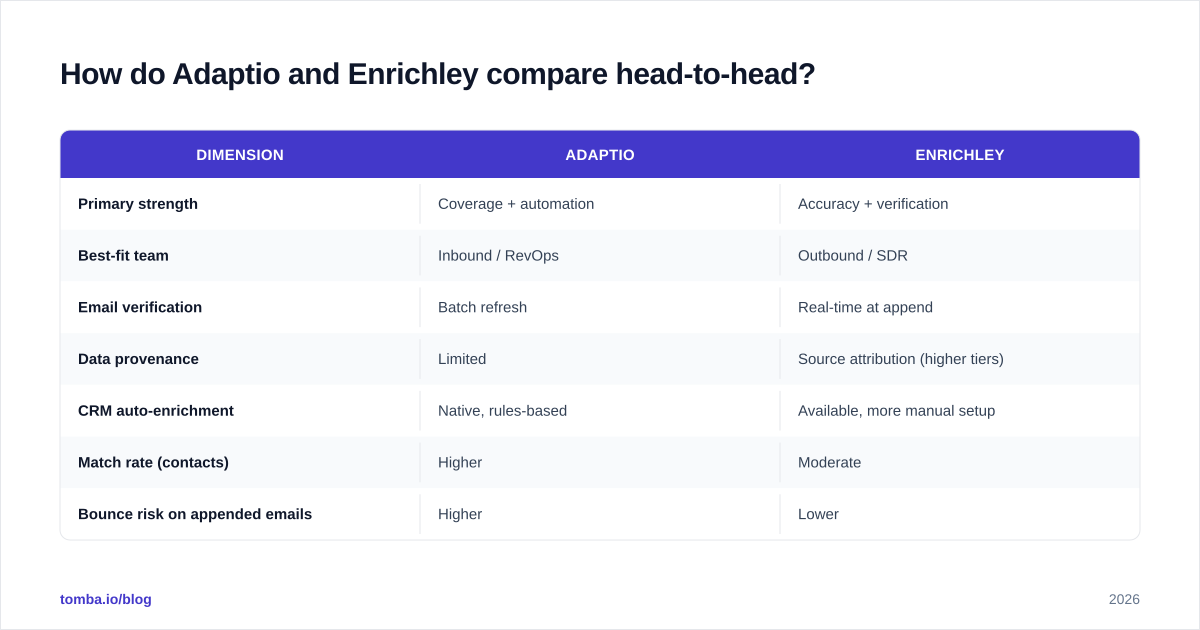
How do Adaptio and Enrichley compare head-to-head?#
Here is the practical breakdown across the dimensions that actually change a buying decision.
| Dimension | Adaptio | Enrichley |
|---|---|---|
| Primary strength | Coverage + automation | Accuracy + verification |
| Best-fit team | Inbound / RevOps | Outbound / SDR |
| Email verification | Batch refresh | Real-time at append |
| Data provenance | Limited | Source attribution (higher tiers) |
| CRM auto-enrichment | Native, rules-based | Available, more manual setup |
| Match rate (contacts) | Higher | Moderate |
| Bounce risk on appended emails | Higher | Lower |
| Starter cost | Mid-tier gate | Mid-tier gate |
| Free tier | Minimal | Minimal |
The pattern is consistent: Adaptio optimizes the fill rate of your database, Enrichley optimizes the trust of each field. Neither is wrong. A marketing ops team scoring inbound leads cares about fill rate because a missing industry field breaks routing. An outbound team cares about trust because a bad email breaks deliverability.
Which one is more accurate?#
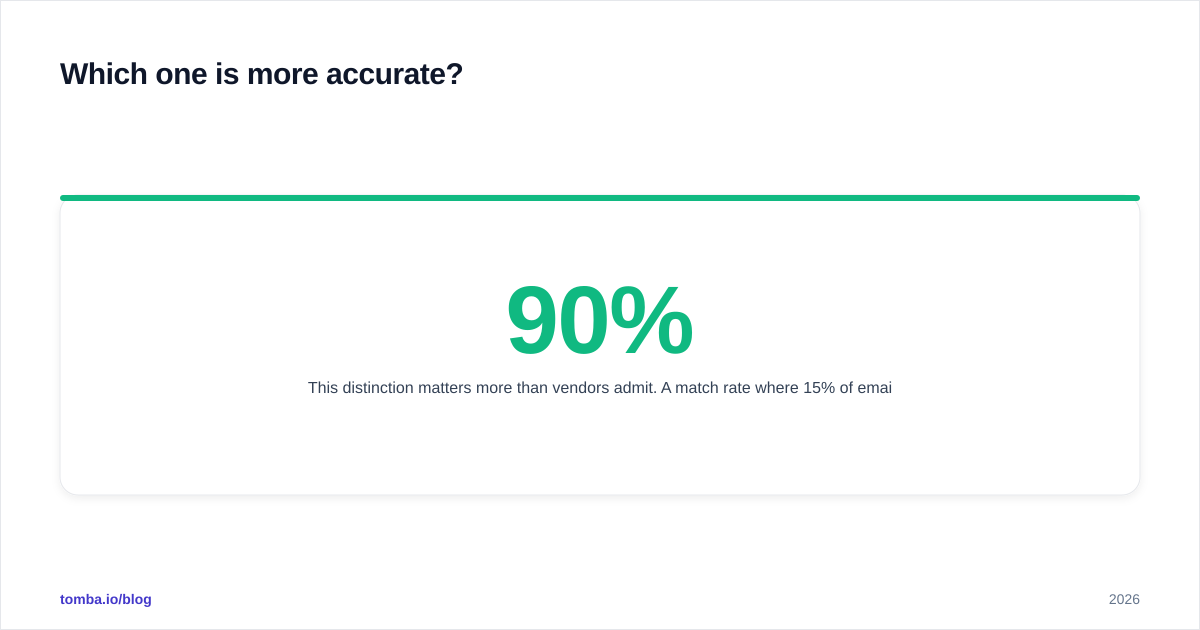
Accuracy depends on what you measure. If "accuracy" means "what percentage of records got enriched at all," Adaptio typically wins on raw match rate. If "accuracy" means "what percentage of the emails I sent actually landed," Enrichley's real-time verification gives it the edge.
This distinction matters more than vendors admit. A 90% match rate where 15% of emails bounce is worse for a cold-email program than a 70% match rate where 2% bounce — because bounces above roughly 3% start damaging your domain reputation and suppress the inbox placement of your good sends too. If you want the mechanics of that, the relationship between bounce rate and email deliverability is the single most underrated variable in outbound.
The honest takeaway: neither platform should be your only line of defense on email quality. Even with Enrichley's real-time check, running appended emails through a dedicated email verifier before a campaign catches catch-all domains and role accounts that generic enrichment passes over. The cost of a verification credit is a rounding error next to the cost of a throttled domain.
How does pricing compare for Adaptio vs Enrichley?#
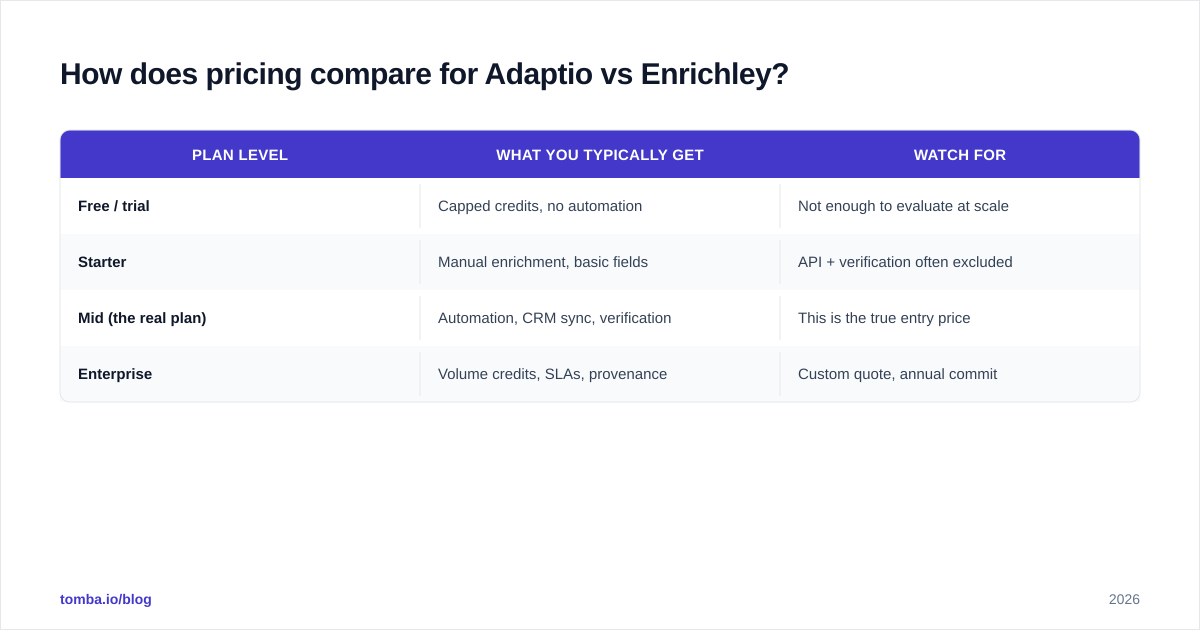
Both platforms follow the standard enrichment playbook: a thin free or trial tier, then a meaningful jump to the plan where the features you actually want live. The exact numbers shift, but the structure is what to plan around.
| Plan level | What you typically get | Watch for |
|---|---|---|
| Free / trial | Capped credits, no automation | Not enough to evaluate at scale |
| Starter | Manual enrichment, basic fields | API + verification often excluded |
| Mid (the real plan) | Automation, CRM sync, verification | This is the true entry price |
| Enterprise | Volume credits, SLAs, provenance | Custom quote, annual commit |
The mistake teams make is comparing free tiers. Both free tiers are demos, not products. Compare the mid tier — the one with automation and verification turned on — because that is what you will actually run. When you model it, calculate cost per usable record, not cost per credit. A cheaper credit that returns an unverified email is more expensive once you price in the bounce.
For reference, a focused email tool like Tomba prices transparently: a free tier with 25 searches per month, then Starter at $49/mo and Growth at $99/mo, scaling to Pro at $249/mo. You can see the full Tomba pricing breakdown without a sales call — a useful baseline when an enrichment vendor quotes you "custom."
)
Which integrates better with your stack?#
Adaptio's native, rules-based CRM enrichment is its standout integration feature. If you live in Salesforce or HubSpot and want enrichment to happen on record creation with zero human steps, Adaptio's automation is genuinely less work to set up. It is built for the "set it and forget it" RevOps motion.
Enrichley integrates with the same major CRMs but expects a bit more configuration to reach the same hands-off state. In exchange you get more control over when enrichment fires and which records qualify — useful if you want to spend credits only on leads that pass a scoring threshold rather than enriching everything indiscriminately.
A few integration questions worth answering before you commit:
- Does it write back to custom fields, or only standard ones?
- Can you gate enrichment by lead score or segment to control spend?
- Is there a real API for enriching outside the CRM, and what does it cost?
- Does bulk enrichment run as a background job or block your UI?
If your workflow is spreadsheet-heavy rather than CRM-native, check whether either tool offers a clean export path. Many teams end up wanting a bulk email finder or a Sheets-based workflow for ad-hoc list building, which neither pure-enrichment platform handles as gracefully as a dedicated finder.
Is Adaptio or Enrichley better for cold outbound?#
For cold outbound specifically, Enrichley's verification-first design is the safer default — but with a caveat. Outbound success is a chain: find the right person, get a valid email, write something worth reading, and land in the inbox. Enrichment tools only touch the first two links. They do not warm your domain, write your copy, or fix your sending infrastructure.
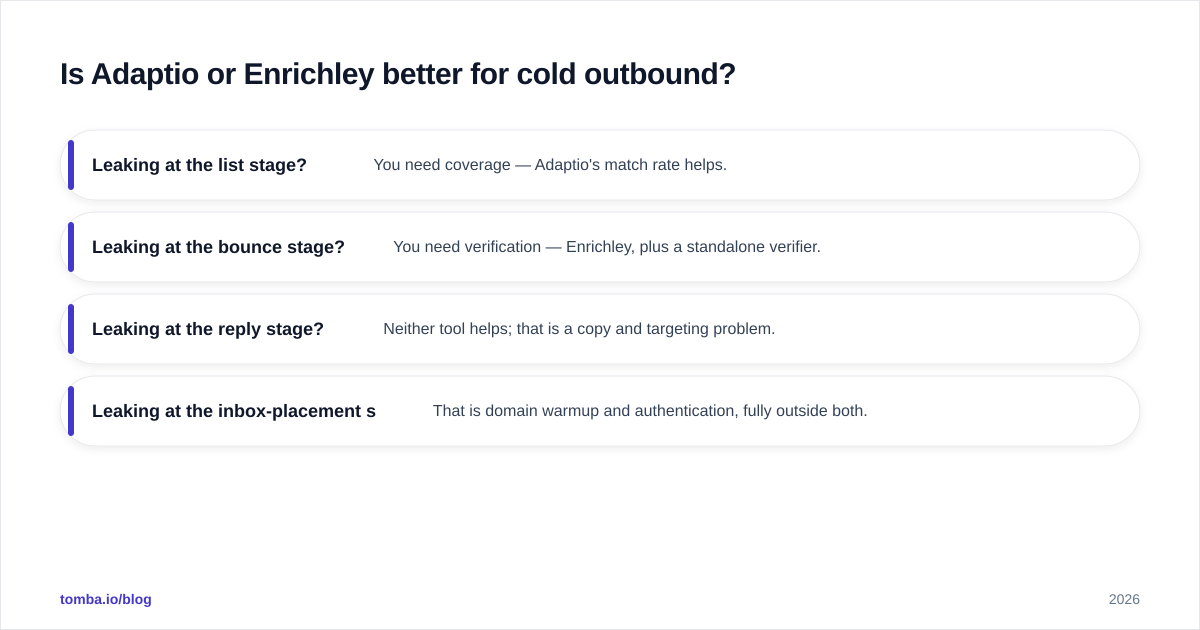
So the better question is not "which tool wins" but "where is my outbound actually leaking?" Map it honestly:
- Leaking at the list stage? You need coverage — Adaptio's match rate helps.
- Leaking at the bounce stage? You need verification — Enrichley, plus a standalone verifier.
- Leaking at the reply stage? Neither tool helps; that is a copy and targeting problem.
- Leaking at the inbox-placement stage? That is domain warmup and authentication, fully outside both.
Teams routinely buy a more expensive enrichment plan to fix a problem that lives three links down the chain. Diagnose before you upgrade. If your bounce rate is already under control, paying Enrichley's premium for verification you do not need is wasted spend; if it is not, Adaptio's coverage is a liability that quietly degrades your sender reputation.
Where do dedicated email finders fit in?#
Here is the part most head-to-head comparisons skip: for the specific job of finding and verifying a professional email, a purpose-built email finder usually beats a broad enrichment suite on cost-per-valid-email. Enrichment platforms charge for a bundle of fields; if all you need is the verified email and maybe a phone number, you are paying for firmographics and technographics you may not use.
This is where a tool like Tomba slots in alongside — or instead of — a full enrichment platform. Its core email finder, paired with a built-in verifier, domain search for mapping an entire company's contacts, and a catch-all verifier for the domains that trip up generic tools, covers the high-value 80% of what outbound teams actually pull from enrichment vendors. For independent benchmarking, sites like G2 and Capterra let you compare match rates and verified-email accuracy across categories before you commit budget.
The decision tree is simple:
- Need a 360° data layer feeding scoring and routing? A full enrichment platform (Adaptio or Enrichley) earns its keep.
- Mostly need verified emails and phones for outreach? A focused finder is cheaper and often more accurate on that one job.
- Need both? Use a finder for outbound list building and reserve enrichment credits for the firmographic depth your RevOps motion genuinely requires.
For the methodology behind how vendors source and refresh contact data — and why provenance matters — HubSpot's overview of data enrichment is a vendor-neutral primer worth a read before any purchase.
Verdict: which should you pick?#
Pick Adaptio if you run an inbound-heavy, RevOps-driven motion where automated, high-coverage enrichment on every CRM record removes manual work and feeds your routing and scoring. Its automation is the real product, and breadth is a feature when missing fields break your workflow.
Pick Enrichley if you run outbound and live and die by deliverability. Its real-time verification and provenance are worth the smaller match rate because, for you, a wrong email costs more than a missing one.
But before you sign either annual contract, audit what you actually pull from enrichment. If 80% of your usage is "find this person's verified email," you are overpaying. A focused tool gets you the same outbound-ready contacts at a lower cost-per-valid-email, and you can layer enrichment back in only where the firmographic depth pays for itself.
That is where Tomba fits best for outbound teams. Tomba Email Finder finds professional emails by name, domain, or company, verifies them in the same flow, and starts free with 25 searches a month — no sales call to test it. Run your next list through it, compare the verified-email cost against your enrichment bill, and let the bounce rate make the decision for you.
// get started
Find, verify and enrich your first contacts today
Start on the free plan with 25 searches a month, then scale when your team is ready.
Free plan · No credit card required · GDPR & CCPA
// about the author