Adaptio vs Extruct AI (2026): AI Company Research Compared
A neutral, hands-on breakdown of Adaptio vs Extruct AI in 2026 — how each AI research tool sources data, scales pipelines, and prices, plus where each one actually fits.
TL;DR
- Adaptio leans toward adaptive, signal-driven account scoring — it's built for teams that want AI to continuously re-rank and prioritize a target list as buying signals change.
- Extruct AI is an AI research agent for building and enriching company lists from natural-language criteria — strong when you need to construct a dataset that doesn't exist in a static database.
- Neither is an email finder. Both produce account- and company-level intelligence, so you still need a contact-level layer (like a dedicated email finder) to turn accounts into reachable people.
- Pick Extruct AI for net-new list building and custom research; pick Adaptio for ongoing prioritization of an existing pipeline.
- Budget, data freshness, and how much manual QA your team tolerates matter more than any single feature checkbox.
What are Adaptio and Extruct AI?#
Both Adaptio and Extruct AI sit in the AI-powered company research category — tools that use large language models to gather, structure, and score B2B account data instead of relying purely on a fixed, pre-scraped database.
The simplest analogy: a traditional B2B database is a library where every book is already on a shelf. An AI research agent is more like a research assistant you send into the stacks (and out onto the open web) to assemble a custom reading list on demand. That difference — pre-built versus assembled-on-request — is the heart of the adaptio vs extruct ai comparison.
- Adaptio focuses on adaptive prioritization. You feed it accounts and a definition of your ideal customer, and it continuously scores and re-ranks them as new signals appear (hiring, funding, tech changes, intent). The promise is that your rep always works the hottest account next.
- Extruct AI focuses on research and list construction. You describe the companies you want in plain language — "Series B fintechs in the EU using a specific payment stack" — and its agents go assemble and enrich that list column by column.
They overlap because both reduce manual research hours. They diverge on the core job: one keeps an existing list sharp, the other builds a list from scratch.
How do Adaptio and Extruct AI source their data?#
This is where the two tools differ most, and it's the question that should drive your decision.
Extruct AI is research-first. Its agents pull from the live web, company sites, and structured sources, then normalize the result into spreadsheet-style columns you define. The upside is coverage of long-tail and net-new companies that a static database hasn't indexed yet. The tradeoff is that agent-gathered data needs verification — any system reading the open web inherits the web's errors, so you'll want a QA pass before a list hits a sequence.
Adaptio is signal-first. It's less about discovering unknown companies and more about layering scoring signals onto accounts you already care about. Its value compounds over time as it watches your accounts and adjusts priority. That makes it weaker for cold, net-new discovery and stronger for "I have 5,000 accounts, tell me which 200 to call this week."
If you care about where B2B tools get their numbers and how that affects accuracy, our breakdown of data sources is a useful primer on the difference between scraped, contributed, and verified data.
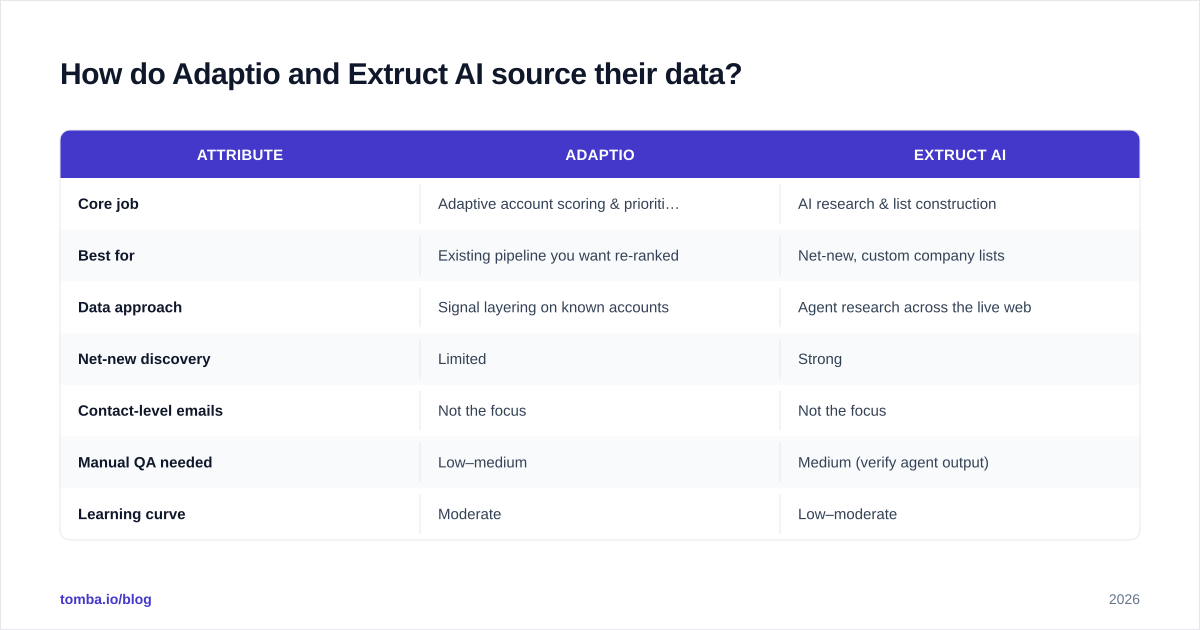
| Attribute | Adaptio | Extruct AI |
|---|---|---|
| Core job | Adaptive account scoring & prioritization | AI research & list construction |
| Best for | Existing pipeline you want re-ranked | Net-new, custom company lists |
| Data approach | Signal layering on known accounts | Agent research across the live web |
| Net-new discovery | Limited | Strong |
| Contact-level emails | Not the focus | Not the focus |
| Manual QA needed | Low–medium | Medium (verify agent output) |
| Learning curve | Moderate | Low–moderate |
| Typical buyer | RevOps / SDR leadership | Founders, growth, research teams |
Is Extruct AI better than Adaptio for list building?#
Yes — for genuinely net-new list building, Extruct AI is the stronger fit, and it's not especially close.
Extruct's whole design centers on turning a natural-language brief into a structured, enriched company list. If your target market is niche enough that no off-the-shelf database covers it well — emerging verticals, specific tech stacks, regional players — an AI research agent will out-cover a static list every time.
Adaptio can ingest and score a list, but it expects you to bring the list. It's optimized for the second half of the funnel of intent: deciding what to work, not finding what exists.
)
That said, "better at list building" is not "better overall." A freshly assembled Extruct list is raw material. Before it's usable you'll typically:
- Deduplicate entries (the same company under two names or domains).
- Verify firmographic claims that the agent inferred.
- Enrich to the contact level — turn each company into named decision-makers with valid emails and phone numbers.
That third step is the gap neither tool fully closes. This is where a dedicated data enrichment and domain search layer earns its place in the stack: it converts a company row into reachable humans.
Where does Adaptio win?#
Adaptio wins on sustained prioritization. If you already have a defined ICP and a pile of accounts, the daily question isn't "who exists?" — it's "who do I touch first today?" Adaptio's adaptive scoring is built precisely for that, and it keeps adjusting as signals shift.
Concretely, Adaptio tends to fit when:
- You run an outbound or ABM motion with a stable, large account list.
- You have RevOps maturity — someone to define signals, weight them, and trust the scoring.
- Your bottleneck is rep focus, not data discovery.
- You want prioritization that decays stale accounts automatically instead of letting reps chase cold logos.
It's the difference between a map (static) and a live navigation app that reroutes around traffic. For teams drowning in a big TAM, that rerouting is worth real money.
)
Adaptio vs Extruct AI: pricing and total cost#
Both vendors publish limited public pricing and lean on custom quotes for larger seats, which is common in this category. Rather than cite numbers that change quarterly, evaluate total cost across three axes:
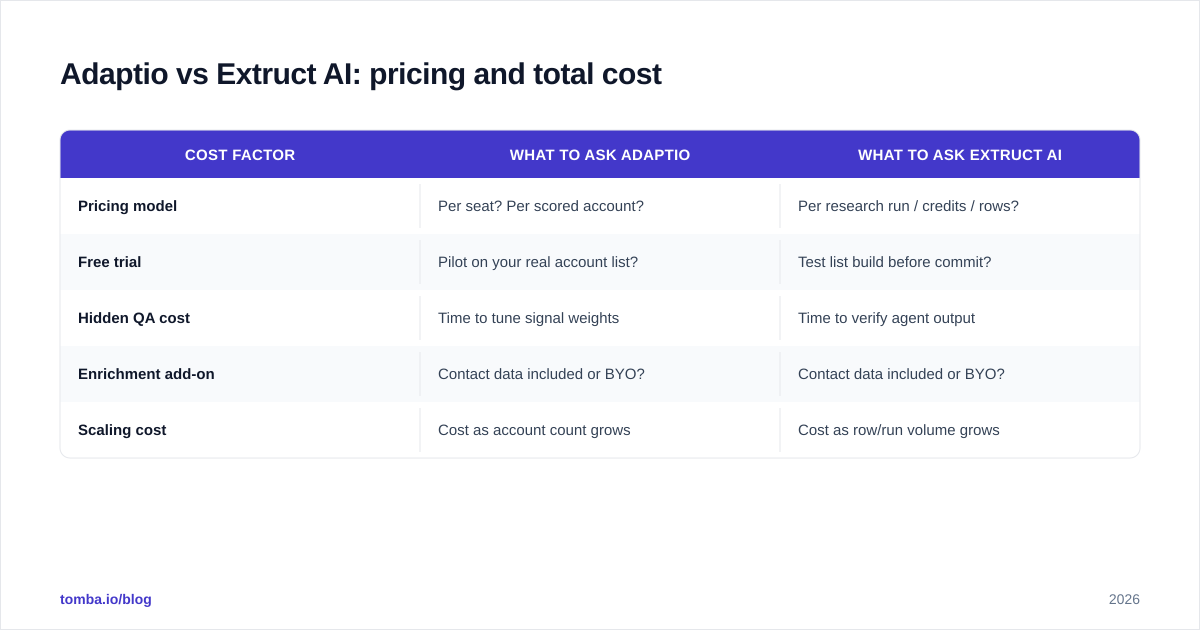
| Cost factor | What to ask Adaptio | What to ask Extruct AI |
|---|---|---|
| Pricing model | Per seat? Per scored account? | Per research run / credits / rows? |
| Free trial | Pilot on your real account list? | Test list build before commit? |
| Hidden QA cost | Time to tune signal weights | Time to verify agent output |
| Enrichment add-on | Contact data included or BYO? | Contact data included or BYO? |
| Scaling cost | Cost as account count grows | Cost as row/run volume grows |
Always check the current vendor pages and third-party reviews on G2 or Capterra before signing — and confirm pricing directly on each tool's homepage, since this category reprices often. Independent analyst coverage from a firm like Gartner is also worth a scan if you're a larger buyer running a formal evaluation.
The cost that surprises most teams isn't the subscription — it's the contact-data layer. Neither tool is primarily an email or phone provider, so factor in a verified contact source. Transparent, usage-based options like Tomba pricing (free tier at 25 searches/mo, Starter at $49/mo, Growth at $99/mo, Pro at $249/mo) keep that line item predictable instead of bundling it into an opaque enterprise quote.
Which one fits your GTM stack?#
Here's the decision in one paragraph, conclusion first: choose Extruct AI when your problem is "I don't have the list," and choose Adaptio when your problem is "I have the list but don't know what to work." Many mature teams end up wanting both jobs done — discovery and prioritization — and run one tool for each, or supplement with a broader B2B database underneath.
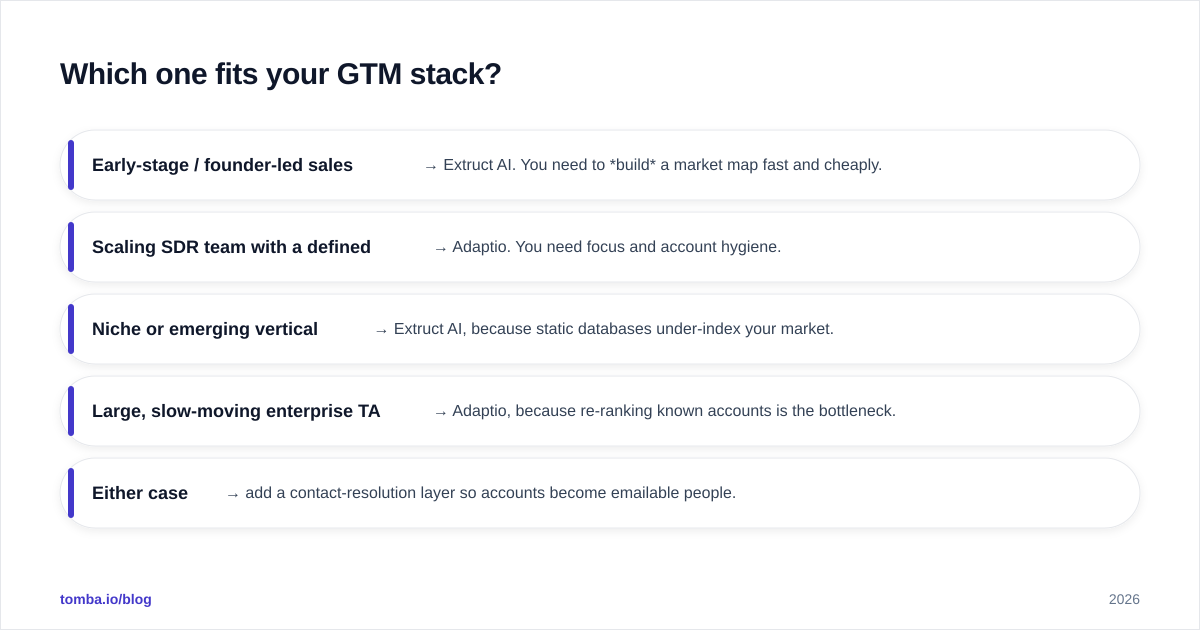
Map it to your actual constraint:
- Early-stage / founder-led sales → Extruct AI. You need to build a market map fast and cheaply.
- Scaling SDR team with a defined ICP → Adaptio. You need focus and account hygiene.
- Niche or emerging vertical → Extruct AI, because static databases under-index your market.
- Large, slow-moving enterprise TAM → Adaptio, because re-ranking known accounts is the bottleneck.
- Either case → add a contact-resolution layer so accounts become emailable people.
A quick gut check: if your last three "bad week" retros blamed list quality, lean Extruct. If they blamed rep prioritization or wasted dials on dead accounts, lean Adaptio.
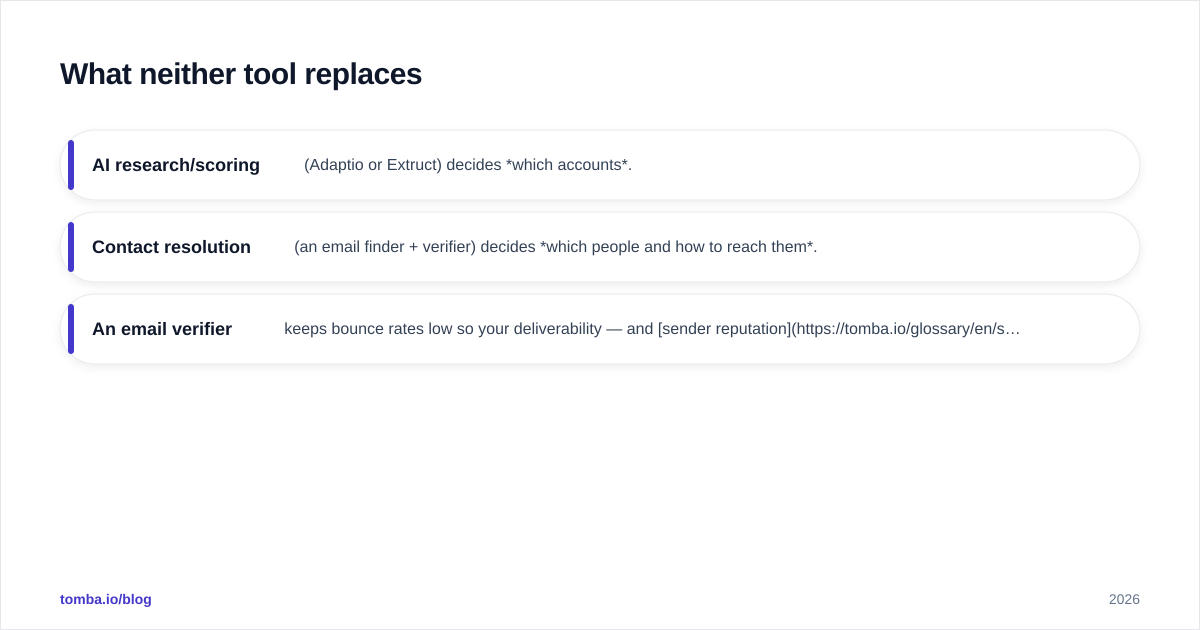
What neither tool replaces#
Both Adaptio and Extruct AI operate at the company level. Sales still happens at the person level. That handoff — from "here's an account that matters" to "here's the named VP of Engineering and her verified email" — is the step you must own regardless of which platform you buy.
That's why the most resilient 2026 stacks pair an AI research or scoring layer with a verification-grade contact layer:
- AI research/scoring (Adaptio or Extruct) decides which accounts.
- Contact resolution (an email finder + verifier) decides which people and how to reach them.
- An email verifier keeps bounce rates low so your deliverability — and sender reputation — survives the volume.
Skip the contact layer and you get beautifully prioritized accounts you can't actually email. Skip verification and you torch your domain reputation on bad addresses. The research layer and the contact layer are complements, not substitutes.
Frequently asked questions#
Is Adaptio or Extruct AI an email finder? Neither. They produce account- and company-level intelligence. To get verified business emails you pair them with a dedicated email finder and email verifier.
Can I use both Adaptio and Extruct AI together? Yes, and many teams do. Use Extruct AI to build and enrich a net-new list, then feed qualified accounts into Adaptio for ongoing prioritization. Just make sure your data flows are deduplicated before they merge.
How accurate is AI-agent-sourced data? It varies by source freshness and the specificity of your query. Agent-gathered data should always get a verification pass before outreach — especially anything that will drive a sequence or a dialer list.
Which is cheaper? It depends on volume model (accounts scored vs. research rows produced). Compare on total cost including the contact-data layer, not just the headline subscription.
The bottom line#
Adaptio and Extruct AI solve adjacent but distinct problems: Adaptio keeps a known pipeline sharp through adaptive scoring, while Extruct AI builds and enriches lists that don't exist yet. The right pick is whichever matches your current bottleneck — discovery or prioritization — and in practice, growing teams often want both.
Whichever you choose, the accounts they surface are only as valuable as your ability to reach the right person inside them. That's the layer Tomba is built for. Start with the Tomba Email Finder to turn any company on your target list into verified, decision-maker contacts — then verify before you send, protect your deliverability, and let your AI research stack focus on what it does best. Spin up the free tier (25 searches/mo) and connect it to the GTM tool you already use.
Ready to find emails that actually work?
Join 150,000+ professionals who stopped guessing and started sending. Free credits on signup — no credit card required.
Get the Tomba newsletter
Practical outbound tactics and product updates — once every two weeks.
About the author