Adaptio vs Fac Intelligence 2026: AI Sales Tools Compared
A neutral, side-by-side breakdown of Adaptio vs Fac Intelligence — how each AI sales platform handles signals, forecasting, and rep workflows, and which fits your GTM motion in 2026.
TL;DR
- Adaptio leans toward adaptive sales execution — surfacing next-best actions and coaching reps inside the deal as conditions change.
- Fac Intelligence leans toward forecast and account intelligence — turning scattered CRM and activity data into pipeline and revenue predictions.
- Neither tool finds or verifies contact data for you, so both sit downstream of your prospecting stack, not in place of it.
- Pick Adaptio if your bottleneck is rep behavior and deal velocity; pick Fac Intelligence if your bottleneck is forecast accuracy and account prioritization.
- Whichever you choose, the predictions are only as good as the data underneath — clean contacts and enriched accounts from a tool like Tomba are the foundation both platforms assume you already have.
If you are evaluating Adaptio vs Fac Intelligence, you are really asking a deeper question: where does your revenue team actually leak — in how reps execute, or in how leaders forecast? This guide answers that without pretending either tool is a silver bullet.
What are Adaptio and Fac Intelligence?#
Think of your revenue engine like a car. Adaptio is the driver-assist system — it watches the road in real time and nudges the rep ("brake here, take this exit, this deal is drifting"). Fac Intelligence is the dashboard and trip computer — it tells leadership how far you'll get on the fuel you have and which routes are most likely to arrive on time.
Technically, both belong to the AI sales technology category, but they solve different jobs:
- Adaptio is positioned around adaptive execution: ingesting deal activity, meeting data, and CRM stages to recommend next-best actions, flag at-risk opportunities, and coach reps mid-cycle.
- Fac Intelligence is positioned around revenue and account intelligence: aggregating first-party signals into pipeline forecasts, account scoring, and territory-level predictions for managers and RevOps.
Both assume you already have accounts in your CRM and contacts to work. Neither is a data enrichment or contact-discovery layer — they reason over data you feed them.
A quick honesty note: both are emerging platforms, and feature sets move fast. Treat the comparisons below as a decision framework rather than a frozen spec sheet, and confirm current capabilities directly with each vendor before you sign.
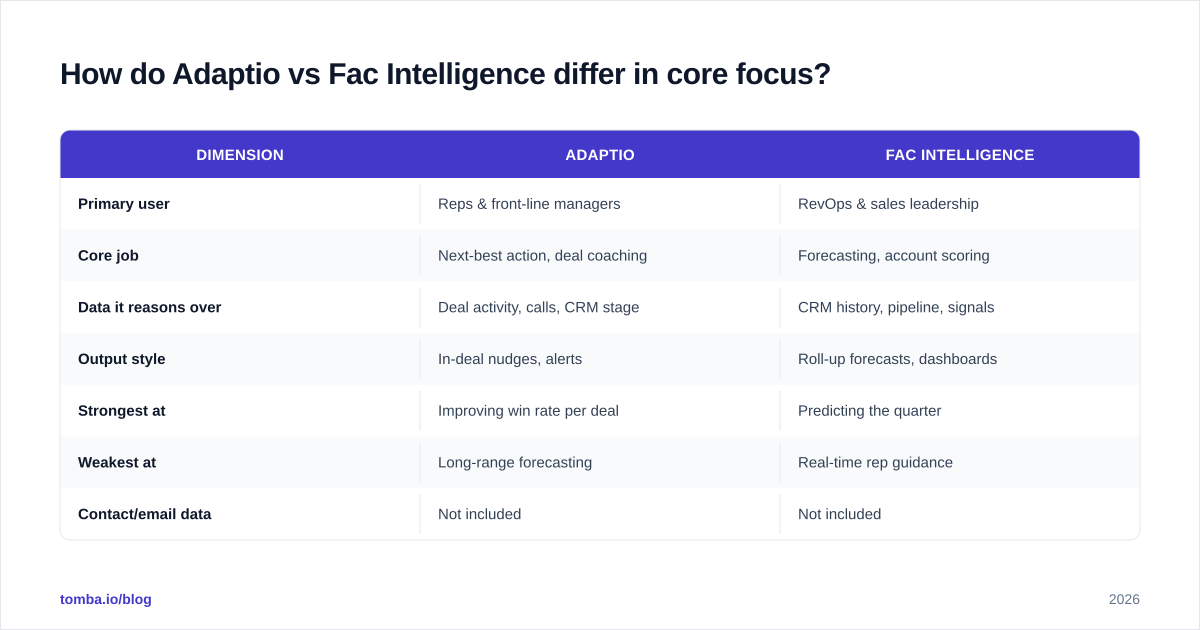
How do Adaptio vs Fac Intelligence differ in core focus?#
The cleanest way to separate them is by who they serve first.
| Dimension | Adaptio | Fac Intelligence |
|---|---|---|
| Primary user | Reps & front-line managers | RevOps & sales leadership |
| Core job | Next-best action, deal coaching | Forecasting, account scoring |
| Data it reasons over | Deal activity, calls, CRM stage | CRM history, pipeline, signals |
| Output style | In-deal nudges, alerts | Roll-up forecasts, dashboards |
| Strongest at | Improving win rate per deal | Predicting the quarter |
| Weakest at | Long-range forecasting | Real-time rep guidance |
| Contact/email data | Not included | Not included |
| Typical pricing model | Per-seat / quote-based | Platform + usage / quote-based |
The pattern: Adaptio optimizes the next move; Fac Intelligence predicts the final score. Some teams genuinely need both, layered. Most teams have one dominant pain and should solve that first.

If you can't articulate which row in that table keeps you up at night, you're not ready to buy either — you're ready to diagnose. That's a feature, not a failure.
Is Adaptio better than Fac Intelligence for rep productivity?#
For day-to-day rep productivity, Adaptio is the more natural fit — that's the lane it's built for.
Adaptive execution tools earn their keep when:
- Reps work many concurrent deals and lose track of which to push.
- Deal slippage is silent until the forecast call, when it's too late.
- Onboarding ramp is slow because tribal "what to do next" knowledge isn't codified.
Adaptio's value proposition is compressing that judgment into prompts the rep sees inside their workflow. Done well, it raises your win rate by catching stalls early and standardizing how your best reps behave.
Fac Intelligence can surface rep-level insight, but it does so from the manager's altitude — "this rep's pipeline is inflated" rather than "send this follow-up today." That's coaching ammunition, not in-the-moment execution.
Verdict: if your reps are busy but un-directed, Adaptio addresses the symptom more directly.
Is Fac Intelligence better than Adaptio for forecasting?#
Yes — forecasting is Fac Intelligence's home turf.
Accurate forecasting is a different discipline from deal coaching. It requires modeling historical conversion, deal-age decay, seasonality, and signal strength across the whole book — not just the deal in front of a rep. Fac Intelligence is architected for that roll-up: it weights opportunities, scores accounts, and produces a defensible number leadership can take to the board.
This matters more than teams admit. A sales org that consistently misses forecast by 20% has a credibility problem with finance long before it has a pipeline problem. If that's you, the ROI of better prediction is immediate and measurable.
Adaptio's forecasting, by contrast, tends to be a byproduct of its deal-level view rather than a purpose-built engine. It can tell you a deal looks shaky; it's less suited to telling the CFO what Q3 lands at with a confidence interval.
For deeper context on how forecasting fits the broader operating model, the discipline of revenue operations is worth understanding before you pick a tool — RevOps maturity determines whether either platform's output gets acted on.
What do Adaptio vs Fac Intelligence cost?#
Both follow the typical enterprise-AI pattern: quote-based, seat- or usage-influenced pricing, with limited public list prices. Expect to negotiate based on seat count, data volume, and CRM integration depth.
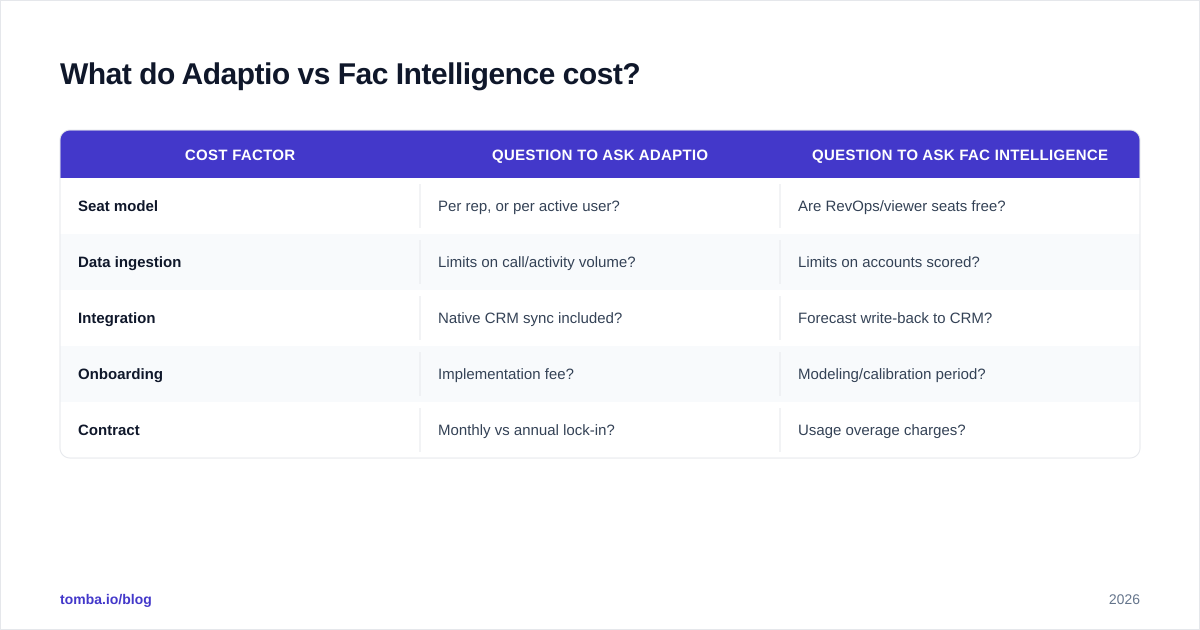
Because neither vendor publishes a clean self-serve tier the way email tools do, treat any number you hear secondhand with skepticism and get it in writing. A practical evaluation checklist:
| Cost factor | Question to ask Adaptio | Question to ask Fac Intelligence |
|---|---|---|
| Seat model | Per rep, or per active user? | Are RevOps/viewer seats free? |
| Data ingestion | Limits on call/activity volume? | Limits on accounts scored? |
| Integration | Native CRM sync included? | Forecast write-back to CRM? |
| Onboarding | Implementation fee? | Modeling/calibration period? |
| Contract | Monthly vs annual lock-in? | Usage overage charges? |
The cheapest tool is the one your team actually adopts. A powerful forecasting engine nobody trusts is more expensive than a simpler one reps and leaders both use.
Where do email finders and data tools fit alongside Adaptio or Fac Intelligence?#
This is the gap most buyers miss: both Adaptio and Fac Intelligence are reasoning engines, not data sources. They predict and prescribe on top of records you already have. If those records are thin, stale, or missing decision-makers, the AI inherits the garbage.
Garbage in, confident garbage out — arguably worse than no tool, because a polished forecast built on bad data feels trustworthy when it isn't.
That's where a dedicated discovery and enrichment layer sits in front of either platform:
- Use an email finder to attach verified contacts to the accounts your AI is scoring.
- Use data enrichment to fill firmographics and role data so account scores reflect reality.
- Pipe it all through an email finder API so enrichment runs automatically as new accounts land, instead of as a manual cleanup chore.
In other words, Adaptio and Fac Intelligence answer "what should we do and what will happen?" — but only after a tool like Tomba has answered "who are we even talking to, and is the contact real?"
Which should you choose: Adaptio vs Fac Intelligence?#
Decide by naming your dominant bottleneck, then match it:
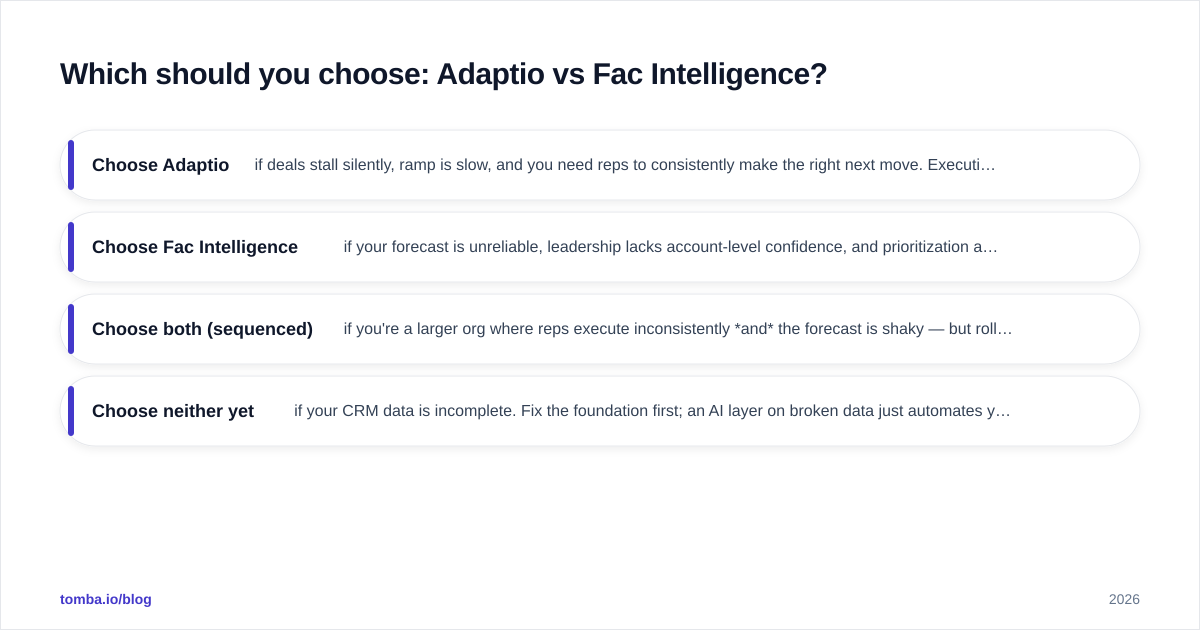
- Choose Adaptio if deals stall silently, ramp is slow, and you need reps to consistently make the right next move. Execution is your gap.
- Choose Fac Intelligence if your forecast is unreliable, leadership lacks account-level confidence, and prioritization across the book is the problem. Prediction is your gap.
- Choose both (sequenced) if you're a larger org where reps execute inconsistently and the forecast is shaky — but roll out one first, prove value, then layer the second.
- Choose neither yet if your CRM data is incomplete. Fix the foundation first; an AI layer on broken data just automates your mistakes.
A useful sanity check from analyst communities like G2 and Gartner is to read reviews filtered by company size and motion similar to yours. A tool that thrills a 500-rep enterprise can drown a 12-person team in setup, and vice versa. Vendor demos show the happy path; peer reviews show the Tuesday-afternoon reality.
How do you evaluate Adaptio vs Fac Intelligence in a trial?#
Don't evaluate on feature lists — evaluate on whether the tool changes a decision you'd otherwise make wrong.
A focused 30-day test:
- Baseline first. Record your current forecast accuracy and average deal cycle before the tool touches anything. No baseline, no proof.
- Feed it real data. Connect a live CRM segment, not a sandbox. AI tools shine or fail on the messiness of production data.
- Pick one metric per tool. For Adaptio, track win rate or cycle time on coached deals vs a control group. For Fac Intelligence, track forecast error across two cycles.
- Check the workflow tax. If reps have to leave their flow to get Adaptio's nudge, adoption dies. If RevOps has to babysit Fac Intelligence's model, trust erodes.
- Audit the data dependency. Note every place the tool's output got worse because a contact or account record was missing — that's your enrichment to-do list, and it's why a B2B database and verification layer matter.
The winner is the tool whose recommendation you'd have missed on your own, delivered where you'd actually act on it. Everything else is dashboard theater.

The bottom line on Adaptio vs Fac Intelligence#
There's no universal winner in Adaptio vs Fac Intelligence — there's only the right fit for your specific leak. Adaptio sharpens execution at the deal level; Fac Intelligence sharpens prediction at the portfolio level. Match the tool to the bottleneck that actually costs you revenue, and ignore the one that doesn't.
But remember what both quietly assume: that the accounts and contacts they reason over are real, current, and complete. That assumption is where most AI-sales rollouts silently break.
Before you spend on an AI reasoning layer, fix the data it reasons over. Tomba's Email Finder finds and verifies professional email addresses by name, domain, or company — so the pipeline Adaptio coaches and the forecast Fac Intelligence predicts are built on contacts that actually exist. Start free with 25 searches a month, scale to paid plans from $49/mo, and give your sales AI something true to think about. See Tomba pricing to match a plan to your team's volume.
// get started
Find, verify and enrich your first contacts today
Start on the free plan with 25 searches a month, then scale when your team is ready.
Free plan · No credit card required · GDPR & CCPA
// about the author