Adaptio vs Fintrx 2026: Wealth Data Platform Comparison
A neutral, side-by-side breakdown of Adaptio vs Fintrx for private-wealth prospecting — data coverage, workflows, pricing models, and which fits your GTM motion in 2026.
Choosing between Adaptio and Fintrx usually comes down to one question: are you selling into private wealth, or building a prospecting motion around it? Both platforms promise clean, structured intelligence on high-net-worth individuals, family offices, RIAs, and the advisors who serve them. They get there differently.
This is a neutral teardown. No vendor wrote it. Where one tool is clearly stronger for a use case, we say so — and where the honest answer is "it depends on your pipeline," we say that too.
TL;DR#
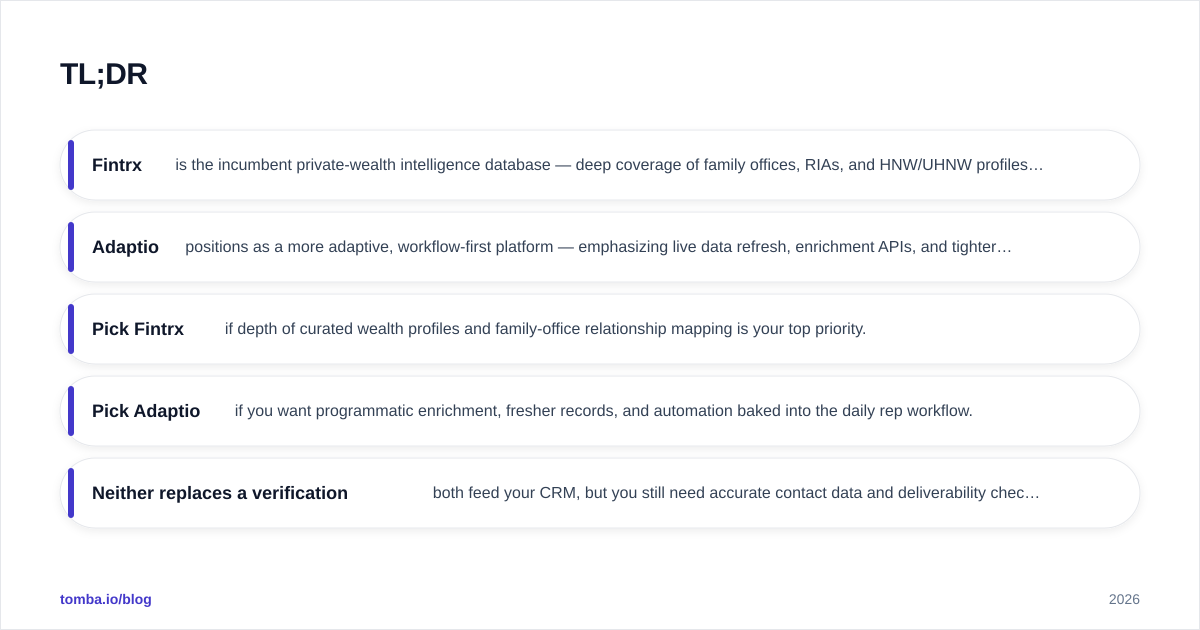
- Fintrx is the incumbent private-wealth intelligence database — deep coverage of family offices, RIAs, and HNW/UHNW profiles, built for asset managers and fintech firms that prospect into wealth.
- Adaptio positions as a more adaptive, workflow-first platform — emphasizing live data refresh, enrichment APIs, and tighter CRM hand-off rather than a static directory.
- Pick Fintrx if depth of curated wealth profiles and family-office relationship mapping is your top priority.
- Pick Adaptio if you want programmatic enrichment, fresher records, and automation baked into the daily rep workflow.
- Neither replaces a verification layer — both feed your CRM, but you still need accurate contact data and deliverability checks before you send.
What problem do Adaptio and Fintrx actually solve?#
Think of these tools as the difference between a phone book and a CRM that updates itself. Both categories help you reach the right people — but a directory hands you a snapshot, while a workflow platform tries to keep that snapshot current and pipe it where you work.
Adaptio and Fintrx both sit in the B2B data and intelligence layer of a go-to-market stack. Their job is to answer three questions before a rep ever drafts an email:
- Who controls the capital (the family office, RIA, or HNW individual)?
- What is the relationship map around them (advisors, gatekeepers, prior firms)?
- How do you reach the decision-maker without burning credibility?
Fintrx built its reputation on the first two. It maintains one of the larger curated databases of private-wealth entities, and its strength is relationship intelligence — who advises whom, which family office backs which deal. Adaptio leans into the third question, treating contact data as something to be enriched and validated continuously rather than looked up once.
How do Adaptio and Fintrx compare head-to-head?#
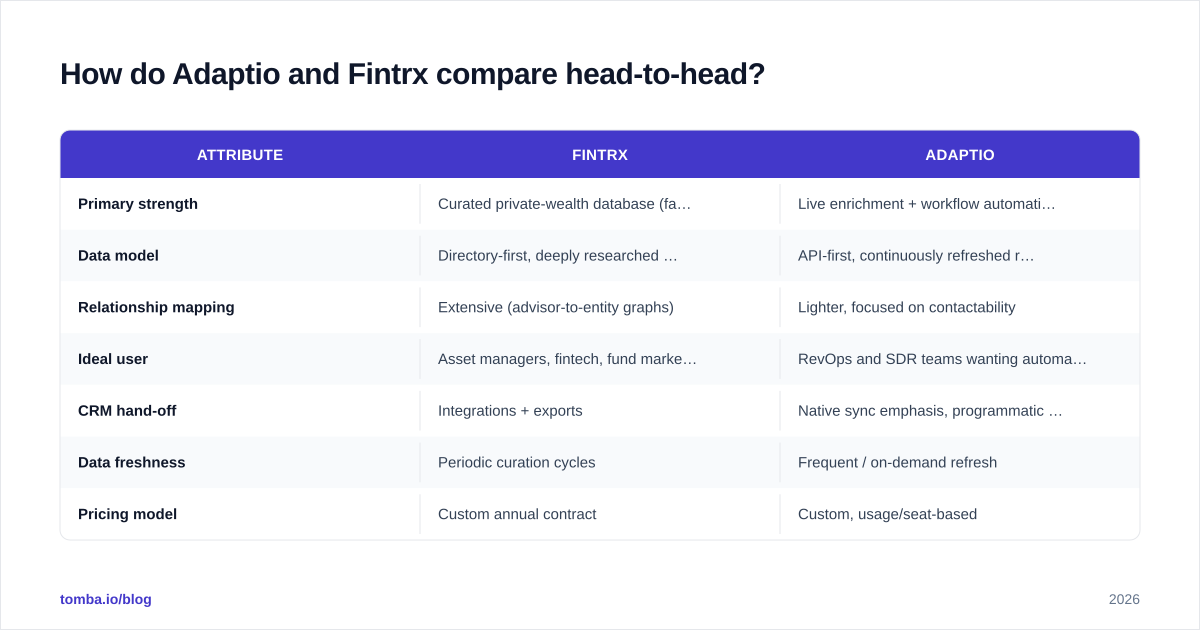
Here is the practical breakdown. Both vendors quote enterprise pricing rather than publishing public tiers, so the pricing row reflects model, not a fixed number.
| Attribute | Fintrx | Adaptio |
|---|---|---|
| Primary strength | Curated private-wealth database (family offices, RIAs, HNW/UHNW) | Live enrichment + workflow automation |
| Data model | Directory-first, deeply researched profiles | API-first, continuously refreshed records |
| Relationship mapping | Extensive (advisor-to-entity graphs) | Lighter, focused on contactability |
| Ideal user | Asset managers, fintech, fund marketers selling into wealth | RevOps and SDR teams wanting automated prospecting |
| CRM hand-off | Integrations + exports | Native sync emphasis, programmatic API |
| Data freshness | Periodic curation cycles | Frequent / on-demand refresh |
| Pricing model | Custom annual contract | Custom, usage/seat-based |
| Learning curve | Moderate (research-heavy UI) | Lower (workflow-oriented) |
| Best for | Depth of wealth intelligence | Speed and automation |
The pattern is consistent: Fintrx optimizes for how much it knows, Adaptio for how fast it moves. Neither is wrong — they reflect different buyers.
Is Fintrx better than Adaptio for data depth?#
Yes — if depth means breadth and richness of curated wealth profiles, Fintrx generally wins. Its core asset is a researched database of family offices and registered investment advisors, with attributes you rarely find scraped: assets under management bands, investment preferences, key principals, and the advisor relationships that connect them.
For a fund marketer trying to map which single-family offices have historically allocated to private credit, that relationship graph is the product. You are not just buying contacts; you are buying context.
The trade-off is freshness and friction. Curated databases update on research cycles, and a contact that was accurate last quarter may have moved firms. That is the structural weakness of any directory-first model, and it is exactly the gap Adaptio targets.
Is Adaptio better than Fintrx for workflow and automation?#
For teams that live in their CRM and sequence tools, Adaptio's workflow-first design tends to win. Instead of treating the database as a destination you log into, Adaptio frames data as something that flows — enriched on trigger, synced to your pipeline, validated before it reaches a rep's queue.
This matters for revenue operations teams that measure success in records-per-rep-per-day. A platform that pushes fresh, deduplicated contacts into Salesforce or HubSpot automatically removes the copy-paste tax that kills SDR throughput.
The honest caveat: automation amplifies whatever data quality you start with. If Adaptio's wealth-entity coverage is thinner than Fintrx's in your niche, faster syncing of thinner data does not help. Evaluate coverage in your segment before you fall in love with the automation.
What about contact accuracy and deliverability?#
This is where most wealth-data evaluations go wrong: buyers obsess over profile depth and ignore whether the email actually lands. A perfect family-office profile with a stale email is a bounce waiting to happen.
Both Adaptio and Fintrx are intelligence layers. Neither was built primarily as a contact-verification engine, and both will hand you addresses that need a second check before a campaign. That is not a knock — it is the category. The fix is to run platform-sourced contacts through a dedicated verification step.
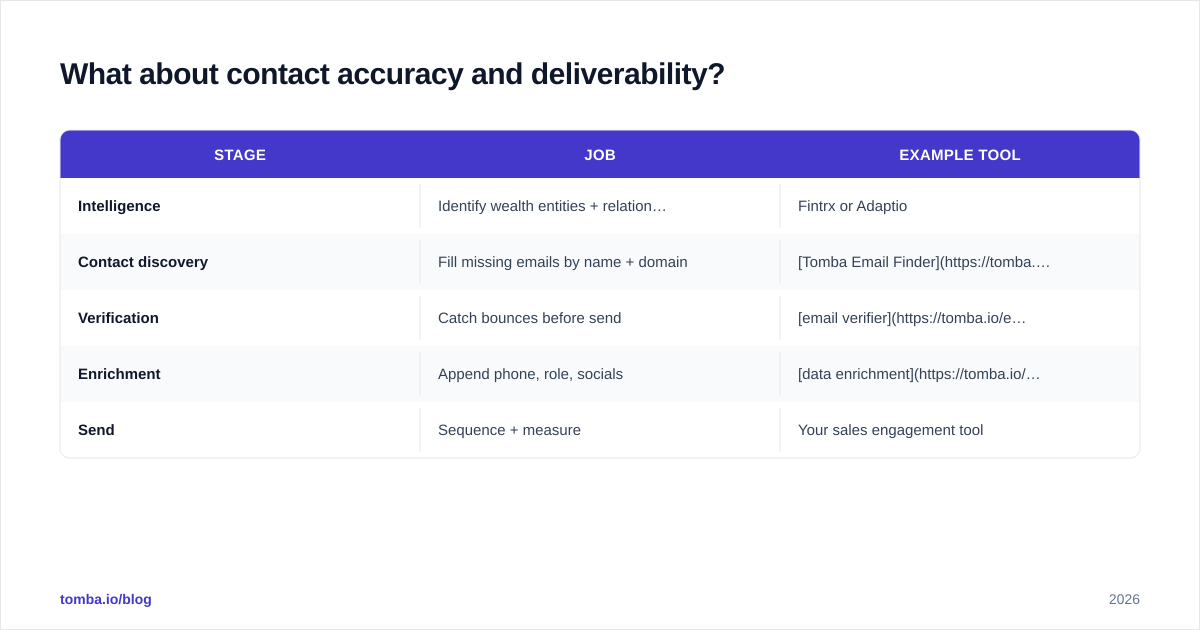
A typical clean stack looks like this:
| Stage | Job | Example tool |
|---|---|---|
| Intelligence | Identify wealth entities + relationships | Fintrx or Adaptio |
| Contact discovery | Fill missing emails by name + domain | Tomba Email Finder |
| Verification | Catch bounces before send | email verifier |
| Enrichment | Append phone, role, socials | data enrichment |
| Send | Sequence + measure | Your sales engagement tool |
Wiring a verification and discovery layer in front of your send protects sender reputation and keeps your domain out of spam folders. For high-value, low-volume wealth outreach, one bad bounce list can cost you a quarter of deliverability.
Which integrates better with your existing stack?#
Integration is a tie that breaks on philosophy. Fintrx supports the exports and connectors most teams expect, but its center of gravity is the platform UI — you go to Fintrx to do research. Adaptio's API-first stance means it wants to disappear into your workflow, surfacing data inside the tools you already use.
If your team's daily home is a CRM and a sequencer, Adaptio's model reduces context-switching. If your team runs deliberate research sprints before a fundraise or campaign, Fintrx's dedicated environment is an advantage, not a cost.
Either way, plan for the connective tissue. Both can feed a pipeline through a B2B database workflow or be augmented with a bulk email finder run when you export a target list and need to fill contact gaps at scale.
Adaptio vs Fintrx: pros and cons#
Fintrx — pros
- Deep, researched private-wealth coverage
- Strong family-office and RIA relationship mapping
- Trusted by asset managers and fund marketers
- Rich qualitative attributes (AUM bands, preferences)
Fintrx — cons
- Curation cycles mean some records lag reality
- Research-heavy UI has a steeper learning curve
- Less automation-native than newer entrants
Adaptio — pros
- Workflow-first, API-driven design
- Fresher, continuously refreshed records
- Lower friction for SDR/RevOps day-to-day
- Cleaner CRM hand-off
Adaptio — cons
- Newer entrant; coverage depth varies by niche
- Lighter relationship-graph intelligence
- Automation amplifies any data-quality gaps
How should you choose between Adaptio and Fintrx?#
Match the tool to your motion, not the feature list.
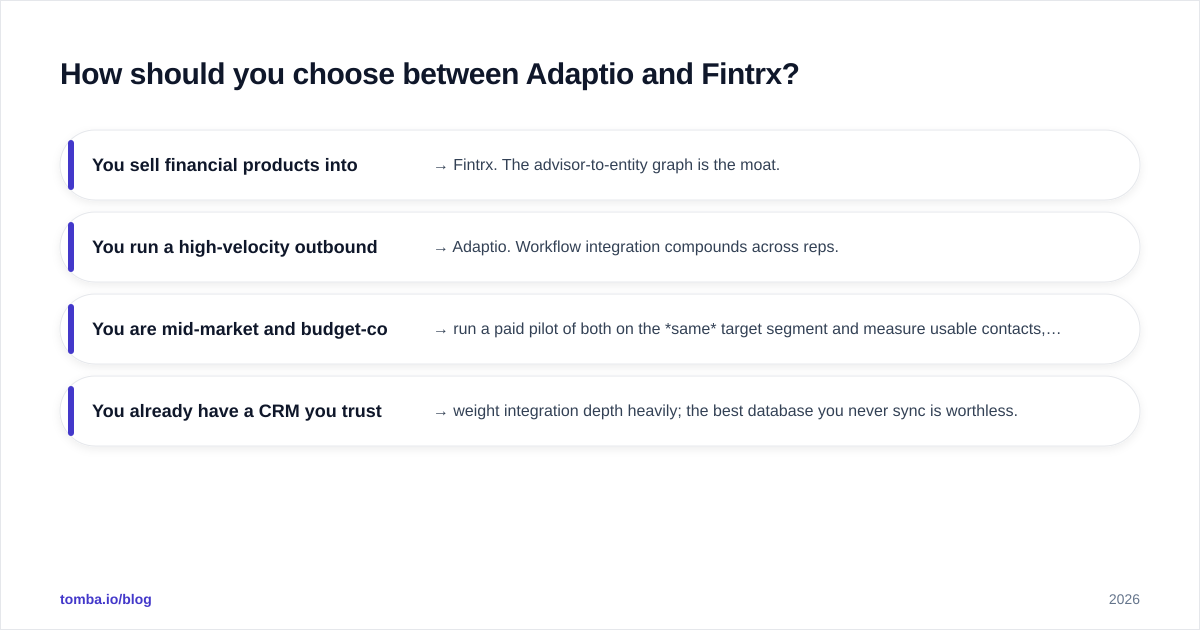
- You sell financial products into wealth and need relationship context → Fintrx. The advisor-to-entity graph is the moat.
- You run a high-velocity outbound team and want automation → Adaptio. Workflow integration compounds across reps.
- You are mid-market and budget-constrained → run a paid pilot of both on the same target segment and measure usable contacts, not total records.
- You already have a CRM you trust → weight integration depth heavily; the best database you never sync is worthless.
Whichever you pick, validate vendor claims against your own list. Ask each for a sample export covering 100 entities in your exact niche, then measure how many contacts survive verification. That single test predicts campaign performance better than any feature matrix — including this one. You can sanity-check vendor accuracy claims against third-party reviews on G2 and review Fintrx's own positioning on fintrx.com before you commit to an annual contract.
For context on the buyer category itself, the concept of the family office is worth understanding — it shapes how both platforms structure their data.
The bottom line#
Fintrx is the depth play; Adaptio is the velocity play. If your edge is knowing wealth relationships nobody else maps, Fintrx earns its contract. If your edge is moving fast with clean, synced data, Adaptio fits the daily grind better. Most teams overvalue raw record counts and undervalue the verification layer that decides whether those records ever reach an inbox.
Wherever your intelligence comes from, make the last mile accurate. Use the Tomba Email Finder to fill the contact gaps your wealth-data platform leaves behind — find verified professional emails by name and domain, append them with data enrichment, and run a verification pass before you send. Start free with 25 searches a month, and see Tomba pricing when you're ready to scale your outreach without burning deliverability.
Ready to find emails that actually work?
Join 150,000+ professionals who stopped guessing and started sending. Free credits on signup — no credit card required.
Get the Tomba newsletter
Practical outbound tactics and product updates — once every two weeks.
About the author