Adaptio vs Gazelle (2026): AI Sales Coaching Tools Compared
A neutral, hands-on breakdown of Adaptio vs Gazelle in 2026 — how the two AI sales platforms differ on coaching, data, pricing model, and best-fit team size.
Choosing between Adaptio and Gazelle usually comes down to one question: do you want an AI platform that coaches reps in the moment, or one that scores and forecasts the pipeline behind them? Both promise to make sellers more effective with AI, but they solve different halves of the same problem.
This is a neutral buyer's comparison. No vendor paid for placement here, and where pricing isn't public we say so instead of inventing a number. The goal is to help you match the tool to your team — not to crown a universal winner.
TL;DR#
- Adaptio leans toward real-time, adaptive seller guidance — surfacing next-best-actions and coaching cues during live deals.
- Gazelle leans toward pipeline intelligence — scoring deals, flagging risk, and tightening forecast accuracy for managers and RevOps.
- Both are AI-first and integrate with your CRM; neither replaces clean contact data, which they consume rather than create.
- Pricing for both is quote-based (no transparent self-serve tier published as of 2026), so total cost depends on seat count and modules.
- Pick Adaptio if you're scaling a rep team and want enablement at the point of action; pick Gazelle if your pain is forecast reliability and deal inspection.
What are Adaptio and Gazelle?#
Both Adaptio and Gazelle sit in the broader AI sales technology category — software that layers machine learning on top of your CRM and activity data to make sellers and managers more effective. They are not email finders, not dialers, and not sequencing tools. They're decision-support layers.
Adaptio positions itself around adaptive selling: the idea that the right move in a deal changes based on stage, buyer behavior, and signal strength. Its core promise is to give a rep the next-best-action while the deal is still live, rather than in a Monday post-mortem.
Gazelle positions itself around pipeline intelligence and forecasting: ingesting deal activity to score health, predict close probability, and give managers a defensible forecast. Its center of gravity is the manager and RevOps seat more than the individual rep.
If you remember one distinction, make it this: Adaptio optimizes the rep's next move; Gazelle optimizes the organization's view of the pipeline. Many teams eventually want both — but you rarely buy both at once.
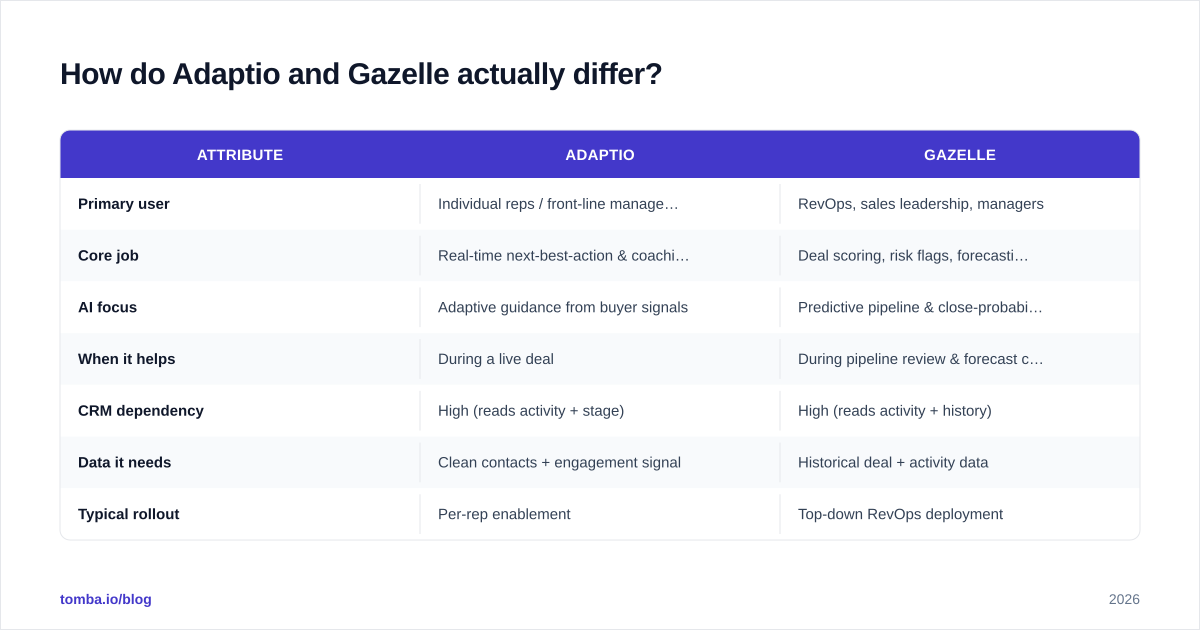
How do Adaptio and Gazelle actually differ?#
The marketing pages of AI sales tools all sound alike — "close more, faster, with AI." The differences show up in who uses the product daily and what decision it changes.
| Attribute | Adaptio | Gazelle |
|---|---|---|
| Primary user | Individual reps / front-line managers | RevOps, sales leadership, managers |
| Core job | Real-time next-best-action & coaching | Deal scoring, risk flags, forecasting |
| AI focus | Adaptive guidance from buyer signals | Predictive pipeline & close-probability |
| When it helps | During a live deal | During pipeline review & forecast calls |
| CRM dependency | High (reads activity + stage) | High (reads activity + history) |
| Data it needs | Clean contacts + engagement signal | Historical deal + activity data |
| Typical rollout | Per-rep enablement | Top-down RevOps deployment |
| Pricing model | Quote-based (seat + modules) | Quote-based (seat + modules) |
A few practical notes on that table:
- Time-to-value differs. Adaptio tends to show value once reps are active in it and signals accumulate. Gazelle's forecasting models want historical deal data, so accuracy improves over a quarter or two as it learns your sales cycle.
- Adoption risk differs. Rep-facing tools (Adaptio) live or die on daily seller adoption. Manager-facing tools (Gazelle) can deliver value even if reps barely touch them, because the analysis happens above the rep.
- Both are only as good as your inputs. Garbage activity data produces garbage scores and garbage guidance. This is the part buyers underestimate.
Which one is better for coaching reps?#
Adaptio is the stronger fit for active, in-the-moment coaching. Its whole design assumes the most valuable coaching happens before a deal slips, not after. For a team where ramp time and consistency across reps are the bottleneck, that real-time layer is the differentiator.
Gazelle can support coaching too, but indirectly. A manager reviewing Gazelle's risk flags can spot which deals need a conversation — that's coaching driven by data, but it still depends on a human manager carving out the time. Adaptio aims to compress that loop so the guidance reaches the rep without a manager in the middle.
If your team is large, distributed, or hiring quickly, the adaptive-guidance model usually wins. If your team is small and senior — five reps who already know how to sell — you may not need the in-the-moment layer at all, and Gazelle's higher-level view will feel more useful.
Which one is better for forecasting and pipeline?#
Gazelle is built for this and it shows. Forecast accuracy is a board-level metric, and Gazelle's deal scoring, slippage detection, and probability modeling are aimed squarely at the question "what will actually close this quarter?" RevOps teams that have been burning hours stitching together spreadsheet forecasts are the natural buyers.
Adaptio influences the forecast too — better next-best-actions mean cleaner pipeline — but it does so as a side effect of helping reps, not as its headline feature. If your number-one pain is an unreliable forecast and inconsistent deal inspection, Gazelle is the more direct answer.
This is also where your existing stack matters. If you already run a CRM with decent hygiene, Gazelle has clean fuel to learn from. If your CRM is a mess of half-filled fields, fix the data first — no forecasting AI overcomes missing activity logging.
What do Adaptio and Gazelle cost in 2026?#
Neither vendor publishes a transparent self-serve price as of 2026 — both run quote-based, sales-led pricing that scales with seat count and the modules you turn on. That means three things for your evaluation:
- Budget for a sales cycle, not a credit-card signup. Expect a demo, a scoping call, and an annual contract conversation.
- Ask for the all-in number. "Per seat" rarely includes implementation, data integration, or premium AI modules. Get the fully loaded figure.
- Negotiate on term and seats. Annual commitments and larger seat blocks are where these tools discount.
Because pricing is opaque, the real cost comparison is total cost of value: how fast each tool pays back, how much admin overhead it adds, and whether you need to buy supporting data to feed it. Cross-check current capabilities and reviews on independent sources like G2 and Gartner Peer Insights before you sit through a demo — verified user reviews surface the rough edges vendor decks won't.
For context, transparent tooling does exist elsewhere in the sales stack — Tomba publishes its pricing openly (Free, then $49/mo Starter up to custom Enterprise), which is the norm for data tools but the exception for AI sales-intelligence platforms.
The hidden dependency both tools share: data quality#
Here's the part that decides whether either platform works: both Adaptio and Gazelle consume contact and activity data — they don't generate it.
Think of it like a high-performance engine. Adaptio and Gazelle are the engine and the dashboard. Clean, complete contact data is the fuel. Pour in low-octane fuel — bouncing emails, missing decision-makers, stale records — and even the best engine sputters. AI scoring inherits every gap in your underlying data.
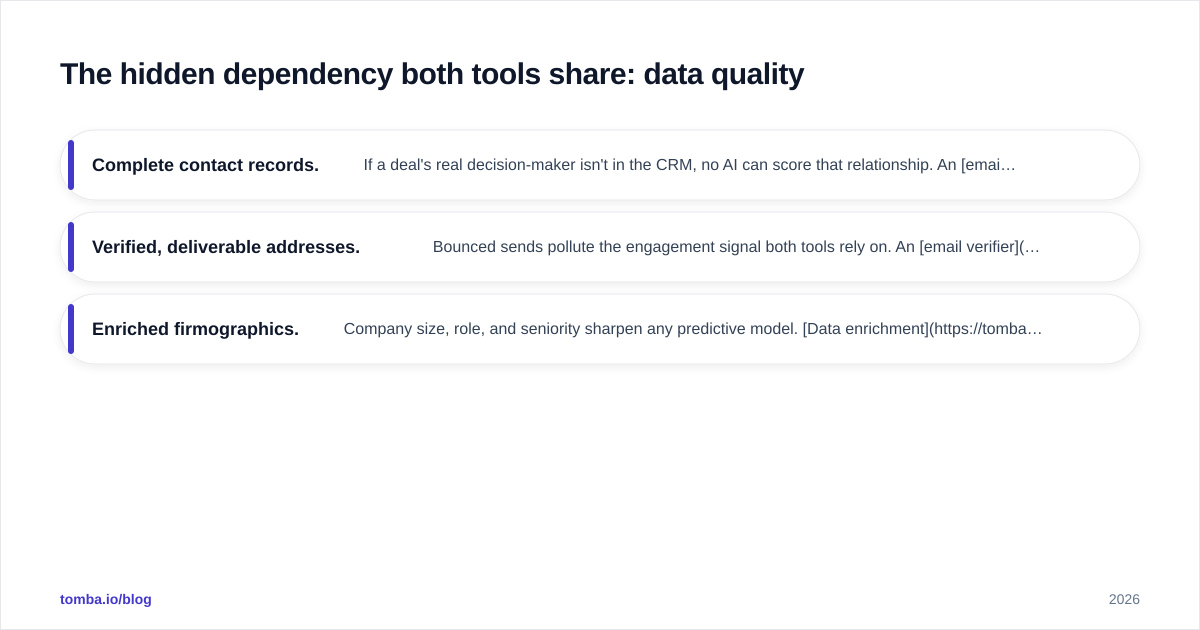
That's why the highest-leverage move before adopting either tool is fixing the data layer:
- Complete contact records. If a deal's real decision-maker isn't in the CRM, no AI can score that relationship. An email finder closes those gaps by sourcing the right professional contacts by name, company, or domain.
- Verified, deliverable addresses. Bounced sends pollute the engagement signal both tools rely on. An email verifier keeps the activity data honest.
- Enriched firmographics. Company size, role, and seniority sharpen any predictive model. Data enrichment fills those fields automatically.
Get this layer right and both platforms perform measurably better — the scores are more trustworthy and the guidance is grounded in real, reachable contacts. Skip it, and you'll blame the AI for a data problem.
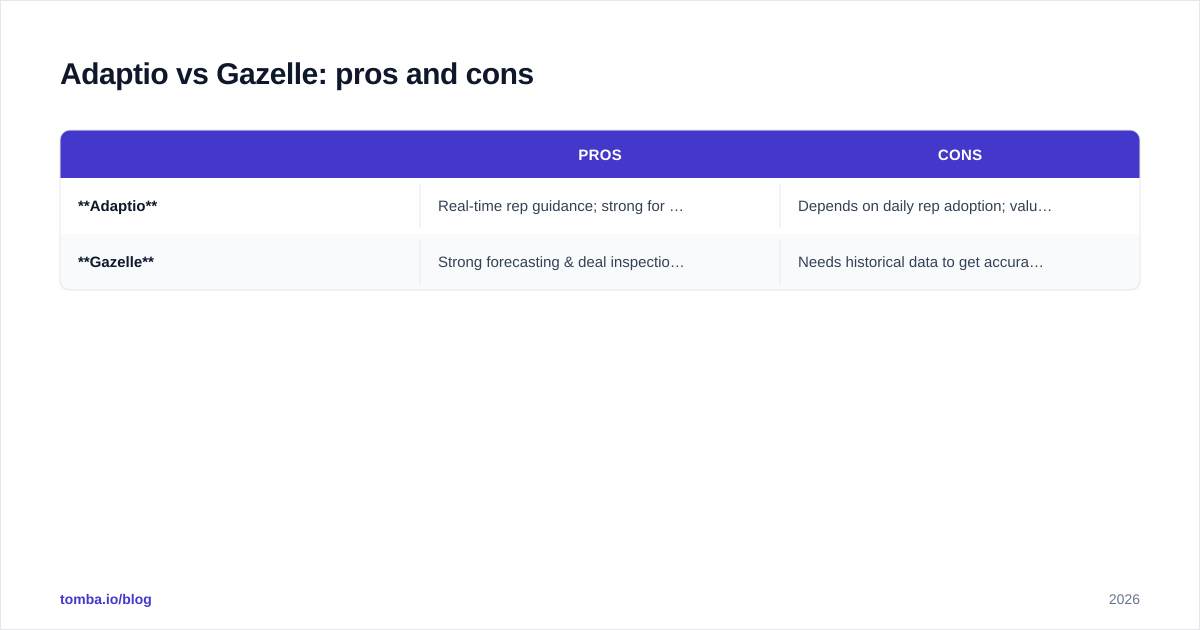
Adaptio vs Gazelle: pros and cons#
| Pros | Cons | |
|---|---|---|
| Adaptio | Real-time rep guidance; strong for ramp & consistency; coaching at point of action | Depends on daily rep adoption; value scales with signal volume; opaque pricing |
| Gazelle | Strong forecasting & deal inspection; manager-friendly; works above the rep | Needs historical data to get accurate; less direct rep value; opaque pricing |
Neither list is disqualifying. They're trade-offs, and the right trade-off depends on whether your bottleneck is seller execution or pipeline visibility.
Which should you choose?#
Choose Adaptio if:
- You're scaling a rep team and ramp time is your constraint.
- You want coaching to reach reps during deals, not in retro.
- Daily seller adoption of new tools is realistic at your org.
Choose Gazelle if:
- Forecast accuracy is a board-level problem you need solved.
- RevOps and managers are the primary buyers and users.
- You have enough historical deal data for predictive models to learn from.
Choose neither yet if:
- Your CRM data is incomplete or unverified. Fix the data foundation first — it's cheaper, faster, and makes whichever platform you eventually pick dramatically more effective.
A useful mental model: Gazelle tells you which deals are at risk; Adaptio tells reps what to do about it. If you can only fund one in 2026, buy the one that attacks your loudest pain — and improve your contact data in parallel regardless of which you choose, because win rate improvements compound on top of clean data, not in spite of dirty data.
Frequently asked questions#
Is Adaptio a CRM replacement? No. Both Adaptio and Gazelle sit on top of your CRM and read from it. They enhance decisions; they don't store your system of record.
Does Gazelle work without historical data? It runs, but predictive accuracy is weak until it has learned your sales cycle. Plan for a quarter or two of model maturation.
Can I use both together? Technically yes — they address different layers — but most teams start with one to control cost and change-management load. Revisit the second once the first is adopted.
What's the single biggest factor in success with either tool? Data quality. Verified contacts, complete decision-maker coverage, and accurate activity logging matter more than which logo you pick.
The bottom line#
Adaptio and Gazelle aren't really rivals so much as neighbors — one sharpens the seller's next move, the other sharpens leadership's view of the pipeline. Map the choice to your bottleneck, demand the all-in price, and verify claims against independent reviews before signing anything.
Whichever you choose, the multiplier is the same: clean, verified, enriched contact data. That's the layer that makes every AI score and every coaching cue trustworthy. If your records are thin or your sends are bouncing, start by closing those gaps with the Tomba Email Finder — find the right decision-makers by name, company, or domain, verify they're reachable, and feed your AI sales platform the high-octane data it needs to actually perform. Start free with 25 searches a month, and scale on a transparent plan when you're ready.
Ready to find emails that actually work?
Join 150,000+ professionals who stopped guessing and started sending. Free credits on signup — no credit card required.
Get the Tomba newsletter
Practical outbound tactics and product updates — once every two weeks.
About the author