Adaptio vs Getro: Talent Network Platforms Compared (2026)
Adaptio vs Getro, side by side: how each talent-network and community job-board platform handles members, jobs, integrations, and contact data in 2026 — plus how to keep the underlying records clean.

Choosing between Adaptio and Getro usually comes down to one question: do you need a polished community job board, or a full talent-network engine that ties members, companies, and jobs together? Both promise to turn a loose pool of candidates, founders, or community members into something searchable and useful. They get there differently.
This guide breaks down how the two compare in 2026 — feature scope, who each one fits, integration depth, pricing models, and the part most buyers underestimate: how clean your contact data stays once the platform fills up. If you run a VC talent program, an accelerator network, or any community where "who do we know" is the whole point, the differences matter.
TL;DR#
- Getro is the established name in venture and community talent networks — job boards, a connected talent CRM, and automated job aggregation across portfolio or member companies.
- Adaptio positions itself as a more configurable, workflow-driven alternative for organizations that want to shape the talent or community experience around their own processes rather than a fixed template.
- Pricing for both is quote-based (contact sales), so total cost depends on network size, modules, and seats rather than a public sticker price.
- Neither tool is a data-hygiene engine. Member emails decay, bounce, and go stale regardless of which platform stores them — that gap is where a dedicated email verifier and data enrichment layer earns its keep.
- Pick by job-to-be-done: Getro if you want a proven, batteries-included talent network; Adaptio if configurability and process fit outrank out-of-the-box speed.

What are Adaptio and Getro?#
Both products live in the same broad category — software that helps an organization run a talent network or community job board — but they emphasize different things.
Getro (you can see its current positioning at getro.com) is widely used by venture capital firms, accelerators, and professional communities to spin up branded job boards and a connected talent network. Its core promise is automation: it crawls and aggregates open roles from the companies in your network so the board stays current without manual posting, and it pairs that with a talent CRM for managing candidates and warm intros.
Adaptio approaches the same problem with a configurability-first mindset. Rather than a single opinionated template, it leans toward letting teams adapt the workflows — how members are onboarded, how roles are surfaced, how the community engages — to match an existing process. That flexibility is the selling point for organizations whose program doesn't fit a standard job-board mold.
Think of it like buying a kitchen. Getro hands you a fully fitted one where the appliances are already wired in and the layout is proven — you start cooking on day one. Adaptio hands you a modular system where you choose the layout, which suits you if your recipes are unusual, but you spend more time on setup before the first meal.
For independent reviews and category context, G2 and Capterra are the most reliable third-party sources — vendor sites understandably show themselves in the best light.
What features actually separate them?#
At a high level, both cover the talent-network basics: a public-facing job board, a way to manage members or candidates, and some flavor of company directory. The separation shows up in depth and philosophy.
- Job aggregation. Getro's automated job crawling across network companies is one of its best-known strengths — roles populate the board without staff posting each one. Evaluate how Adaptio handles the same problem; aggregation maturity is a common differentiator in this space.
- Talent CRM. A talent network is only as valuable as your ability to act on it. Look at how each tool tracks candidate stages, tags, notes, and warm-intro paths back to portfolio or member companies.
- Configurability vs. convention. Adaptio's pitch is bending to your workflow; Getro's is a proven default that gets you live fast. Neither is universally "better" — it depends on whether your process is standard or bespoke.
- Member experience. Self-serve profiles, opt-in preferences, and engagement features determine whether members keep their own data current — which directly affects how stale your records get.
- Reporting. Network growth, board traffic, placements, and engagement metrics are where you justify the program internally. Confirm each platform reports on the numbers your stakeholders ask for.
Adaptio vs Getro: side-by-side comparison#
The table below summarizes the practical decision points. Treat the pricing rows as "model, not exact number" — both vendors quote based on your network size and modules, so always get a tailored quote.
| Attribute | Getro | Adaptio |
|---|---|---|
| Primary focus | Talent networks + community job boards | Configurable talent/community workflows |
| Best for | VC firms, accelerators, established communities | Teams needing process-specific customization |
| Automated job aggregation | Core, well-established feature | Verify scope during demo |
| Talent CRM / candidate management | Included, connected to the board | Workflow-driven; confirm depth |
| Setup speed | Fast — opinionated, batteries-included | Slower — more configuration upfront |
| Customization ceiling | Template-led, branded | Higher; adapts to bespoke processes |
| Pricing model | Quote-based (contact sales) | Quote-based (contact sales) |
| Built-in data verification | Not a core function | Not a core function |
| Best paired with | Enrichment + verification layer | Enrichment + verification layer |
The single most important row for most buyers is the last two: neither platform is built to keep contact data accurate over time. That is not a knock — it is simply outside their scope. It is also the gap that quietly erodes ROI, which we cover below.

Which one is better for VC and accelerator talent programs?#
For a venture or accelerator program, Getro is the safer default. Its automated aggregation across portfolio companies and its talent CRM are purpose-built for the "help our companies hire, help our community find roles" loop. The proven template means you launch in days, not weeks, and the feature set maps cleanly to how most funds run talent.
Adaptio becomes the stronger choice when your program has requirements a standard board can't express — unusual membership tiers, multi-community structures, approval workflows, or engagement mechanics you've already designed and don't want to abandon. If you've outgrown a templated tool or your process is genuinely non-standard, configurability is worth the longer setup.
A simple rule: if you can describe your program in one paragraph and it sounds like every other fund's talent network, Getro's speed wins. If describing it takes a whiteboard, Adaptio's flexibility is worth evaluating.
Either way, the platform is only half the system. The other half is the data that flows through it.
Why does contact data quality decide the real winner?#
Here's the part both vendor demos gloss over: a talent network is a contact database, and contact databases rot. People change jobs, company domains change, personal emails go dormant, and recruiters' "warm" lists turn cold. Industry estimates routinely put B2B data decay at roughly 2–3% per month — which compounds to a meaningfully degraded list inside a year.
That means whichever platform you pick, you'll eventually email members or candidates and watch a chunk bounce. High bounce rates don't just waste outreach — they damage your sender reputation, which then hurts deliverability for every message you send afterward. The platform stores the email; it doesn't keep it true.
This is where a verification and enrichment layer sits underneath whichever platform you choose:
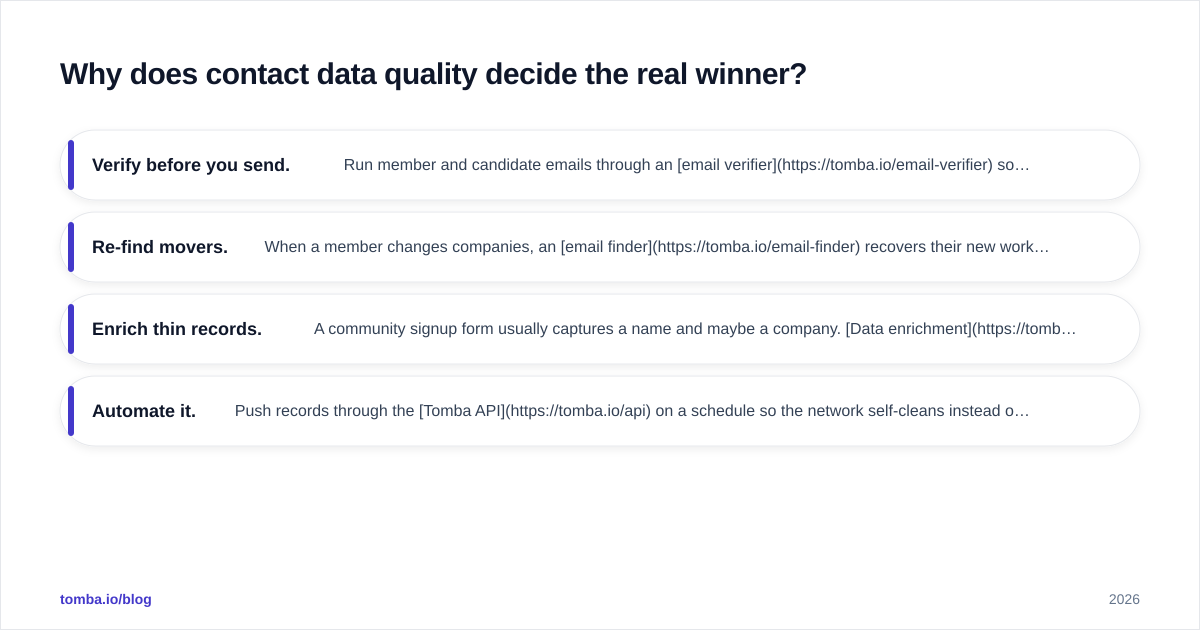
- Verify before you send. Run member and candidate emails through an email verifier so you catch dead addresses before they bounce.
- Re-find movers. When a member changes companies, an email finder recovers their new work address from name + company, so the relationship survives the job change.
- Enrich thin records. A community signup form usually captures a name and maybe a company. Data enrichment backfills role, company domain, and contact details so the record is actually actionable.
- Automate it. Push records through the Tomba API on a schedule so the network self-cleans instead of decaying silently.
In other words: Adaptio vs Getro decides how you organize your network. A verification layer decides whether that network still works a year from now. Buyers who only evaluate the first question are surprised when their beautiful talent board produces a 20% bounce rate.
How should you evaluate Adaptio vs Getro for your team?#
Run both through the same structured trial instead of judging by sales decks. A repeatable scorecard beats a gut feel.
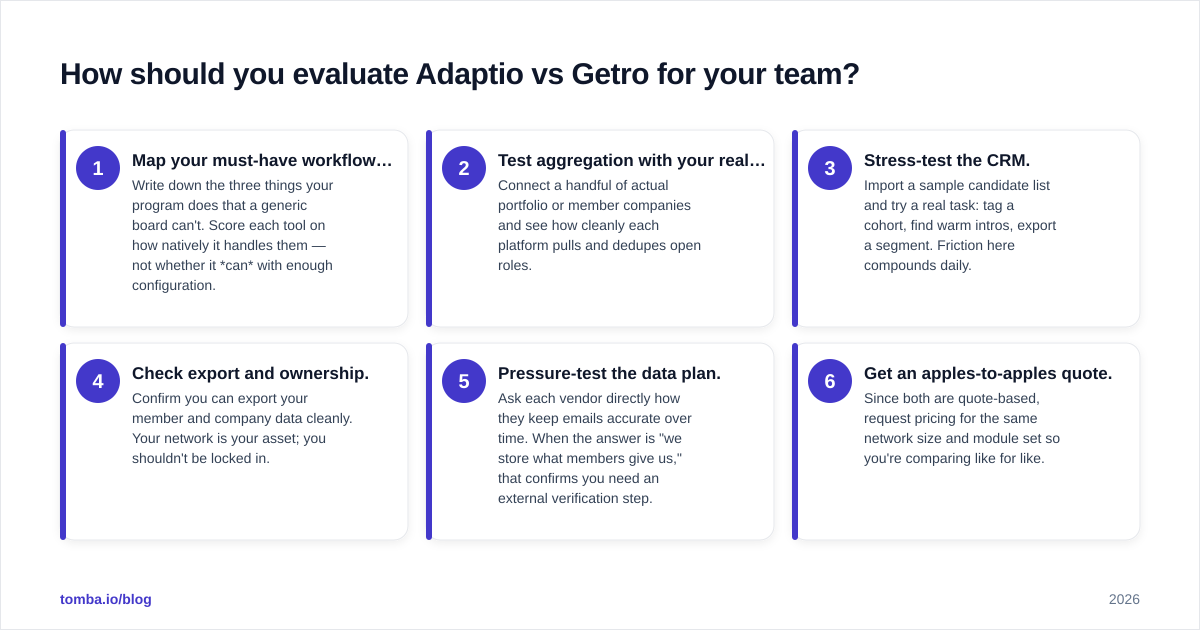
- Map your must-have workflow first. Write down the three things your program does that a generic board can't. Score each tool on how natively it handles them — not whether it can with enough configuration.
- Test aggregation with your real companies. Connect a handful of actual portfolio or member companies and see how cleanly each platform pulls and dedupes open roles.
- Stress-test the CRM. Import a sample candidate list and try a real task: tag a cohort, find warm intros, export a segment. Friction here compounds daily.
- Check export and ownership. Confirm you can export your member and company data cleanly. Your network is your asset; you shouldn't be locked in.
- Pressure-test the data plan. Ask each vendor directly how they keep emails accurate over time. When the answer is "we store what members give us," that confirms you need an external verification step.
- Get an apples-to-apples quote. Since both are quote-based, request pricing for the same network size and module set so you're comparing like for like.
For the data side of that scorecard, you can validate a sample list immediately with a free email checker or run a company email pattern lookup to see how recoverable your members' work addresses are — useful evidence before you commit to either platform.
What does each tool cost?#
Both Adaptio and Getro use quote-based pricing, so there's no public per-seat number to compare. Cost scales with network size, the modules you enable (job board only vs. full talent CRM), and seat count. Always request a tailored quote and ask what's included at each tier versus what's an add-on.
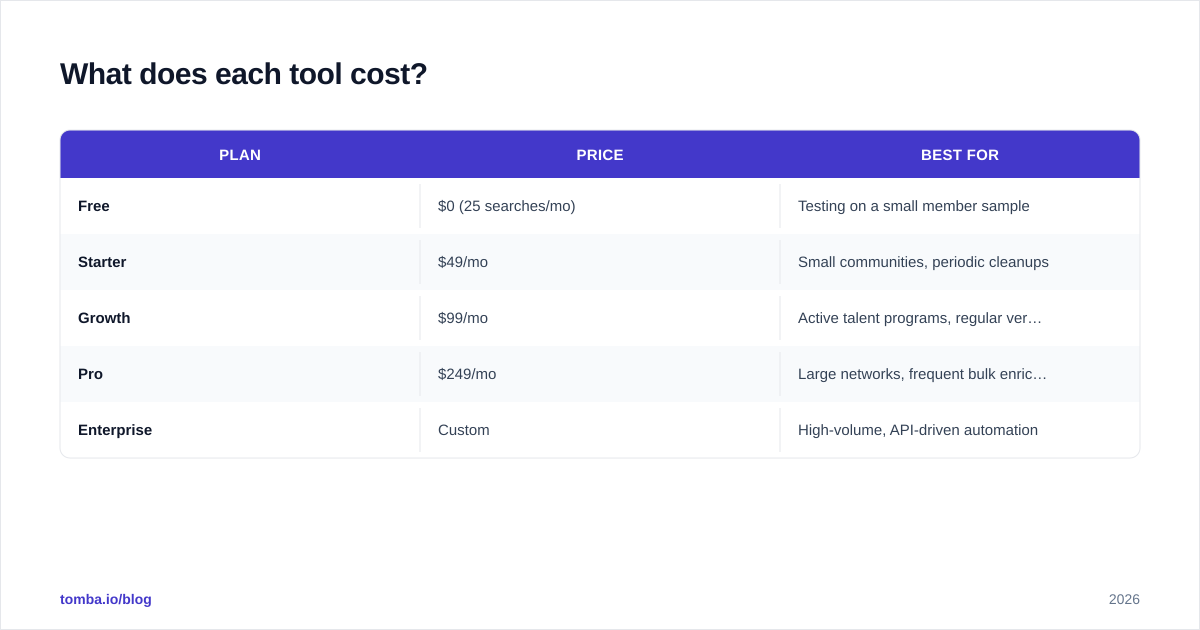
For budgeting the data layer that complements either platform, the numbers are public. Tomba's pricing is transparent, which makes it easy to slot into a plan:
| Plan | Price | Best for |
|---|---|---|
| Free | $0 (25 searches/mo) | Testing on a small member sample |
| Starter | $49/mo | Small communities, periodic cleanups |
| Growth | $99/mo | Active talent programs, regular verification |
| Pro | $249/mo | Large networks, frequent bulk enrichment |
| Enterprise | Custom | High-volume, API-driven automation |
See full Tomba pricing for credit details. The point isn't that data tooling replaces a talent platform — it's that a predictable, low add-on cost protects the value of the larger platform investment you're about to make.
The bottom line: which should you choose?#
Choose Getro if you want a proven, fast-to-launch talent network with strong automated job aggregation and a CRM tuned for VC and community use cases — it's the lower-risk default for standard programs. Choose Adaptio if your process is non-standard and configurability outranks out-of-the-box speed, and you're willing to invest more in setup to get a workflow that fits exactly.
But don't let the platform decision distract you from the data decision. The most polished talent network is only as valuable as the contact records inside it, and those records decay no matter which logo is on the dashboard.
Keep your network alive by pairing whichever platform you pick with the Tomba Email Finder: recover members' new work emails when they switch jobs, verify addresses before you send, and enrich thin signup records into something your team can actually act on. Start free with 25 searches, validate a slice of your existing list, and see how many "lost" contacts you can bring back — then automate the cleanup through the API so your talent network stays accurate long after launch day.
Ready to find emails that actually work?
Join 150,000+ professionals who stopped guessing and started sending. Free credits on signup — no credit card required.
Get the Tomba newsletter
Practical outbound tactics and product updates — once every two weeks.
About the author