Adaptio vs Harmonic (2026): Which B2B Data Platform Wins?
Adaptio vs Harmonic in 2026: how the adaptive GTM-signals platform stacks up against the startup-intelligence engine on data coverage, signals, pricing, and fit.
Choosing between Adaptio and Harmonic comes down to one question: do you want a platform that scores and routes accounts based on live GTM signals, or one that maps the private-company and startup universe before anyone else notices it? They sound similar on a feature grid, but they solve different jobs.
This guide breaks down what each tool actually does, where their data comes from, how they price, and which one fits your motion in 2026 — without pretending either is a silver bullet.
TL;DR#
- Adaptio is an adaptive GTM intelligence layer: it ingests signals (intent, hiring, tech installs, engagement) and continuously re-scores and re-routes accounts so reps work the right ones now.
- Harmonic is a startup and private-company intelligence engine: deep coverage of founders, funding, headcount trajectory, and emerging companies — strong for VC, recruiting, and frontier-market sales.
- Data freshness vs data depth: Adaptio optimizes for timing, Harmonic optimizes for discovery. The better choice depends on whether your bottleneck is prioritization or sourcing.
- Pricing for both is quote-based/enterprise, so total cost depends on seats, API volume, and CRM integration scope — budget for a sales cycle, not a self-serve checkout.
- Neither finds and verifies contact emails as its core job. Pair whichever you pick with a dedicated email finder so your enriched accounts turn into reachable contacts.
What is Adaptio?#
Adaptio is best understood as a decision layer that sits on top of your existing data. Think of it like a traffic controller at a busy airport: planes (accounts) are constantly arriving, and the controller's job is to sequence them by priority so the most important one lands first. Adaptio watches signals across your stack — buying intent, job changes, hiring spikes, technographic shifts, product usage, and inbound engagement — and continuously recomputes which accounts deserve attention.
The "adaptive" part is the point. Instead of a static lead score you set once and forget, Adaptio re-ranks accounts as new signals arrive and feeds that prioritization back into your CRM and sequencing tools. A reps' list this morning may look different by this afternoon because a target company just posted ten new sales-engineer roles or lit up on a competitor comparison page.
Where it's strong:
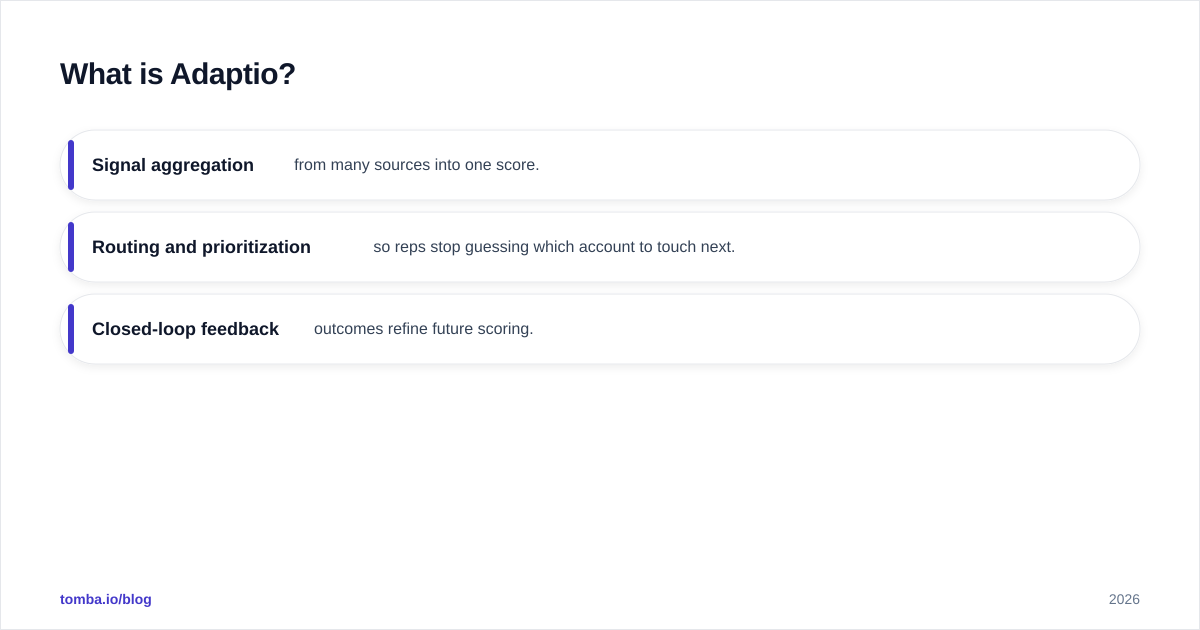
- Signal aggregation from many sources into one score.
- Routing and prioritization so reps stop guessing which account to touch next.
- Closed-loop feedback — outcomes refine future scoring.
Where it's weaker: Adaptio is only as good as the accounts and contacts already flowing into it. It sharpens prioritization; it does not, on its own, discover companies you've never heard of or hand you verified email addresses.
What is Harmonic?#
Harmonic is a private-company and startup intelligence platform. If Adaptio is the air-traffic controller, Harmonic is the satellite that maps every airport on Earth — including the ones still under construction. It tracks millions of companies with a bias toward early-stage and emerging organizations: founders, funding rounds, headcount growth curves, web traffic, social footprint, and the subtle momentum signals that suggest a company is about to break out.
Harmonic's original audience skews toward venture capital and talent — investors hunting for the next round before it's announced, recruiters chasing fast-growing teams. But the same dataset is increasingly used by GTM teams selling into startups, dev-tools companies, and frontier markets where traditional B2B databases lag months behind reality.
Where it's strong:
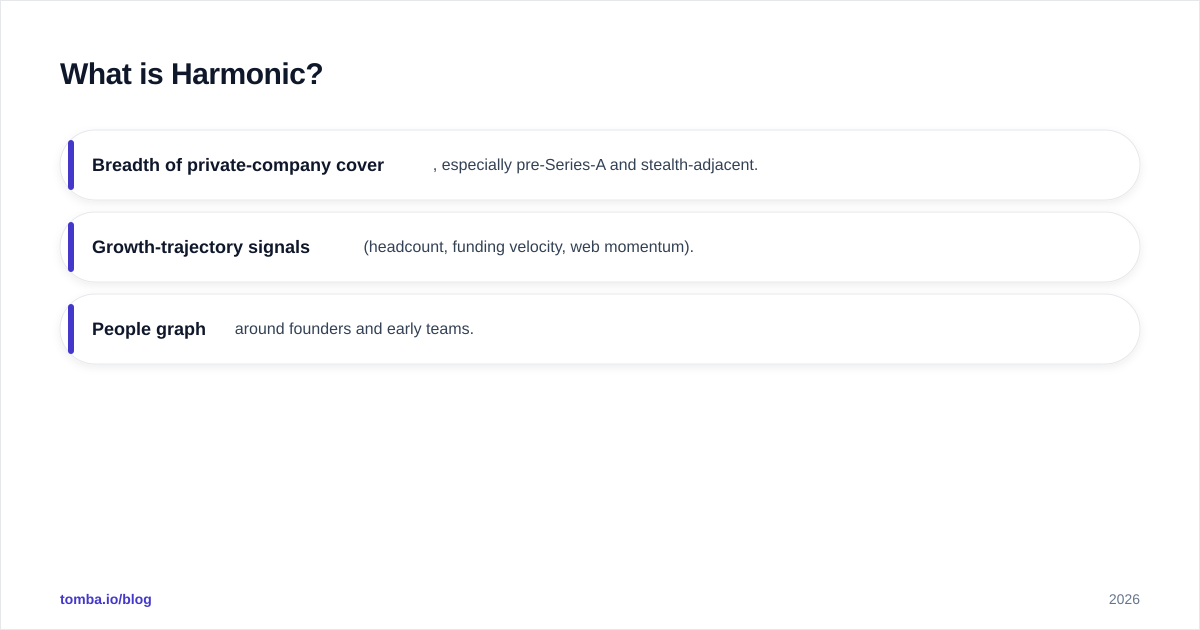
- Breadth of private-company coverage, especially pre-Series-A and stealth-adjacent.
- Growth-trajectory signals (headcount, funding velocity, web momentum).
- People graph around founders and early teams.
Where it's weaker: it's a discovery and research engine, not a routing engine. It tells you who exists and who's rising; it does less to tell your reps which of your existing pipeline accounts to call at 2pm today. You can read more about the platform on the official Harmonic site.

How do Adaptio and Harmonic compare head-to-head?#
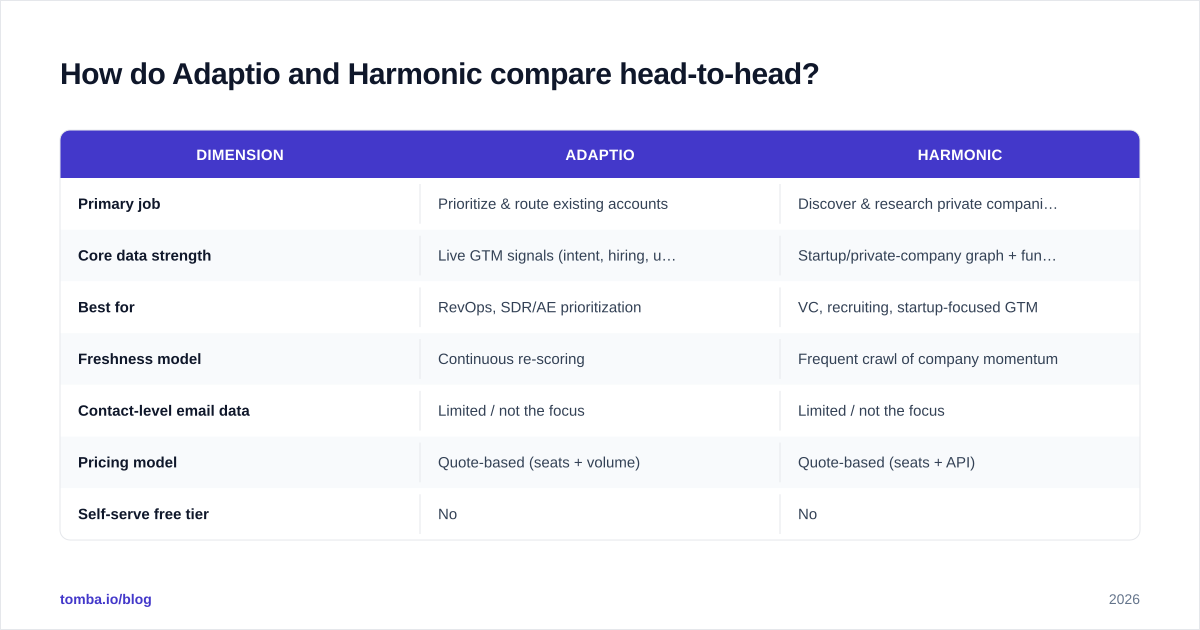
The fastest way to see the split is by job-to-be-done. One platform optimizes the accounts you already have; the other expands the universe of accounts you could have.
| Dimension | Adaptio | Harmonic |
|---|---|---|
| Primary job | Prioritize & route existing accounts | Discover & research private companies |
| Core data strength | Live GTM signals (intent, hiring, usage) | Startup/private-company graph + funding |
| Best for | RevOps, SDR/AE prioritization | VC, recruiting, startup-focused GTM |
| Freshness model | Continuous re-scoring | Frequent crawl of company momentum |
| Contact-level email data | Limited / not the focus | Limited / not the focus |
| Pricing model | Quote-based (seats + volume) | Quote-based (seats + API) |
| Self-serve free tier | No | No |
| CRM/workflow fit | Strong (routing back into CRM) | Research-first, integrations vary |
A useful mental model: Harmonic fills the top of your funnel with companies; Adaptio decides the order you work them. They are closer to complementary than competitive for a mature GTM org — but most teams evaluating them only have budget for one, so the decision is real.
Which one has better data?#
It depends on which kind of "better" you mean — and this is where most comparisons go wrong by treating data as a single number.
Coverage of emerging companies: Harmonic wins. Its entire reason for existing is to surface companies before they hit mainstream databases. If you sell to startups, scaleups, or anyone in a fast-moving category, Harmonic's lead time is a genuine moat.
Timeliness of buying signals: Adaptio wins. Harmonic tells you a company raised a Series B; Adaptio tells you that your target account just visited your pricing page twice and added three roles on your ICP's team. For an active sales motion, signal timing usually beats raw breadth.
Contact accuracy: This is the honest caveat for both. Neither platform's core competency is delivering verified, deliverable email addresses at the individual level — that's a separate data discipline. Account intelligence and contact data degrade on different clocks: a company's funding status is stable for months, but a person's work email can go stale the day they switch jobs. That's why teams layer a dedicated data enrichment and verification step on top of either tool. Independent reviews on G2 consistently show that account-intelligence platforms and contact-data tools score differently, because they're measuring different things.
If you want to understand how contact databases are actually built and refreshed, Tomba documents its own data sources — a useful reference point for evaluating any vendor's accuracy claims.
How much do Adaptio and Harmonic cost?#
Both are quote-based, enterprise-leaning platforms. Neither publishes a transparent self-serve price the way many email tools do, so treat any specific number you see in a forum as unverified.
What actually drives your cost:
- Seats — per-user pricing scales fast for larger SDR/AE teams.
- API and export volume — pulling data programmatically or in bulk raises the tier.
- Integration scope — CRM sync, routing automation, and data warehouse connectors often sit in higher plans.
- Contract length — annual commitments are standard; expect a procurement cycle.
Because both require a sales conversation, build evaluation time into your plan. And factor in the adjacent costs: you'll likely still need a contact-finding and verification tool, since neither replaces that. For comparison, transparent contact-data tooling like Tomba pricing starts with a free tier (25 searches/mo) and a $49/mo Starter plan — predictable line items you can model before signing anything enterprise.
For category-level context on how these platforms are positioned and rated, analyst coverage from Gartner is a neutral starting point before you talk to either vendor's sales team.
Adaptio vs Harmonic: which should you choose?#
Match the tool to your actual bottleneck. Run yourself through these scenarios.
Choose Adaptio if:
- Your pipeline already has plenty of accounts and the problem is which to work first.
- You have a RevOps function that can wire signals back into routing and sequencing.
- Your sales cycle rewards timing — reacting within hours of an intent spike materially changes win rate.
- You want a closed loop where outcomes improve future prioritization.
Choose Harmonic if:
- You sell into startups, dev tools, or fast-moving categories where databases lag.
- Sourcing net-new accounts is your constraint, not prioritizing existing ones.
- You're in VC, corporate development, or recruiting and need founder/funding depth.
- Early discovery — finding companies before competitors — is a strategic edge.
Choose neither (yet) if: your real gap is reachable contacts. A perfectly prioritized account list is worthless if you can't reach the buyer. In that case, start with a B2B database and an email finder, prove out a repeatable outreach motion, and add an account-intelligence layer once volume justifies the spend.
A decision framework#
Ask three questions in order:
- Discovery or prioritization? If you can't name enough target accounts, lean Harmonic. If you have too many and can't sequence them, lean Adaptio.
- Do you have the ops muscle? Adaptio's value depends on acting on signals automatically. No RevOps to operationalize it? Its edge shrinks.
- What's your contact-data plan? Whichever you pick, you still need verified emails and phones. Decide that before you sign, not after.
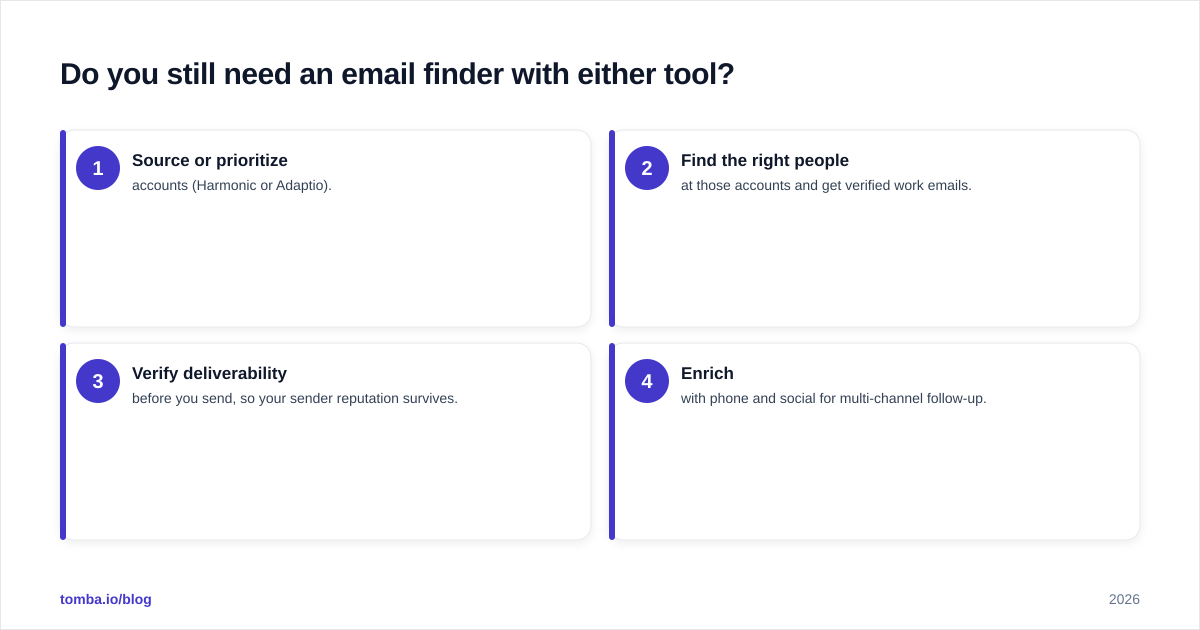
Do you still need an email finder with either tool?#
Yes — and this is the part teams underestimate. Both Adaptio and Harmonic operate primarily at the account and company level. Even Harmonic's people graph and Adaptio's contact enrichment are designed to support intelligence, not to guarantee a deliverable inbox for every prospect on your list.
The workflow that actually converts looks like this:
- Source or prioritize accounts (Harmonic or Adaptio).
- Find the right people at those accounts and get verified work emails.
- Verify deliverability before you send, so your sender reputation survives.
- Enrich with phone and social for multi-channel follow-up.
Tomba covers steps 2–4 with a domain search to map a company's contacts, an email finder to get the specific person, and an email verifier to keep bounce rates low. That combination plugs cleanly into whichever intelligence layer you choose, so your signal advantage actually reaches a human.
Frequently asked questions#
Is Adaptio a direct competitor to Harmonic? Not really. They overlap on the surface (both are "B2B data" platforms) but solve different jobs — prioritization versus discovery. Many mature teams could use both; most evaluating teams pick the one that fixes their current bottleneck.
Which has better startup data? Harmonic, clearly. Early-stage and private-company coverage is its core product, with funding and headcount-momentum signals as standouts.
Which is better for an outbound SDR team? Adaptio, if your list is already large and the problem is sequencing. Harmonic, if your SDRs are starving for net-new accounts in a fast category.
Do either of them replace an email finder? No. Treat contact-finding and verification as a separate, dedicated layer regardless of which platform you choose.
The bottom line#
Adaptio and Harmonic both belong in the B2B data intelligence conversation, but they win on different axes. Harmonic is the discovery engine — unmatched for surfacing emerging private companies early. Adaptio is the prioritization engine — built to make sure your team works the right accounts at the right moment. Pick based on whether your funnel's weak point is the top (sourcing) or the middle (sequencing), and budget for an enterprise sales cycle either way.
Whatever you choose, don't let perfect account intelligence stall on the last mile. The fastest way to turn a prioritized or freshly discovered account into a real conversation is verified contact data. Start free with the Tomba Email Finder — 25 searches a month at no cost, $49/mo when you scale — and connect it to your intelligence layer so every high-signal account becomes a reachable buyer instead of a name on a dashboard.
// get started
Find, verify and enrich your first contacts today
Start on the free plan with 25 searches a month, then scale when your team is ready.
Free plan · No credit card required · GDPR & CCPA
// about the author