Adaptio vs HitHorizons 2026: B2B Company Data Compared
Adaptio vs HitHorizons compared on coverage, firmographics, pricing, and workflow fit — plus how to turn either dataset into reach-ready contacts.
TL;DR
- Adaptio leans toward dynamic account intelligence and targeting signals; HitHorizons is built around a broad European company database with standardized firmographics. They overlap less than the name pairing suggests.
- Pick HitHorizons when you need wide, normalized company records (registry-grade firmographics, EU coverage). Pick Adaptio when you want targeting and scoring layered on top of company data.
- Neither is primarily an email-finder. Both give you companies and firmographics — you still need a contact layer to actually reach buyers.
- Pricing models differ: HitHorizons exposes credit/API-style access to company records, while Adaptio is positioned as a platform subscription. Always confirm live quotes.
- The fastest path to pipeline is pairing whichever dataset you choose with an enrichment and email finder layer so company rows become reachable contacts.
What are Adaptio and HitHorizons?#
Short version: both sell B2B company data, but they solve different halves of the same problem. HitHorizons is a company-information database — think standardized firmographic records (company name, location, size band, industry codes, registry identifiers) across a very large European footprint. Adaptio sits closer to the go-to-market workflow, focusing on account targeting, signals, and intelligence you act on rather than a raw directory you query.
An analogy: HitHorizons is the phone book printed for an entire continent — comprehensive, consistent, and great for lookups. Adaptio is the research assistant who reads that phone book and tells you which 200 companies to call this quarter. One is the reference layer; the other is the decision layer.
That distinction matters because "Adaptio vs HitHorizons" is rarely a true apples-to-apples bake-off. Most teams are actually asking one of two questions: "Where do I get reliable company records?" (favors HitHorizons) or "How do I prioritize accounts and act on intent?" (favors Adaptio). This guide answers both, then shows how either output feeds a contact layer.
How do Adaptio and HitHorizons compare on data and features?#
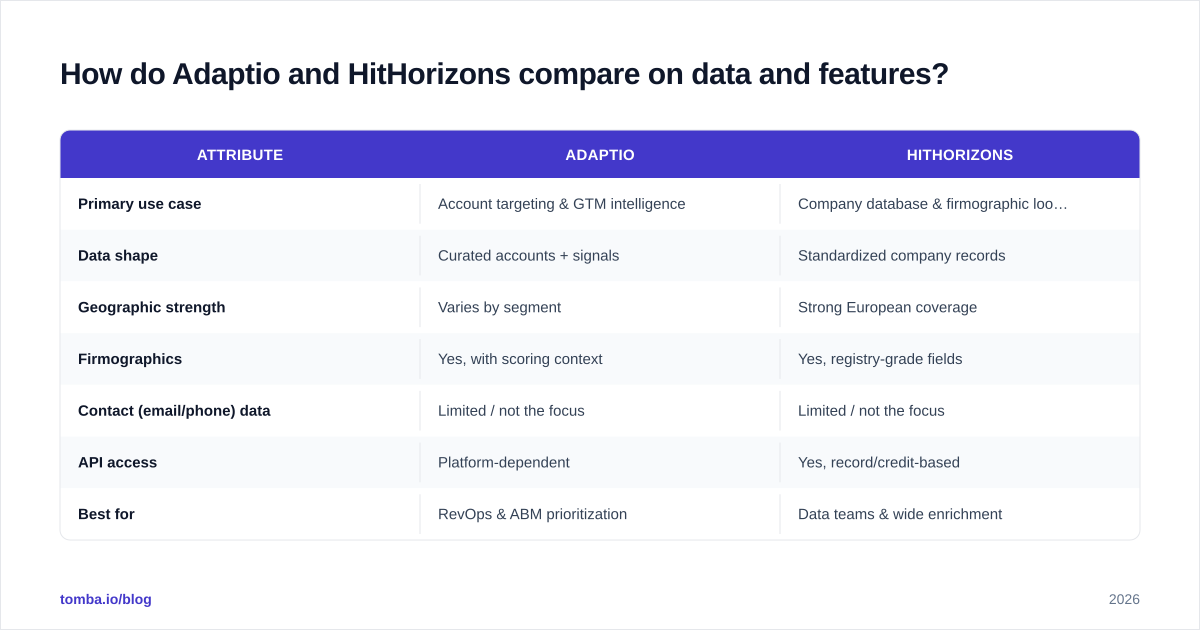
The core decision comes down to breadth of records versus depth of targeting. HitHorizons wins on raw coverage and standardization; Adaptio wins on the analysis you layer on top.
| Attribute | Adaptio | HitHorizons |
|---|---|---|
| Primary use case | Account targeting & GTM intelligence | Company database & firmographic lookup |
| Data shape | Curated accounts + signals | Standardized company records |
| Geographic strength | Varies by segment | Strong European coverage |
| Firmographics | Yes, with scoring context | Yes, registry-grade fields |
| Contact (email/phone) data | Limited / not the focus | Limited / not the focus |
| API access | Platform-dependent | Yes, record/credit-based |
| Best for | RevOps & ABM prioritization | Data teams & wide enrichment |
| Pricing model | Subscription (confirm live) | Credit/API tiers (confirm live) |
A few honest caveats. Vendor feature sets move quarterly, and both companies position themselves differently than a third party would. Treat the table as a starting map, not gospel — confirm current coverage counts, field-level completeness, and pricing directly with each vendor before you commit budget. I'm flagging that explicitly because firmographic "coverage" numbers are notoriously inconsistent between providers and refresh cycles.
The bigger structural point: neither tool is designed to hand you a verified work email and direct dial for the specific decision-maker you want to reach. They give you the account. Turning that account into a person you can email is a separate job, which is where a data enrichment and contact-finding step comes in.
Which one has better data coverage and accuracy?#
For breadth across European registries, HitHorizons is usually the stronger reference layer; for decision-ready prioritization, Adaptio's intelligence does more of the thinking for you.
Coverage and accuracy are two different axes, and teams conflate them constantly:
- Coverage = how many companies exist in the dataset and how many fields are populated. HitHorizons' registry-rooted approach tends to score well here, especially in markets where official company registries are the source of truth.
- Accuracy/freshness = how current those fields are. Registry data is authoritative but can lag operational reality (a company changed its trading name, opened a new HQ, or shifted headcount). Signal-driven platforms like Adaptio aim to be timelier on the dimensions they track, but over a narrower, curated set.
A practical test before you buy either: pull a sample of 50 accounts you already know well — your existing customers and recent losses. Check each tool for completeness on the fields you actually filter on (industry code, employee band, location, registration ID). Whichever tool fills your real workflow fields without manual cleanup wins, regardless of headline coverage claims. Independent reviews on G2 and the vendors' own documentation on hithorizons.com are useful sanity checks, but your own 50-account sample beats any star rating.
One more accuracy note that applies to both: company-level data ages faster than people assume. Whatever you import, plan to re-validate quarterly. Stale firmographics quietly poison segmentation, routing, and scoring downstream — and you won't notice until win rates dip.
Is Adaptio better than HitHorizons for B2B prospecting?#
It depends on whether your bottleneck is finding the right accounts or reaching the right people — and for the second job, neither tool is the answer on its own.
If your prospecting problem is "we don't know which accounts to chase," Adaptio's targeting orientation is the better fit. ABM and RevOps teams that need account scoring, fit signals, and a prioritized list will get more out of an intelligence platform than a raw directory. You can read more on how this connects to pipeline design in the context of revenue operations workflows.
If your problem is "we need clean, consistent company records to enrich our CRM or build a TAM," HitHorizons' database approach is more direct. Data teams building a B2B database or normalizing messy CRM rows will appreciate the standardized fields and API access.
But here's the gap both share for prospecting: contact data. Knowing that Acme GmbH is a 200-person logistics firm in Hamburg is necessary but not sufficient. You still need the VP of Operations' verified email before a single message goes out. That's the layer to plan for explicitly.
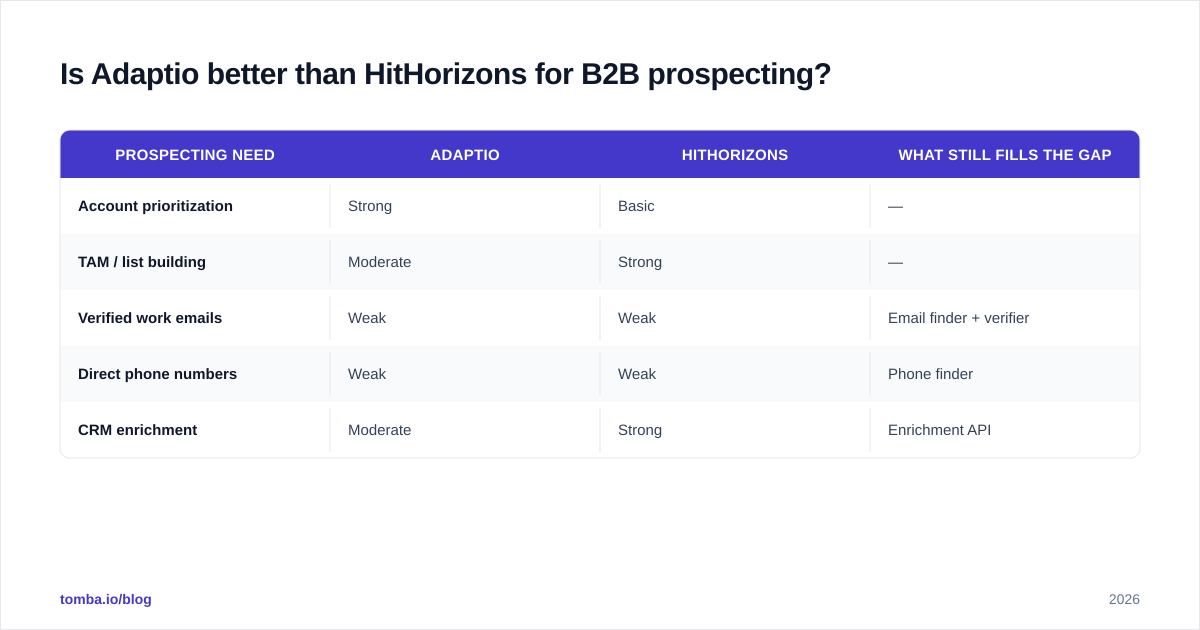
| Prospecting need | Adaptio | HitHorizons | What still fills the gap |
|---|---|---|---|
| Account prioritization | Strong | Basic | — |
| TAM / list building | Moderate | Strong | — |
| Verified work emails | Weak | Weak | Email finder + verifier |
| Direct phone numbers | Weak | Weak | Phone finder |
| CRM enrichment | Moderate | Strong | Enrichment API |
How do you turn either dataset into reachable contacts?#
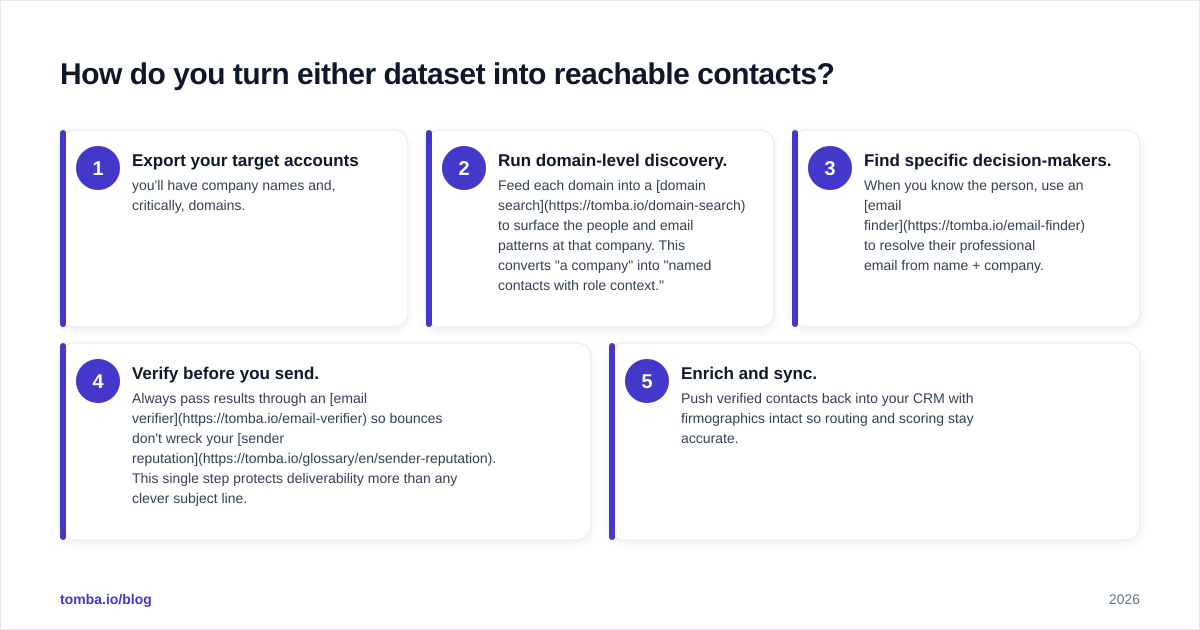
Layer a contact-finding step on top: take the company domains from Adaptio or HitHorizons, then run them through an email finder and verifier to get reach-ready people.
The workflow is the same regardless of which platform you chose:
- Export your target accounts — you'll have company names and, critically, domains.
- Run domain-level discovery. Feed each domain into a domain search to surface the people and email patterns at that company. This converts "a company" into "named contacts with role context."
- Find specific decision-makers. When you know the person, use an email finder to resolve their professional email from name + company.
- Verify before you send. Always pass results through an email verifier so bounces don't wreck your sender reputation. This single step protects deliverability more than any clever subject line.
- Enrich and sync. Push verified contacts back into your CRM with firmographics intact so routing and scoring stay accurate.
This is the part the "Adaptio vs HitHorizons" framing usually omits. The data platform is the front half of the pipeline; the contact layer is the back half. You need both, and the back half is where deals actually start.
For teams doing this at volume, batch processing matters. Rather than resolving emails one at a time, a bulk email finder lets you upload an export from either platform and get contacts back in one pass — turning a multi-day manual chore into a single job.
What about pricing and total cost?#
Budget for two line items, not one: the data platform plus the contact layer. Looking at either tool's sticker price in isolation understates what it costs to actually run outreach.
Both Adaptio and HitHorizons use models that reward confirming a live quote rather than trusting a blog's numbers — HitHorizons leans toward record/credit-based API access, Adaptio toward platform subscription. Neither bundles unlimited verified contact data, so factor in the enrichment layer separately.
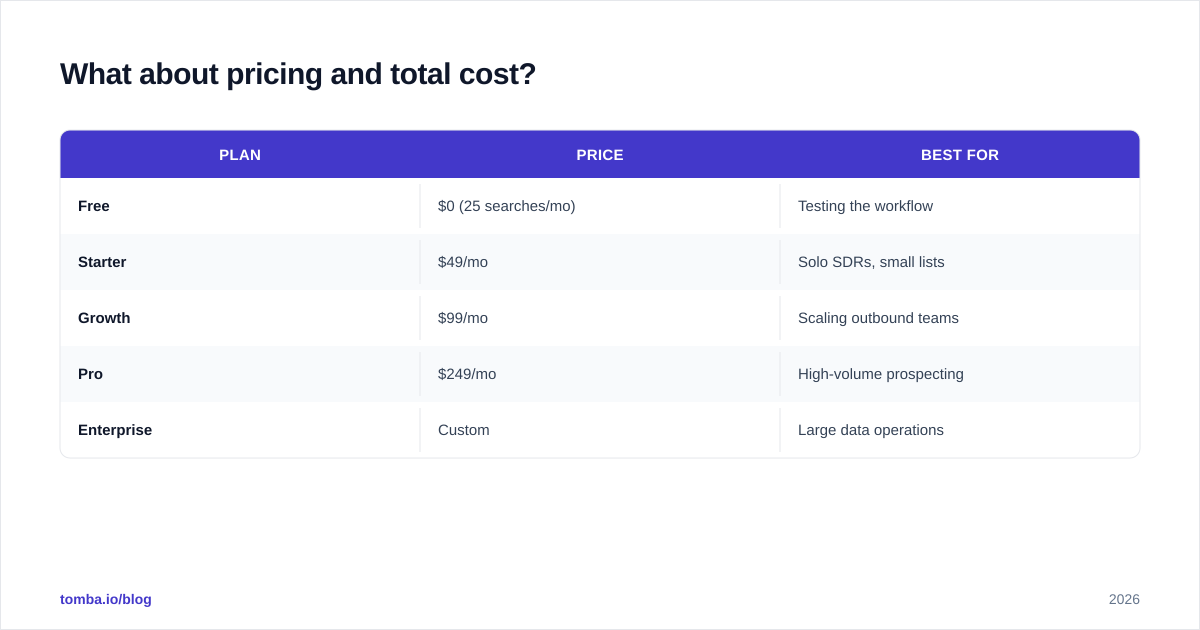
For the contact layer, transparent published pricing helps you model cost. Tomba pricing is straightforward:
| Plan | Price | Best for |
|---|---|---|
| Free | $0 (25 searches/mo) | Testing the workflow |
| Starter | $49/mo | Solo SDRs, small lists |
| Growth | $99/mo | Scaling outbound teams |
| Pro | $249/mo | High-volume prospecting |
| Enterprise | Custom | Large data operations |
The total-cost math that actually matters: data platform subscription + contact resolution + verification. A common mistake is over-investing in a premium data platform and then sending to unverified addresses, which burns the domain reputation the whole program depends on. Spend proportionally — clean, verified contacts are cheaper than a damaged sending domain.
So which should you choose?#
Decide by your bottleneck, then add the contact layer either way:
- Choose HitHorizons if you need wide, standardized European company records, registry-grade firmographics, and API access for CRM enrichment or TAM building. It's the stronger reference dataset.
- Choose Adaptio if your priority is account prioritization, fit scoring, and GTM intelligence that tells you which accounts to work, not just that they exist.
- Choose both, or neither exclusively, if you realize the real gap is contact data — because that gap exists with both tools.
Whatever you pick for the company layer, the deals start when you reach a real person. Take your account list from Adaptio or HitHorizons, drop the domains into the Tomba Email Finder, verify the results, and sync reach-ready contacts straight into your CRM. Start on the free tier (25 searches), confirm the data quality on your own 50-account sample, and scale to a Tomba plan once it's pulling its weight. The company database tells you who to chase; Tomba tells you how to reach them.
Ready to find emails that actually work?
Join 150,000+ professionals who stopped guessing and started sending. Free credits on signup — no credit card required.
Get the Tomba newsletter
Practical outbound tactics and product updates — once every two weeks.
About the author