Adaptio vs OutboundView (2026): Which Outbound Engine Wins?
A neutral, side-by-side breakdown of Adaptio vs OutboundView in 2026 — pricing models, data quality, automation, and which outbound approach fits your team.
Adaptio vs OutboundView: Which Outbound Engine Should You Run in 2026?
Choosing between Adaptio and OutboundView is really a choice between two philosophies of outbound: a self-serve platform that hands your reps an AI-assisted workflow, versus a done-for-you service that runs the campaigns on your behalf. They solve the same business problem — booked meetings — from opposite ends of the build-vs-buy spectrum.
This is a vendor-neutral breakdown. Where Tomba is the better-fit layer underneath either option, I'll say so plainly; where it isn't, I won't pretend otherwise.
TL;DR#
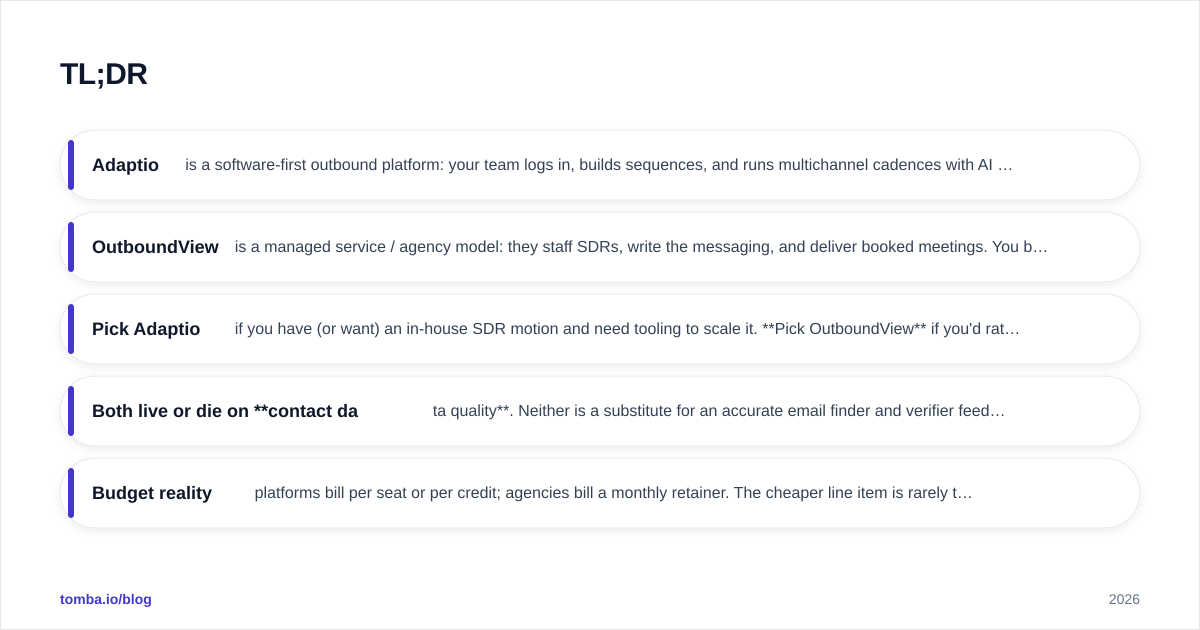
- Adaptio is a software-first outbound platform: your team logs in, builds sequences, and runs multichannel cadences with AI assist. You keep control; you also keep the labor.
- OutboundView is a managed service / agency model: they staff SDRs, write the messaging, and deliver booked meetings. You buy outcomes, not seats.
- Pick Adaptio if you have (or want) an in-house SDR motion and need tooling to scale it. Pick OutboundView if you'd rather outsource execution and pay for pipeline.
- Both live or die on contact data quality. Neither is a substitute for an accurate email finder and verifier feeding the top of the funnel.
- Budget reality: platforms bill per seat or per credit; agencies bill a monthly retainer. The cheaper line item is rarely the cheaper outcome.
What are Adaptio and OutboundView?#
Adaptio positions itself as an outbound execution platform — software your reps use to plan accounts, build sequences, and run email plus LinkedIn plus phone touches with AI helping draft and prioritize. The value proposition is leverage: one rep does the work of several because the busywork is automated.
OutboundView is an outbound agency and consultancy. Instead of selling you a login, they assign people — SDRs, copywriters, strategists — to build and run campaigns that book meetings for your account executives. You're buying a managed outcome and the expertise that comes with it.
The distinction matters because the two are not really competitors in the way two email tools are. They're competing answers to a single question: do you build the outbound motion in-house, or rent it?
How do Adaptio and OutboundView compare head-to-head?#
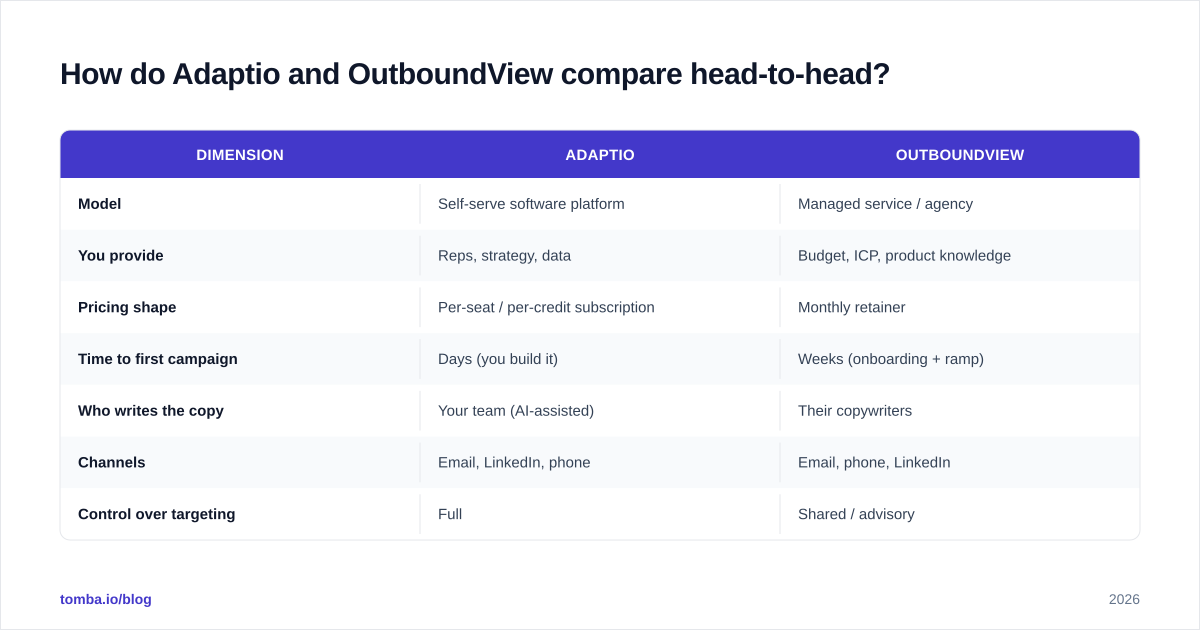
Here's the practical comparison across the dimensions that actually change your decision.
| Dimension | Adaptio | OutboundView |
|---|---|---|
| Model | Self-serve software platform | Managed service / agency |
| You provide | Reps, strategy, data | Budget, ICP, product knowledge |
| Pricing shape | Per-seat / per-credit subscription | Monthly retainer |
| Time to first campaign | Days (you build it) | Weeks (onboarding + ramp) |
| Who writes the copy | Your team (AI-assisted) | Their copywriters |
| Channels | Email, LinkedIn, phone | Email, phone, LinkedIn |
| Control over targeting | Full | Shared / advisory |
| Scales by | Adding seats + automation | Adding headcount |
| Best for | Teams building an in-house engine | Teams outsourcing execution |
| Data included? | Usually limited / bring-your-own | Often sourced by the agency |
The biggest line in that table is the last one. Both models assume someone is supplying clean, deliverable contact records — and that's where most outbound programs quietly fail before a single email is sent.
Is Adaptio better than OutboundView?#
Neither is "better" in the abstract — they're better for different teams. Use this lens:
Adaptio wins when you want ownership. If outbound is core to your go-to-market and you intend to keep it in-house for years, owning the platform and the process compounds. Your reps learn your market, your messaging library grows, and you're not renting institutional knowledge that walks out the door when a contract ends. The tradeoff is that you carry the management burden: hiring SDRs, coaching them, and keeping the tooling productive.
OutboundView wins when speed and expertise beat ownership. If you need pipeline this quarter and don't have an SDR function — or yours is underperforming — an agency buys you a running start and a team that has done this across many accounts. The tradeoff is less control, a ramp period, and a retainer that doesn't shrink when you're busy.
A useful gut check: if you can't articulate your ideal customer profile and a rough message-market fit, an agency will help you find it faster than a platform will. If you already know those cold and just need to execute at volume, a platform gives you more output per dollar over time.
What about data quality — the part both models depend on?#
Here's the uncomfortable truth that sits underneath this entire comparison: the platform or agency is only as good as the data you feed it. A flawless sequence sent to a bounced or role-based address is worse than no email at all — it damages your sender reputation and drags down everything in the queue.
Industry bounce-rate guidance is blunt about this: keep hard bounces under roughly 2% or mailbox providers start throttling you. That number is a data-hygiene problem, not a copywriting problem. No amount of AI-assisted messaging in Adaptio, and no agency SDR at OutboundView, fixes a list that's 15% stale.
This is the layer where a dedicated provider earns its place regardless of which outbound model you pick. Tomba's email finder resolves verified professional addresses by name and domain, the email verifier screens out invalid and risky records before they ever enter a sequence, and data enrichment fills in the firmographic gaps your targeting depends on. If you're building lists at the account level, domain search returns the known addresses and patterns for a company in one call.
The point isn't "use Tomba instead of Adaptio or OutboundView." It's that data sourcing and execution are different jobs. Conflating them is why so many outbound programs underperform their tooling.
How does pricing really compare?#
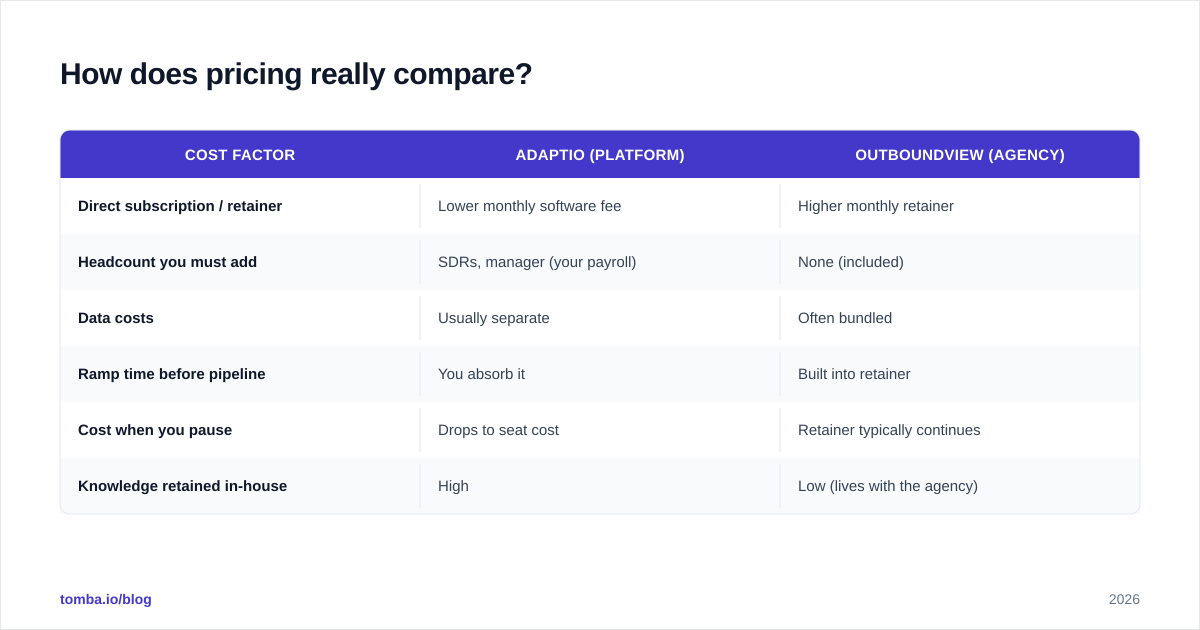
Compare cost per booked meeting, not the headline price. A platform looks cheaper on the invoice and an agency looks expensive — until you load in the fully-burdened cost of the SDRs you'd need to make the platform productive.
| Cost factor | Adaptio (platform) | OutboundView (agency) |
|---|---|---|
| Direct subscription / retainer | Lower monthly software fee | Higher monthly retainer |
| Headcount you must add | SDRs, manager (your payroll) | None (included) |
| Data costs | Usually separate | Often bundled |
| Ramp time before pipeline | You absorb it | Built into retainer |
| Cost when you pause | Drops to seat cost | Retainer typically continues |
| Knowledge retained in-house | High | Low (lives with the agency) |
For a rough mental model: a self-serve platform plus two SDRs plus a data subscription can easily match or exceed an agency retainer once you count salaries — but you own the output and the learning. If you can't staff or coach SDRs well, that "cheaper" path produces less pipeline per dollar than the agency.
If you want a clean benchmark for the data portion of either budget, Tomba pricing is straightforward: a free tier with 25 searches per month, Starter at $49/mo, Growth at $99/mo, and Pro at $249/mo. That predictability makes it easy to model the data line independently of whichever execution model you choose.

Which integrations and workflows matter?#
Whichever side you land on, the outbound stack has to connect to your CRM and your data sources or you'll drown in manual exports.
- With Adaptio, you'll want clean data flowing into the platform automatically. Tomba's Tomba API and the bulk email finder let you resolve and verify lists at scale, then push them in. A phone finder adds dialing as a channel when email saturates.
- With OutboundView, you're handing off execution, but you should still own your data foundation so you're not locked into the agency's sourcing. Maintaining your own verified B2B database means you can switch agencies — or bring it in-house — without starting from zero.
A practical sequencing rule: enrich and verify before anything enters a cadence, not after bounces come back. Front-loading verification is the single highest-leverage habit in outbound, and it's model-agnostic.
What do reviewers and the market say?#
Both categories are well-documented on the major software marketplaces. For agency-style providers, check references and case studies directly — OutboundView's own site publishes its service breakdown, and outbound agencies generally live or die on referenceable results, so ask for them. For platforms, peer-review aggregators like G2 and buyer guides from HubSpot are reasonable places to sanity-check feature claims and read unfiltered user feedback before you commit budget.
Treat any single review score with skepticism. The more useful signal is fit: a five-star platform is worthless if you have no one to run it, and a top-rated agency is a poor buy if outbound is your core competency and you'd rather own it.
How do you actually decide?#
Run this short checklist:
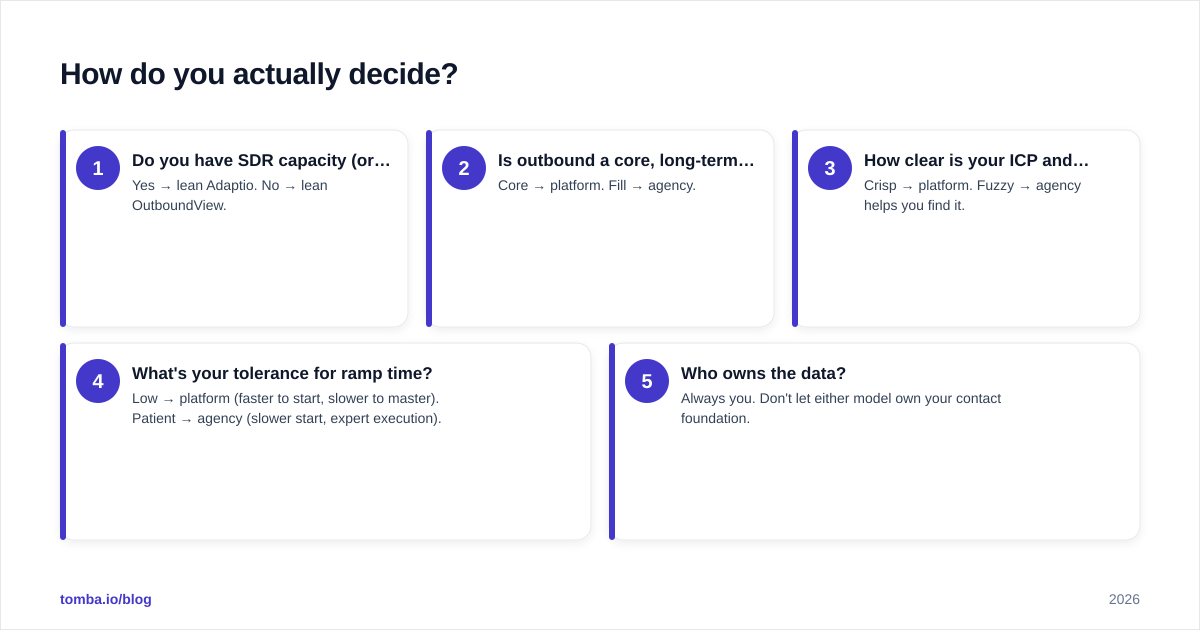
- Do you have SDR capacity (or will you hire it)? Yes → lean Adaptio. No → lean OutboundView.
- Is outbound a core, long-term motion or a short-term pipeline fill? Core → platform. Fill → agency.
- How clear is your ICP and messaging? Crisp → platform. Fuzzy → agency helps you find it.
- What's your tolerance for ramp time? Low → platform (faster to start, slower to master). Patient → agency (slower start, expert execution).
- Who owns the data? Always you. Don't let either model own your contact foundation.
Whatever you choose, the data layer is the constant. The teams that win at outbound in 2026 treat list quality as a discipline, not an afterthought — they verify before they send, enrich before they target, and measure cost per booked meeting rather than cost per tool.
The bottom line#
Adaptio and OutboundView aren't really rivals; they're two answers to "build or buy." Pick Adaptio to own an in-house engine and compound the learning. Pick OutboundView to rent execution and expertise when speed matters more than ownership. Both depend entirely on the accuracy of the contacts you put into them.
That's where to start. Before you commit to either platform or agency, get your data foundation right: use the Tomba Email Finder to source verified, deliverable professional emails by name, company, or domain — then feed clean lists into whichever outbound model you choose. Spin up the free tier, test it against your current list's bounce rate, and you'll see the difference accurate data makes before you spend a dollar on execution.
// get started
Find, verify and enrich your first contacts today
Start on the free plan with 25 searches a month, then scale when your team is ready.
Free plan · No credit card required · GDPR & CCPA
// about the author