Adaptio vs Revli 2026: Which B2B Sales Tool Should You Pick?
A neutral, side-by-side breakdown of Adaptio vs Revli in 2026 — features, pricing models, data quality, and which sales team each one actually fits.
Choosing between two sales platforms usually comes down to three things: how clean their data is, how their pricing scales, and whether the workflow matches how your team actually sells. Adaptio vs Revli is no different — and the right answer depends more on your motion than on a feature checklist.
This is a neutral breakdown. Neither tool is a silver bullet, both have real gaps, and there's a category of work — finding and verifying the contact data that feeds them — where a dedicated tool beats either one. Here's how to decide.
TL;DR#
- Adaptio leans toward workflow and orchestration: sequencing, task management, and keeping reps moving through a pipeline.
- Revli leans toward data and signals: enrichment, intent, and surfacing accounts worth working.
- Neither replaces a dedicated email finder or verifier — both inherit the accuracy of whatever data you feed them.
- Pricing models differ in kind, not just price: seat-based vs usage/credit-based, which changes who wins at scale.
- Pick by motion: high-volume outbound favors signal-rich data; relationship-led sales favors orchestration.
What is Adaptio?#
Adaptio sits in the sales engagement and workflow corner of the stack. The core promise is orchestration — taking a list of contacts and moving them through multi-step sequences (email, calls, tasks, social touches) without reps dropping the ball. Think of it as the conveyor belt of your outbound motion: the value is in keeping everything moving in order, not in sourcing the parts.
Teams gravitate to this kind of platform when the bottleneck is execution — reps have leads but follow-up is inconsistent, cadences live in spreadsheets, and managers can't see what's actually happening. If that's your pain, an orchestration-first tool earns its seat.
The trade-off: orchestration tools assume you already have good contacts. Feed a sequence bad email addresses and you'll automate your way into a sender reputation problem faster than ever.
What is Revli?#
Revli sits closer to the data and intelligence corner — enrichment, firmographics, and buying signals. The promise here is targeting: instead of just working a list faster, you work a better list, prioritized by who's showing intent or fits your ICP.
This is the right center of gravity when your bottleneck is who to contact, not how. If reps burn hours researching accounts, guessing at fit, or chasing cold prospects with no signal, a data-and-signals platform shifts the odds before the first touch.
The trade-off mirrors Adaptio's: signal-rich platforms are only as good as the contact-level data underneath the account-level intelligence. Knowing a company is in-market doesn't help if you can't reach the right person with a deliverable email.
Adaptio vs Revli: how do they compare?#
Here's the honest side-by-side. Treat the rows as dimensions to evaluate, not marketing claims — verify each against your own trial data and current pricing on their sites.
| Dimension | Adaptio | Revli |
|---|---|---|
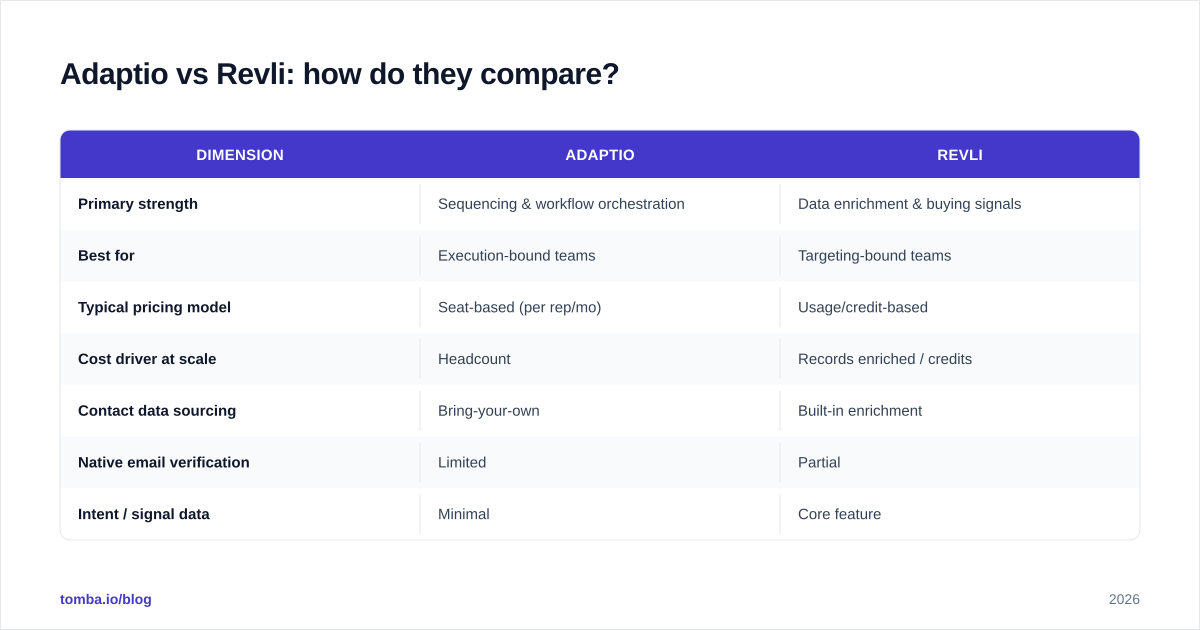
| Primary strength | Sequencing & workflow orchestration | Data enrichment & buying signals |
| Best for | Execution-bound teams | Targeting-bound teams |
| Typical pricing model | Seat-based (per rep/mo) | Usage/credit-based |
| Cost driver at scale | Headcount | Records enriched / credits |
| Contact data sourcing | Bring-your-own | Built-in enrichment |
| Native email verification | Limited | Partial |
| Intent / signal data | Minimal | Core feature |
| CRM sync | Strong | Strong |
| Learning curve | Moderate | Moderate–high |
| Where it falls short | Garbage-in if data is bad | Account-level ≠ contact-level reach |
The pattern: these tools are complements more often than substitutes. Many teams run an orchestration layer and a data layer. The "vs" framing matters most when budget forces a single choice — and then it comes down to which bottleneck is costing you more.

Is Adaptio better than Revli for outbound?#
It depends on where your outbound breaks down. Run this diagnostic:
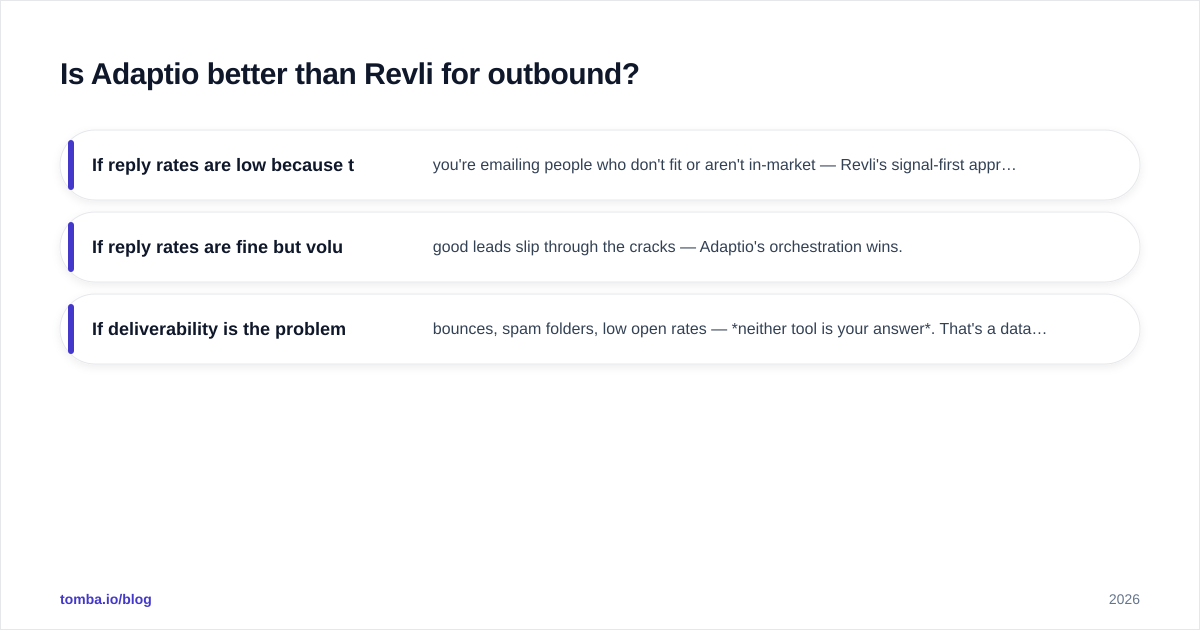
- If reply rates are low because targeting is off — you're emailing people who don't fit or aren't in-market — Revli's signal-first approach moves the needle more.
- If reply rates are fine but volume and consistency are the problem — good leads slip through the cracks — Adaptio's orchestration wins.
- If deliverability is the problem — bounces, spam folders, low open rates — neither tool is your answer. That's a data-hygiene and email deliverability issue, and it sits upstream of both.
That third case is the one teams misdiagnose most. They buy a fancier engagement platform or a richer data feed when the real fix is verifying contacts before they ever enter a sequence. According to peer-review sites like G2 and Capterra, the most common complaint across the entire sales-tech category isn't features — it's data decay. Contacts go stale at roughly 25–30% per year, and no orchestration or signal layer fixes a wrong email.
How should you evaluate data quality?#
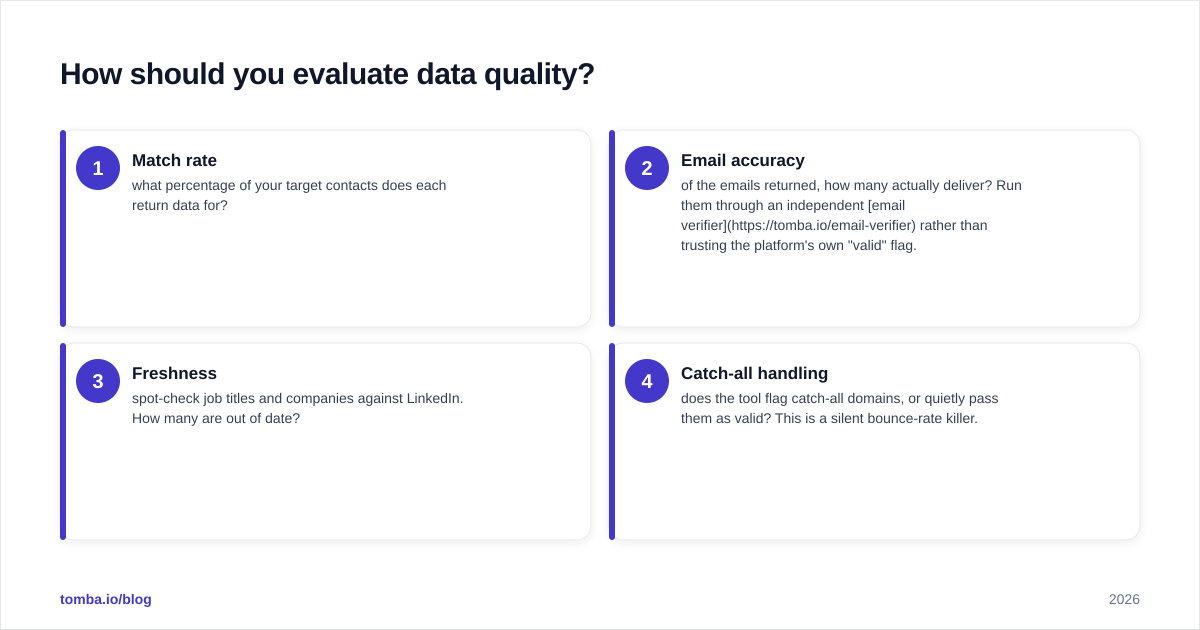
This is where most comparisons get hand-wavy, so be concrete. When you trial Adaptio vs Revli, run the same 100-contact list through both and measure:
- Match rate — what percentage of your target contacts does each return data for?
- Email accuracy — of the emails returned, how many actually deliver? Run them through an independent email verifier rather than trusting the platform's own "valid" flag.
- Freshness — spot-check job titles and companies against LinkedIn. How many are out of date?
- Catch-all handling — does the tool flag catch-all domains, or quietly pass them as valid? This is a silent bounce-rate killer.
Whatever the marketing pages claim, your bounce rate after the first send is the only benchmark that counts. Industry analysts like Gartner consistently rank data quality as the top predictor of sales-tech ROI — ahead of features, UI, or integrations.
What do Adaptio and Revli both miss?#
Both platforms optimize for what happens after you have a clean, verified contact list. Neither is built to be your primary source of accurate, deliverable email addresses at the contact level — and that's the gap that quietly caps results.
This is where a dedicated finder-and-verifier layer pays for itself. A focused tool like the Tomba Email Finder does one job well: turn a name and domain into a verified, deliverable email. You can run a domain search to map an entire company's reachable contacts, then push clean data into Adaptio's sequences or alongside Revli's signals.
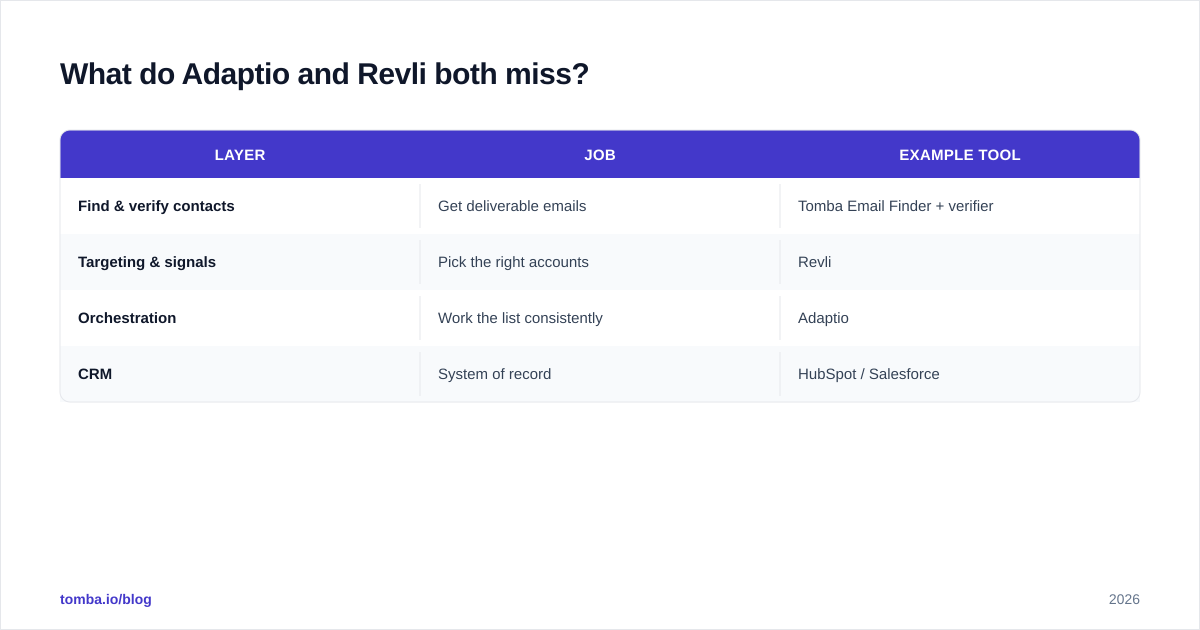
The stack that actually works for most teams looks like this:
| Layer | Job | Example tool |
|---|---|---|
| Find & verify contacts | Get deliverable emails | Tomba Email Finder + verifier |
| Targeting & signals | Pick the right accounts | Revli |
| Orchestration | Work the list consistently | Adaptio |
| CRM | System of record | HubSpot / Salesforce |
You don't have to choose Adaptio or Revli to fix the most expensive problem — bad data. You fix that with data enrichment and verification at the top of the funnel, then let whichever engagement or signal tool you pick do its actual job. Both integrate with the same CRMs anyway, so the data layer feeds all of them.
Which one is right for your team?#
A simple decision framework:
- Choose Adaptio if your reps have leads but execution is inconsistent, you're managing cadences in spreadsheets, and you need pipeline visibility. Seat-based pricing favors small, high-output teams.
- Choose Revli if your reps waste time on research and weak-fit accounts, and you'd reach more with better prioritization. Usage-based pricing favors teams that enrich in bursts rather than constantly.
- Choose both if budget allows and your motion is high-volume — orchestration plus signals is a legitimate combination.
- Choose neither (yet) if your bounce rates are high or your lists are stale. Fix data hygiene first; both tools will perform better for it.
Check current, exact numbers on each vendor's own pricing page before committing — sales-tech pricing changes often, and seat vs credit math flips at different team sizes.
The bottom line#
Adaptio vs Revli isn't really a duel — it's two different bets on where your funnel leaks. Adaptio bets on execution; Revli bets on targeting. Both are reasonable, both are beatable by the wrong assumption: that the data feeding them is good enough.
Before you spend on either, make sure the contacts entering your sequences are real and deliverable. Start with the Tomba Email Finder to source and verify accurate B2B emails by name, domain, or company — there's a free tier (25 searches/month) to test match and accuracy on your own list, with paid plans from $49/mo when you scale. See full Tomba pricing to match a plan to your volume. Clean data first; then let Adaptio or Revli do what it's good at.
// get started
Find, verify and enrich your first contacts today
Start on the free plan with 25 searches a month, then scale when your team is ready.
Free plan · No credit card required · GDPR & CCPA
// about the author