Adaptio vs SignalHire 2026: Which Prospecting Tool Wins?
Adaptio leans on AI-driven signals and execution; SignalHire is a contact-data finder for emails and phones. Here's how the two stack up in 2026 — and where each one actually fits.
TL;DR
- Adaptio is built around AI-driven prospecting and execution — it leans on intent signals, account research, and workflow automation to tell reps who to contact and when.
- SignalHire is a contact-data tool first: it finds verified emails and phone numbers from profiles, with a Chrome extension and bulk lookups as the core experience.
- They overlap on "get me contacts," but they solve different halves of the funnel. Adaptio answers who and when; SignalHire answers how do I reach them.
- For raw email accuracy and cost-per-verified-contact, a dedicated finder like Tomba often beats both — and pairs cleanly with either.
- Pick Adaptio if you want an AI co-pilot for outbound strategy; pick SignalHire if you mostly need phone numbers and emails on demand.
Who are Adaptio and SignalHire?#
Short version: Adaptio is an AI sales-execution platform, and SignalHire is a contact-finder. They get lumped together because both promise "more pipeline," but they attack the problem from opposite ends.
Think of it like building a house. SignalHire is the tool that hands you bricks — verified emails and phone numbers you can act on immediately. Adaptio is more like the project manager that decides which house to build first and in what order. One supplies materials; the other supplies a plan. You can use both, and many teams do.
If you're comparing them head-to-head, the real question isn't "which is better" in the abstract. It's "which half of my prospecting problem hurts more right now — finding the right accounts, or finding the right contact details?"
What does Adaptio do?#
Adaptio positions itself as an AI-led prospecting and execution layer that sits on top of your sales motion. The pitch is that reps waste hours deciding who to contact, researching accounts, and drafting outreach — and that an AI system can compress that into minutes.
In practice, tools in this category typically offer:
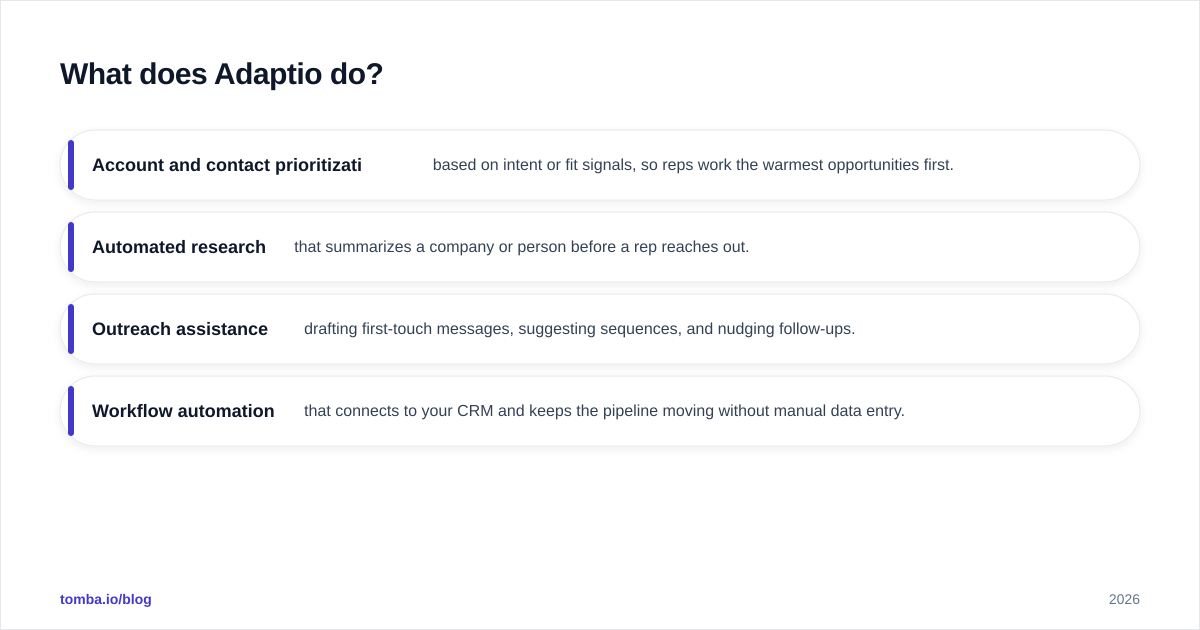
- Account and contact prioritization based on intent or fit signals, so reps work the warmest opportunities first.
- Automated research that summarizes a company or person before a rep reaches out.
- Outreach assistance — drafting first-touch messages, suggesting sequences, and nudging follow-ups.
- Workflow automation that connects to your CRM and keeps the pipeline moving without manual data entry.
The value proposition is time and judgment, not just data. If your reps are competent but spread thin, an AI execution layer aims to give each one the leverage of a small research team. The trade-off is that these platforms are only as good as the signals feeding them — and they still need accurate contact data underneath to actually send anything.
What does SignalHire do?#
SignalHire is a contact-discovery tool focused on returning verified emails and phone numbers. Its center of gravity is the browser extension: you land on a LinkedIn profile or a company page, click, and SignalHire surfaces reachable contact details. It also supports bulk searches and list building for teams that need volume.
The things SignalHire is known for:
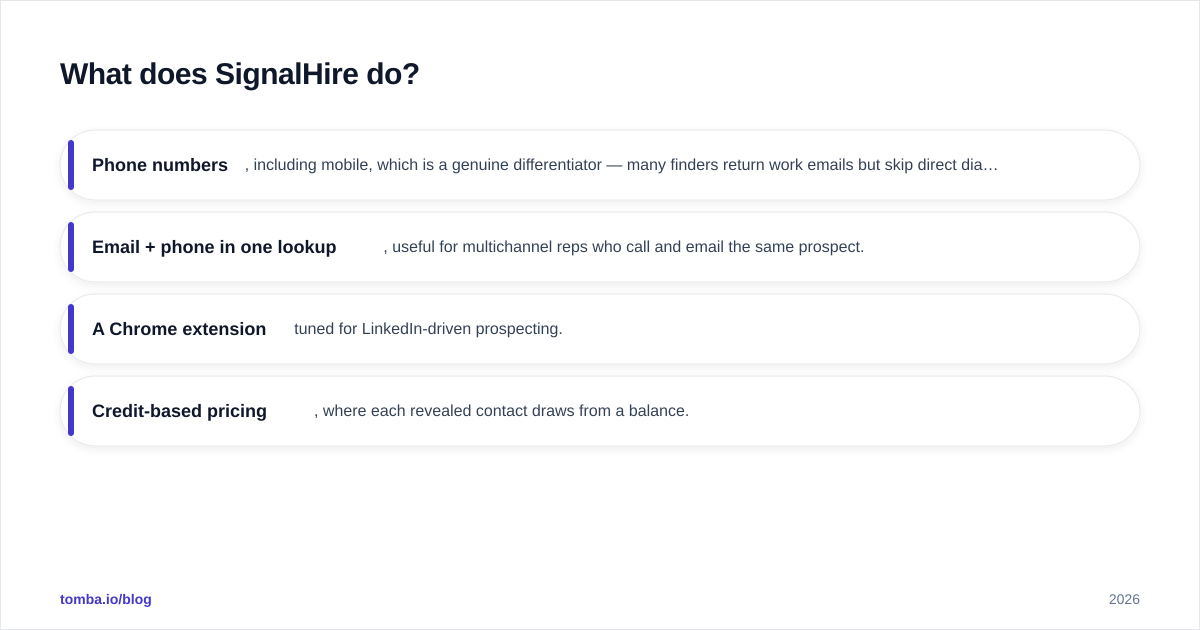
- Phone numbers, including mobile, which is a genuine differentiator — many finders return work emails but skip direct dials.
- Email + phone in one lookup, useful for multichannel reps who call and email the same prospect.
- A Chrome extension tuned for LinkedIn-driven prospecting.
- Credit-based pricing, where each revealed contact draws from a balance.
SignalHire is closer in spirit to tools like RocketReach or ContactOut: you bring a person or a company, it returns the way to reach them. It does not try to decide your strategy for you — and depending on your workflow, that's either refreshingly simple or a missing layer you'll fill elsewhere. You can see how the broader market rates it on G2 before committing.

Adaptio vs SignalHire: how do they compare?#
Here's the side-by-side on the attributes that actually drive a buying decision. Treat the pricing rows as directional — both vendors adjust plans, so confirm current numbers on their sites before you sign.
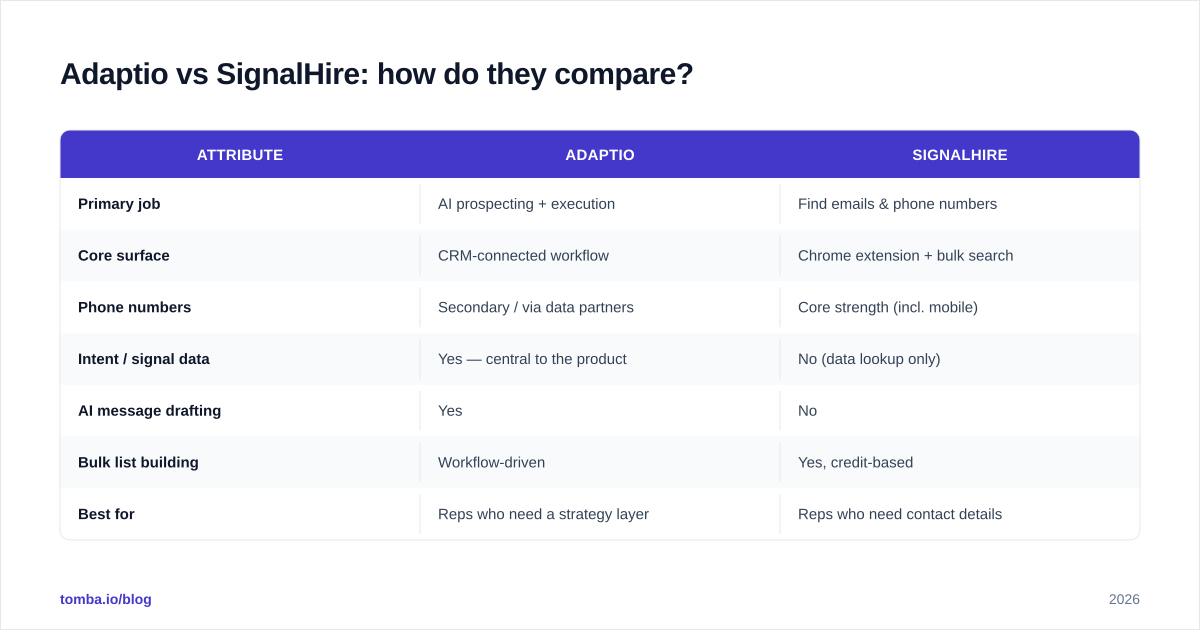
| Attribute | Adaptio | SignalHire |
|---|---|---|
| Primary job | AI prospecting + execution | Find emails & phone numbers |
| Core surface | CRM-connected workflow | Chrome extension + bulk search |
| Phone numbers | Secondary / via data partners | Core strength (incl. mobile) |
| Intent / signal data | Yes — central to the product | No (data lookup only) |
| AI message drafting | Yes | No |
| Bulk list building | Workflow-driven | Yes, credit-based |
| Best for | Reps who need a strategy layer | Reps who need contact details |
| Pricing model | Platform / seat-based | Credit-based, starts low |
| Learning curve | Higher (it's a system) | Low (point and click) |
The pattern is clear: Adaptio is a platform you adopt; SignalHire is a utility you reach for. A platform reshapes how your team works. A utility slots into whatever you already do. Neither is automatically the right call — it depends on whether your bottleneck is process or data.
One more thing worth saying plainly: if your honest problem is "my contact data is wrong and bounces are killing deliverability," neither tool's headline feature solves that. That's a data-quality problem, and it's worth treating it as one. We'll come back to that.
Which one has better data accuracy?#
For pure contact accuracy, judge SignalHire on its verified-data hit rate and Adaptio on the quality of its signals — they're not measuring the same thing.
SignalHire's reputation rests on returning reachable emails and, especially, working phone numbers. The fair benchmark for a finder is: of the contacts it returns, how many are valid and not stale? Phone data decays fast — people change roles and numbers — so any phone-heavy tool lives or dies on refresh frequency.
Adaptio's "accuracy" is a different metric. It's about whether the signals (intent, timing, fit) point reps at the right accounts. A platform can have brilliant prioritization and still hand reps a bad email — because the underlying contact record came from a third-party source that hasn't been re-verified.
This is exactly why a lot of teams run a dedicated verification step regardless of which prospecting tool they buy. Running discovered contacts through an email verifier before a send catches the dead addresses that drag down sender reputation. If you want to understand why that matters, the mechanics of email deliverability are worth ten minutes of reading — bounce rate is a direct input to whether your future emails reach the inbox at all.
A practical rule: never trust a single source's "verified" label blindly. Cross-check. The cost of a second verification pass is trivial compared to the cost of burning a domain.
How do pricing and plans differ?#
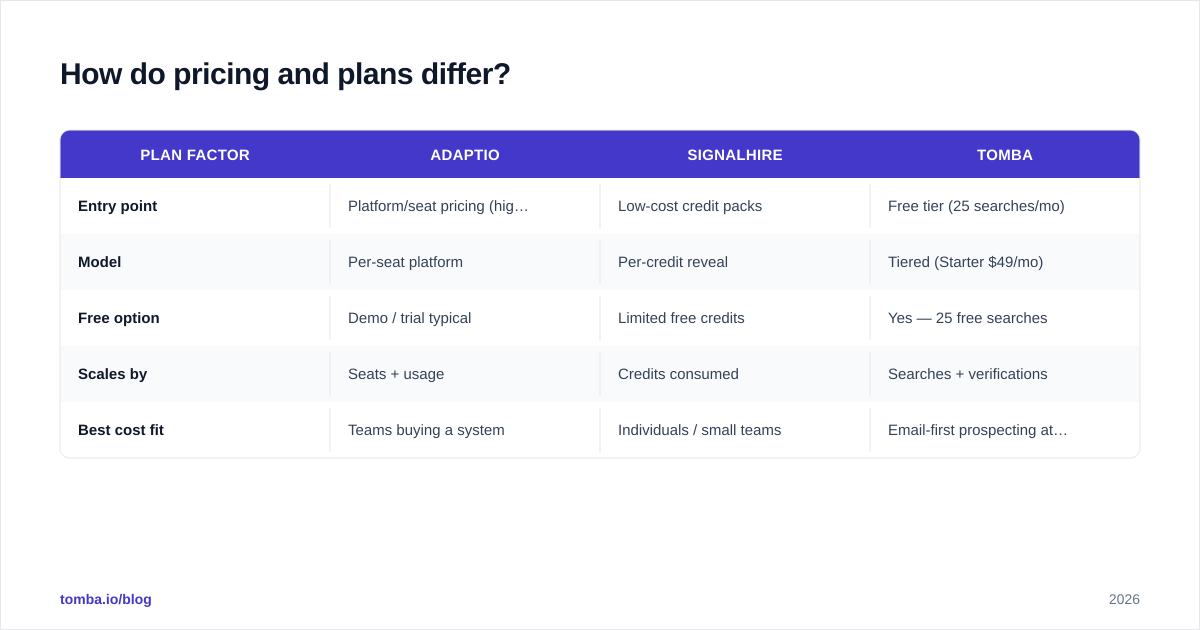
Pricing is where these two diverge most, because they're priced for different buyers.
| Plan factor | Adaptio | SignalHire | Tomba |
|---|---|---|---|
| Entry point | Platform/seat pricing (higher) | Low-cost credit packs | Free tier (25 searches/mo) |
| Model | Per-seat platform | Per-credit reveal | Tiered (Starter $49/mo) |
| Free option | Demo / trial typical | Limited free credits | Yes — 25 free searches |
| Scales by | Seats + usage | Credits consumed | Searches + verifications |
| Best cost fit | Teams buying a system | Individuals / small teams | Email-first prospecting at scale |
SignalHire's credit model is friendly to individuals and small teams — you pay for what you reveal, and the entry cost is low. Adaptio, as a platform, generally carries a higher commitment because you're buying an operating system for outbound, not a pay-as-you-go utility.
If your spend is going mostly toward finding and verifying emails at volume, it's worth pricing that workload separately. A focused finder is usually cheaper per verified contact than either a full platform seat or a phone-heavy credit pack. You can compare the math against Tomba pricing — the Starter plan is $49/mo, with Growth at $99 and Pro at $249, plus a genuine free tier to test accuracy before paying.
Which should you choose for your sales workflow?#
Match the tool to the bottleneck. Here's the decision in plain terms.
Choose Adaptio if:
- Your reps are competent but drowning in research and prioritization.
- You want an AI layer that decides who and when, not just how to reach.
- You're buying for a team and can absorb a platform-level commitment.
- Your CRM is central and you want execution wired into it.
Choose SignalHire if:
- You need phone numbers — especially mobile — alongside emails.
- You prospect heavily from LinkedIn and want a fast extension workflow.
- You're an individual or small team that prefers pay-per-reveal credits.
- You don't want a "system"; you want contacts on demand.
Choose a dedicated finder (like Tomba) if:
- Your main cost driver is finding and verifying email at volume.
- Deliverability matters and you want verification built into the same flow.
- You want an email finder API or bulk email finder to wire into your own stack.
The honest answer for many teams is "more than one." Use an execution platform or a phone-finder for what each does best, and run a cheap, accurate email layer underneath so your sends don't bounce. These tools aren't mutually exclusive — they're layers.
Can you use Adaptio and SignalHire together?#
Yes — and it's a reasonable setup. Adaptio (or any AI execution layer) tells reps which accounts to work; SignalHire fills in the phone numbers; a verification step keeps the email side clean. The stack only breaks when the layers fight each other on data, which is why a single source of truth for verified contacts helps.
If you go multi-tool, decide early which system owns the canonical contact record. Usually that's your CRM, fed by whichever finder you trust most for accuracy. Then enrich leads once, verify, and let the AI layer act on clean data instead of re-discovering the same contacts three times.
The anti-pattern to avoid: buying three overlapping tools that each "find contacts," paying three times for the same person, and still sending to unverified addresses. Layering only works if each tool has a distinct job.
Where does Tomba fit in this comparison?#
Tomba isn't trying to be an AI execution platform or a phone-first finder — it's a focused email-finding and verification engine, and that focus is the point. If the part of this comparison that resonated was "I just need accurate emails, verified, without paying platform prices," that's the gap Tomba fills.
The Tomba Email Finder returns professional emails by name, company, or domain, with verification in the same workflow so you're not stitching two vendors together. There's a free tier (25 searches/month) to test real accuracy on your own list before you commit, then Tomba pricing starts at $49/mo. Need volume? The bulk email finder and domain search handle list building, and the Tomba API drops into whatever Adaptio or SignalHire setup you already run.
Start free, verify your first list, and see how the accuracy compares — then decide which layers of your stack are worth paying platform prices for. Most teams find the email layer isn't one of them.
Ready to find emails that actually work?
Join 150,000+ professionals who stopped guessing and started sending. Free credits on signup — no credit card required.
Get the Tomba newsletter
Practical outbound tactics and product updates — once every two weeks.
About the author