Adaptio vs Startup Tracker: Best B2B Tool in 2026?
Adaptio and Startup Tracker both promise live B2B and startup intelligence. This 2026 breakdown compares data coverage, accuracy, pricing, and fit so you pick the right one.
TL;DR
- Adaptio leans toward adaptive, signal-driven account intelligence — it scores and re-prioritizes accounts as buying signals change, which suits ABM and mid-market sales teams.
- Startup Tracker is built around discovering and monitoring early-stage and high-growth companies — funding rounds, headcount spikes, and new launches — which suits teams selling into startups.
- They overlap on "find companies worth contacting," but they answer different questions: which accounts should I work now? (Adaptio) vs which new companies just became sellable? (Startup Tracker).
- Neither is a contact-data tool first. Both lean on you to turn a company into a real, reachable person — which is where an email finder and enrichment layer matters.
- Pricing and feature claims below are representative of the category in 2026; always confirm current numbers on each vendor's own site before you buy.
What are Adaptio and Startup Tracker?#
The short version: both are B2B company-intelligence tools, but they're tuned for different jobs.
Think of it like two scouts watching the same city. One scout (Adaptio) watches the businesses you already care about and tells you the moment one of them starts behaving like a buyer — new hires, tech changes, a leadership shuffle. The other scout (Startup Tracker) watches the edges of the city for brand-new shops opening their doors — fresh funding, a product launch, a sudden hiring sprint — so you can be the first rep through the door.
Adaptio is positioned as an adaptive account-intelligence layer. The core idea is that account priority isn't static: a company that wasn't a fit last quarter can light up this quarter because it raised money, adopted a competing tool, or started hiring for the role your product serves. Adaptio's pitch is continuous re-scoring against those signals.
Startup Tracker is positioned around discovery and monitoring of emerging companies. If your ICP is "Series A–B SaaS companies that just raised," or "startups that crossed 50 employees in the last 90 days," this is the lens. It's a feed of new and growing entities plus the metadata around them.
If you want the textbook definition of this whole space, Gartner's sales intelligence category is a reasonable neutral reference, and peer reviews on G2 help you sanity-check vendor claims against real users.
How do Adaptio and Startup Tracker actually differ?#
The cleanest way to separate them is by the question each one is best at answering.
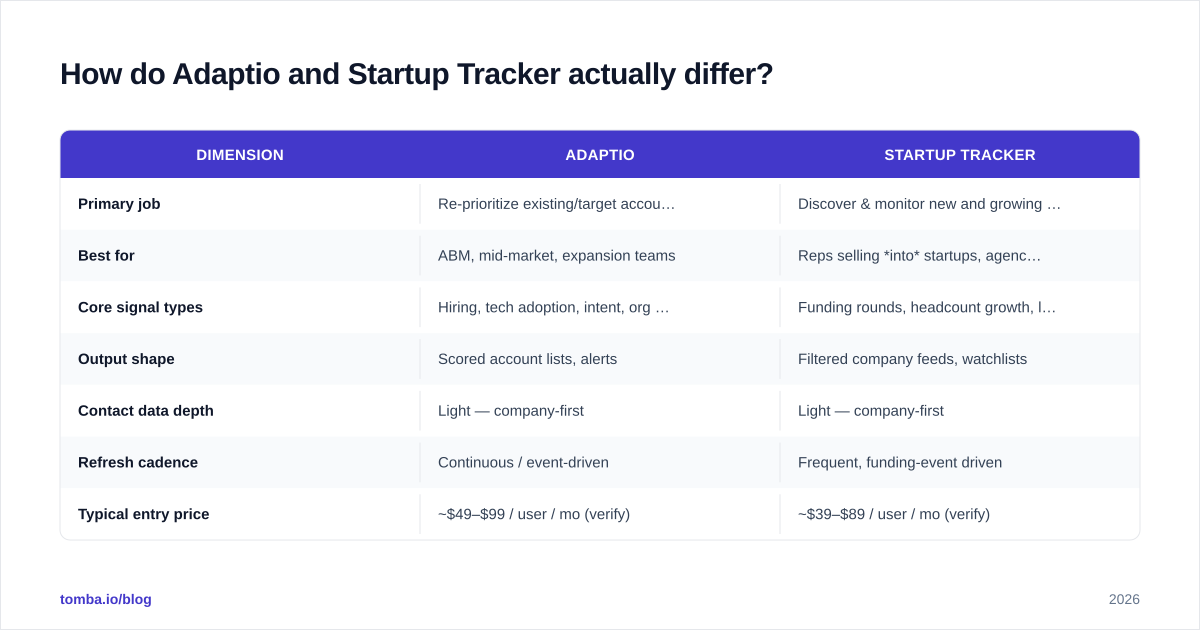
| Dimension | Adaptio | Startup Tracker |
|---|---|---|
| Primary job | Re-prioritize existing/target accounts | Discover & monitor new and growing companies |
| Best for | ABM, mid-market, expansion teams | Reps selling into startups, agencies, fintech |
| Core signal types | Hiring, tech adoption, intent, org changes | Funding rounds, headcount growth, launches |
| Output shape | Scored account lists, alerts | Filtered company feeds, watchlists |
| Contact data depth | Light — company-first | Light — company-first |
| Refresh cadence | Continuous / event-driven | Frequent, funding-event driven |
| Typical entry price | ~$49–$99 / user / mo (verify) | ~$39–$89 / user / mo (verify) |
| Weak spot | Less useful for net-new discovery | Less useful for working a fixed account list |
The pattern: Adaptio is a prioritization engine, Startup Tracker is a discovery engine. A team with a defined named-account list gets more from Adaptio. A team whose whole motion is "find companies that didn't exist as buyers six months ago" gets more from Startup Tracker.

Signal quality and freshness#
Both tools live or die on freshness. A funding round you hear about three weeks late is a round three other vendors already called on. Startup Tracker's whole value proposition rests on catching events fast, so evaluate it on latency — how quickly a new round or launch appears after it's public.
Adaptio's value rests on relevance — does the re-scoring actually move the right accounts up? A scoring model that flags every account as "hot" is noise. Run a two-week pilot and check whether the accounts it elevates match the deals your reps would have manually chosen.
Coverage and bias#
Discovery tools tend to over-index on the regions and sectors their data partners cover well — often US tech and venture-backed SaaS. If you sell into European mid-market manufacturing, test coverage there before committing. This is the same coverage question you'd ask of any B2B database: breadth is meaningless if it misses your slice of the market.
Which one is better for cold outreach?#
Neither — on its own. Here's the honest gap: both tools are excellent at telling you which company to contact and weak at telling you which human to email and what their address is.
A signal like "Acme just raised a Series B and is hiring three RevOps managers" is gold. But you can't send a signal an email. You still need:
- The right person (the RevOps lead, not a generic info@).
- Their verified work email.
- Enough context to write something that isn't generic.
That last mile is where a dedicated contact layer earns its place next to either tool. You can take a company surfaced by Adaptio or Startup Tracker, run a domain search to pull the email pattern and known contacts, then use an email finder to get the specific decision-maker's address. Layering data enrichment on top fills in title, seniority, and social profiles so your first line isn't "Hi there."
This is why "Adaptio vs Startup Tracker" is often the wrong framing. The real stack is one intelligence tool + one contact/verification tool. The intelligence tool tells you where to dig; the contact tool hands you the shovel.

How do they compare on pricing and value?#
Pricing in this category moves quarterly, so treat the numbers below as directional and confirm on each vendor's pricing page before you commit budget.
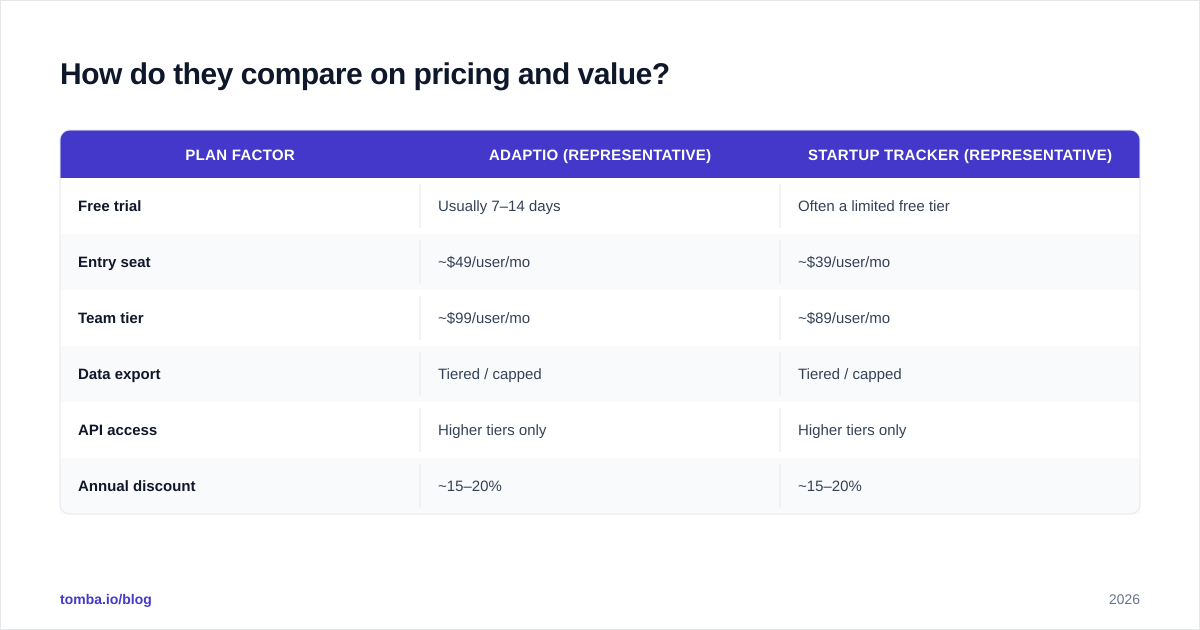
| Plan factor | Adaptio (representative) | Startup Tracker (representative) |
|---|---|---|
| Free trial | Usually 7–14 days | Often a limited free tier |
| Entry seat | ~$49/user/mo | ~$39/user/mo |
| Team tier | ~$99/user/mo | ~$89/user/mo |
| Data export | Tiered / capped | Tiered / capped |
| API access | Higher tiers only | Higher tiers only |
| Annual discount | ~15–20% | ~15–20% |
A few buying notes that hold regardless of the exact figures:
- Per-seat pricing punishes large teams. If you have 20 reps, a $50/seat difference is $12,000/year. Model total cost, not sticker price.
- Export caps are the hidden tax. A cheap plan that caps you at 500 exports a month can cost more in practice than a pricier plan with generous limits.
- API access usually sits on the top tier. If you plan to pipe signals into your CRM or a custom workflow, price the tier you'll actually need, not the entry tier.
For contrast, a contact-data tool like Tomba prices on lookups rather than per-seat — the free tier covers 25 searches a month, Starter is $49/mo, and Growth is $99/mo. You can see the full breakdown on the Tomba pricing page. The point isn't that one model is "better"; it's that intelligence tools and contact tools price on different axes, so budgeting for both separately is normal.
What do the pros and cons look like?#
Adaptio — strengths
- Strong at keeping a fixed account list ranked by real-time fit.
- Reduces "which account do I call first?" paralysis.
- Plays well with an established ABM motion.
Adaptio — weaknesses
- Weaker for true net-new discovery outside your existing universe.
- Scoring is only as good as the signals feeding it — garbage in, garbage out.
- Can encourage tunnel vision on already-known accounts.
Startup Tracker — strengths
- Fast at surfacing newly fundable, newly sellable companies.
- Excellent for timing-sensitive plays (sell right after a raise).
- Great top-of-funnel volume for SMB/startup-focused reps.
Startup Tracker — weaknesses
- Less useful once you've defined a finite named-account list.
- Volume can become noise without tight filters.
- Coverage skews toward venture-backed tech.
You'll notice both "weakness" lists circle the same theme: the tool gives you companies, not conversations. The conversation depends on the contact layer you add.
Which should you choose?#
Decide by motion, not by feature count.
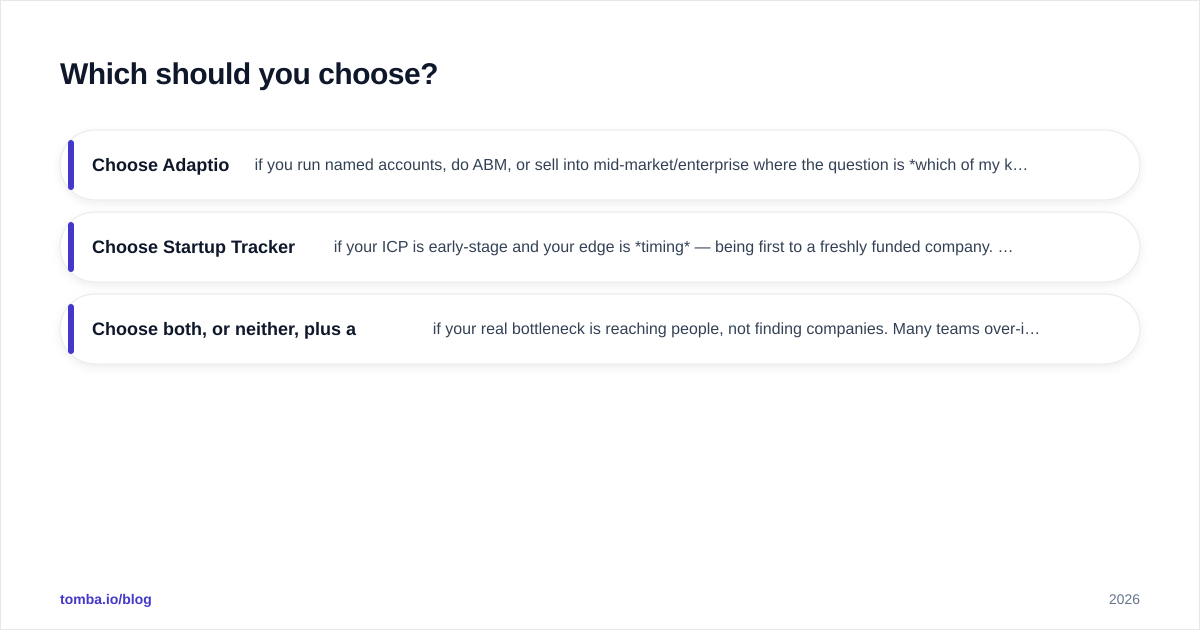
- Choose Adaptio if you run named accounts, do ABM, or sell into mid-market/enterprise where the question is which of my known targets is ready now. Pair it with an email verifier so the contacts you prioritize don't bounce.
- Choose Startup Tracker if your ICP is early-stage and your edge is timing — being first to a freshly funded company. Pair it with a bulk email finder so you can act on a whole new cohort in one pass instead of one company at a time.
- Choose both, or neither, plus a contact tool if your real bottleneck is reaching people, not finding companies. Many teams over-invest in a second intelligence subscription when their conversion gap is actually bad or missing email data.
Before you sign anything, cross-check current feature sets and user sentiment on Capterra — vendor pages age fast, and the category shifts every quarter.
A simple test: take ten companies each tool surfaces this week. For each, can you, within five minutes, produce a verified email for the right decision-maker and one specific reason to reach out? If yes, the tool is pulling its weight. If you keep stalling at "I have the company but not the person," your next purchase isn't another tracker — it's a contact and verification layer.
The bottom line#
Adaptio and Startup Tracker aren't really rivals; they're specialists. Adaptio re-ranks the accounts you already chose. Startup Tracker finds accounts you didn't know to chase yet. Pick based on whether your gap is prioritization or discovery — and don't let either one's company-level data fool you into skipping the part where you turn a company into a real, reachable human.
That last mile is exactly what Tomba is built for. Feed it a domain or a name from whichever intelligence tool you choose, and the Tomba Email Finder returns verified, deliverability-checked email addresses for the specific people you want to reach — with enrichment and bulk processing when you're working a whole cohort. Start free with 25 searches a month, and turn your signals into actual conversations.
// get started
Find, verify and enrich your first contacts today
Start on the free plan with 25 searches a month, then scale when your team is ready.
Free plan · No credit card required · GDPR & CCPA
// about the author