Adaptio vs Stirista (2026): B2B Audience Data Compared
Adaptio vs Stirista compared for 2026: identity data, activation channels, pricing models, and which platform fits your GTM data stack.
TL;DR
- Adaptio leans toward AI-driven audience modeling and adaptive media activation — its strength is turning signals into optimized ad delivery.
- Stirista is an identity-data and omnichannel activation platform — its strength is a deterministic identity graph that links email, postal, device, and CTV.
- Neither is a prospecting tool. They activate audiences; they don't hand you the verified work email or direct dial of a named decision-maker.
- For account-level outbound, you still need a contact-data layer. That's where an email finder and data enrichment fit alongside either platform.
- Pick by job-to-be-done: media reach and lookalikes → Adaptio; identity resolution and multichannel activation → Stirista; named-contact outbound → a dedicated finder.
What are Adaptio and Stirista?#
Short version: both are B2B audience-data platforms, but they solve different halves of the same funnel.
Think of it like a concert. Stirista is the guest list and the door — it knows who a person is across email, mailing address, device IDs, and connected TV, and it can resolve fragmented identifiers back to one real human or household. Adaptio is the sound engineer — it takes those signals and tunes how and where the message plays, optimizing media delivery against an audience model in near real time.
Stirista is the more established name in the identity-data space, with a published data and identity offering spanning programmatic, email, and CTV activation. Adaptio sits closer to the adaptive-media and AI-optimization end of the market. Because both vendors update positioning frequently, verify current specifics on their own sites and on third-party review hubs like G2 before you sign — vendor categories in this space shift fast, and analysts at Gartner reclassify identity and activation tooling almost yearly.
The framework above is the lens for the rest of this post: resolve → model → activate → contact. Stirista is strongest at resolve, Adaptio at model + activate, and neither owns contact — the verified, named-person layer.

How do Adaptio and Stirista compare head to head?#
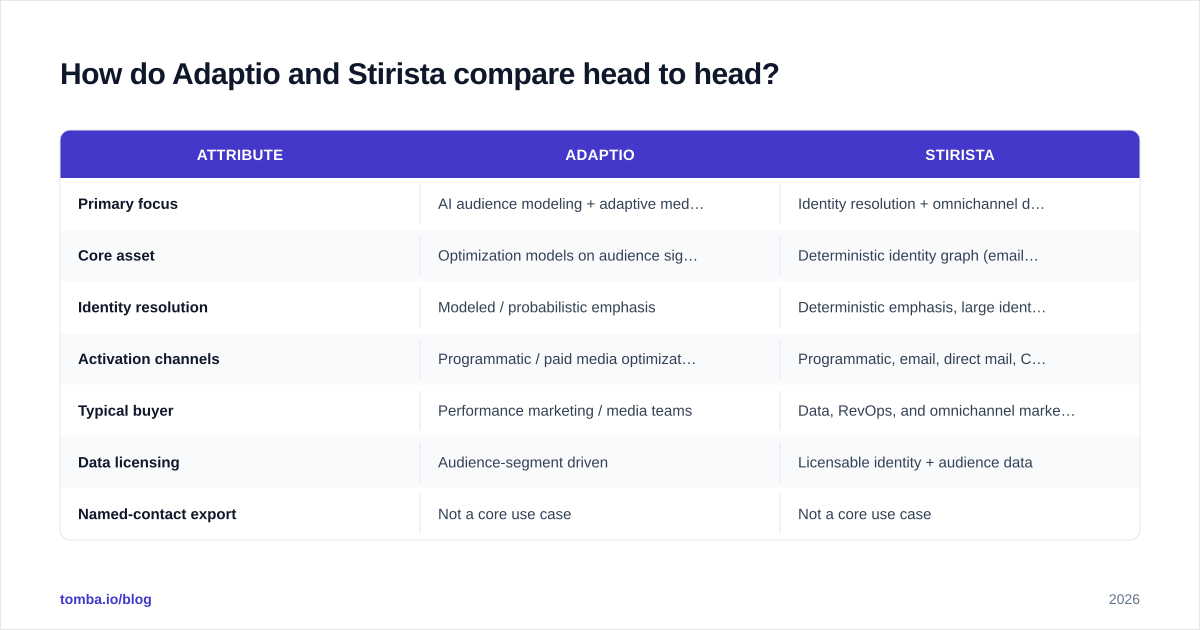
Here's the at-a-glance comparison. Treat capability rows as directional — confirm against a live demo with your own data.
| Attribute | Adaptio | Stirista |
|---|---|---|
| Primary focus | AI audience modeling + adaptive media activation | Identity resolution + omnichannel data activation |
| Core asset | Optimization models on audience signals | Deterministic identity graph (email, postal, device, CTV) |
| Identity resolution | Modeled / probabilistic emphasis | Deterministic emphasis, large identity graph |
| Activation channels | Programmatic / paid media optimization | Programmatic, email, direct mail, CTV |
| Typical buyer | Performance marketing / media teams | Data, RevOps, and omnichannel marketing teams |
| Data licensing | Audience-segment driven | Licensable identity + audience data |
| Named-contact export | Not a core use case | Not a core use case |
| Best for | Squeezing ROAS from existing audiences | Stitching fragmented identity into one view |
| Pricing model | Custom / usage-based (request quote) | Custom / data-volume based (request quote) |
The honest takeaway: this is not a "which is better" contest, it's a "which job" contest. If your problem is my media spend is leaking because my audiences are fuzzy, Adaptio's modeling angle is the closer fit. If your problem is I have the same customer showing up as five different records across five channels, Stirista's identity graph is the closer fit.
Which platform fits identity resolution better?#
Stirista, in most cases. Identity resolution is its center of gravity.
Identity resolution is the plumbing that connects a hashed email, a cookie, a postal address, and a CTV device back to one person or household. When that plumbing is deterministic — matched on known, verified linkages rather than statistical guesses — your audiences are cleaner and your suppression lists actually suppress. Stirista positions its graph as a deterministic-first asset, which matters for compliance-sensitive channels like direct mail and email where a wrong match is expensive.
Adaptio can consume resolved identity, but its differentiation is what happens after resolution: modeling lookalikes, predicting response, and adjusting delivery. If you already have a strong identity source (a CDP, or Stirista itself), Adaptio's job becomes activating it more efficiently.
A practical pattern some teams run: Stirista (or an equivalent graph) resolves identity, Adaptio optimizes the media, and a contact-data layer fills the gap for sales. Which brings us to the part both platforms quietly leave open.
Where do both platforms leave a gap for sales teams?#
The named-contact layer. Audience platforms are built for reach at scale, not one verified person at one account.
Here's the disconnect. Marketing activates a 40,000-record CTV audience through Stirista, and a modeled lookalike through Adaptio. Sales then asks: "Great — who at Acme Corp do I actually email, and what's their real address?" Audience platforms don't answer that. They deal in segments, hashes, and device graphs, not "jane.doe@acme.com, verified, VP of Engineering."
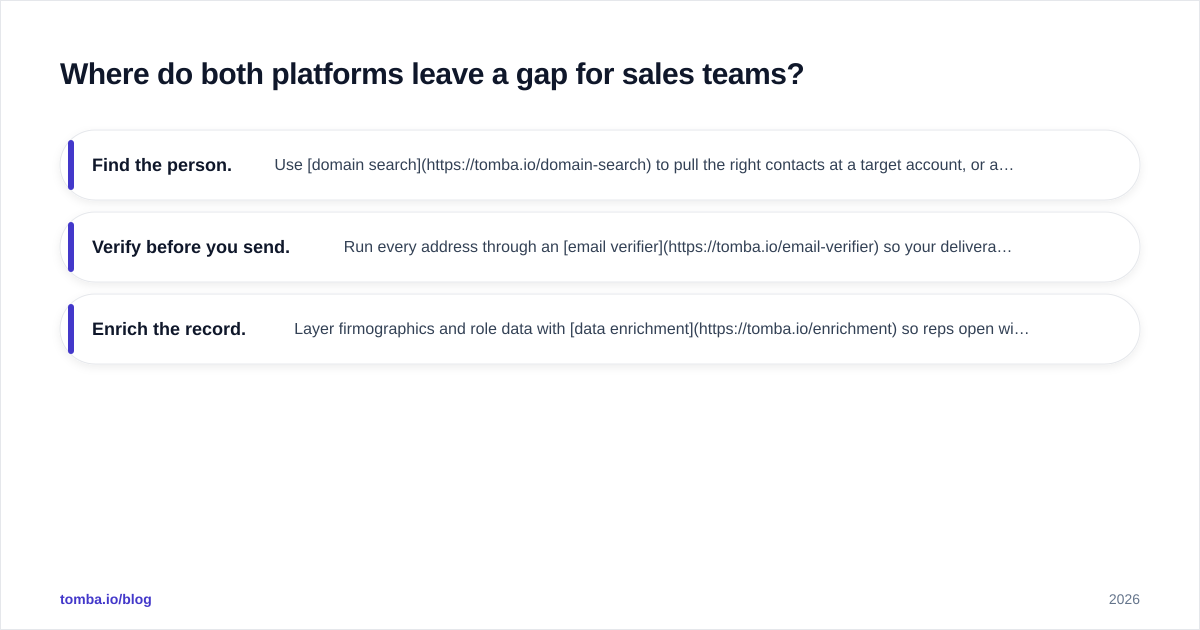
That gap is exactly what a contact-data stack closes:
- Find the person. Use domain search to pull the right contacts at a target account, or an email finder to resolve a known name to a work address.
- Verify before you send. Run every address through an email verifier so your deliverability and sender reputation survive the campaign.
- Enrich the record. Layer firmographics and role data with data enrichment so reps open with context, not a cold guess.
This isn't a knock on either Adaptio or Stirista — it's a scope reality. Audience reach and named-contact outbound are different muscles. The strongest GTM stacks run both.
What does Adaptio vs Stirista cost in 2026?#
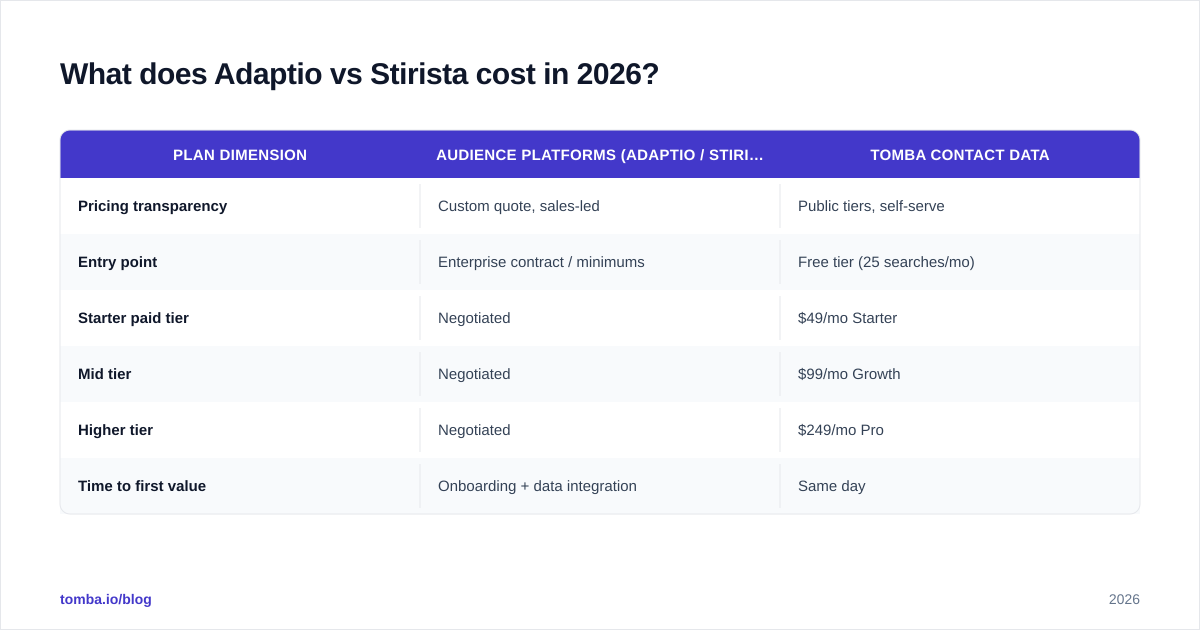
Both are quote-based, not self-serve. Expect custom pricing tied to data volume, audience size, channels, and contract length — neither publishes a public price card, so budget for a sales cycle and a minimum commitment.
That matters for stack planning. If you're a smaller team that needs contact data tomorrow without an enterprise data contract, an audience platform is the wrong first purchase. A transparent, self-serve contact tool gets you moving in minutes. For reference, here's how a contact-data layer is typically priced versus the enterprise-data model:
| Plan dimension | Audience platforms (Adaptio / Stirista) | Tomba contact data |
|---|---|---|
| Pricing transparency | Custom quote, sales-led | Public tiers, self-serve |
| Entry point | Enterprise contract / minimums | Free tier (25 searches/mo) |
| Starter paid tier | Negotiated | $49/mo Starter |
| Mid tier | Negotiated | $99/mo Growth |
| Higher tier | Negotiated | $249/mo Pro |
| Time to first value | Onboarding + data integration | Same day |
See current Tomba pricing for exact tiers. The point isn't that one replaces the other — it's that the contact layer is cheap and fast to add, so there's little reason to leave the named-contact gap open while you negotiate an audience contract.
When should you choose Adaptio over Stirista (and vice versa)?#
Match the tool to the bottleneck:
- Choose Adaptio when your audiences already exist and the problem is efficiency — wasted impressions, weak lookalikes, flat ROAS. Its modeling-and-activation angle is built to optimize spend against signals you already have.
- Choose Stirista when your problem is fragmentation — the same customer appearing as different records across email, mail, and CTV, or you need a licensable identity/audience source to feed downstream tools. Deterministic resolution is the differentiator.
- Choose both when you run large multichannel programs: resolve identity with Stirista, optimize media with Adaptio.
- Choose neither (yet) when your real need is sales-ready, named-contact outbound. Start with a finder-and-verifier stack and add an audience platform once you're spending enough on media to justify it.
A useful gut check: if your KPI is cost per thousand impressions or match rate, you're in audience-platform territory. If your KPI is replies from named decision-makers, you're in contact-data territory. Don't buy a $50k identity contract to solve a problem a bulk email finder solves for a fraction of the cost.
How do you combine audience data with verified contact data?#
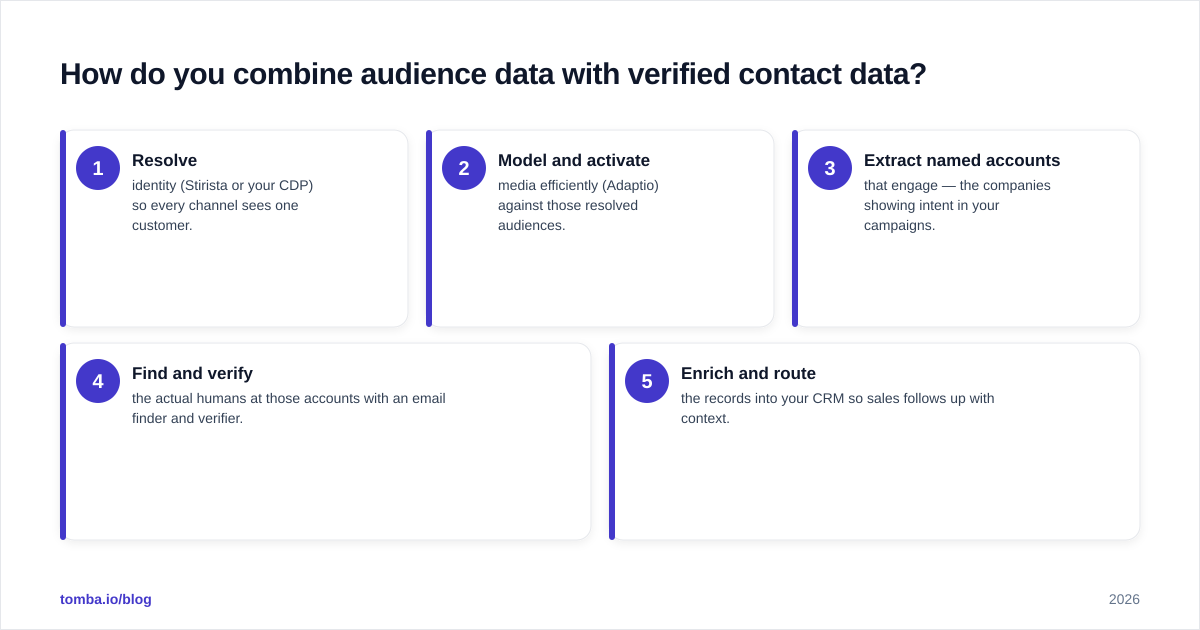
Run them as layers, not competitors. A clean sequence:
- Resolve identity (Stirista or your CDP) so every channel sees one customer.
- Model and activate media efficiently (Adaptio) against those resolved audiences.
- Extract named accounts that engage — the companies showing intent in your campaigns.
- Find and verify the actual humans at those accounts with an email finder and verifier.
- Enrich and route the records into your CRM so sales follows up with context.
Steps 1–2 are the audience platforms' job. Steps 4–5 are the contact layer's job. Step 3 is the handoff most teams fumble — they generate engagement at the audience level but never convert it into named, contactable people. Closing that handoff is usually the highest-leverage fix in the whole stack, and it costs almost nothing relative to the media budget above it.
The bottom line#
Adaptio and Stirista are both legitimate B2B audience-data platforms aimed at different jobs — Adaptio at AI-driven media optimization, Stirista at deterministic identity resolution and omnichannel activation. Neither is a prospecting tool, and treating either as one leaves your sales team without the verified, named contacts they actually need to send.
If your immediate problem is reaching real decision-makers — not modeling audiences — start with the contact layer. Tomba's Email Finder turns a name and company into a verified work email in seconds, with a free tier to test it before you commit and no enterprise contract to negotiate. Pair it with verification and enrichment, and you've closed the exact gap that Adaptio and Stirista leave open. Find the people behind the audience, verify them, and let your media platform do what it does best.
// get started
Find, verify and enrich your first contacts today
Start on the free plan with 25 searches a month, then scale when your team is ready.
Free plan · No credit card required · GDPR & CCPA
// about the author