Adaptio vs Techsalerator 2026: B2B Data Platform Compared
Adaptio vs Techsalerator compared on coverage, accuracy, pricing, and fit. See which B2B data platform earns your 2026 budget — and where a leaner stack wins.
You are evaluating two B2B data vendors with very different DNA, and the brochures will not tell you which one fits your motion. This breakdown does.
TL;DR — Adaptio vs Techsalerator at a glance#
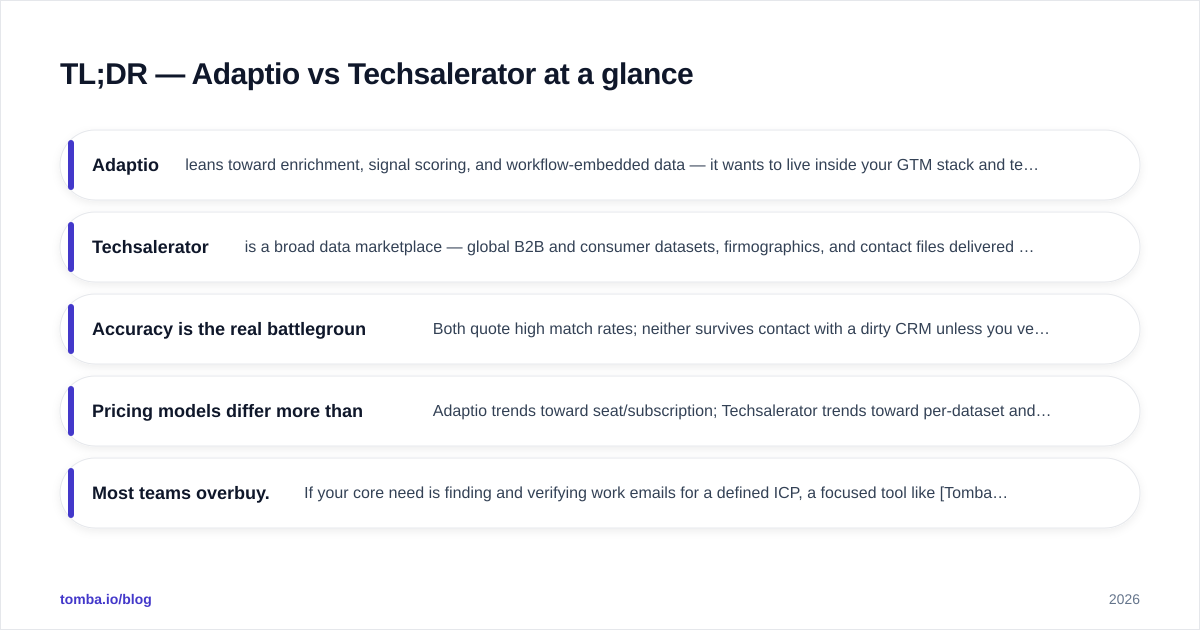
- Adaptio leans toward enrichment, signal scoring, and workflow-embedded data — it wants to live inside your GTM stack and tell you who to act on now.
- Techsalerator is a broad data marketplace — global B2B and consumer datasets, firmographics, and contact files delivered in bulk or via API, priced per dataset.
- Accuracy is the real battleground. Both quote high match rates; neither survives contact with a dirty CRM unless you verify on ingestion.
- Pricing models differ more than the features. Adaptio trends toward seat/subscription; Techsalerator trends toward per-dataset and volume licensing — that single difference often decides the deal.
- Most teams overbuy. If your core need is finding and verifying work emails for a defined ICP, a focused tool like Tomba's email finder covers it at a fraction of a full-platform contract.
What is Adaptio?#
Adaptio positions itself as a go-to-market intelligence layer rather than a raw list vendor. The pitch is enrichment plus prioritization: take the accounts and contacts you already have, append firmographic and technographic attributes, then surface buying signals so reps spend time on the highest-propensity targets.
Think of it like a sommelier rather than a wine warehouse. A warehouse sells you everything by the case; a sommelier looks at what you're cooking tonight and hands you the three bottles that fit. Adaptio's value proposition is the second one — curation and timing, not sheer volume. Technically, that means it emphasizes CRM-embedded enrichment, scoring models, and intent or engagement signals over a downloadable database you manage yourself.
That design choice has consequences. Platforms built around signals and scoring are sticky — they reward teams with a defined revenue operations function who can operationalize the output. Drop the same tool on a two-person sales team with no process and most of the value evaporates.
What is Techsalerator?#
Techsalerator is a data provider and marketplace. Its catalog spans global B2B firmographics, contact records, consumer data, and specialized datasets across regions and industries. You typically license a dataset — by geography, sector, or record count — and receive it as a file or pull it through an API.
Back to the analogy: Techsalerator is the warehouse. Enormous breadth, international coverage, and the flexibility to buy exactly the slice you need. If you're expanding into a market where domestic tools have thin coverage, a marketplace model is genuinely useful — you can acquire a country-specific dataset that a US-centric enrichment platform simply doesn't hold.
The trade-off is that breadth and freshness pull in opposite directions. A massive multi-region catalog is harder to keep current than a narrow, continuously re-verified one. So the question you must ask Techsalerator (and any marketplace) is not "how many records?" but "when was this dataset last validated, and what's your bounce guarantee?"
Adaptio vs Techsalerator: the core comparison#
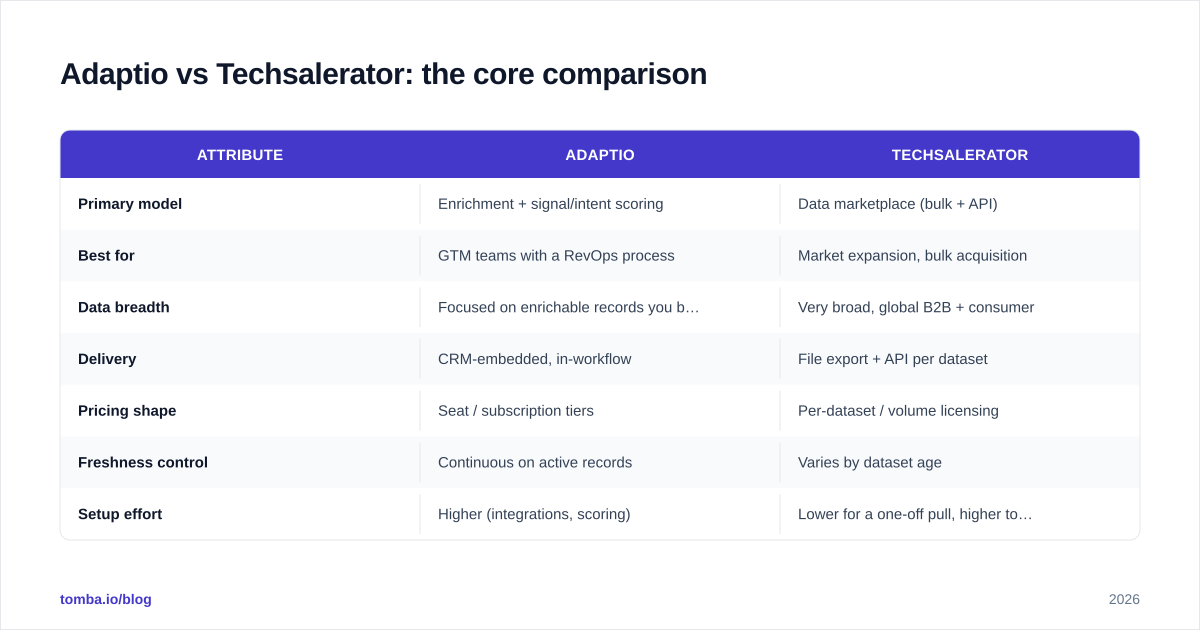
Here is the head-to-head on the attributes that actually move a buying decision. Treat vendor-published match rates as ceilings, not averages — your realized accuracy depends on your ICP and how aggressively you verify.
| Attribute | Adaptio | Techsalerator |
|---|---|---|
| Primary model | Enrichment + signal/intent scoring | Data marketplace (bulk + API) |
| Best for | GTM teams with a RevOps process | Market expansion, bulk acquisition |
| Data breadth | Focused on enrichable records you bring | Very broad, global B2B + consumer |
| Delivery | CRM-embedded, in-workflow | File export + API per dataset |
| Pricing shape | Seat / subscription tiers | Per-dataset / volume licensing |
| Freshness control | Continuous on active records | Varies by dataset age |
| Setup effort | Higher (integrations, scoring) | Lower for a one-off pull, higher to operationalize |
| Verification | Built into enrichment flow | Often your responsibility on ingest |
)
Which has better data accuracy?#
Neither vendor wins accuracy on reputation alone — you win it on verification discipline. A record that was correct at purchase decays roughly 2–2.5% per month as people change jobs, which compounds to a quarter of your list going stale within a year. That is true of Adaptio's enriched records and Techsalerator's licensed files alike.
The structural edge goes to whichever model re-validates closest to the moment of use. Adaptio's continuous enrichment on active CRM records has an advantage here, because it touches a contact when a rep is about to act on it. A bulk dataset is a photograph; an enrichment stream is a live feed. But the photograph is cheaper and perfectly fine if you verify before you send.
That is exactly where a dedicated email verifier belongs in either workflow — run any list, from either vendor, through verification before it enters a sequence. It is the single highest-ROI step in B2B data hygiene, and it is vendor-agnostic. For deeper context on bounce avoidance, the email deliverability fundamentals haven't changed: clean lists protect sender reputation, and reputation protects inbox placement.
)
Which is easier to deploy?#
Techsalerator wins the first 48 hours; Adaptio wins the first 90 days.
A one-off Techsalerator dataset can be in your hands and loaded into a CRM the same week — buy the slice, get the file, import. Adaptio asks more upfront: integrations, field mapping, scoring configuration, and someone to own the signals. But once that investment is made, Adaptio keeps paying it back automatically, while a static file starts decaying the day it lands.
So "easier" depends entirely on your horizon. Running a single outbound campaign into a new vertical? The marketplace path is faster. Building a repeatable inbound-plus-outbound engine you'll run for years? The embedded platform amortizes better.
How should you choose between Adaptio and Techsalerator?#
Use a three-question filter instead of a feature checklist.
1. Is your bottleneck finding accounts or prioritizing them? If your TAM is clear and you just need to know who's in-market this quarter, Adaptio's signal model is the right shape. If you can't even assemble the account universe — especially abroad — Techsalerator's catalog fills the gap first.
2. Do you have someone to operationalize signals? Intent and scoring are worthless without a play attached. No RevOps owner, no defined cadence? You'll extract more from a clean list and a tight sequence than from a scoring engine nobody actions.
3. What's your buying rhythm? Continuous programs reward subscriptions. Episodic, project-based pushes — a conference, a regional launch — reward per-dataset licensing where you pay only for what you pull.
For a structured way to map vendor capabilities to your funnel stages, frameworks like G2's grid and Gartner's market guides are useful sanity checks against vendor self-description — read the deployment and freshness reviews, not just the star ratings.
When is neither the right answer?#
Often. Full-platform and full-marketplace contracts solve problems many teams don't actually have yet.
If you strip a typical early outbound motion down to its load-bearing parts, you need three things: a way to find the right contacts at target companies, confidence those contacts are reachable, and the ability to push them into your CRM. You do not need a global consumer dataset or a multi-model scoring engine to send 200 well-targeted emails a week.
This is where a focused stack beats a platform on cost and time-to-value:
- Targeted discovery — domain search returns the verified contacts at a specific company, so you build account lists without licensing a region you'll never touch.
- Verification on ingest — every address checked before it costs you a bounce.
- Bulk when you scale — a bulk email finder handles volume once a play proves out, without a per-dataset negotiation each time.
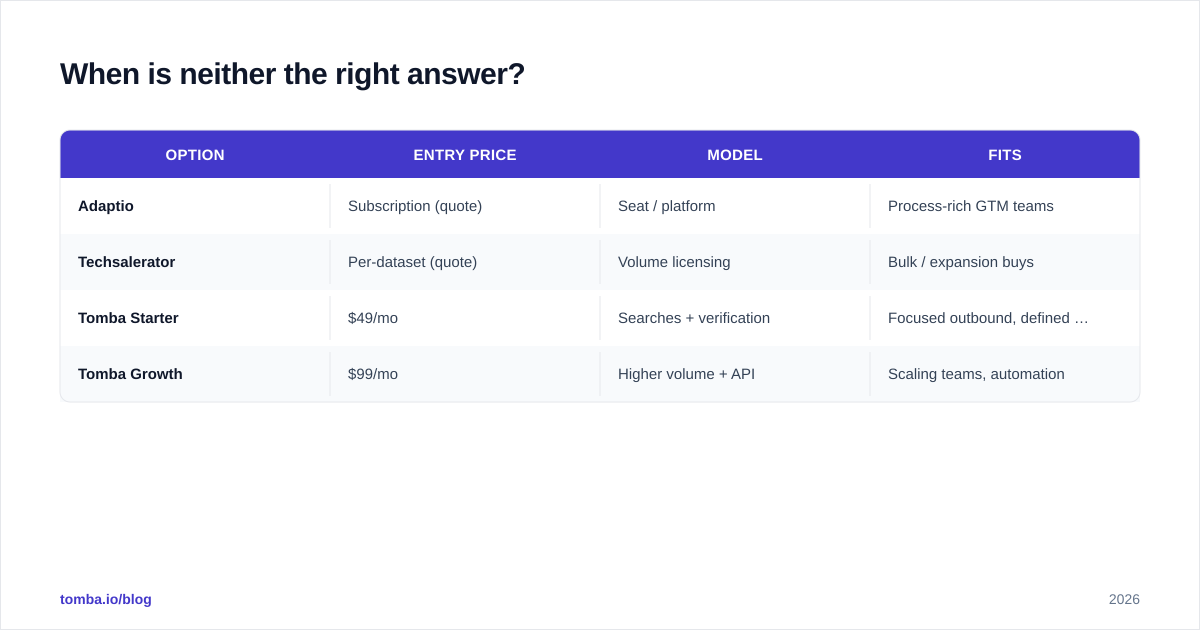
Compare the entry economics directly:
| Option | Entry price | Model | Fits |
|---|---|---|---|
| Adaptio | Subscription (quote) | Seat / platform | Process-rich GTM teams |
| Techsalerator | Per-dataset (quote) | Volume licensing | Bulk / expansion buys |
| Tomba Starter | $49/mo | Searches + verification | Focused outbound, defined ICP |
| Tomba Growth | $99/mo | Higher volume + API | Scaling teams, automation |
Tomba's Free tier (25 searches/month) lets you validate the workflow before any spend — a luxury enterprise data contracts rarely offer. Full Tomba pricing runs Starter $49/mo, Growth $99/mo, Pro $249/mo, and custom Enterprise.
What about integration and API access?#
All three approaches expose an API; the difference is what flows through it.
Adaptio's API is enrichment-shaped: send identifiers, receive appended attributes and scores in your workflow. Techsalerator's is delivery-shaped: query and retrieve records from licensed datasets. A focused tool's API is task-shaped — the Tomba API finds and verifies on demand, which is what you wire into a sequencer or a HubSpot integration when you want enrichment at the point of capture rather than as a quarterly batch.
The practical test for any of them: can a non-engineer trigger it from the tools they already use? Native connectors to your CRM and outreach platform matter more than raw endpoint count, because the data only creates value once it reaches the rep without a manual export step in between. If your evaluation involves authoritative deliverability or CRM guidance, vendor docs like HubSpot's knowledge base are worth checking for integration-specific gotchas before you commit.
The honest verdict#
There is no universal winner, and any post claiming one is selling something.
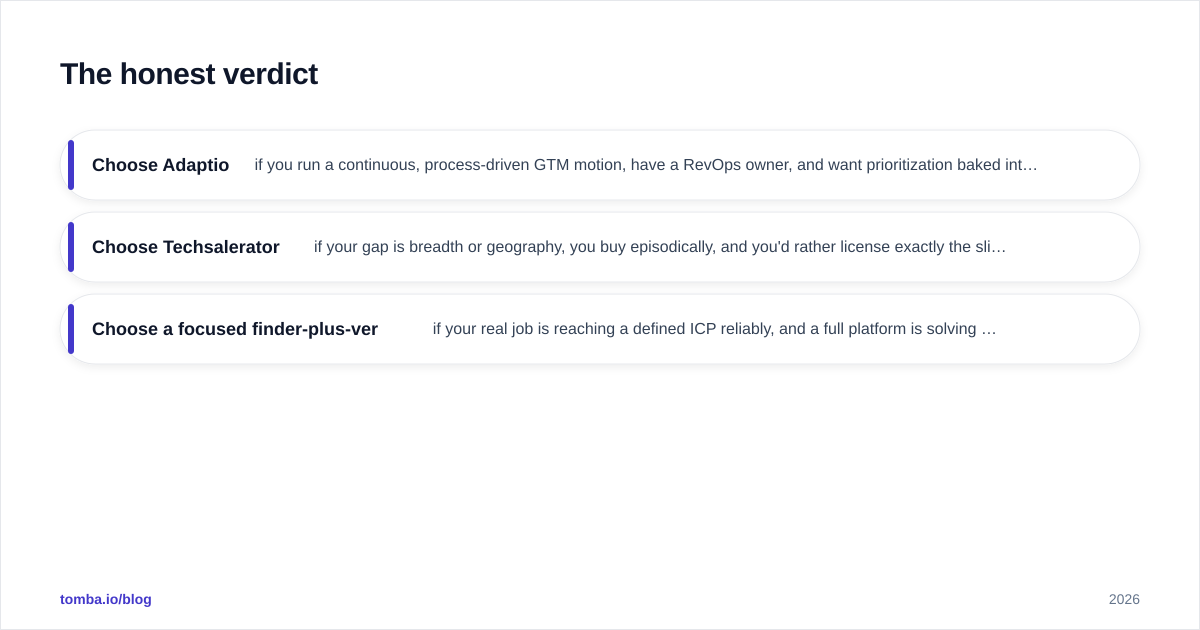
- Choose Adaptio if you run a continuous, process-driven GTM motion, have a RevOps owner, and want prioritization baked into the workflow. You're paying for timing and curation — make sure you have the team to act on it.
- Choose Techsalerator if your gap is breadth or geography, you buy episodically, and you'd rather license exactly the slice you need than rent a platform year-round. Just pin down dataset freshness and verify on ingest.
- Choose a focused finder-plus-verifier if your real job is reaching a defined ICP reliably, and a full platform is solving problems you don't have yet — or you want to prove the motion before signing an enterprise contract.
The most expensive mistake in B2B data isn't picking the "wrong" vendor between two capable ones. It's buying a tier of complexity your team can't operationalize, then blaming the data when the real issue was process. Match the tool to the motion you actually run today.
Start with accuracy, not acreage#
Before you sign for breadth you may not use, prove your funnel works on data you can trust. Tomba's Email Finder gets you verified, ICP-matched contacts in minutes — find emails by name, company, or domain, verify them in the same flow, and push them straight into your CRM. Start free with 25 searches, scale to Starter at $49/mo when the motion proves out, and add enrichment or a full platform only when your process genuinely outgrows a focused stack. Spend on acreage last, not first.
// get started
Find, verify and enrich your first contacts today
Start on the free plan with 25 searches a month, then scale when your team is ready.
Free plan · No credit card required · GDPR & CCPA
// about the author