Adaptio vs ZoomInfo: B2B Data Platforms Compared (2026)
Adaptio vs ZoomInfo, compared on data accuracy, pricing, intent signals, and fit. See which B2B data platform wins for your team in 2026 — and where a leaner finder beats both.
Choosing between Adaptio and ZoomInfo comes down to one trade-off: a modern, AI-native challenger versus the heavyweight incumbent with the deepest database in the category. Both promise accurate B2B contact data, buying signals, and a workflow that fills your pipeline. They go about it very differently, and they cost very different amounts of money.
This guide breaks down where each platform wins, where the contracts hurt, and when neither one is the right call.
TL;DR#
- ZoomInfo is the market incumbent: the largest contact and company database, deep intent and Scoops data, and enterprise-grade integrations — sold on annual contracts that routinely start in the five figures.
- Adaptio is the newer, AI-native challenger: leaner, faster to onboard, built around signal-driven prospecting and automation, and priced more transparently for mid-market teams.
- Accuracy is close on common roles; ZoomInfo pulls ahead on hard-to-find direct dials and niche verticals, while Adaptio leans on real-time enrichment to stay fresh.
- Pick ZoomInfo if you need coverage depth, intent at scale, and have budget for a platform commitment. Pick Adaptio if you want speed, flexibility, and a smaller monthly bill.
- If you mainly need verified emails and domain search without a platform contract, a focused tool like Tomba Email Finder does that job for a fraction of either price.
What is Adaptio?#
Adaptio is a B2B sales intelligence and prospecting platform built around the idea that data alone is no longer the moat — timing is. Instead of asking you to export a static list and hope the contacts are still accurate, Adaptio emphasizes signal-driven prospecting: surfacing accounts that are hiring, expanding, switching tools, or showing other buying behavior, then enriching the right contacts at that moment.
Think of it like the difference between a phone book and a live news feed. ZoomInfo historically sold you the biggest phone book in the world. Adaptio is betting that you'd rather know who just moved into the neighborhood than own every address ever printed.
Its core pillars are AI-assisted account targeting, real-time contact enrichment, and automation hooks that push qualified contacts straight into your sequencer or CRM. The pitch is aimed squarely at mid-market revenue teams that found ZoomInfo powerful but heavy, slow to deploy, and expensive to renew.
What is ZoomInfo?#
ZoomInfo is the category leader in B2B data and sales intelligence. It maintains one of the largest databases of company and contact records anywhere — hundreds of millions of professional profiles, direct dials, org charts, technographics, and firmographics — refreshed by a mix of contributory networks, web crawling, and a large research operation.
Beyond raw data, ZoomInfo sells an ecosystem: Intent (which accounts are actively researching topics like yours), Scoops (human-sourced insights about projects and budget), WebSights (website visitor de-anonymization), conversation intelligence, and a workflow engine for routing and automation. It's less a tool and more an operating system for go-to-market teams — and it's priced and contracted accordingly.
If you've ever heard a sales leader say "we run on ZoomInfo," this is what they mean. It's also why switching off it feels risky once it's embedded.
Adaptio vs ZoomInfo: how do they compare at a glance?#
Here's the head-to-head on the attributes that actually drive a buying decision.
| Attribute | Adaptio | ZoomInfo |
|---|---|---|
| Category position | AI-native challenger | Market incumbent / leader |
| Database size | Smaller, freshness-focused | Largest in category (100M+ contacts) |
| Intent data | Built-in, signal-first | Bombora-powered + proprietary Intent |
| Direct dials | Growing coverage | Deepest direct-dial coverage |
| Speed to onboard | Days | Weeks (implementation + training) |
| Pricing model | Transparent, monthly-friendly | Annual contract, custom quote |
| Typical entry cost | Low-to-mid four figures/yr | $15k+/yr common |
| Best fit | Mid-market, lean RevOps | Enterprise, large SDR teams |
| Contract flexibility | High | Low (annual, auto-renew) |
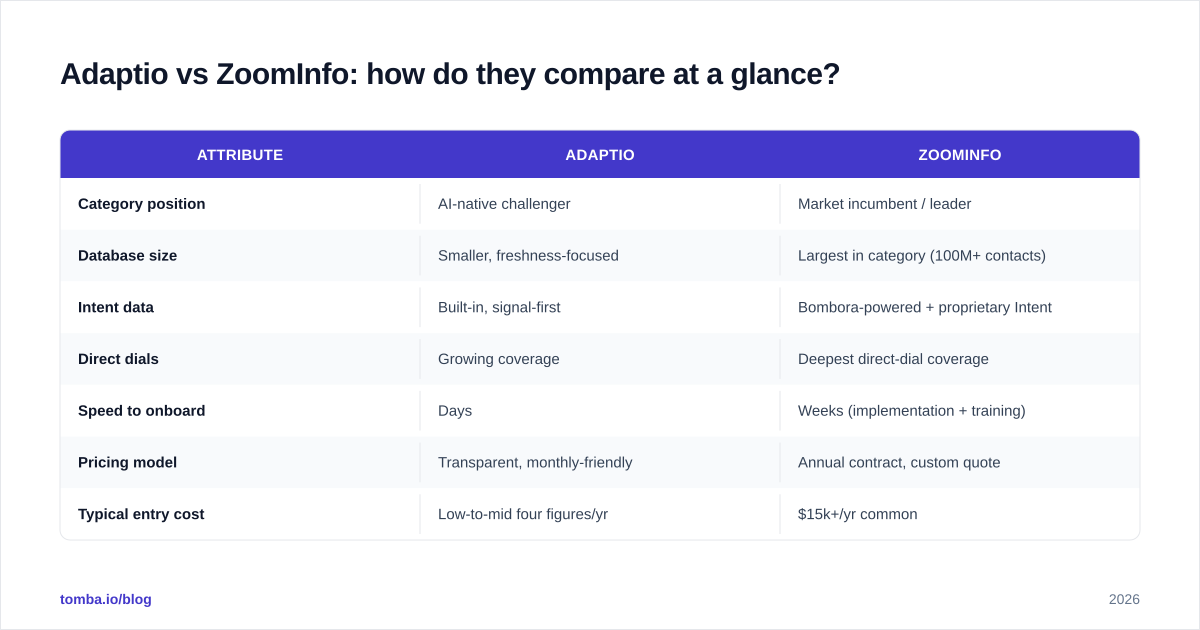
The pattern is clear: ZoomInfo wins on depth and ecosystem, Adaptio wins on speed, flexibility, and cost. Neither is "better" in the abstract — it depends on what you're optimizing for.

Wait — that's the wrong slot. Here's the meme that actually fits the "incumbent vs challenger" framing:
Is ZoomInfo more accurate than Adaptio?#
On the contacts most teams chase — VPs, directors, and managers at companies with a real web presence — accuracy is close enough that you won't feel a dramatic difference in day-to-day prospecting. Both vendors will quote high match and accuracy rates, and both are roughly true for mainstream roles.
The gap shows up at the edges:
- Direct dials and mobile numbers.
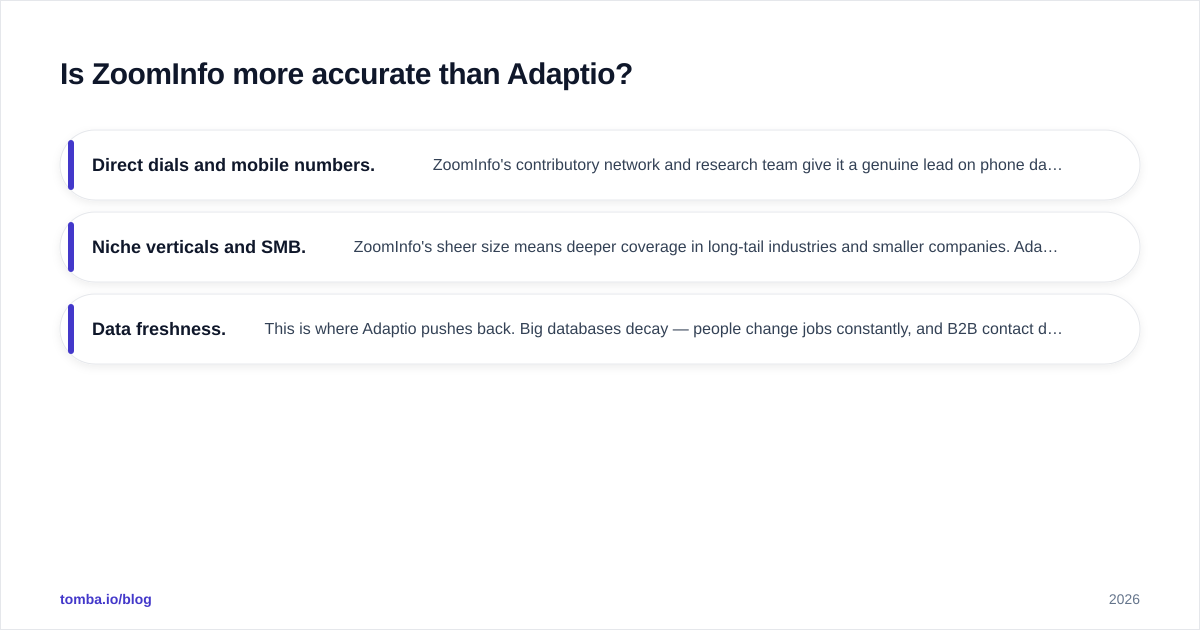
ZoomInfo's contributory network and research team give it a genuine lead on phone data, especially mobile numbers. If cold calling is core to your motion, this matters a lot.
- Niche verticals and SMB. ZoomInfo's sheer size means deeper coverage in long-tail industries and smaller companies. Adaptio's freshness-first approach can leave thinner coverage in obscure segments.
- Data freshness. This is where Adaptio pushes back. Big databases decay — people change jobs constantly, and B2B contact data goes stale at roughly 25–30% per year. Real-time enrichment at the moment of outreach can beat a larger-but-older record.
No matter which platform you choose, verify before you send. A large list with a 15% bounce rate will still wreck your sender reputation. Running contacts through a dedicated email verifier before they hit your sequencer is non-negotiable, and it's worth understanding where the data comes from when you evaluate any provider's accuracy claims.
How does pricing compare?#
This is usually the deciding factor, and it's where the two platforms diverge most sharply.
**
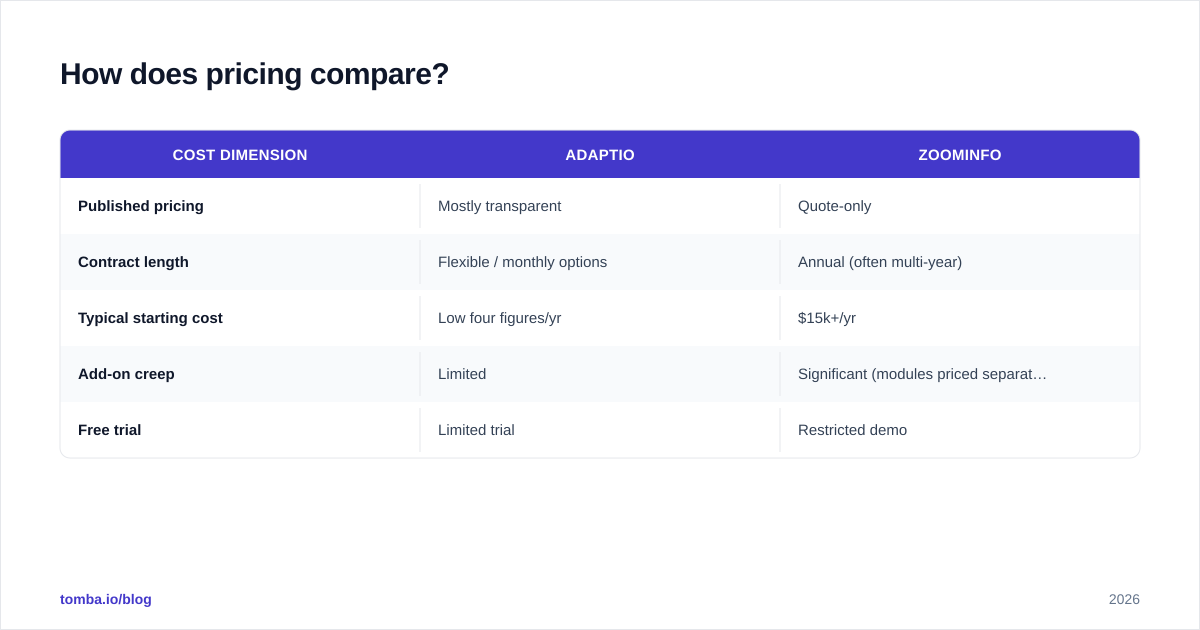
ZoomInfo** does not publish standard pricing. Plans are quoted per seat, per module, on annual contracts, and the entry point for a real sales team commonly lands in the $15,000+/year range — often much higher once you add Intent, Scoops, conversation intelligence, or extra seats. Contracts are annual, frequently multi-year, and auto-renew. The depth is real, but so is the commitment.
Adaptio positions itself as the antidote to that: more transparent pricing, monthly-friendlier terms, and an entry point aimed at mid-market budgets rather than enterprise procurement. You trade some database depth for a bill that doesn't require board approval.
| Cost dimension | Adaptio | ZoomInfo |
|---|---|---|
| Published pricing | Mostly transparent | Quote-only |
| Contract length | Flexible / monthly options | Annual (often multi-year) |
| Typical starting cost | Low four figures/yr | $15k+/yr |
| Add-on creep | Limited | Significant (modules priced separately) |
| Free trial | Limited trial | Restricted demo |
If your real need is "find and verify email addresses," paying enterprise platform rates for that one job is overkill. For context, Tomba pricing starts free at 25 searches per month, with a Starter plan at $49/mo and Growth at $99/mo — a different category of spend entirely. More on that below.
Which has better intent data and signals?#
Both platforms sell on signals, but they frame them differently.
ZoomInfo offers mature, well-integrated intent: Bombora-powered topic surges plus its own proprietary Intent signals, layered with Scoops (human-researched project and budget intelligence) and WebSights for visitor de-anonymization. For a large team that can act on volume, this is a strong, battle-tested signal stack. The catch is that intent is typically a paid add-on, pushing the total cost higher.
Adaptio builds signals into the core experience rather than bolting them on. Its whole premise is signal-first prospecting — job changes, hiring, funding, tech adoption — used to decide who to enrich and when to reach out. For a lean team, having timing baked into the default workflow can be more actionable than a separate intent dashboard nobody checks.
The honest answer: ZoomInfo has more signal types and depth; Adaptio makes its signals easier to act on without extra modules. If you have an ops team to operationalize intent, ZoomInfo's breadth wins. If you want signals to drive the workflow out of the box, Adaptio's design is cleaner.
What about integrations and workflow?#
ZoomInfo has the maturity advantage. Native, deep integrations with Salesforce, HubSpot, Outreach, Salesloft, and most major CRMs and sequencers are a core selling point, along with enrichment automation, lead routing, and a well-documented API. For a complex RevOps stack, this matters.
Adaptio integrates with the common suspects too, with a lighter, faster setup, but it doesn't yet match the incumbent's breadth of certified connectors and enterprise governance features.
This is also where a focused data tool can slot into either platform's gaps. If you're enriching records in a CRM, a HubSpot integration or Salesforce integration plus a bulk email finder can fill verified contacts into the exact accounts your intent data flags — without paying for a second full platform. For programmatic teams, the Tomba API handles enrichment at scale.
When should you choose neither?#
Here's the part most comparison posts skip: a lot of teams buy a full sales-intelligence platform when they only needed a sliver of it.
Ask yourself what you actually do with the tool most days. If the honest answer is "I look up email addresses for prospects I've already identified," then you're paying enterprise platform money to use one feature. Both Adaptio and ZoomInfo are overkill for that.
Consider a lighter stack when:
- Your targeting comes from elsewhere (LinkedIn, events, inbound, referrals) and you just need contact details.
- You're a small team or solo founder who can't justify a four- or five-figure annual commitment.
- You want to pay per use, not per seat, and avoid annual lock-in.
- Your core need is find emails → verify → export to your sequencer, full stop.
In that scenario, a dedicated finder is faster and dramatically cheaper. You can run domain search to pull every contact at a target company, find individual emails by name, and verify the whole list — then push it wherever you sequence. No implementation project, no procurement cycle, no auto-renew.
| Use case | Best fit |
|---|---|
| Enterprise, big SDR team, intent at scale | ZoomInfo |
| Mid-market, lean RevOps, signal-driven | Adaptio |
| Just need verified emails + domain search | Email finder (e.g. Tomba) |
| Cold-call-heavy motion, direct dials | ZoomInfo |
| Tight budget, pay-as-you-go | Email finder + verifier |
How do you actually decide?#
Run this quick filter:
- Budget reality check. If $15k+/year isn't a problem and you have a team to operationalize it,
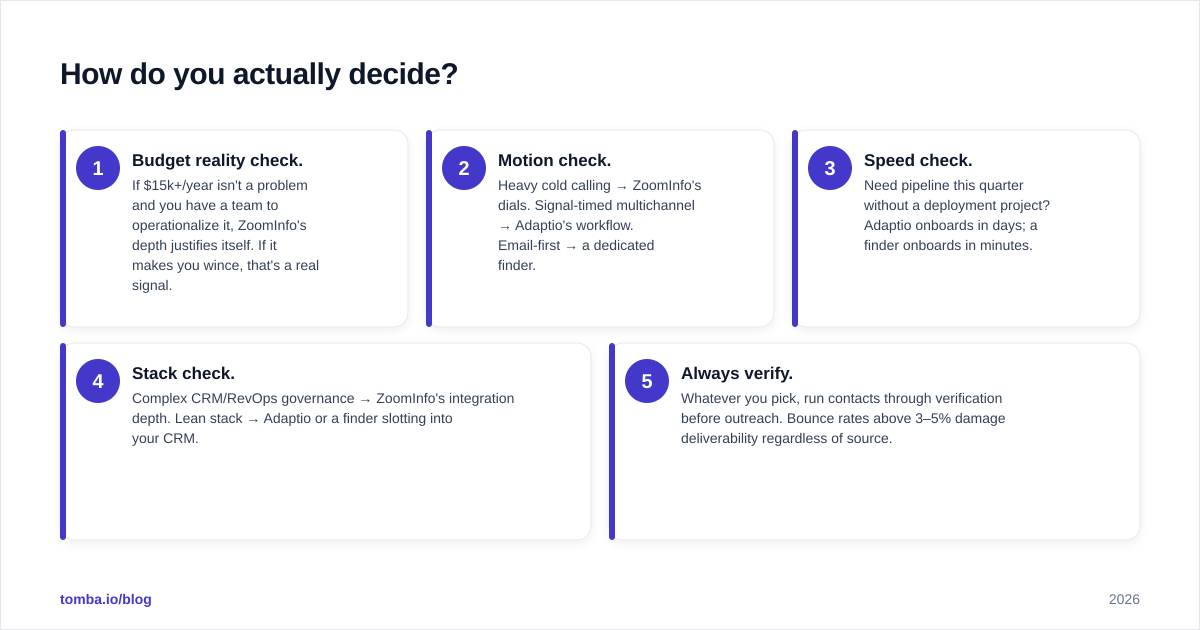
ZoomInfo's depth justifies itself. If it makes you wince, that's a real signal. 2. Motion check. Heavy cold calling → ZoomInfo's dials. Signal-timed multichannel → Adaptio's workflow. Email-first → a dedicated finder. 3. Speed check. Need pipeline this quarter without a deployment project? Adaptio onboards in days; a finder onboards in minutes. 4. Stack check. Complex CRM/RevOps governance → ZoomInfo's integration depth. Lean stack → Adaptio or a finder slotting into your CRM. 5. Always verify. Whatever you pick, run contacts through verification before outreach. Bounce rates above 3–5% damage deliverability regardless of source.
Read independent reviews on G2 before committing — pay attention to comments about contract renewals and data accuracy in your specific vertical, since both vary widely by segment.
The bottom line#
ZoomInfo is the safe, deep, expensive incumbent — buy it when coverage, intent breadth, and direct dials justify a platform commitment. Adaptio is the faster, leaner, more affordable challenger — buy it when you want signal-driven prospecting without enterprise overhead. They're solving the same problem from opposite ends of the price and complexity spectrum.
But if you strip the decision down to its core — find the right person's verified email and reach them — you may not need either platform's full weight. Tomba's Email Finder gives you accurate, verified B2B emails by name, company, or domain, with built-in verification, domain search, and a free tier of 25 searches per month so you can test accuracy on your own target list before paying a cent. Pair it with the email verifier and push clean contacts straight into the same sequencer Adaptio or ZoomInfo would feed — at a fraction of the cost. Start free, verify your first list today, and only graduate to a heavier platform when your volume genuinely demands it.
// get started
Find, verify and enrich your first contacts today
Start on the free plan with 25 searches a month, then scale when your team is ready.
Free plan · No credit card required · GDPR & CCPA
// about the author