Best Addvocate Alternatives for Employee Advocacy in 2026
Addvocate shut down years ago. Here are the strongest employee advocacy and social selling alternatives in 2026, compared on features, pricing, and fit.
If you landed here searching for Addvocate alternatives, you already know the awkward truth: Addvocate isn't a product you can buy anymore. The content-amplification and employee advocacy startup was acquired by Trapit back in 2014 and folded into other offerings. So the real question isn't "what replaces Addvocate feature-for-feature" — it's "which modern employee advocacy and social selling platform actually moves pipeline in 2026."
This guide compares the tools worth your shortlist, shows you how to pick based on team size and goals, and explains where advocacy software stops and your data stack needs to take over.
TL;DR#
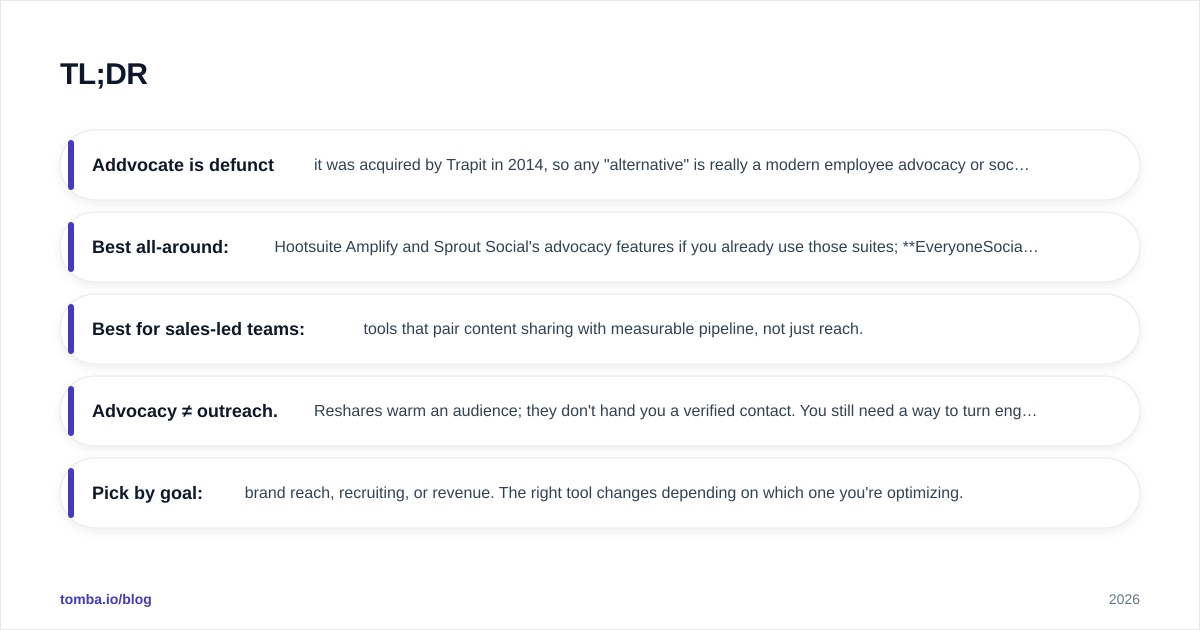
- Addvocate is defunct — it was acquired by Trapit in 2014, so any "alternative" is really a modern employee advocacy or social selling tool.
- Best all-around: Hootsuite Amplify and Sprout Social's advocacy features if you already use those suites; EveryoneSocial and GaggleAMP if you want a standalone advocacy platform.
- Best for sales-led teams: tools that pair content sharing with measurable pipeline, not just reach.
- Advocacy ≠ outreach. Reshares warm an audience; they don't hand you a verified contact. You still need a way to turn engaged buyers into real email addresses.
- Pick by goal: brand reach, recruiting, or revenue. The right tool changes depending on which one you're optimizing.
What was Addvocate, and why do people still search for it?#
Addvocate was an early employee advocacy platform. The pitch was simple and ahead of its time: give employees a browser extension and a curated content feed so they could share company posts to their own social networks, then measure the reach and engagement that resulted. It leaned into what we now call social selling — using your team's personal credibility instead of the corporate logo to reach buyers.
The product was acquired by Trapit in 2014 and the standalone Addvocate brand effectively disappeared. People still search for it because the category exploded after Addvocate left. Marketers who remember the original tool now want the modern equivalent, and SEO trails from a decade of old blog posts keep pointing them here.
So treat "Addvocate alternatives" as shorthand for "the best employee advocacy and content-amplification tools available today."
What should a modern Addvocate alternative actually do?#
The category matured well past "let employees reshare a link." A 2026-grade platform should cover:
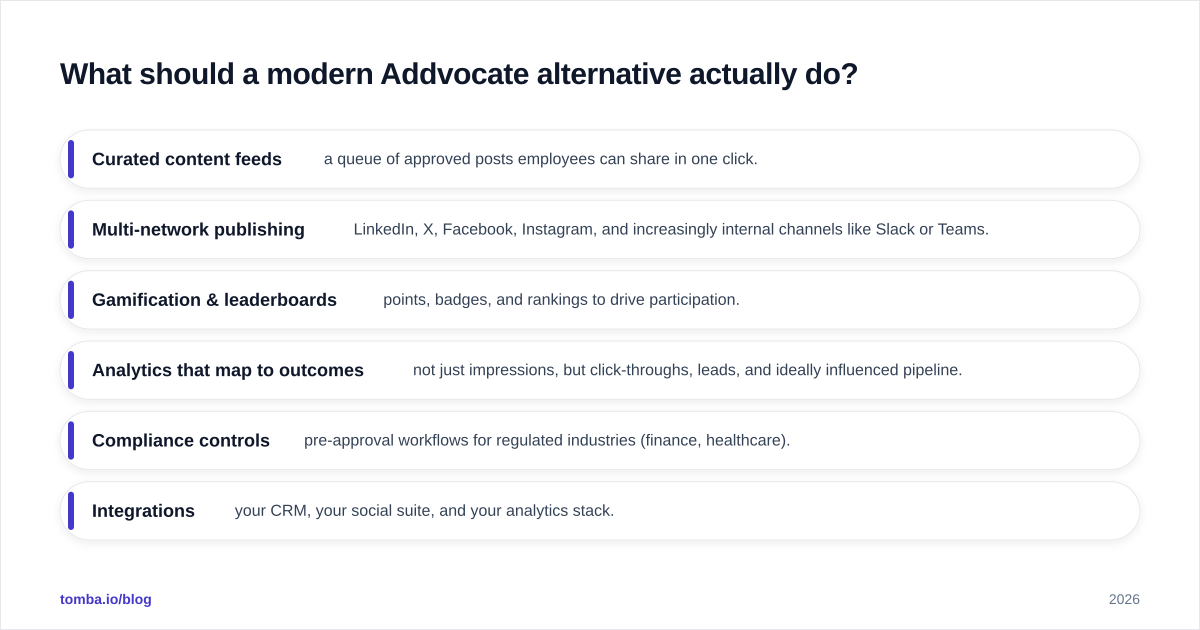
- Curated content feeds — a queue of approved posts employees can share in one click.
- Multi-network publishing — LinkedIn, X, Facebook, Instagram, and increasingly internal channels like Slack or Teams.
- Gamification & leaderboards — points, badges, and rankings to drive participation.
- Analytics that map to outcomes — not just impressions, but click-throughs, leads, and ideally influenced pipeline.
- Compliance controls — pre-approval workflows for regulated industries (finance, healthcare).
- Integrations — your CRM, your social suite, and your analytics stack.
Anything that stops at "reach" is selling you a vanity metric. The tools below are ranked by how far they push toward measurable revenue.
Which Addvocate alternatives are best in 2026?#
Here are the platforms that consistently show up on serious shortlists, grouped by who they fit.
Hootsuite Amplify#
If your social team already lives in Hootsuite, Amplify is the path of least resistance. It bolts advocacy onto the broader publishing and scheduling suite, so content curators don't switch tools. Strong mobile app, decent analytics, and tight integration with the scheduling calendar your marketers already use.
Sprout Social (Employee Advocacy)#
Sprout Social folds advocacy into a polished analytics-first platform. The reporting is the differentiator — if your CMO wants clean dashboards tying advocacy to engagement, this is the comfortable choice. Pricier, and advocacy is an add-on rather than the core product.
EveryoneSocial#
A standalone advocacy specialist. It's built for scale (enterprise sales and recruiting teams use it heavily), with strong content personalization, smart feeds, and gamification. If advocacy is a primary program rather than a side feature, this belongs on the list.
GaggleAMP#
Known for granular "engagement activities" — you can assign specific actions (like, comment, share with custom text) rather than just blasting the same post. Good for teams that want authentic, varied engagement instead of identical reshares that look robotic.
Bambu / legacy tools#
Some buyers still search for older names. Most have been absorbed or rebranded — Bambu became Sprout's advocacy feature, for example. Don't anchor your shortlist to brands that no longer ship as independent products.
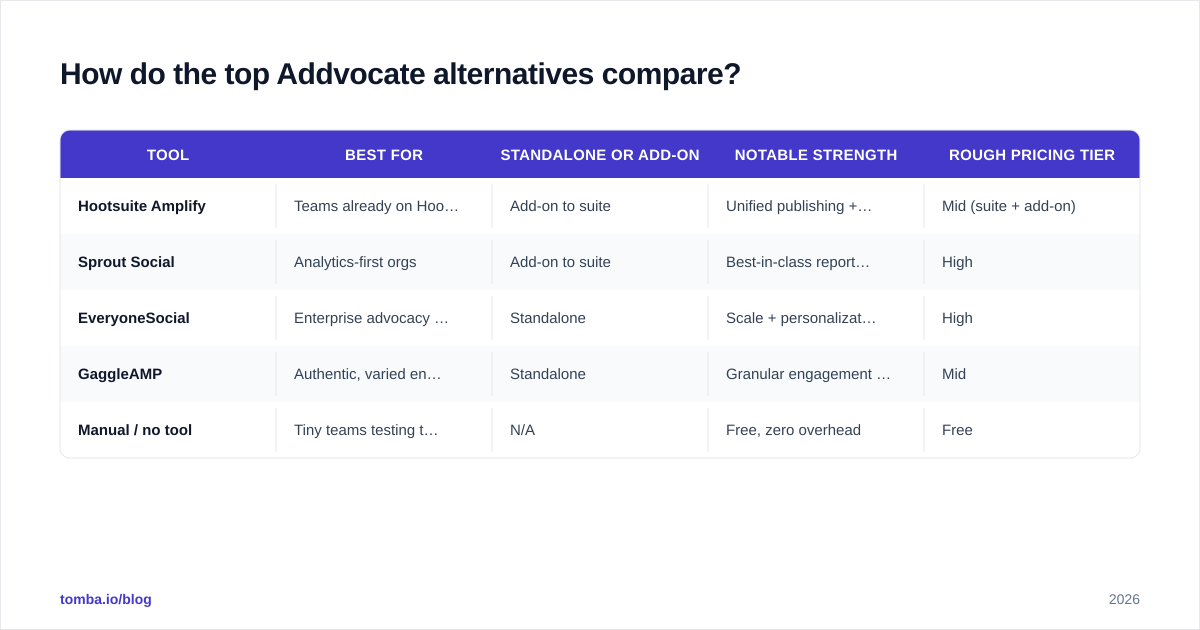
How do the top Addvocate alternatives compare?#
| Tool | Best for | Standalone or add-on | Notable strength | Rough pricing tier |
|---|---|---|---|---|
| Hootsuite Amplify | Teams already on Hootsuite | Add-on to suite | Unified publishing + advocacy | Mid (suite + add-on) |
| Sprout Social | Analytics-first orgs | Add-on to suite | Best-in-class reporting | High |
| EveryoneSocial | Enterprise advocacy programs | Standalone | Scale + personalization | High |
| GaggleAMP | Authentic, varied engagement | Standalone | Granular engagement actions | Mid |
| Manual / no tool | Tiny teams testing the idea | N/A | Free, zero overhead | Free |
Pricing for advocacy platforms is almost always quote-based and tied to seat count, so treat the tiers as relative. Validate current numbers on a review site like G2 before you commit — vendor pricing pages change quarterly.
Is employee advocacy software better than just posting manually?#
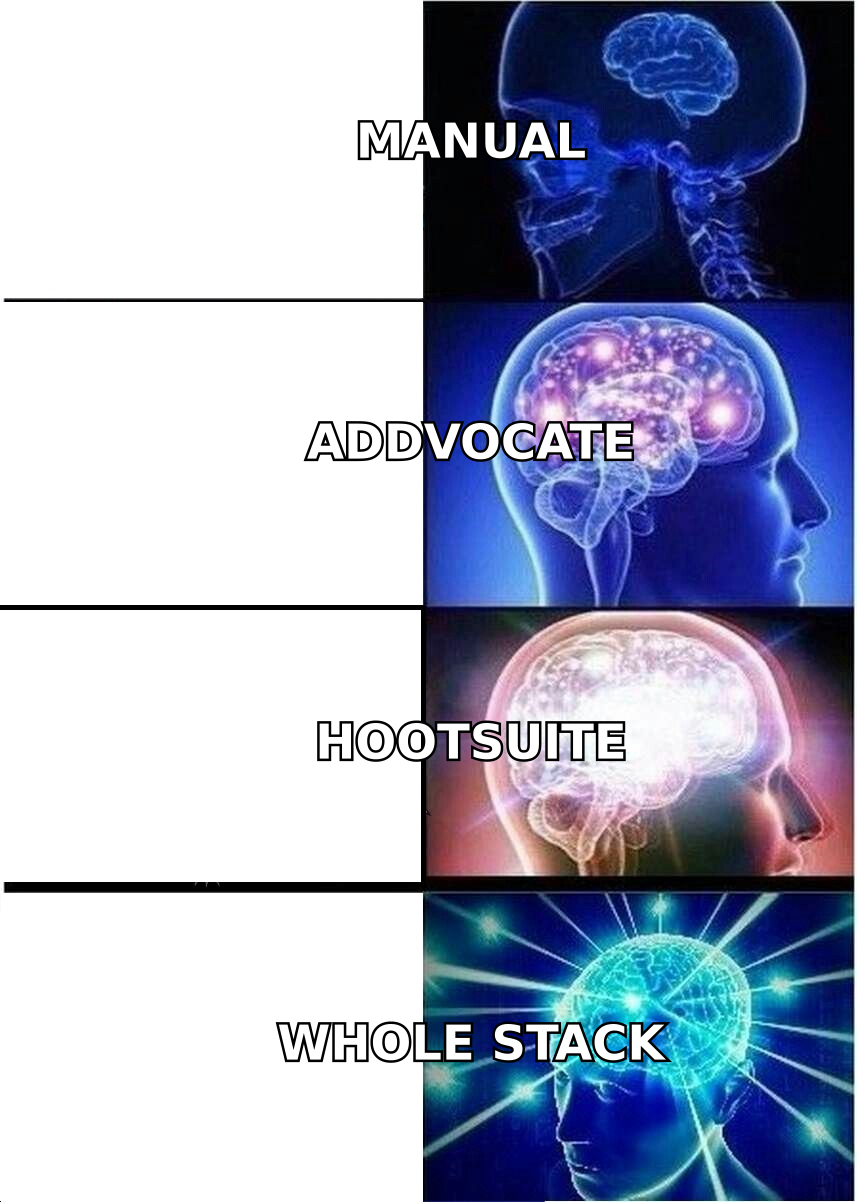
Short answer: yes, once you cross roughly 15–20 active sharers. Below that, the overhead of a platform outweighs the benefit, and a shared content doc plus a Slack reminder works fine. Above it, manual coordination collapses — you can't track who shared what, participation drifts, and you have no analytics to prove ROI.
The tipping point is usually about measurement and consistency, not capability. Anyone can paste a link. What you can't do manually at scale is:
- See which employees drive the most clicks (not just shares).
- Keep a steady cadence so the program doesn't die after week three.
- Tie advocacy activity back to leads and your team's response rate.
If you're a small team, start manual, prove the motion works, then graduate to a tool. Don't buy enterprise advocacy software to discover whether your people will participate.
How do you choose the right alternative for your team?#
Pick by your primary goal, because the best tool changes depending on what you're optimizing.
If your goal is brand reach and awareness: prioritize multi-network publishing and a frictionless mobile share experience. Hootsuite Amplify or Sprout fit because your marketing team already manages the content engine there.
If your goal is recruiting: EveryoneSocial has deep roots in employer-branding use cases — sharing culture content, open roles, and team wins to employees' networks.
If your goal is revenue (social selling): you need advocacy plus a way to act on the buyers who engage. This is where most teams hit a wall. A platform tells you a post got 400 clicks from your sales reps' networks. Great — but it won't hand you the contact details of the prospects who clicked. That gap is the difference between "engagement" and "pipeline."
This is the honest limit of every tool on this list: advocacy software warms an audience, it does not build your outbound list. Pair it with proper LinkedIn outreach and a contact-data workflow, or the reach evaporates without conversion.
Where does advocacy stop and your data stack begin?#
Think of employee advocacy like a restaurant putting out free samples at a farmers' market. The samples (your team's authentic posts) pull a crowd and build trust. But samples alone don't fill tables — at some point you need to take a reservation, which means getting the customer's actual contact information.
That "reservation" step is where a data tool comes in. When a prospect engages with your reps' content, you want to:
- Identify the person and their company.
- Find a verified work email or phone number.
- Drop them into a sequence or hand them to sales.
Advocacy platforms don't do steps 2 and 3. A purpose-built finder does. With an email finder you turn a name and company surfaced by social engagement into a deliverable address, and a phone finder adds a second channel for high-intent leads. If you're working a whole target account, domain search pulls the full roster of contacts at that company so advocacy-driven interest becomes a structured outreach list.
The teams that win treat advocacy and data as one loop: content earns attention, attention surfaces interested buyers, and a finder converts those buyers into contactable leads. Skip the last step and you've optimized for applause, not revenue.
What about pricing — is a dedicated tool worth it?#
For advocacy platforms, expect quote-based enterprise pricing that scales with seats, often landing in the four-to-five-figure annual range for mid-market programs. That's justifiable when advocacy is a funded, measured program with executive buy-in. It's overkill when you're still testing whether employees will participate.
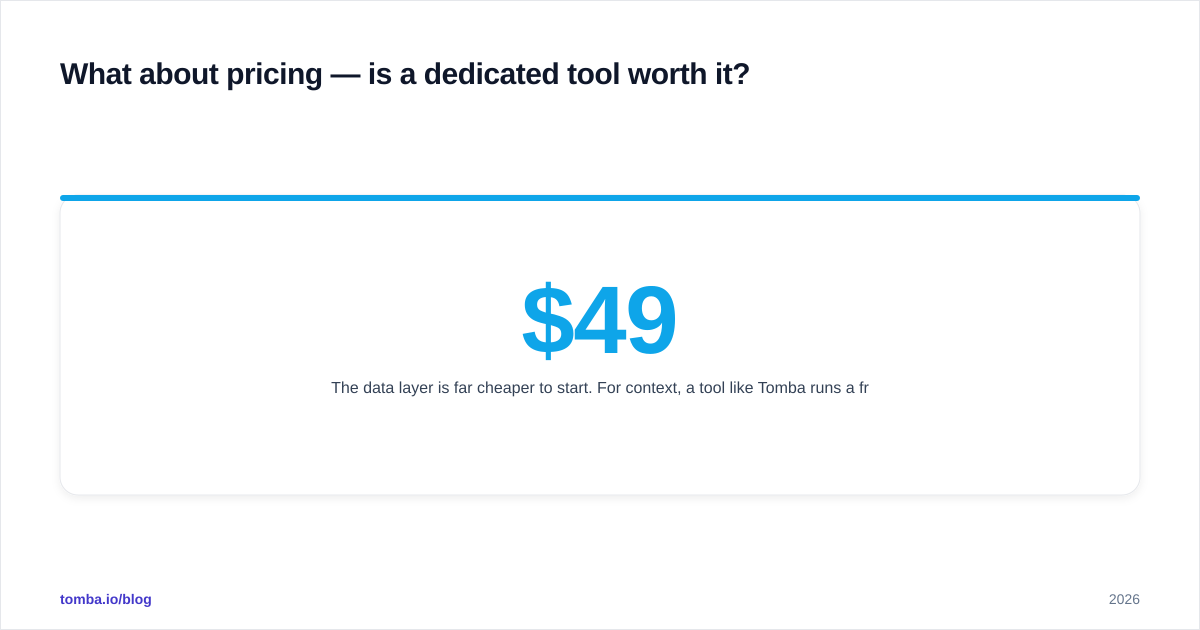
The data layer is far cheaper to start. For context, a tool like Tomba runs a free tier (25 searches/mo), then Starter at $49/mo, Growth at $99/mo, and Pro at $249/mo — so you can validate the "turn engagement into contacts" motion for the price of a team lunch before scaling. See full Tomba pricing for current limits. The point: don't front-load a five-figure advocacy contract before you've proven the cheap, high-leverage step (acting on the leads) actually works.
Quick FAQ#
Is Addvocate still available? No. It was acquired by Trapit in 2014 and no longer exists as a standalone product. Everything marketed as an "Addvocate alternative" is a newer employee advocacy or social selling tool.
What's the closest modern equivalent to Addvocate? EveryoneSocial and GaggleAMP are the closest standalone advocacy specialists. If you want advocacy bundled into a broader social suite, Hootsuite Amplify or Sprout Social fit.
Do I need advocacy software and a data tool? If revenue is your goal, yes. Advocacy software drives reach and engagement; a contact-data tool converts engaged buyers into reachable leads. They solve different halves of the same funnel.
How many employees do I need before a tool pays off? Roughly 15–20 active sharers. Below that, manual coordination is cheaper and faster.
The bottom line#
Addvocate is gone, but the playbook it pioneered is stronger than ever. Choose your alternative by goal — reach, recruiting, or revenue — and don't mistake impressions for pipeline. If you're optimizing for revenue, the advocacy platform is only half the system.
Once your team's content surfaces interested buyers, close the loop with the Tomba Email Finder: turn the names and companies engaging with your reps into verified, deliverable email addresses you can actually sequence. Start free with 25 searches a month, prove the conversion motion, and scale only when the pipeline justifies it. Advocacy gets you the audience — Tomba turns that audience into contacts.
// get started
Find, verify and enrich your first contacts today
Start on the free plan with 25 searches a month, then scale when your team is ready.
Free plan · No credit card required · GDPR & CCPA
// about the author