Addvocate Pricing Reviews Pros and Cons (2026 Guide)
A neutral breakdown of Addvocate pricing, real-world reviews, and the honest pros and cons of running employee advocacy on it in 2026 — plus what to use instead.
Employee advocacy tools all promise one thing: turn your team's social profiles into a distribution channel. Addvocate was one of the early names in that category. This guide is a straight, plain-English look at Addvocate pricing reviews pros and cons. People still search for all of that before they commit budget, so let's get to it.
TL;DR#
- Addvocate is an employee advocacy / social-selling platform. It helps companies push curated content through employees' personal LinkedIn, X, and Facebook profiles.
- Public, self-serve pricing is not listed. Like most advocacy vendors, Addvocate runs on quote-based annual contracts. That is the single biggest friction point in reviews.
- Pros: simple content curation, employee leaderboards, and measurable reach lift. Cons: opaque pricing, dated UI feedback, and limited prospecting data on its own.
- An advocacy tool only pays off if the contact and pipeline layer underneath it is solid. That's where a data tool like Tomba Email Finder complements it, rather than competes with it.
- If you want predictable pricing and richer B2B data, several alternatives below beat a black-box quote.
What is Addvocate?#
Addvocate is an employee advocacy platform. It lets a marketing team queue up approved articles, posts, and links. Employees can then reshare that content to their own social networks in one click. The idea behind social selling is simple: a message from a real person's profile gets more trust and reach than the same message from a corporate handle.
Think of it like a company newsletter that your employees forward to their personal contacts. The difference is the channel. Instead of email, it's LinkedIn, X (Twitter), and Facebook. And instead of guessing, you get analytics on who shared what and how much traffic it drove.
Addvocate was an early entrant in this space. It was later associated with Trapit, which folded advocacy into a broader content-recommendation play. That history matters for two reasons. The product is mature on core sharing mechanics. But some reviewers note the UI and integrations feel a step behind newer, venture-backed competitors.
How much does Addvocate cost?#
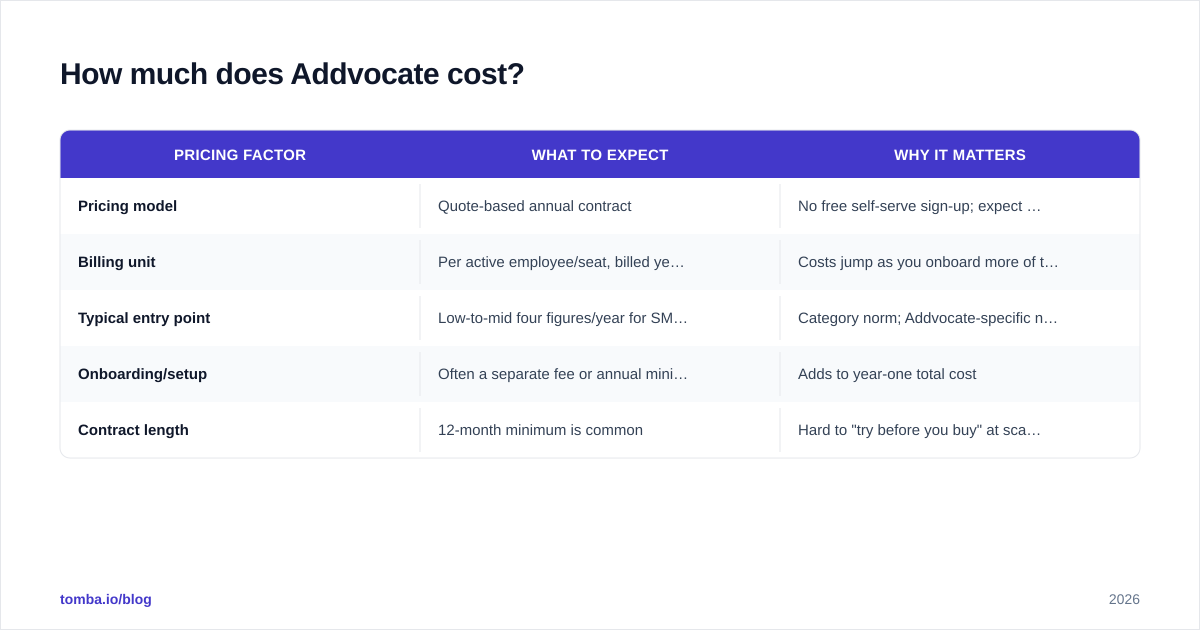
Short answer: Addvocate does not publish self-serve pricing. You request a quote, and cost scales with seat count and contract length. This is standard for the employee advocacy category. It is also the number-one complaint in buyer reviews.
Here's the honest reality of how advocacy pricing works, because Addvocate fits the same mold as the rest of the market:
| Pricing factor | What to expect | Why it matters |
|---|---|---|
| Pricing model | Quote-based annual contract | No free self-serve sign-up; expect a sales call |
| Billing unit | Per active employee/seat, billed yearly | Costs jump as you onboard more of the company |
| Typical entry point | Low-to-mid four figures/year for SMB tiers | Category norm; Addvocate-specific numbers aren't public |
| Onboarding/setup | Often a separate fee or annual minimum | Adds to year-one total cost |
| Contract length | 12-month minimum is common | Hard to "try before you buy" at scale |
Because Addvocate's exact tiers aren't transparent, always ask three questions on the demo call. (1) Is pricing per registered seat or per active seat? (2) What's the annual minimum? (3) What happens to your data and content library if you cancel?
Do you care about transparent, published pricing? Then note that data tools in your stack often are transparent. For example, Tomba pricing is public: a Free tier with 25 searches/mo, Starter at $49/mo, Growth at $99/mo, and Pro at $249/mo. That's the level of clarity advocacy vendors rarely match.
What do Addvocate reviews say?#
We aggregated themes from review sites like G2 and Capterra. Advocacy-platform feedback, Addvocate included, clusters into a predictable pattern.
What reviewers like:
- Low friction for employees. One-click sharing and a pre-approved content queue mean non-marketers actually take part.
- Leaderboards and gamification. Points and rankings reliably lift adoption in the first 90 days.
- Reach attribution. You can show "this post drove X clicks from Y employees," which justifies the program internally.
What reviewers criticize:
- Opaque pricing and pushy renewals. The lack of public pricing frustrates buyers, and annual lock-in draws complaints.
- Adoption decay. Gamification spikes early. Then participation drops unless leadership keeps reinforcing it. That's a program problem more than a software bug, but the tool doesn't solve it for you.
- Thin native data. Advocacy tools tell you who shared, not who to contact next. They don't enrich leads or surface new prospects, so they need a data layer beside them.
That last point is the one most buyers underestimate. Sharing content is the top of the funnel. You still need to identify, reach, and qualify the people who engaged.
Addvocate pricing reviews pros and cons: the balanced scorecard#
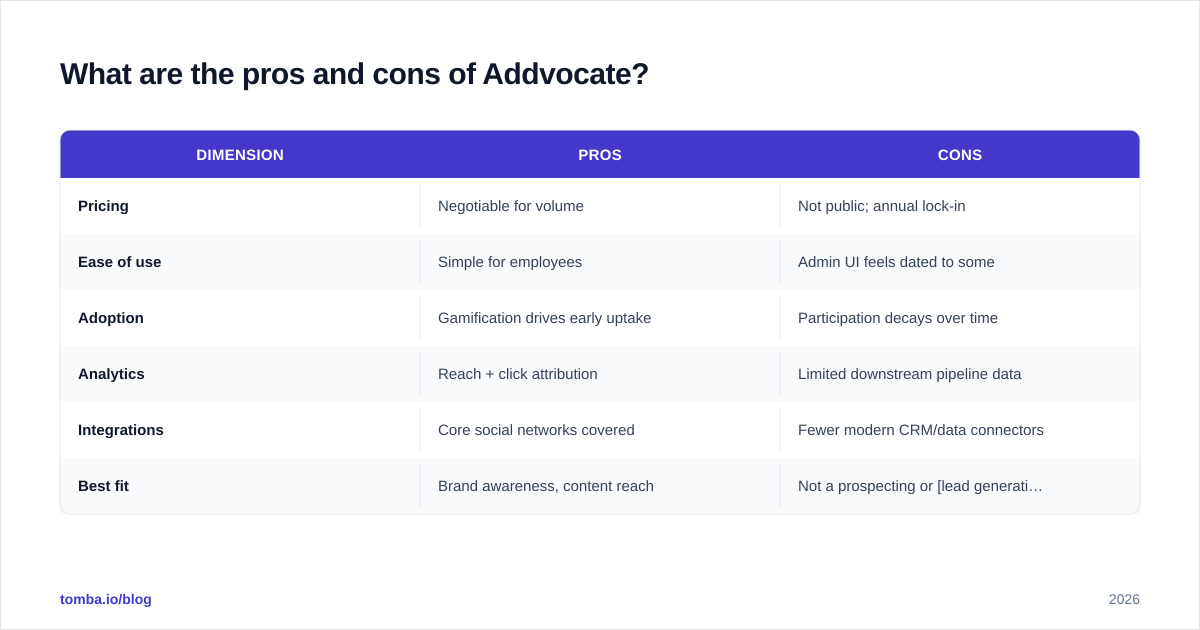
Here's the balanced scorecard.
| Dimension | Pros | Cons |
|---|---|---|
| Pricing | Negotiable for volume | Not public; annual lock-in |
| Ease of use | Simple for employees | Admin UI feels dated to some |
| Adoption | Gamification drives early uptake | Participation decays over time |
| Analytics | Reach + click attribution | Limited downstream pipeline data |
| Integrations | Core social networks covered | Fewer modern CRM/data connectors |
| Best fit | Brand awareness, content reach | Not a prospecting or lead generation engine on its own |
Bottom line: Addvocate is a reasonable amplification tool, not a pipeline-building tool. If your goal is content reach and employer branding, it does the job. If your goal is sourcing and closing pipeline, advocacy is one input. And it's a smaller one than most decks claim.
Is Addvocate worth it in 2026?#
It depends on what problem you're actually solving.
- If you have a content engine and quiet employee profiles: an advocacy tool can be worth it. Once content already exists, extra reach is cheap.
- If you're trying to fill pipeline: advocacy alone won't do it. You need to identify the people engaging with your shared content and start real conversations. That means a prospecting and outreach motion sitting next to advocacy.
The risk in 2026 is buying advocacy software as a pipeline solution. It isn't one. Reach stays a vanity metric until you can turn engaged viewers into named contacts you can email or call. That handoff, from "this person liked our post" to "here's their verified work email," is exactly where most advocacy programs leak.

What are the best Addvocate alternatives?#
Is Addvocate's opacity or feature set a dealbreaker? Then the alternatives split into two buckets: pure advocacy platforms, and the data/outreach tools that make any advocacy program actually convert.
Pure advocacy alternatives (research current pricing directly):
- GaggleAMP — strong gamification and analytics, popular with mid-market teams.
- Hootsuite Amplify — advocacy bolted onto a broader social suite; good if you already use Hootsuite.
- EveryoneSocial / Sociabble — enterprise-leaning, content-heavy, with deeper integrations.
The data layer that makes advocacy convert:
Advocacy gets people to engage. You still have to reach them. That's where an email-finding and enrichment stack earns its keep. Tools like the Tomba Email Finder and domain search turn an engaged LinkedIn viewer into a verified, reachable contact. You can pair them with LinkedIn outreach to start the conversation.
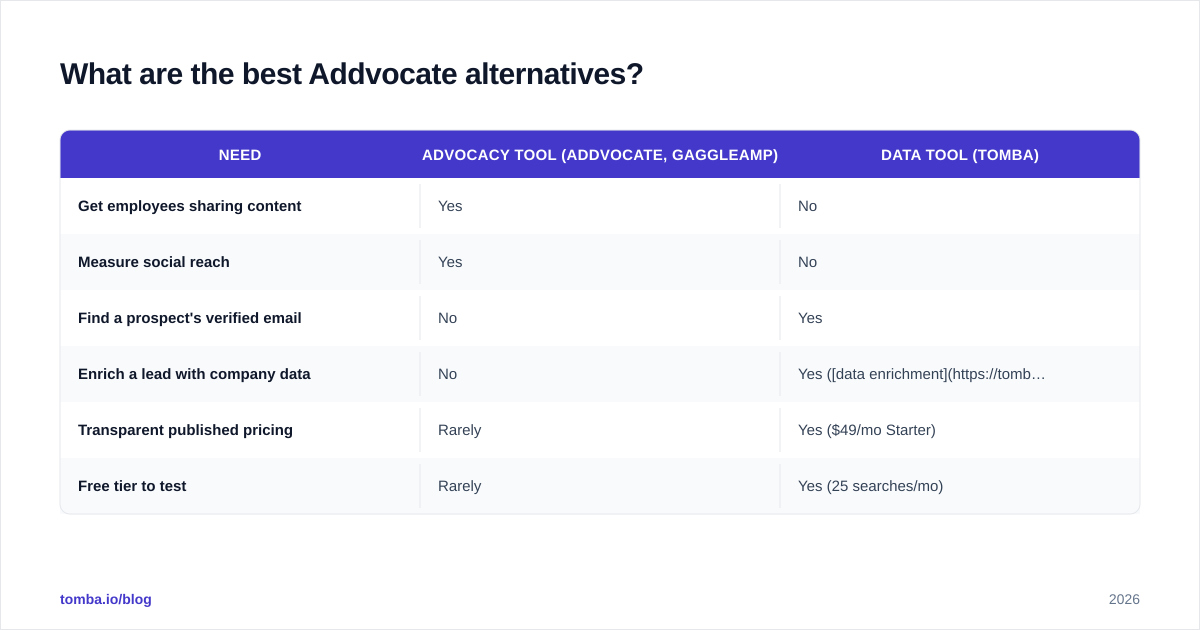
| Need | Advocacy tool (Addvocate, GaggleAMP) | Data tool (Tomba) |
|---|---|---|
| Get employees sharing content | Yes | No |
| Measure social reach | Yes | No |
| Find a prospect's verified email | No | Yes |
| Enrich a lead with company data | No | Yes (data enrichment) |
| Transparent published pricing | Rarely | Yes ($49/mo Starter) |
| Free tier to test | Rarely | Yes (25 searches/mo) |
The two aren't rivals. They're adjacent layers of the same go-to-market motion. Advocacy widens the top of the funnel. A data tool lets you act on the interest it creates.
How do you decide?#
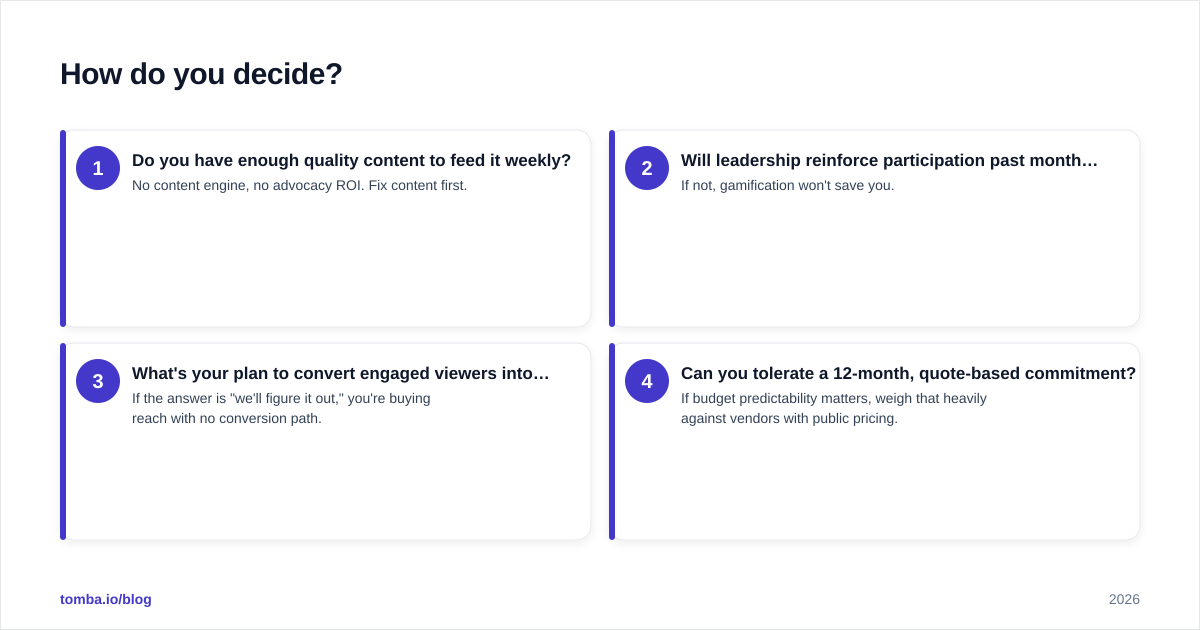
Run this quick decision filter before you sign any advocacy contract:
- Do you have enough quality content to feed it weekly? No content engine, no advocacy ROI. Fix content first.
- Will leadership reinforce participation past month three? If not, gamification won't save you.
- What's your plan to convert engaged viewers into pipeline? If the answer is "we'll figure it out," you're buying reach with no way to convert it.
- Can you tolerate a 12-month, quote-based commitment? If budget predictability matters, weigh that heavily against vendors with public pricing.
Answer those four honestly. You'll then know whether Addvocate, or any advocacy tool, belongs in your stack. You'll also see where it ends and your data tooling needs to begin.
The honest verdict#
That's the full picture of Addvocate pricing reviews pros and cons. It is a competent employee advocacy platform with the category's usual strengths: easy sharing, gamification, and reach analytics. It also carries the category's usual weaknesses: opaque pricing, annual lock-in, adoption decay, and zero prospecting data. It's worth a look if reach and employer branding are the goal. It is not a pipeline machine, and buying it as one will disappoint.
Treat advocacy as the amplifier and your data layer as the converter. The amplifier makes noise. The converter turns that noise into named, reachable people.
Build the data layer your advocacy program is missing#
Whatever advocacy tool you land on, the engagement it creates is only useful if you can act on it. Tomba Email Finder turns the people interacting with your shared content into verified, contactable leads. Find professional emails by name, company, or domain, enrich them, and hand them to sales. Start free with 25 searches a month, scale on transparent Tomba plans, and stop letting top-of-funnel interest leak away. Try the Tomba Email Finder and connect your reach to real pipeline.
// get started
Find, verify and enrich your first contacts today
Start on the free plan with 25 searches a month, then scale when your team is ready.
Free plan · No credit card required · GDPR & CCPA
// about the author