Top Adrack Alternatives for Lead Distribution in 2026
Adrack handles lead distribution and affiliate tracking, but it isn't the only option. Here are 7 Adrack alternatives compared on routing, pricing, and data quality for 2026.
Adrack has been a fixture in lead distribution and affiliate marketing for years, but it is far from the only platform that can ping-post leads, manage publishers, and route traffic in real time. If you are shopping for a replacement — because of pricing, support, missing integrations, or data quality — this guide compares the strongest Adrack alternatives in 2026 and shows you how to choose.
TL;DR#
- Adrack is a lead-generation and affiliate-marketing platform focused on lead distribution, ping-post, and ad management. Its main weaknesses are dated UX and limited self-serve onboarding.
- The best Adrack alternatives in 2026 are LeadsPedia, Phonexa, CAKE, Everflow, TrackDrive, and boberdoo — each strong in a different area (call routing, affiliate tracking, or pure lead distribution).
- If your real problem is lead quality rather than lead routing, a data layer like an email finder and data enrichment tool matters more than the distribution engine.
- Pick on three axes: routing model (ping-post vs. direct post), pricing structure (flat vs. usage), and how clean your inbound data is before it ever hits the router.
- Always run a paid pilot with real traffic before migrating — distribution platforms behave very differently under load.
What is Adrack and what does it actually do?#
Adrack is a lead-generation software platform that sits between traffic sources (affiliates, publishers, paid media) and lead buyers. In plain terms, think of it as an air-traffic controller for leads: a form fill or call comes in, and Adrack decides which buyer gets it, at what price, and in what order — all in milliseconds.
Its core capabilities include lead distribution, ping-post auctions, affiliate and publisher management, ad serving, and reporting. That feature set overlaps with a crowded category of lead-distribution and performance-marketing tools, which is exactly why people look for alternatives.
The common reasons teams leave Adrack:
- Interface feels dated compared with newer SaaS dashboards.
- Onboarding is sales-led, so quick self-serve testing is hard.
- Pricing is opaque and quoted per deployment rather than published.
- Integrations with modern CRMs and data tools require custom work.
How should you evaluate an Adrack alternative?#
Before you look at logos, get clear on what you are actually replacing. Most buyers conflate three separate jobs that a "lead platform" performs, and choosing on the wrong axis is how you end up migrating twice.
- Routing engine — Does it support ping-post auctions, direct post, round-robin, weighted distribution, and real-time bidding between buyers?
- Channel coverage — Web leads only, or also inbound calls, clicks, and warm transfers? Call-heavy verticals (insurance, home services, legal) need a call-routing layer.
- Data quality layer — Garbage in, garbage out. The cleanest router cannot fix a feed full of fake phone numbers and role-based emails.
That third axis is the one most teams underinvest in. A distribution platform optimizes where a lead goes; it does almost nothing to confirm the lead is real. That is why pairing any router with verification — an email verifier and a phone validator — usually moves revenue more than swapping Adrack for a competitor.
What are the best Adrack alternatives in 2026?#
Here is the short list, grouped by what each one does best.
1. LeadsPedia#
A full lead-distribution and affiliate-marketing suite that competes head-on with Adrack. Strong ping-post support, call routing, and a more modern interface. Good fit if you want one platform for both web leads and calls without stitching tools together.
2. Phonexa#
Phonexa leans hardest into the call side — its call-routing and tracking products (LMS Sync, Call Logic) are the draw. If inbound calls drive your revenue, Phonexa's all-in-one marketing cloud is often a better Adrack replacement than a web-first tool.
3. CAKE#
CAKE is performance-marketing infrastructure: affiliate tracking, lead generation, and multichannel attribution at enterprise scale. Choose it when accurate attribution across many publishers matters more than ping-post nuance.
4. Everflow#
Everflow is a modern partner-marketing and tracking platform with excellent analytics and a clean API. It is less of a pure ping-post auctioneer and more of an affiliate/partner engine, so weigh it if your model is partner-led growth rather than lead reselling.
5. TrackDrive#
TrackDrive specializes in inbound call automation and lead-to-call workflows. Strong for teams converting web leads into scheduled calls and warm transfers.
6. boberdoo#
boberdoo is one of the oldest dedicated lead-distribution systems and a direct Adrack competitor. It is flexible and vertical-agnostic, with a long track record in regulated industries.
7. A data-first stack (the contrarian pick)#
If your churn comes from bad leads rather than bad routing, the highest-ROI "alternative" is to add a verification and enrichment layer in front of whatever router you keep. Validate emails and phones, enrich thin records, and only then distribute. More on this below.
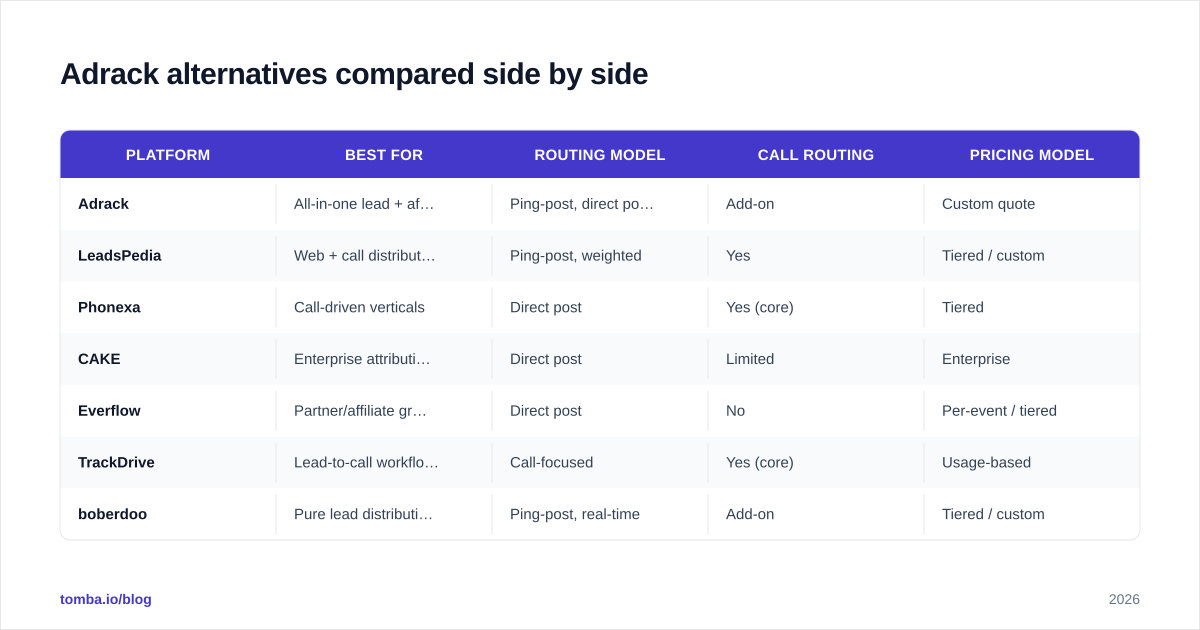
Adrack alternatives compared side by side#
| Platform | Best for | Routing model | Call routing | Pricing model |
|---|---|---|---|---|
| Adrack | All-in-one lead + affiliate | Ping-post, direct post | Add-on | Custom quote |
| LeadsPedia | Web + call distribution | Ping-post, weighted | Yes | Tiered / custom |
| Phonexa | Call-driven verticals | Direct post | Yes (core) | Tiered |
| CAKE | Enterprise attribution | Direct post | Limited | Enterprise |
| Everflow | Partner/affiliate growth | Direct post | No | Per-event / tiered |
| TrackDrive | Lead-to-call workflows | Call-focused | Yes (core) | Usage-based |
| boberdoo | Pure lead distribution | Ping-post, real-time | Add-on | Tiered / custom |
No single row is "the winner." A call-center-heavy insurance buyer should look hard at Phonexa or TrackDrive; a publisher network optimizing attribution leans CAKE or Everflow; a classic lead-reseller wanting ping-post auctions stays close to LeadsPedia or boberdoo.
Which Adrack alternative is right for your use case?#
Match the tool to the job instead of the brand:
- You resell web form leads to multiple buyers → LeadsPedia or boberdoo. Both are built around ping-post auctions and buyer caps.
- Phone calls are your product → Phonexa or TrackDrive. Web-first routers treat calls as an afterthought.
- You run a large affiliate/partner program → Everflow or CAKE for tracking and attribution depth.
- You need enterprise reporting and compliance → CAKE, with boberdoo as a vertical-specific option.
- Your leads convert badly no matter where you send them → fix the data layer first (next section).
A quick analogy: choosing a distribution platform without fixing data is like upgrading the sorting machine at a post office while half the envelopes have the wrong address. The machine gets faster; the mail still bounces.

Why data quality beats routing — and where Tomba fits#
Here is the conclusion first: most "our leads are bad" problems are verification and enrichment problems, not routing problems. Lead-distribution platforms — Adrack included — assume the data arriving at the router is already accurate. It usually isn't.
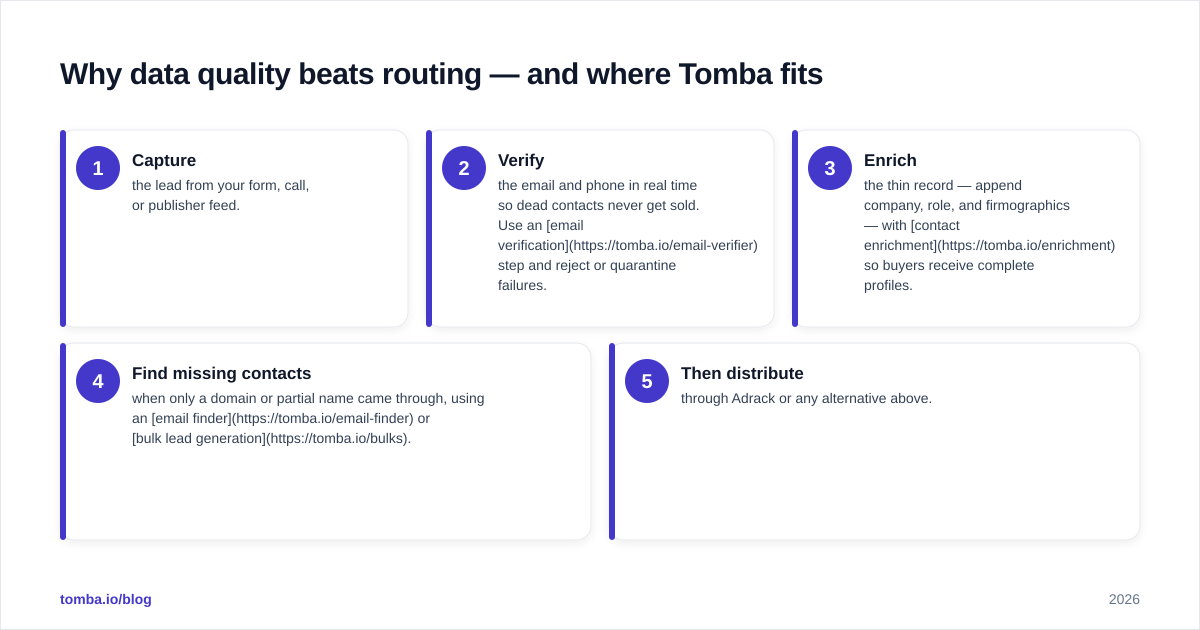
A practical pre-distribution layer looks like this:
- Capture the lead from your form, call, or publisher feed.
- Verify the email and phone in real time so dead contacts never get sold. Use an email verification step and reject or quarantine failures.
- Enrich the thin record — append company, role, and firmographics — with contact enrichment so buyers receive complete profiles.
- Find missing contacts when only a domain or partial name came through, using an email finder or bulk lead generation.
- Then distribute through Adrack or any alternative above.
This is exactly where Tomba complements — rather than replaces — a distribution engine. Tomba is not a ping-post router; it is the data layer that makes whatever router you choose more profitable. You can wire it in programmatically through the email finder API so verification and enrichment happen automatically before a lead ever hits the auction.
The economics are simple: if 15% of your distributed leads are undeliverable, you are paying buyer refunds, burning publisher trust, and skewing your routing analytics. Cutting that to 2% with upfront validation often returns more than any routing optimization the platform itself can offer.
How much do Adrack alternatives cost?#
Pricing in this category is famously hard to compare because most vendors quote custom deals based on lead volume, seats, and channels. General patterns in 2026:
- Pure distribution tools (boberdoo, LeadsPedia) — tiered subscriptions that scale with lead volume and active buyers, often with setup fees.
- Call-centric platforms (Phonexa, TrackDrive) — usage-based, tied to call minutes and tracking numbers.
- Attribution/affiliate suites (CAKE, Everflow) — per-event or enterprise contracts.
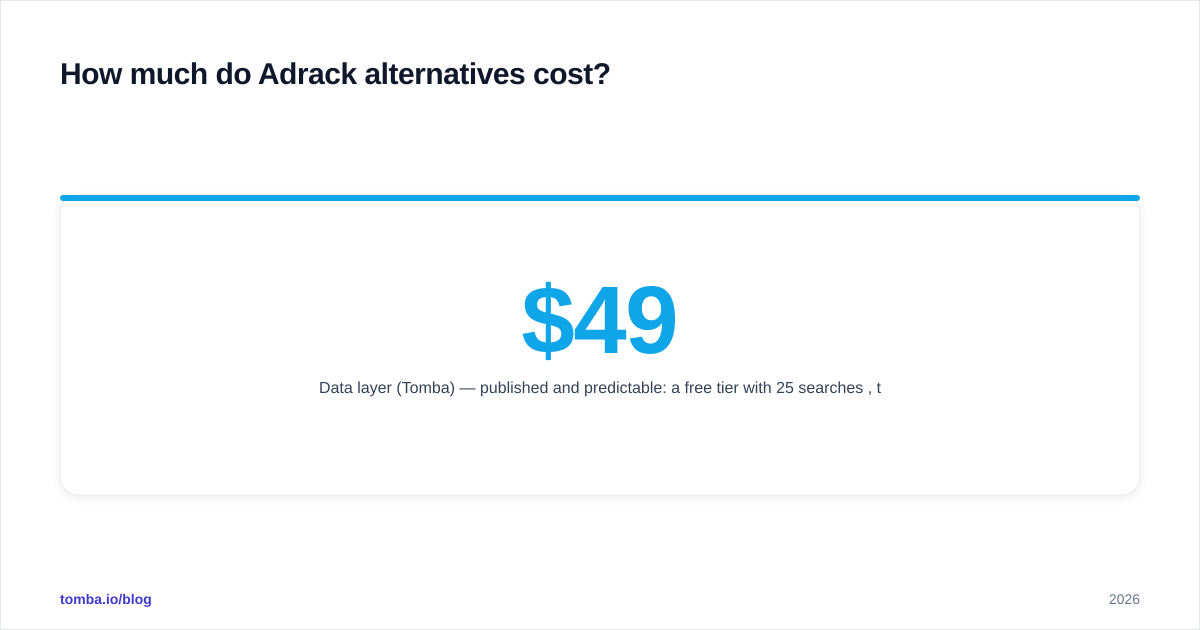
- Data layer (Tomba) — published and predictable: a free tier with 25 searches per month, then Starter at $49/mo, Growth at $99/mo, and Pro at $249/mo, with Enterprise custom. See full Tomba pricing for credit details.
Because routing vendors rarely publish numbers, always insist on a written quote tied to your projected volume, and read independent reviews on G2 and Capterra before signing. You can also compare Adrack's own positioning on its official site to see which features are bundled versus add-ons.
What should you do before migrating off Adrack?#
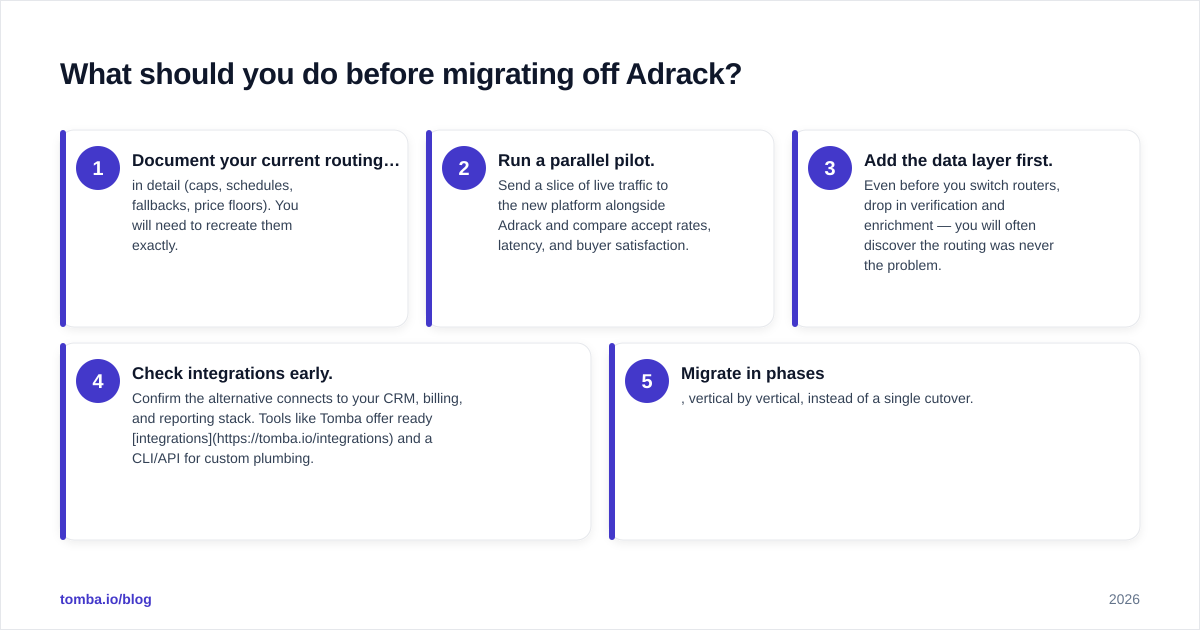
Switching distribution platforms is disruptive — buyers, caps, and publisher feeds all need re-mapping. Reduce the risk:
- Document your current routing rules in detail (caps, schedules, fallbacks, price floors). You will need to recreate them exactly.
- Run a parallel pilot. Send a slice of live traffic to the new platform alongside Adrack and compare accept rates, latency, and buyer satisfaction.
- Add the data layer first. Even before you switch routers, drop in verification and enrichment — you will often discover the routing was never the problem.
- Check integrations early. Confirm the alternative connects to your CRM, billing, and reporting stack. Tools like Tomba offer ready integrations and a CLI/API for custom plumbing.
- Migrate in phases, vertical by vertical, instead of a single cutover.
Frequently asked questions#
Is there a free Adrack alternative? Pure lead-distribution platforms rarely offer free tiers because they are infrastructure. The data layer is where free access exists — Tomba's free plan includes 25 searches per month, letting you test verification and enrichment at zero cost.
Can I keep Adrack and just improve lead quality? Yes. Adding a verification and enrichment step in front of Adrack is the lowest-risk improvement available, and it requires no migration. Many teams find this solves the problem they were trying to fix by switching platforms.
Which Adrack alternative is best for inbound calls? Phonexa and TrackDrive are purpose-built for call routing and tracking, making them stronger than web-first distribution tools for call-heavy verticals.
Do these platforms handle compliance (TCPA, consent)? Most mature platforms (boberdoo, LeadsPedia, Phonexa) offer consent capture and trail features, but specifics vary. Make compliance support a hard requirement in your evaluation and confirm it in writing.
The bottom line#
The best Adrack alternative depends entirely on your model: LeadsPedia or boberdoo for ping-post web distribution, Phonexa or TrackDrive for calls, and CAKE or Everflow for affiliate attribution at scale. But before you migrate anything, look upstream. A faster router that distributes the same unverified leads will not move your numbers.
Start by cleaning what flows into the system. Use Tomba Email Finder — plus its verification and enrichment tools — to confirm every lead is real and complete before it ever hits your distribution engine. Spin up the free tier, validate a batch of your current leads, and measure how many were dead on arrival. That single test usually tells you whether you have a routing problem or a data problem — and it is the cheapest, fastest experiment you can run this quarter.
// get started
Find, verify and enrich your first contacts today
Start on the free plan with 25 searches a month, then scale when your team is ready.
Free plan · No credit card required · GDPR & CCPA
// about the author