Adrack Pricing, Reviews, Pros and Cons: 2026 Buyer Guide
Thinking about Adrack for digital marketing and lead gen? Here's an honest look at Adrack's pricing model, real user reviews, and the pros and cons before you sign a contract.
TL;DR
- Adrack is a full-service digital marketing agency (PPC, SEO, web design, email, and lead generation) — not a self-serve SaaS tool, so its pricing is quote-based and varies widely by scope.
- Expect custom retainers rather than published tiers; reviewers report monthly engagements ranging from a few hundred to several thousand dollars depending on services bundled.
- Strengths: managed service, multi-channel execution, and hands-off campaigns for teams without in-house marketing.
- Weaknesses: no transparent pricing page, contract lock-in, and limited control compared with running tools yourself.
- If your real need is finding and verifying contact data to feed campaigns, a self-serve tool like Tomba (from $49/mo) is far cheaper and more transparent than an agency retainer.
What is Adrack and who is it for?#
Adrack is a digital marketing services company that bundles paid advertising, search engine optimization, web design and development, email marketing, and lead generation into managed engagements. Think of it less like a software subscription you log into and more like hiring an outside marketing department that runs campaigns on your behalf.
That distinction matters the moment you start researching adrack pricing reviews pros and cons, because Adrack does not sell seats or credits. You are buying outcomes and labor, which is why there is no public pricing table and why two companies can pay very different amounts for what sounds like "the same" service.
Adrack tends to fit small and mid-sized businesses that lack an internal marketing team and want a single vendor to own demand generation end to end. It is a poor fit if you already have operators in-house who just need better tooling — in that case you are paying agency margin for work you could run yourself.
How does Adrack pricing actually work?#
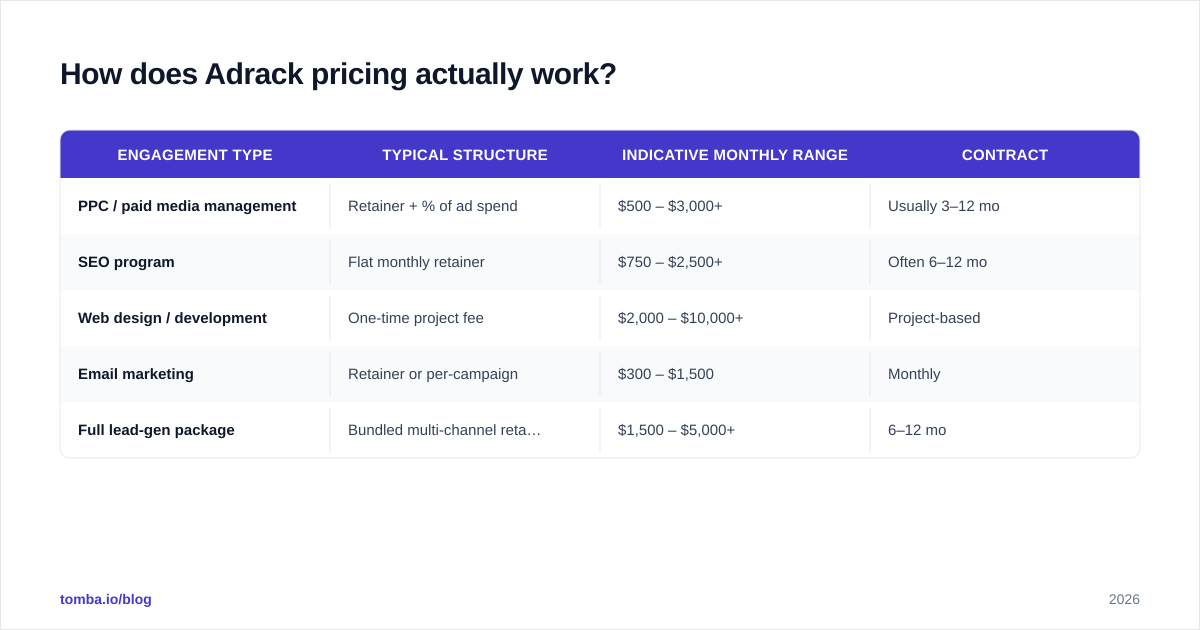
Adrack pricing is quote-based. You book a consultation, describe your goals, and receive a proposal scoped to the channels and volume you need. There are no published monthly tiers, so the numbers below are directional ranges gathered from review platforms and typical agency norms, not official rate cards. Always confirm current figures directly on the official Adrack website.
| Engagement type | Typical structure | Indicative monthly range | Contract |
|---|---|---|---|
| PPC / paid media management | Retainer + % of ad spend | $500 – $3,000+ | Usually 3–12 mo |
| SEO program | Flat monthly retainer | $750 – $2,500+ | Often 6–12 mo |
| Web design / development | One-time project fee | $2,000 – $10,000+ | Project-based |
| Email marketing | Retainer or per-campaign | $300 – $1,500 | Monthly |
| Full lead-gen package | Bundled multi-channel retainer | $1,500 – $5,000+ | 6–12 mo |
Two things stand out. First, ad spend is typically separate from management fees, so a "$1,000/month" PPC engagement can cost far more once you fund the actual clicks. Second, the longer minimum-term contracts common in agency deals mean your true commitment is the monthly figure multiplied by six or twelve — budget accordingly.
Because the model is opaque, compare any Adrack quote against doing the same work with self-serve tools plus a freelancer. For many lead-generation tasks, the tooling cost is a fraction of an agency retainer. You can sanity-check that math against transparent, published Tomba pricing to see what the data layer alone should cost.
What do Adrack reviews say?#
Adrack maintains a presence on agency directories and review sites. As with most service businesses, sentiment clusters around communication, results, and value rather than features. You can read current ratings on G2 and Capterra before committing.
Common themes from public reviews:
- Positive: Responsive account management, willingness to handle multiple channels under one roof, and useful for owners who want to delegate marketing entirely.
- Positive: Reasonable for small businesses that cannot justify a full-time marketing hire.
- Mixed: Results vary by vertical and budget; smaller ad spends naturally produce smaller returns, which some reviewers conflate with underperformance.
- Negative: Lack of pricing transparency upfront and contract terms that feel rigid once signed.
- Negative: Less granular reporting and control than teams used to running their own dashboards expect.
Treat any single review as one data point. Service quality at agencies is often tied to the specific account manager assigned to you, so ask who will run your account and request references in your industry before signing.
What are the pros and cons of Adrack?#
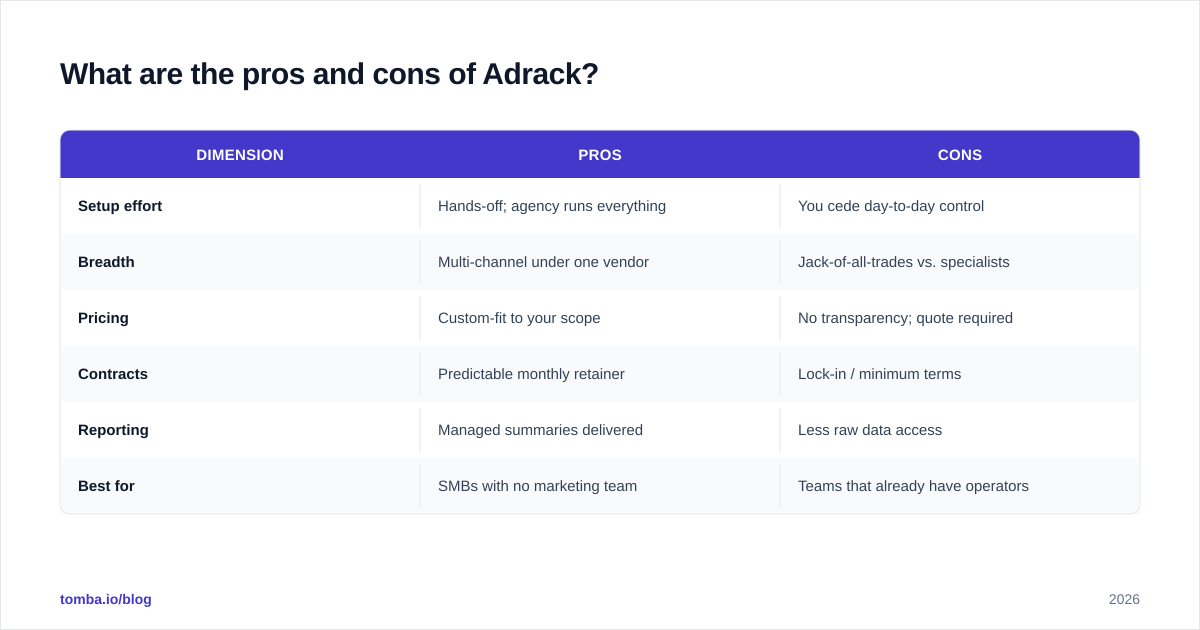
Here is the honest balance sheet. The right answer depends entirely on whether you want a done-for-you service or control over your own stack.
| Dimension | Pros | Cons |
|---|---|---|
| Setup effort | Hands-off; agency runs everything | You cede day-to-day control |
| Breadth | Multi-channel under one vendor | Jack-of-all-trades vs. specialists |
| Pricing | Custom-fit to your scope | No transparency; quote required |
| Contracts | Predictable monthly retainer | Lock-in / minimum terms |
| Reporting | Managed summaries delivered | Less raw data access |
| Best for | SMBs with no marketing team | Teams that already have operators |
The pros in plain terms: if you have no marketing function and no desire to build one, Adrack removes the burden of hiring, tooling, and campaign management. One invoice, one point of contact, multiple channels handled.
The cons in plain terms: you pay agency margin, you sign a term, and you lose granular control. If your bottleneck is not "who runs the campaign" but "do we have accurate contact data to run it against," an agency is an expensive way to solve a data problem.

Is Adrack worth it versus running campaigns in-house?#
It depends on where your gap actually is. Agencies solve a labor and expertise gap. Tools solve a data and execution gap. Many teams assume they need an agency when they really just need better inputs.
Lead generation, for example, breaks into three jobs: finding the right companies and people, getting accurate contact details, and running outreach. An agency can do all three, but the middle job — accurate, verified contact data — is where most campaigns quietly fail. Bad data wastes ad spend and tanks deliverability no matter who runs the campaign.
If you decide to keep execution in-house, your stack typically looks like a data source, a verification layer, and a sending or ads platform. The data layer is where a self-serve email finder replaces a big chunk of what you'd otherwise pay an agency to handle. You can find emails by name and company, run a domain search to pull every contact at a target account, and then verify the list before it ever touches a campaign.
This is also where you reclaim transparency. Instead of a quote, you get a published price; instead of a six-month term, you get monthly billing; instead of a summary report, you get the raw data in your own systems via data enrichment and exports.
How does Adrack compare to a self-serve data stack?#
If your primary goal is filling the top of the funnel with accurate B2B contacts, compare the agency route against a tool-led route directly.
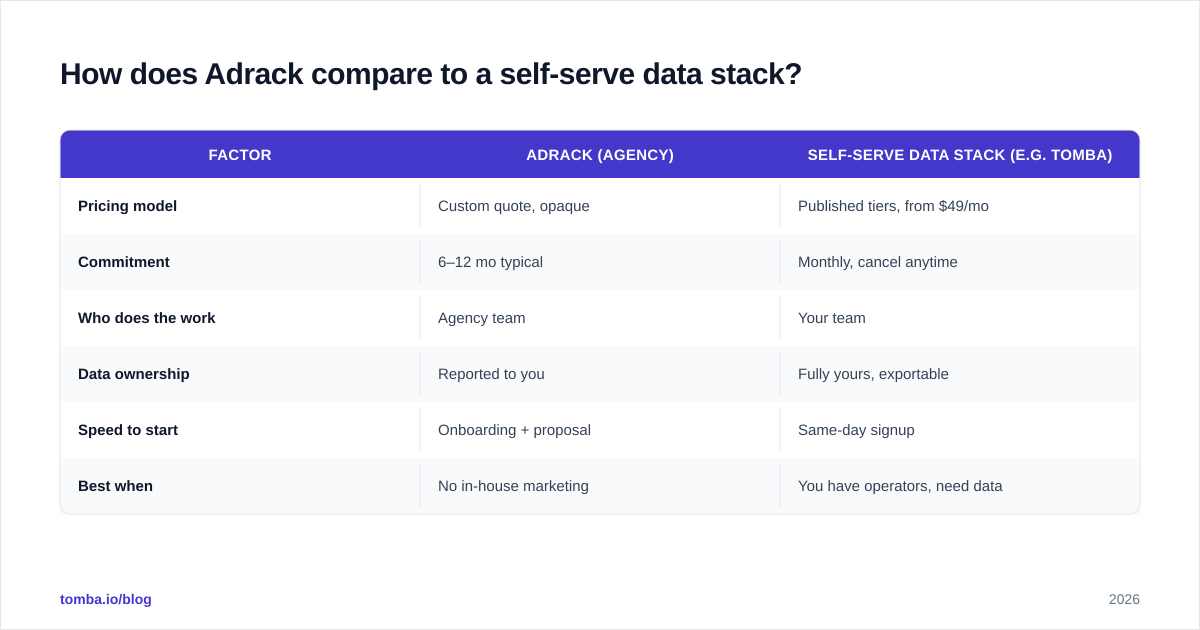
| Factor | Adrack (agency) | Self-serve data stack (e.g. Tomba) |
|---|---|---|
| Pricing model | Custom quote, opaque | Published tiers, from $49/mo |
| Commitment | 6–12 mo typical | Monthly, cancel anytime |
| Who does the work | Agency team | Your team |
| Data ownership | Reported to you | Fully yours, exportable |
| Speed to start | Onboarding + proposal | Same-day signup |
| Best when | No in-house marketing | You have operators, need data |
The two are not mutually exclusive. Plenty of teams run a lean agency relationship for paid media while keeping prospecting data in-house, because contact data is cheaper, faster, and more controllable when you own the tool. Using a dedicated email finder plus an email verifier often costs less per month than a single hour of agency retainer time, and it scales with you.
What should you ask before signing with Adrack?#
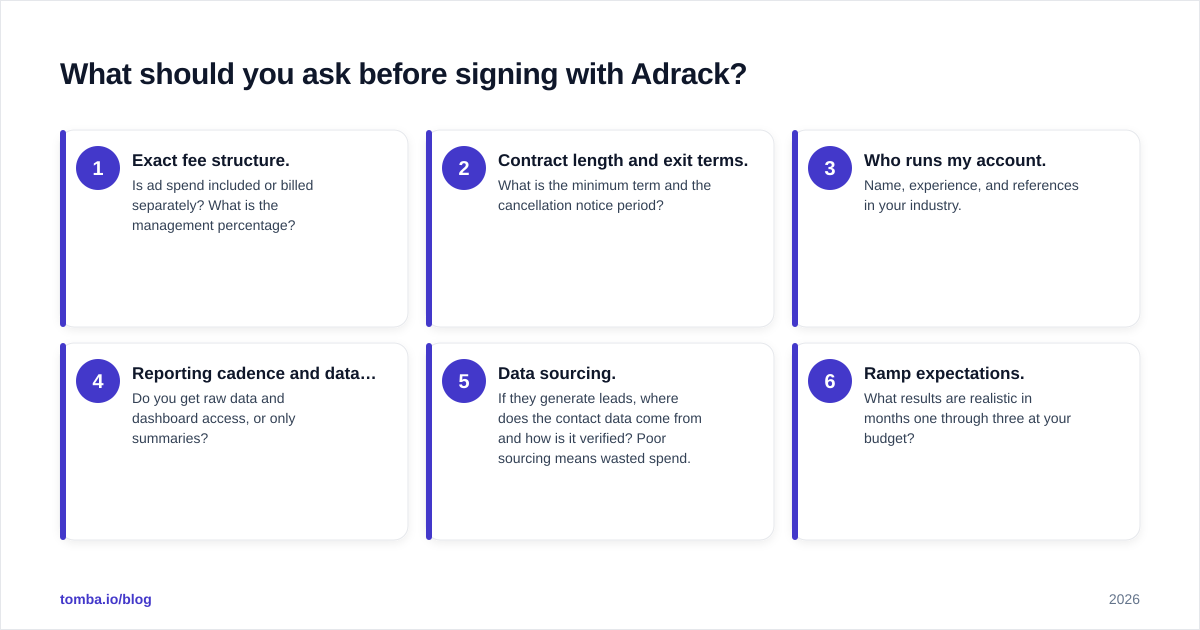
Before you commit to any agency — Adrack included — get these answers in writing:
- Exact fee structure. Is ad spend included or billed separately? What is the management percentage?
- Contract length and exit terms. What is the minimum term and the cancellation notice period?
- Who runs my account. Name, experience, and references in your industry.
- Reporting cadence and data access. Do you get raw data and dashboard access, or only summaries?
- Data sourcing. If they generate leads, where does the contact data come from and how is it verified? Poor sourcing means wasted spend.
- Ramp expectations. What results are realistic in months one through three at your budget?
If the honest answer to question five is "we buy lists" or "we scrape," that's a red flag — unverified data drives bounces and reputation damage. You can do better in-house with a verified domain search that returns current, checked addresses for the companies you actually want to reach.
Who should choose Adrack, and who shouldn't?#
Choose Adrack if: you are a small or mid-sized business with no marketing team, you want a single vendor to own multiple channels, and you are comfortable trading control and transparency for convenience. The managed model genuinely saves time for owners who would otherwise be doing this themselves at midnight.
Skip Adrack if: you already have marketers or SDRs on staff, you want transparent month-to-month pricing, or your real constraint is data quality rather than labor. In that case, invest in tooling you control and keep the agency margin in your own budget.
The most common mistake we see is buying a full agency retainer to solve what is really a contact-data problem. If your reps have a process but keep hitting bounces, dead numbers, and missing decision-makers, the fix is better data — not outsourcing the whole funnel.
The bottom line on Adrack pricing, reviews, pros and cons#
Adrack is a legitimate done-for-you marketing option for businesses that want to delegate execution and don't mind quote-based, contract-bound pricing. Reviews skew positive on service and mixed on transparency, and the pros-and-cons balance comes down to one question: do you need labor, or do you need data?
If you need labor and have no team, an agency like Adrack can be worth it. If you have operators and your bottleneck is accurate contacts, you'll get more leverage — and far more transparency — from a self-serve data tool.
That's where Tomba fits. The Tomba Email Finder lets you find and verify professional email addresses by name, company, or domain, starting free with 25 searches a month and scaling at a published $49/mo Starter plan — no quotes, no contracts, no agency margin. Build your prospecting data layer in-house, keep full ownership of every contact, and point your budget at campaigns instead of retainers. Start free and see how much of the "agency" work you already control.
// get started
Find, verify and enrich your first contacts today
Start on the free plan with 25 searches a month, then scale when your team is ready.
Free plan · No credit card required · GDPR & CCPA
// about the author