Advantages of Personal Selling: Why It Still Wins in 2026
Personal selling is slower and pricier than automation — and still closes the deals that matter most. Here are the real advantages, the trade-offs, and when to use it in 2026.
TL;DR
- Personal selling is direct, person-to-person persuasion — and its core advantage is the two-way dialogue automation can't replicate.
- The biggest wins: higher conversion on complex deals, real-time objection handling, instant feedback, stronger relationships, and natural upsell/cross-sell.
- The trade-offs are real too: it's expensive, slow to scale, and only pays off above a certain deal size.
- The 2026 playbook is hybrid — let automation handle volume and qualification, then route warm, high-value buyers to a human.
- Personal selling only works if you reach the right person. Accurate contact data is the unglamorous prerequisite behind every great sales conversation.
What is personal selling?#
Personal selling is the process of one person directly persuading another to buy, usually through a real conversation — a call, a video meeting, a demo, or a face-to-face pitch. Unlike an ad or a drip campaign, it's a two-way exchange: the seller reads the buyer, adjusts in real time, and answers the exact question standing between "interested" and "signed."
Think of it like the difference between a recipe card and a chef cooking for you at the table. The recipe (your automated email sequence) scales infinitely and never gets tired, but it can't taste the dish or ask if you wanted less salt. The chef costs more and serves fewer people — but they adapt every plate to the person in front of them. That adaptability is the whole argument for personal selling, and it's why it survives every new wave of automation.
The model shows up across B2B SaaS demos, enterprise procurement, financial services, real estate, and high-ticket consulting — anywhere the purchase is expensive, complicated, or emotionally loaded enough that a buyer wants a human on the other end.
What are the main advantages of personal selling?#
The advantages of personal selling all trace back to one root: a human can sense and respond in the moment. Everything below is a branch of that.
1. Two-way communication. A landing page broadcasts. A salesperson converses. When a buyer says "we already use a competitor," a rep can pivot immediately — ask what's not working, reframe the value, or drop the pitch entirely if it's a bad fit. That live loop is impossible with one-directional channels.
2. Higher conversion on complex deals. For considered purchases, talking to a knowledgeable human moves more buyers across the line than any automated touch. The harder the decision, the more the conversation matters. According to Gartner research on B2B buying, purchase groups now include six to ten stakeholders — and a skilled seller is often the only thing aligning them.
3. Real-time objection handling. Objections kill deals when they go unanswered. In person, a rep hears the hesitation in a buyer's voice, surfaces the unspoken concern, and resolves it before it festers. An email sequence can only guess which objection to pre-empt.
4. Immediate feedback. Every conversation is market research. Reps learn which features land, which pricing raises eyebrows, and which competitors keep coming up — intelligence that flows straight back to product and marketing. You can read more on tracking this in our guide to response rate benchmarks.
5. Relationship building. People buy from people they trust, and trust compounds. A strong rep relationship reduces churn, shortens the next deal cycle, and turns a customer into a referral source.
6. Tailored messaging. No two buyers care about the same thing. Personal selling lets you lead with security for the CISO, ROI for the CFO, and ease-of-use for the end user — in the same account, on the same day.
7. Natural upsell and cross-sell. A rep who understands a customer's workflow spots the next product they need before the customer asks. That contextual expansion is where account revenue actually grows.
What are the disadvantages of personal selling?#
Being honest about the cost is what separates analysis from a sales pitch. Personal selling has three real weaknesses.
It's expensive. Salaries, commission, training, travel, and tooling add up. A fully loaded B2B rep can cost six figures a year, so every deal they touch has to justify that overhead.
It doesn't scale linearly. One rep can only hold so many conversations a day. Doubling revenue often means doubling headcount, while an automated funnel scales with near-zero marginal cost.
It's inconsistent. Two reps reading from the same script deliver wildly different results. Message control, ramp time, and turnover all become operational headaches that automated channels simply don't have.
This is why personal selling is a poor fit for low-ticket, high-volume, transactional products. If your average deal is $30, no human conversation can pay for itself — and that's exactly the gap automation fills.
Personal selling vs. automated outreach: how do they compare?#
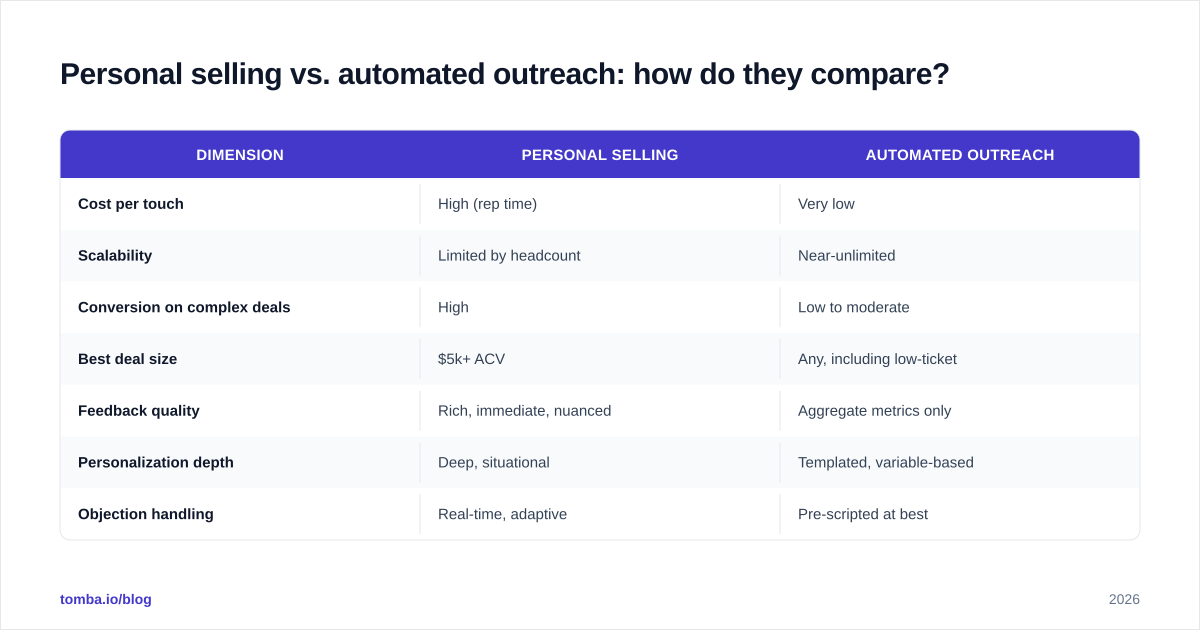
Most teams frame this as a fight. It isn't. They solve different problems at different points in the funnel. The table below lays out where each one wins.
| Dimension | Personal Selling | Automated Outreach |
|---|---|---|
| Cost per touch | High (rep time) | Very low |
| Scalability | Limited by headcount | Near-unlimited |
| Conversion on complex deals | High | Low to moderate |
| Best deal size | $5k+ ACV | Any, including low-ticket |
| Feedback quality | Rich, immediate, nuanced | Aggregate metrics only |
| Personalization depth | Deep, situational | Templated, variable-based |
| Objection handling | Real-time, adaptive | Pre-scripted at best |
| Relationship building | Strong | Weak |
| Speed to reach 1,000 prospects | Slow | Instant |
Read across the rows and the strategy writes itself: use automation to reach the thousand, and personal selling to close the fifty that matter. The mistake teams make is forcing one tool to do both jobs.
For a broader look at where automated tooling fits, our overview of sales automation breaks down the categories worth investing in.
When should you use personal selling in 2026?#
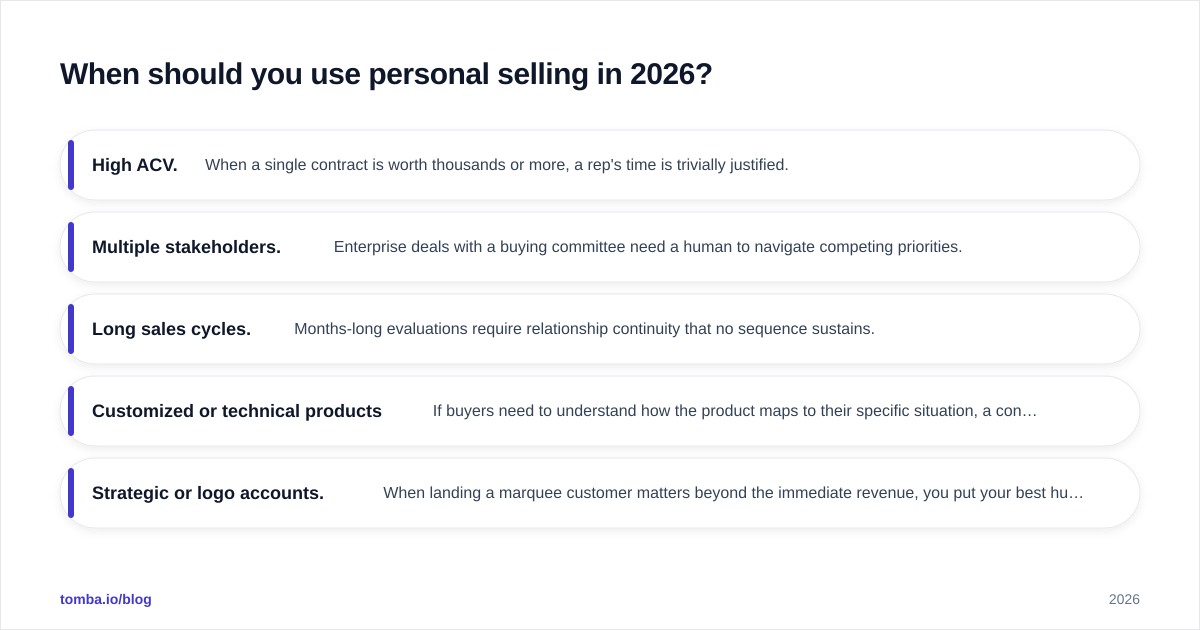
Reach for personal selling when the deal clears a complexity-or-value threshold. Concretely:
- High ACV. When a single contract is worth thousands or more, a rep's time is trivially justified.
- Multiple stakeholders. Enterprise deals with a buying committee need a human to navigate competing priorities.
- Long sales cycles. Months-long evaluations require relationship continuity that no sequence sustains.
- Customized or technical products. If buyers need to understand how the product maps to their specific situation, a conversation beats a brochure.
- Strategic or logo accounts. When landing a marquee customer matters beyond the immediate revenue, you put your best human on it.
Conversely, skip it for self-serve products, freemium funnels, and anything under a few hundred dollars in annual value. There, the math favors a great onboarding flow and a tight automated nurture.
How does the hybrid model work?#
The winning 2026 setup isn't personal selling or automation — it's a relay race where automation runs the first leg and a human runs the anchor.
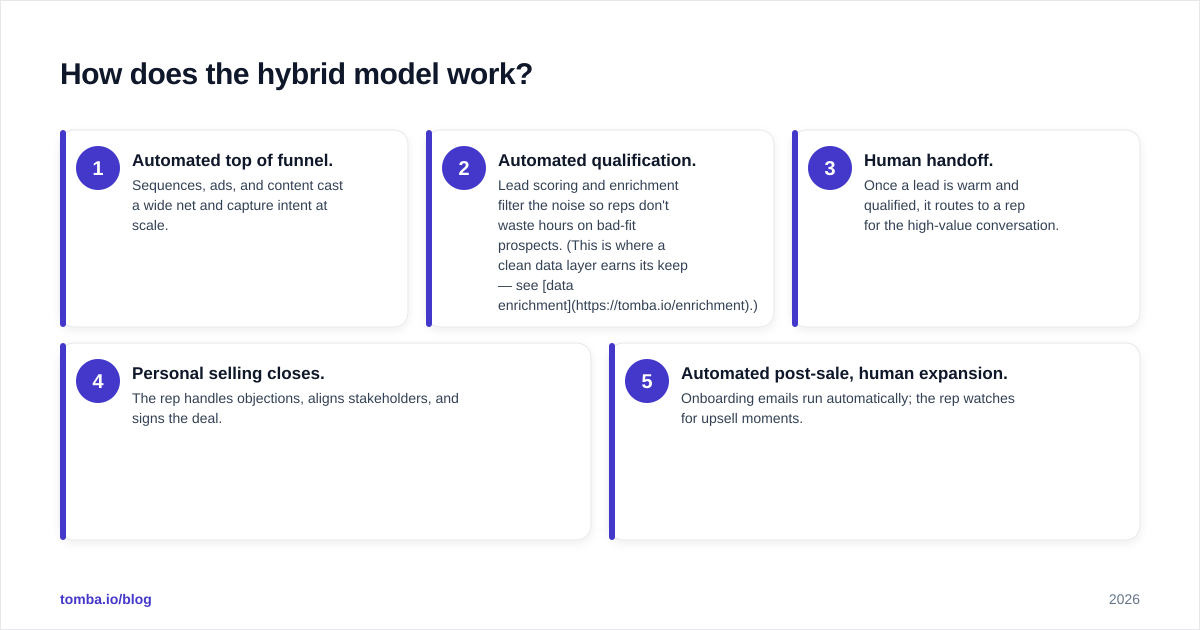
Here's the typical flow:
- Automated top of funnel. Sequences, ads, and content cast a wide net and capture intent at scale.
- Automated qualification. Lead scoring and enrichment filter the noise so reps don't waste hours on bad-fit prospects. (This is where a clean data layer earns its keep — see data enrichment.)
- Human handoff. Once a lead is warm and qualified, it routes to a rep for the high-value conversation.
- Personal selling closes. The rep handles objections, aligns stakeholders, and signs the deal.
- Automated post-sale, human expansion. Onboarding emails run automatically; the rep watches for upsell moments.
The hybrid model captures the cost-efficiency of automation and the conversion power of human selling. The handoff point — when a lead becomes "rep-worthy" — is the single most important number to tune in your funnel.
What skills make personal selling effective?#
Even the best-timed handoff fails if the rep can't sell. The advantages above only materialize with real skill behind them.
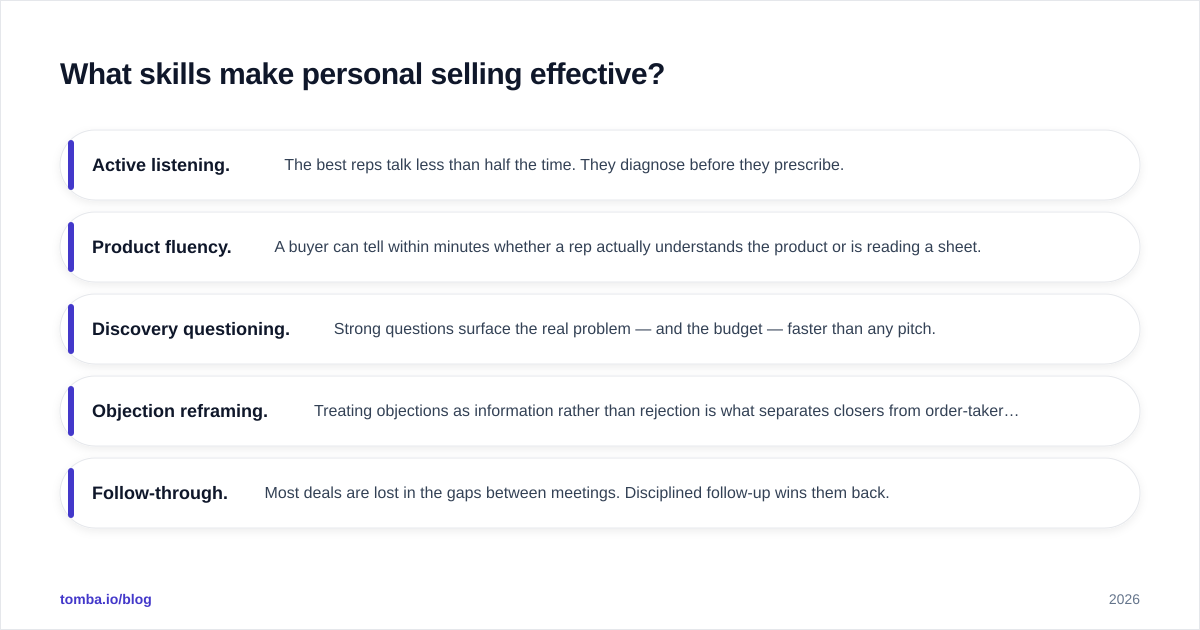
- Active listening. The best reps talk less than half the time. They diagnose before they prescribe.
- Product fluency. A buyer can tell within minutes whether a rep actually understands the product or is reading a sheet.
- Discovery questioning. Strong questions surface the real problem — and the budget — faster than any pitch.
- Objection reframing. Treating objections as information rather than rejection is what separates closers from order-takers.
- Follow-through. Most deals are lost in the gaps between meetings. Disciplined follow-up wins them back.
Worth noting for managers: these skills compound with good sales process discipline and CRM hygiene. Talent without process leaks revenue.
What data do you need before a personal sales conversation?#
This is the unglamorous prerequisite nobody puts on the advantages list — but it gates all of them. A brilliant rep with the wrong contact details closes nothing.
Before a rep ever picks up the phone, they need:
- The right person — the actual decision-maker or champion, not a generic info@ inbox.
- A valid, verified email so the first touch doesn't bounce and burn your sender reputation.
- A direct phone number when the conversation needs to happen live.
- Enrichment context — role, company size, tech stack — so the rep walks in informed.
Bad data quietly destroys the economics of personal selling. If reps spend a third of their day hunting for contacts or chasing dead addresses, the cost-per-deal that already worried your CFO gets worse. According to HubSpot sales research, prospecting and data hygiene remain among the most time-consuming parts of a rep's week — time that should be spent selling.
This is exactly why teams pair their human selling motion with a fast, accurate email finder and a reliable email verifier. Feed reps clean, verified contacts and you reclaim the hours that make personal selling profitable.
The bottom line#
Personal selling's advantages — two-way dialogue, real-time objection handling, deep personalization, trust, and upsell — are precisely the things automation still can't fake. Its disadvantages — cost, limited scale, inconsistency — are precisely the things automation handles best. The smart move in 2026 isn't choosing a side. It's building a funnel where automation feeds your reps a steady stream of qualified, well-researched prospects, and your reps do what only humans can: close.
That handoff lives or dies on data quality. If you want your reps spending their time in conversations instead of digging for contact details, start by fixing the input. Tomba's Email Finder finds and verifies the right decision-maker's email by name, company, or domain — so every personal sales conversation starts with a real person on the other end. Check the Tomba pricing plans, including a free tier with 25 searches a month, and give your sellers the clean data their skills deserve.
// get started
Find, verify and enrich your first contacts today
Start on the free plan with 25 searches a month, then scale when your team is ready.
Free plan · No credit card required · GDPR & CCPA
// about the author