AdvizorPro vs Ampliz: B2B Data Tools Compared (2026)
AdvizorPro targets financial-advisor data; Ampliz goes broad across healthcare and global B2B. Here's which fits your pipeline in 2026 — and where a finder beats both.
TL;DR
- AdvizorPro is a vertical database built for one audience: financial advisors, RIAs, broker-dealers, and insurance producers. If you sell into wealth management, its depth is hard to beat.
- Ampliz is a horizontal B2B data platform with a strong healthcare bent and broad global firmographic coverage. If your ICP spans industries and geographies, it casts a wider net.
- They rarely compete head-to-head. The real question is niche depth vs. broad reach — not which is "better."
- Both sell static records. Neither verifies an email at the moment you send, which is where bounce rates actually come from.
- If your core need is simply finding and verifying reachable work emails by company or name, a focused tool like Tomba Email Finder often does that job cheaper and with fresher results than either platform.
What are AdvizorPro and Ampliz?#
Short answer: they're both B2B data providers, but they solve different problems.
Think of it like fishing. AdvizorPro is a guide who knows one lake intimately — every cove where financial advisors swim, how much each manages, and which boat they switched to last quarter. Ampliz is a supplier of nets and charts for the whole ocean, with an unusually detailed map of the healthcare reef.
AdvizorPro specializes in the wealth and insurance ecosystem. It tracks registered investment advisors (RIAs), broker-dealer reps, insurance agents, and the firms they work for — including assets under management (AUM), licenses, custodial relationships, and advisor movement between firms. Vendors and recruiters who sell to financial professionals use it because that data simply isn't surfaced well by generalist tools.
Ampliz is a broader B2B data and intelligence play. It offers global company and contact data, intent signals, and a well-known healthcare intelligence module (physicians, hospitals, NPI-linked records). Teams selling across multiple verticals — or specifically into healthcare — reach for it when they need volume and geographic spread.

So the comparison isn't apples-to-apples. It's "deep well" vs. "wide reservoir." Picking correctly starts with one honest question: is your entire addressable market inside financial services, or not?
How do AdvizorPro and Ampliz compare on coverage and data?#
This is where the two platforms diverge most sharply.
AdvizorPro's coverage is narrow by design. It pulls heavily from regulatory sources — SEC and FINRA filings, Form ADV, state insurance registries — and layers contact data on top. Because those filings are public and structured, the firmographic accuracy on advisors (AUM, registrations, firm affiliation) tends to be strong and auditable. The trade-off: if you need a marketing director at a SaaS company, AdvizorPro has nothing for you.
Ampliz trades depth for breadth. It claims tens of millions of global contacts spanning most industries, plus a specialized healthcare database. Coverage outside the US is a genuine selling point. The trade-off is the one every large horizontal database carries: record freshness and email accuracy vary widely by segment, and you'll find more stale or generic records the further you get from its core verticals.
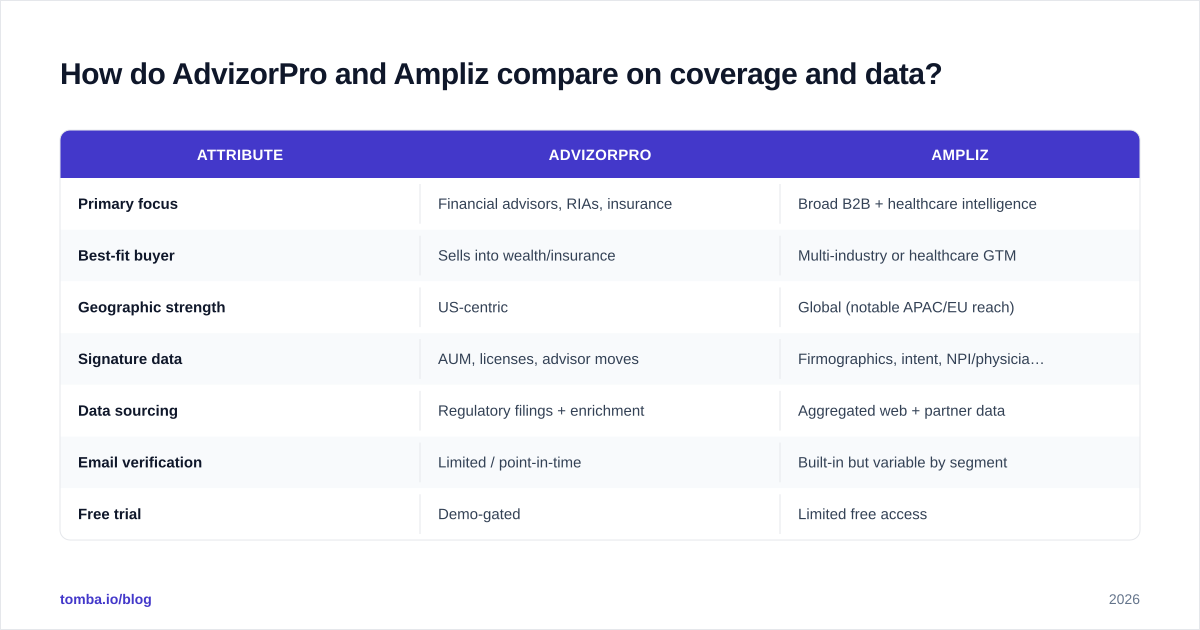
Here's the practical breakdown:
| Attribute | AdvizorPro | Ampliz |
|---|---|---|
| Primary focus | Financial advisors, RIAs, insurance | Broad B2B + healthcare intelligence |
| Best-fit buyer | Sells into wealth/insurance | Multi-industry or healthcare GTM |
| Geographic strength | US-centric | Global (notable APAC/EU reach) |
| Signature data | AUM, licenses, advisor moves | Firmographics, intent, NPI/physician data |
| Data sourcing | Regulatory filings + enrichment | Aggregated web + partner data |
| Email verification | Limited / point-in-time | Built-in but variable by segment |
| Free trial | Demo-gated | Limited free access |
| Typical pricing | Custom, mid-to-high | Custom, tiered |
Two caveats worth stating plainly. First, both vendors keep pricing behind a sales call, so any number you see quoted elsewhere is someone's old contract, not a list price. Verify current terms on G2 or Capterra and in your own demo. Second, "number of contacts" is a vanity metric — what matters is how many records match your ICP and still have a deliverable email.
Is AdvizorPro better than Ampliz?#
Conclusion first: for selling into financial services, yes — and it's not close. For everything else, Ampliz wins by default because AdvizorPro doesn't play there.
Choose AdvizorPro when:
- Your total addressable market is advisors, RIAs, broker-dealers, or insurance producers.
- You need AUM tiers, license types, or custodial relationships to segment and prioritize.
- You're a recruiter or asset manager tracking advisor movement between firms.
- Regulatory-grade accuracy matters more than raw volume.
Choose Ampliz when:
- Your ICP spans multiple industries or you're scaling outbound globally.
- Healthcare is a target market and you need physician/hospital data.
- You want intent signals layered onto firmographics.
- Volume and geographic spread matter more than vertical depth.

There's a third answer that neither vendor will volunteer: you may not need a full database at all. A large share of "data platform" spend goes toward records you'll never touch. If your workflow is "I have a company and a name, I need a reachable email," you're paying database prices for a finder's job.
Why does data accuracy decay — and what does that cost you?#
Here's the part both platforms gloss over: every static database is wrong the moment it's built, and gets worse every day.
People change jobs. Companies rebrand domains. Advisors switch broker-dealers. Studies across the industry consistently put B2B data decay at roughly 25–30% per year — meaning a quarter of any list you buy today is stale within twelve months. AdvizorPro mitigates this for advisors by re-syncing from filings, but contact emails still drift. Ampliz, with a far larger surface area, has more records decaying at once.
Why it matters for you: a record being "in the database" is not the same as the email being deliverable today. When you send to a decayed list, mailbox providers see bounces and spam-trap hits, and your sender reputation takes the damage. One bad import can suppress deliverability for weeks across your entire domain — including the prospects whose addresses were fine.
This is the core argument for separating two jobs that platforms bundle together:
- Discovery — finding who exists and which company they're at. Databases are good at this.
- Verification — confirming the email resolves right now, before you hit send. Databases are weak at this because their data is a snapshot.
A dedicated email verifier closes that gap by checking MX records, SMTP response, and catch-all status at the moment you ask — not whenever the vendor last refreshed. Running any list (AdvizorPro, Ampliz, or a scraped CSV) through verification before a campaign is the single cheapest insurance you can buy for your deliverability.
What does AdvizorPro vs Ampliz cost in practice?#
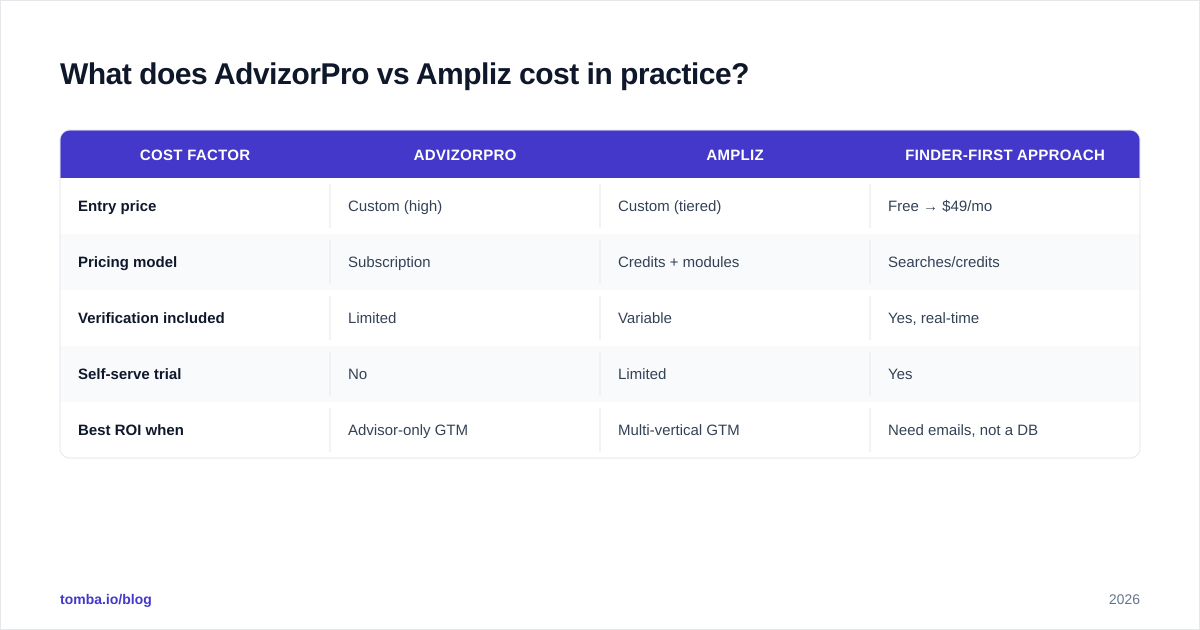
Both are mid-market-and-up tools priced by quote, so treat the table above as direction, not gospel. A few patterns hold:
- AdvizorPro prices like a specialty data subscription — you pay a premium for a dataset you genuinely can't assemble yourself. For a firm whose entire pipeline is advisors, the ROI math is straightforward.
- Ampliz prices like a horizontal platform — tiered by credits, seats, and modules (healthcare and intent usually cost extra). Costs climb fast as you add data types.
- Neither offers a meaningful self-serve free tier, which makes them hard to test before a commitment.
Compare that to a usage-based finder. Tomba's pricing starts with a genuine free tier (25 searches/month), then Starter at $49/mo, Growth at $99/mo, and Pro at $249/mo — with the email finder, verifier, domain search, and data enrichment included rather than sold as add-on modules. For teams whose real need is reach-the-contact rather than research-the-market, that's an order-of-magnitude difference in entry cost.
| Cost factor | AdvizorPro | Ampliz | Finder-first approach |
|---|---|---|---|
| Entry price | Custom (high) | Custom (tiered) | Free → $49/mo |
| Pricing model | Subscription | Credits + modules | Searches/credits |
| Verification included | Limited | Variable | Yes, real-time |
| Self-serve trial | No | Limited | Yes |
| Best ROI when | Advisor-only GTM | Multi-vertical GTM | Need emails, not a DB |
When should you skip both and use an email finder instead?#
Skip the full database when your bottleneck is contact, not discovery.
A concrete test: write down your last ten prospecting tasks. If most of them were "I already know the company and the person — I just need their work email and a way to confirm it's live," you don't have a data-coverage problem. You have a finder-and-verifier problem, and you're overpaying if you solve it with a vertical database license.
This is exactly the workflow a focused stack handles well:
- Have a name and a company? Use the email finder to resolve the work address.
- Have a domain and want everyone there? Run a domain search to pull the team and their email pattern.
- Have a messy list from any source — including an AdvizorPro or Ampliz export? Push it through the bulk email finder and verifier before it ever touches your sequencer.
- Building this into a product or CRM sync? The Tomba API does it programmatically, and the data sourcing is documented on the data sources page.
That said — be honest about your ICP. If you genuinely need to discover advisors by AUM tier, or map physicians by specialty across regions, a finder won't build that universe for you. That's the legitimate job AdvizorPro and Ampliz do. The mistake is buying a market-mapping tool to do contact-finding work, or vice versa. Many strong stacks use both: a vertical database to define the universe, and a real-time finder/verifier to keep the contact layer deliverable.
You can sanity-check any platform's contact accuracy yourself before committing. Pull 25 records from a demo, run them through a free email checker, and measure the real deliverable rate against the vendor's marketing claims. Trust the test, not the pitch.
Which one should you pick?#
Decision in one paragraph: If 100% of your buyers are financial advisors or insurance producers, license AdvizorPro — nothing else matches its depth. If you sell across industries or into healthcare, Ampliz gives you the breadth AdvizorPro lacks. If your day-to-day pain is simply finding and verifying work emails at companies you already know, neither justifies its cost, and a finder-first tool will serve you better for a fraction of the price.
The fork that trips people up is treating "B2B data tool" as one category. It isn't. Market intelligence (who exists, how big, what they do) and contact resolution (the deliverable email, verified today) are different jobs with different price tags. Buy for the job you actually do most.
If that job is reaching contacts, start with the Tomba Email Finder. You get a free tier to test real deliverability on your own list, real-time verification built in rather than bolted on, and pricing that starts at $49/mo instead of a custom enterprise quote — so you can find, verify, and enrich the people you already know you want to reach, without paying database rates to do it. Run your next 25 prospects through it today and compare the bounce rate to whatever you're using now.
// get started
Find, verify and enrich your first contacts today
Start on the free plan with 25 searches a month, then scale when your team is ready.
Free plan · No credit card required · GDPR & CCPA
// about the author