AdvizorPro vs Bytemine 2026: Advisor Data Platforms Compared
AdvizorPro and Bytemine both sell financial-advisor contact data — but they win on different things. Here's the honest 2026 breakdown of coverage, accuracy, pricing, and CRM fit.
If you sell into wealth management, insurance, or RIA channels, you have probably had AdvizorPro and Bytemine open in two browser tabs, trying to decide which one actually earns a line in your budget. Both promise the same headline outcome — clean contact data on financial advisors and the firms they work for — but they get there differently, price it differently, and break down in different places.
This is a working comparison, not a press release. We will look at where each platform's data comes from, how accurate it tends to be in practice, what you pay, and how either one slots into your existing prospecting stack. We will also be direct about the one weakness both share: the moment you export a list, the freshness clock starts ticking, and you need a verification step before you hit send.
TL;DR#
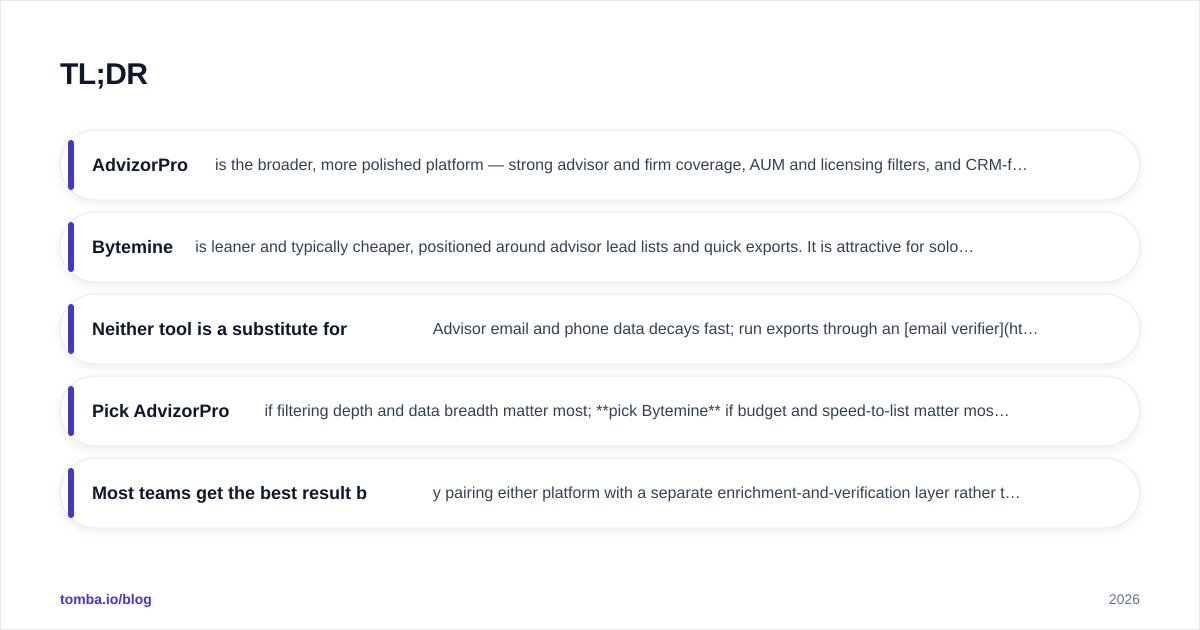
- AdvizorPro is the broader, more polished platform — strong advisor and firm coverage, AUM and licensing filters, and CRM-friendly exports. It costs more and is built for teams that prospect advisors full-time.
- Bytemine is leaner and typically cheaper, positioned around advisor lead lists and quick exports. It is attractive for solo reps and small teams who want data without a heavy contract.
- Neither tool is a substitute for verification. Advisor email and phone data decays fast; run exports through an email verifier before any cold send to protect deliverability.
- Pick AdvizorPro if filtering depth and data breadth matter most; pick Bytemine if budget and speed-to-list matter most.
- Most teams get the best result by pairing either platform with a separate enrichment-and-verification layer rather than trusting raw exports.
What are AdvizorPro and Bytemine?#
Both are B2B data intelligence platforms aimed at a specific buyer: anyone selling products or services to financial advisors. That includes asset managers, fintech vendors, insurance wholesalers, recruiters, and B2B marketers in the wealth space.
AdvizorPro positions itself as a comprehensive advisor database. It aggregates regulatory filings (think SEC and FINRA records), firm data, licensing details, and contact information into a filterable platform. You can slice by assets under management, advisor type (RIA, broker-dealer, hybrid), licenses held, location, and more, then export contacts or push them to your CRM. You can see how the market rates it on G2 and Capterra.
Bytemine plays in the same channel but with a lighter footprint. It emphasizes ready-to-use advisor lead lists and straightforward exports, generally at a lower entry price. The pitch is speed and affordability: get a usable list of advisors and their contact details without a large platform commitment.
The core difference in one sentence: AdvizorPro is a platform you work inside, while Bytemine leans toward being a list source you pull from.
How do their data sources compare?#
Data quality starts with sourcing, and this is where advisor-focused tools differ from generic B2B databases.
The financial-advisor niche has an unusual advantage: a lot of the underlying data is public and regulated. Advisors and firms file disclosures with the SEC and FINRA, which means firmographic and licensing data can be both rich and reasonably authoritative. Both AdvizorPro and Bytemine tap into this regulatory layer.
The divergence happens at the contact layer — direct email addresses and phone numbers. Regulatory filings give you firm addresses and registration details, not always a personal work email. To fill that gap, platforms blend filings with web data, third-party sources, and pattern inference. AdvizorPro tends to invest more here, which shows up as deeper contact coverage and more filterable attributes. Bytemine covers the essentials but with less depth on the long tail.
A practical implication: regulatory-sourced firm data ages slowly, but advisor email and phone data ages fast. Advisors change firms, get acquired, retire, or shift broker-dealer affiliations constantly. A database that was 95% accurate at build time can drift several points per quarter. This is true of both platforms and is the single biggest reason to add a verification step downstream.
AdvizorPro vs Bytemine: feature and pricing comparison#
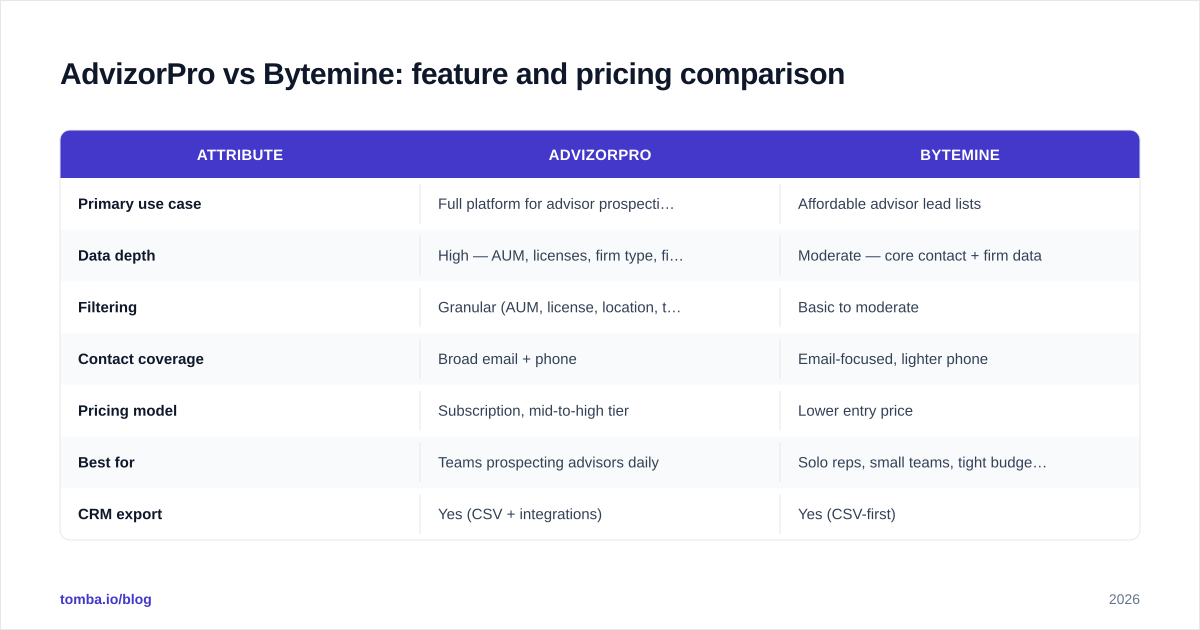
Here is the side-by-side. Pricing for both platforms is quote-based and changes over time, so treat the figures as directional and confirm directly with each vendor.
| Attribute | AdvizorPro | Bytemine |
|---|---|---|
| Primary use case | Full platform for advisor prospecting | Affordable advisor lead lists |
| Data depth | High — AUM, licenses, firm type, filings | Moderate — core contact + firm data |
| Filtering | Granular (AUM, license, location, type) | Basic to moderate |
| Contact coverage | Broad email + phone | Email-focused, lighter phone |
| Pricing model | Subscription, mid-to-high tier | Lower entry price |
| Best for | Teams prospecting advisors daily | Solo reps, small teams, tight budgets |
| CRM export | Yes (CSV + integrations) | Yes (CSV-first) |
| Verification built in | Limited | Limited |
The table makes the trade-off obvious. AdvizorPro wins on depth and tooling; Bytemine wins on price and simplicity. Neither bakes in serious email verification, which is why both leave a gap your stack has to close.
Which one has more accurate data?#
Short answer: AdvizorPro generally edges ahead on coverage and filterable accuracy, but measured accuracy at send time depends almost entirely on how recently the record was refreshed — not on the logo on the dashboard.
Here is the trap teams fall into. Vendors quote accuracy as a build-time number: "95% accurate." That figure describes the database the day it was assembled. By the time you filter a segment, export it, load it into a sequencer, and actually send, weeks may have passed. Advisor mobility means a meaningful share of those addresses are now stale.
So the real accuracy question is not "AdvizorPro vs Bytemine" — it is "exported list vs reality at send time." The only reliable way to answer it is to verify the list yourself right before you use it. Running an export through a dedicated email verification pass catches the addresses that bounced since the database was built, including catch-all domains that neither platform flags clearly.
If you want to enrich beyond what either platform returns — adding firmographics, social profiles, or a verified secondary email — a separate data enrichment step on top of your export usually beats switching platforms entirely.
Is AdvizorPro worth the higher price?#
It depends on volume and how central advisor prospecting is to your revenue.
AdvizorPro pays for itself when: advisors are your primary market, you prospect them every week, and your reps lose real time hunting for the right contact. The granular filters — AUM bands, license types, RIA vs broker-dealer — let you build tight segments instead of blasting generic lists. That precision compounds: better targeting raises response rate, which justifies a higher data spend.
AdvizorPro is overkill when: you run occasional advisor campaigns, you have a small territory, or you are testing the channel before committing. Paying platform pricing for a tool you open twice a month is hard to defend.
A useful mental model: AdvizorPro is like leasing a fully-equipped workshop, while Bytemine is like buying the specific tools you need for one job. The workshop is worth it if you are in there daily. If you only have a weekend project, the toolset is the smarter spend.
When is Bytemine the better choice?#
Bytemine is the pragmatic pick for budget-conscious teams and individual operators.
Choose Bytemine if you are a solo founder selling a fintech product to advisors, a small recruiting shop, or a marketer running a one-off campaign where you need a usable list fast and cannot justify a large platform contract. The lower entry price lowers the risk of testing the channel, and the CSV-first export model is simple to work with.
The trade-offs to accept: shallower filtering, lighter phone coverage, and a smaller long tail of contacts. For high-volume, precision-targeted outbound, those gaps add up. For lean, focused campaigns, they rarely matter.
One more consideration: because Bytemine is list-oriented, you will likely lean harder on external tools to enrich and verify. Budget for that. A cheap list that bounces is not cheap — it costs you sender reputation, which is far more expensive to rebuild than to protect.
How do you protect deliverability with either tool?#
This is the section that matters most and that most comparison articles skip. Whichever platform you choose, your cold outbound results are governed by email deliverability, and stale data is the fastest way to wreck it.
Here is a clean workflow that works with exports from either AdvizorPro or Bytemine:
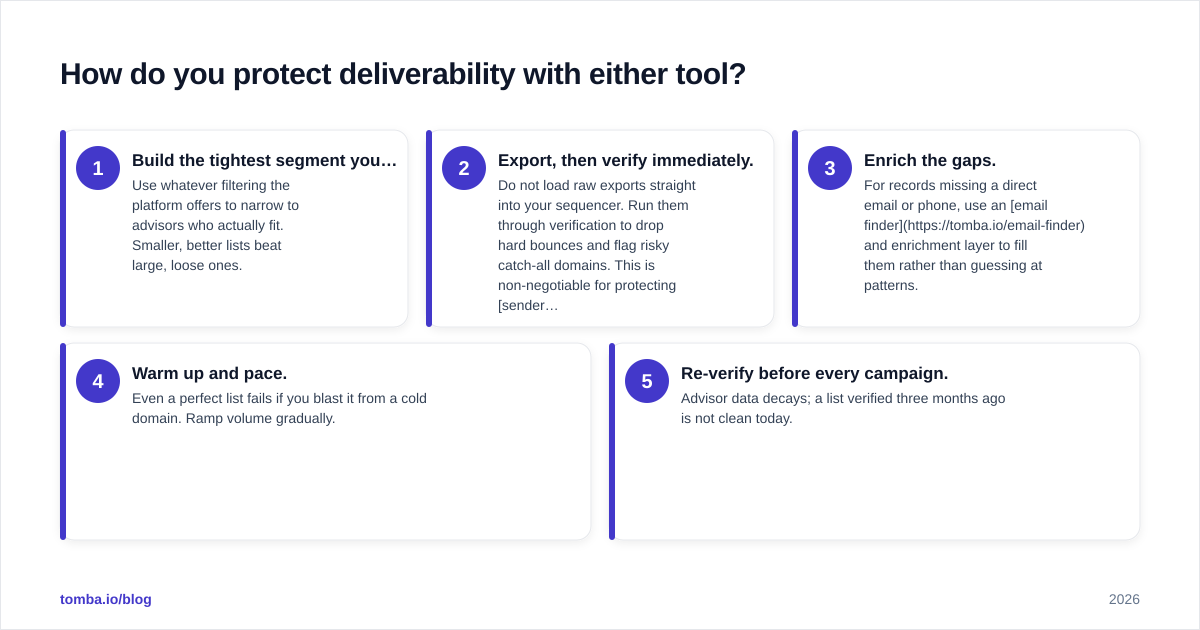
- Build the tightest segment you can. Use whatever filtering the platform offers to narrow to advisors who actually fit. Smaller, better lists beat large, loose ones.
- Export, then verify immediately. Do not load raw exports straight into your sequencer. Run them through verification to drop hard bounces and flag risky catch-all domains. This is non-negotiable for protecting sender reputation.
- Enrich the gaps. For records missing a direct email or phone, use an email finder and enrichment layer to fill them rather than guessing at patterns.
- Warm up and pace. Even a perfect list fails if you blast it from a cold domain. Ramp volume gradually.
- Re-verify before every campaign. Advisor data decays; a list verified three months ago is not clean today.
The recurring theme: the database vendor gets you a starting list, but the verification and enrichment layer is what turns that list into deliverable, revenue-generating outreach. Treat them as separate jobs, because they are.
What about phone outreach to advisors?#
Advisors are a phone-friendly audience — many still prefer a call to a cold email, especially for relationship-driven products. AdvizorPro carries broader phone coverage than Bytemine, which is a genuine differentiator if calling is central to your motion.
That said, phone data decays just like email. Direct dials change, advisors switch firms, and main-line numbers route you to a gatekeeper. If dialing is a core channel, validate numbers before your reps burn hours on dead lines — a phone validator step does for your call list what email verification does for your send list. The principle is identical: trust, but verify, and verify recently.
AdvizorPro vs Bytemine: which should you choose?#
Decide based on three questions:
- How often do you prospect advisors? Daily and at volume → AdvizorPro. Occasionally or in bursts → Bytemine.
- How much does filtering precision matter? If AUM, license type, and firm structure drive your targeting, AdvizorPro's depth earns its price. If you mostly need "advisors in these states," Bytemine is enough.
- What is your budget tolerance? AdvizorPro is a platform investment; Bytemine is a low-risk list buy.
There is no universally correct answer, and anyone telling you otherwise is selling something. AdvizorPro is the stronger platform for serious, ongoing advisor prospecting. Bytemine is the smarter spend for lean teams and early-channel testing. Both leave the same gap — verification — and both perform far better when you close it.
The layer both platforms are missing#
Whichever advisor database you land on, the export is the beginning of the work, not the end. Raw advisor contact data — no matter how good the source — drifts the moment it leaves the platform, and a single bounce-heavy send can damage a sender reputation that took months to build.
That is the gap Tomba is built to close. Use the Tomba Email Finder to fill in missing advisor emails, then run your full AdvizorPro or Bytemine export through Tomba's email verifier to strip dead addresses and catch-all risks before you send. With a free tier (25 searches/month) and paid plans starting at $49/month — see full Tomba pricing for Growth ($99/mo), Pro ($249/mo), and Enterprise — you can verify and enrich at the scale your outbound actually needs. Pick the database that fits your budget; let a dedicated verification layer make sure the contacts you paid for actually land.
Ready to find emails that actually work?
Join 150,000+ professionals who stopped guessing and started sending. Free credits on signup — no credit card required.
Get the Tomba newsletter
Practical outbound tactics and product updates — once every two weeks.
About the author