AdvizorPro vs DiscoverOrg: Which B2B Data Wins in 2026?
AdvizorPro targets wealth and insurance prospecting; DiscoverOrg (now ZoomInfo) chases the whole B2B market. Here's how the two data platforms actually compare in 2026.
TL;DR
- AdvizorPro is a specialist database for financial services — RIAs, broker-dealers, insurance agents, and 401(k) plan data. If you sell to advisors, it is purpose-built for you.
- DiscoverOrg no longer exists as a standalone brand. It merged into ZoomInfo in 2019, so a "DiscoverOrg" purchase today means buying ZoomInfo's broad B2B intelligence suite.
- Choose AdvizorPro for depth in wealth management and insurance; choose ZoomInfo (the former DiscoverOrg) for horizontal coverage across every industry and intent data.
- Both are premium-priced. AdvizorPro starts in the low thousands per year; ZoomInfo commonly lands well into five figures for full seats.
- If you mostly need verified work emails and direct dials at a fraction of either price, a focused email finder like Tomba covers the prospecting layer without the enterprise contract.
Who are AdvizorPro and DiscoverOrg?#
The short version: these two tools solve different problems, and one of them changed names years ago.
AdvizorPro is a vertical data platform built for companies that sell into financial services. Its records center on registered investment advisors (RIAs), broker-dealers, insurance producers, retirement-plan sponsors, and the people who run them. Think of it as a specialty grocer — narrow shelves, but everything on them is fresh and exactly what financial-services marketers want.
DiscoverOrg was, for years, one of the most respected names in B2B sales intelligence, known for human-verified org charts and technographic detail. In 2019 it acquired and merged with ZoomInfo, and the combined company now operates entirely under the ZoomInfo brand. So when someone evaluates "AdvizorPro vs DiscoverOrg" in 2026, the honest framing is AdvizorPro vs ZoomInfo (formerly DiscoverOrg) — a niche financial database against a horizontal, everything-for-everyone intelligence engine.
That distinction drives every decision below.
What does each platform actually cover?#
Coverage is where the two diverge most sharply.
AdvizorPro's edge is regulatory data. Because RIAs and broker-dealers file with the SEC and FINRA, AdvizorPro can enrich firm records with assets under management (AUM), custodian relationships, ADV filings, and advisor movement between firms. That's the kind of B2B data and intelligence you simply can't scrape from a generic contact database.
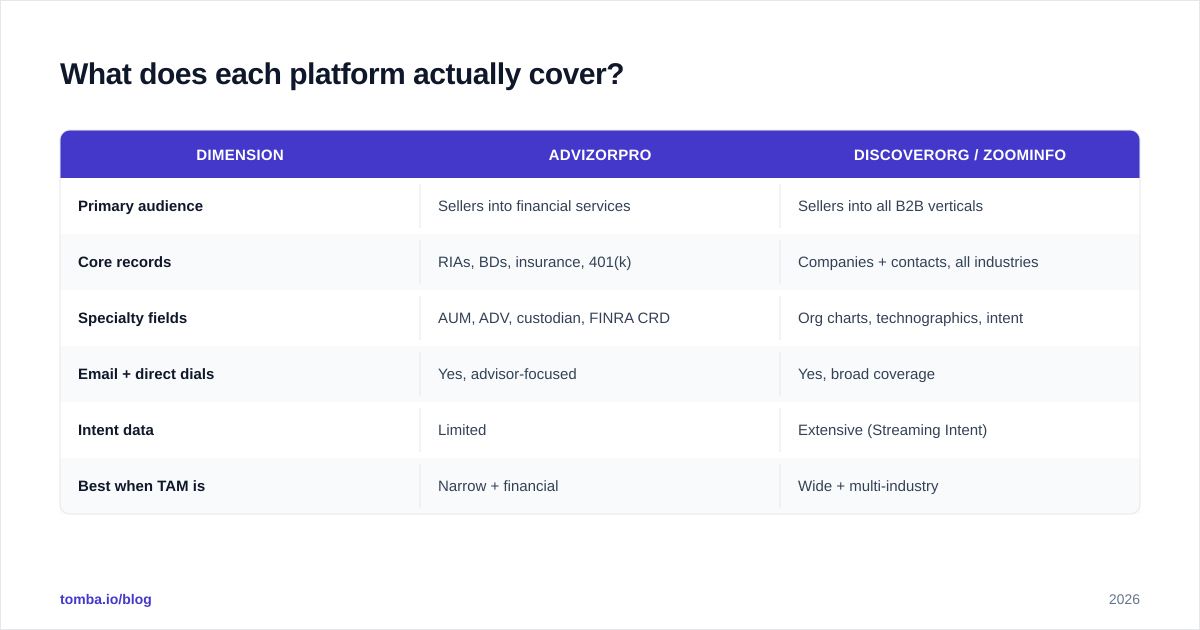
ZoomInfo (the DiscoverOrg lineage) goes wide instead of deep. It maintains hundreds of millions of contacts across every vertical, layered with org charts, technographics, scoops, and intent signals sourced from a large bidstream and research team. If your total addressable market is "all of B2B," that breadth wins.
| Dimension | AdvizorPro | DiscoverOrg / ZoomInfo |
|---|---|---|
| Primary audience | Sellers into financial services | Sellers into all B2B verticals |
| Core records | RIAs, BDs, insurance, 401(k) | Companies + contacts, all industries |
| Specialty fields | AUM, ADV, custodian, FINRA CRD | Org charts, technographics, intent |
| Email + direct dials | Yes, advisor-focused | Yes, broad coverage |
| Intent data | Limited | Extensive (Streaming Intent) |
| Best when TAM is | Narrow + financial | Wide + multi-industry |

How accurate is the data?#
Accuracy depends on how the records are sourced — and the two take different roads.
AdvizorPro benefits from anchoring to public filings. Regulatory data updates on predictable cycles, so advisor names, firm affiliations, and AUM figures tend to be reliable. The weak spot is the same as any niche provider: outside core financial roles (say, a marketing ops contact at an RIA), coverage thins out.
ZoomInfo invests heavily in re-verification and machine learning across a massive contact graph, which is how it sustains broad coverage. The trade-off is the classic scale problem — at hundreds of millions of records, even a small staleness rate produces a meaningful number of bounced emails and dead dials. Independent reviews on G2 consistently praise breadth while flagging that no large database stays perfectly current.
The practical move, regardless of which you pick: run any list through an email verifier before you send. Verification is cheap insurance against a damaged sender reputation, and it matters more than which vendor's marketing claims a higher accuracy percentage.
AdvizorPro vs DiscoverOrg: pricing compared#
Neither tool is cheap, and both gate pricing behind sales calls — so treat the figures below as informed ranges, not published rate cards.
| Plan factor | AdvizorPro | DiscoverOrg /ZoomInfo |
|---|---|---|
| Entry annual cost | Low four figures / seat | Often $15k+ for a team |
| Pricing model | Annual contract, seat-based | Annual contract, credit + seat |
| Free trial | Limited demo | Demo, gated |
| Contract length | Typically 12 months | Typically 12 months, multi-year push |
| Best ROI when | FinServ is your whole market | You work many verticals at scale |
| Overage risk | Lower (focused use) | Higher (credit burn, add-ons) |
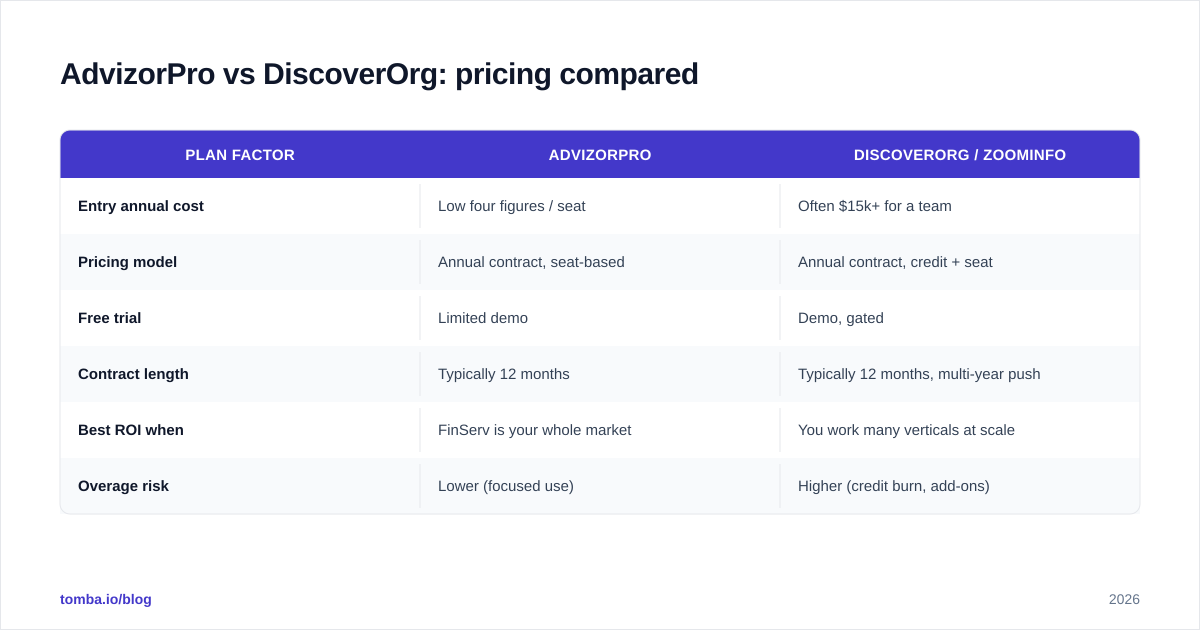
The pattern: AdvizorPro is the more affordable entry if financial services is your lane, because you aren't paying for 190 industries you'll never touch. ZoomInfo's price reflects its breadth and the intent layer — justified if you're running multi-segment outbound, expensive if you only need advisor contacts.
Which one should you choose?#
Here's the decision in one line: match the tool to the shape of your market, not to its brand recognition.
Pick AdvizorPro if:
- You sell software, services, or products to financial advisors, RIAs, or insurance agents.
- Filters like AUM, custodian, and ADV-derived attributes drive your targeting.
- You want specialist depth without an enterprise-scale contract.
Pick ZoomInfo (formerly DiscoverOrg) if:
- Your buyers span many industries and you need horizontal reach.
- Intent data and org charts are central to your revenue operations motion.
- You have the budget and seat count to amortize a five-figure platform.
What if you only need verified emails and phone numbers?#
A lot of teams over-buy. They sign a sprawling intelligence contract when what they actually do every day is simpler: find a prospect, get a deliverable email, maybe a direct dial, and load it into a sequence.
If that describes your workflow, neither a niche regulatory database nor a full enterprise suite is the most efficient spend. A focused contact-discovery tool fills the gap.
That's where Tomba fits. Its domain search returns every public email pattern for a company in seconds, the email finder resolves a specific person by name and domain, and the phone finder adds B2B numbers when you need to call. You can verify in the same flow, then push results to your CRM.
The cost story is straightforward. Where
ZoomInfo can run into five figures, Tomba pricing starts with a free tier of 25 searches per month, then $49/mo for Starter, $99/mo for Growth, and $249/mo for Pro. For many outbound teams, that covers the prospecting layer that a heavyweight platform charges a premium for.
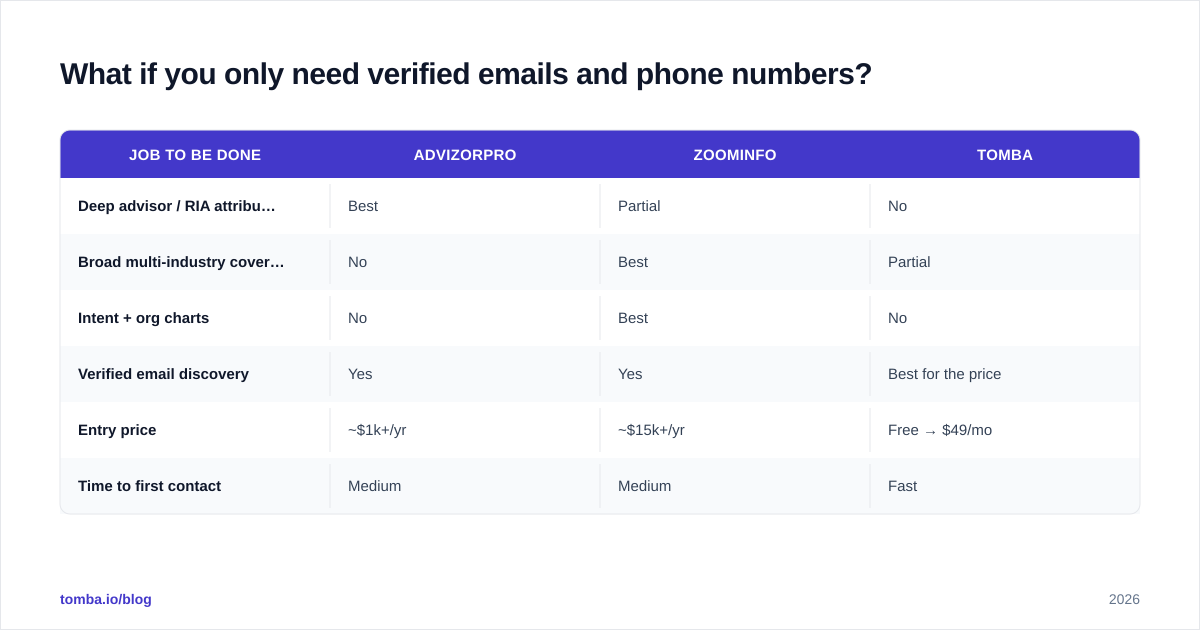
| Job to be done | AdvizorPro | ZoomInfo | Tomba |
|---|---|---|---|
| Deep advisor / RIA attributes | Best | Partial | No |
| Broad multi-industry coverage | No | Best | Partial |
| Intent + org charts | No | Best | No |
| Verified email discovery | Yes | Yes | Best for the price |
| Entry price | ~$1k+/yr | ~$15k+/yr | Free → $49/mo |
| Time to first contact | Medium | Medium | Fast |
How do these tools fit a real prospecting stack?#
In practice, the smartest teams layer rather than pick a single winner.
A financial-services SDR team might keep AdvizorPro as the system of record for who the advisors are, then use a lightweight finder to fill missing emails and confirm deliverability before outreach. A multi-vertical sales org might run ZoomInfo for account selection and intent, while still verifying contacts at send time to protect email deliverability.
The mistake is assuming one tool must do everything. Data platforms are excellent at identifying targets; they are not always the cheapest or freshest source for the contactable details that decide whether your email lands. Splitting "find the account" from "get the verified contact" usually lowers cost and raises connect rates at the same time.
It also future-proofs you. Brands merge — DiscoverOrg becoming ZoomInfo is the obvious example — and pricing models shift. A modular stack where each layer is replaceable beats a single locked-in contract you have to renegotiate from zero.
Frequently asked questions#
Is DiscoverOrg still a separate product? No. DiscoverOrg merged with ZoomInfo in 2019 and the technology now ships under the ZoomInfo brand. Evaluating "DiscoverOrg" today effectively means evaluating ZoomInfo.
Is AdvizorPro better than ZoomInfo? Better for financial-services targeting, yes — it has regulatory-grade depth ZoomInfo can't match. For broad, multi-industry outbound, ZoomInfo's coverage and intent data win.
Can I use a cheaper tool instead of both? If your need is mainly verified emails and phone numbers rather than deep firmographics or intent, a focused finder like Tomba covers that layer at a fraction of either platform's cost.
Do I still need email verification with premium data? Yes. Every large database carries some staleness. Verifying before you send protects your sender reputation regardless of how premium the source is.
The bottom line#
There is no universal winner in AdvizorPro vs DiscoverOrg — there's a winner for your market. AdvizorPro owns financial-services depth; ZoomInfo (the former DiscoverOrg) owns horizontal breadth and intent. Both are premium commitments.
If the real job is finding and verifying business contacts without an enterprise contract, start lean. Spin up the Tomba Email Finder on the free tier, confirm the accuracy and coverage against your own target list, and scale into a paid plan only when the volume justifies it. You can always layer a specialist database on top later — but you can't easily claw back budget you locked into a tool that was bigger than the job.
Ready to find emails that actually work?
Join 150,000+ professionals who stopped guessing and started sending. Free credits on signup — no credit card required.
Get the Tomba newsletter
Practical outbound tactics and product updates — once every two weeks.
About the author