AdvizorPro vs LeadsForge: 2026 B2B Data Platform Comparison
AdvizorPro vs LeadsForge compared on data accuracy, coverage, pricing, and workflow fit—plus where a dedicated email finder beats both for outbound teams in 2026.
Choosing between AdvizorPro and LeadsForge usually comes down to one question: do you need deep, vertical data on financial professionals, or a broad AI engine that builds lead lists across any industry? They look similar on a feature grid, but they solve different problems. Pick the wrong one and you either overpay for niche data you don't use, or you flood your pipeline with generic contacts your reps can't close.
This breakdown compares both on data accuracy, coverage, workflow fit, and price—and shows where a focused, pay-as-you-grow tool fills the gaps either platform leaves behind.
TL;DR#
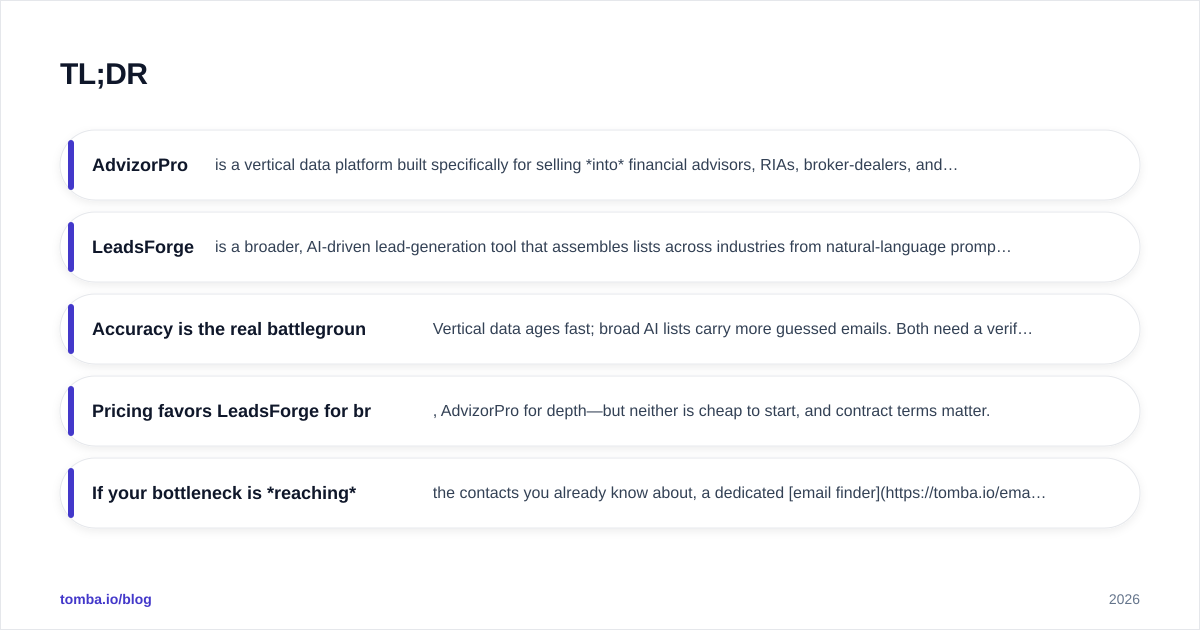
- AdvizorPro is a vertical data platform built specifically for selling into financial advisors, RIAs, broker-dealers, and wealth firms. Best when your entire ICP lives in wealth management.
- LeadsForge is a broader, AI-driven lead-generation tool that assembles lists across industries from natural-language prompts. Best for generalist outbound teams that change targets often.
- Accuracy is the real battleground. Vertical data ages fast; broad AI lists carry more guessed emails. Both need a verification layer.
- Pricing favors LeadsForge for breadth, AdvizorPro for depth—but neither is cheap to start, and contract terms matter.
- If your bottleneck is reaching the contacts you already know about, a dedicated email finder plus email verification is faster and far cheaper than either platform.
What is AdvizorPro?#
AdvizorPro is a contact-intelligence and data platform aimed at companies that sell to the financial-advice industry. Think asset managers, fintech vendors, insurance wholesalers, and recruiters who need to reach advisors, registered investment advisors (RIAs), broker-dealers, and family offices.
Its differentiator is depth in one vertical. Records are enriched with industry-specific signals—assets under management (AUM), custodian relationships, regulatory history (FINRA/SEC), advisor headcount, and firm affiliations—that a general database simply doesn't carry. If your sales motion depends on knowing an advisor's AUM band before you dial, that context is genuinely useful.
The tradeoff is scope. Everything is tuned for wealth management. Sell to anyone outside that world and most of the platform's value evaporates. You can read more on their official site and cross-check real-user reviews on G2.
What is LeadsForge?#
LeadsForge is an AI-first lead-generation tool. Instead of browsing a fixed schema, you describe your ideal customer in plain language—"VP of marketing at Series B SaaS companies in the US"—and it assembles a list with contact details. It's industry-agnostic by design.
That flexibility is the appeal. A generalist agency or an outbound team that pivots ICPs monthly can spin up a new list without learning a rigid filter system. The weakness is the flip side of the same coin: breadth without a vertical anchor means data quality varies a lot by segment, and AI-assembled lists tend to include more inferred or pattern-guessed email addresses that need verification before you send.
You can compare positioning and pricing notes on directories like Capterra before committing.
AdvizorPro vs LeadsForge: how do they compare?#
Here's the head-to-head on the attributes that actually change your results.
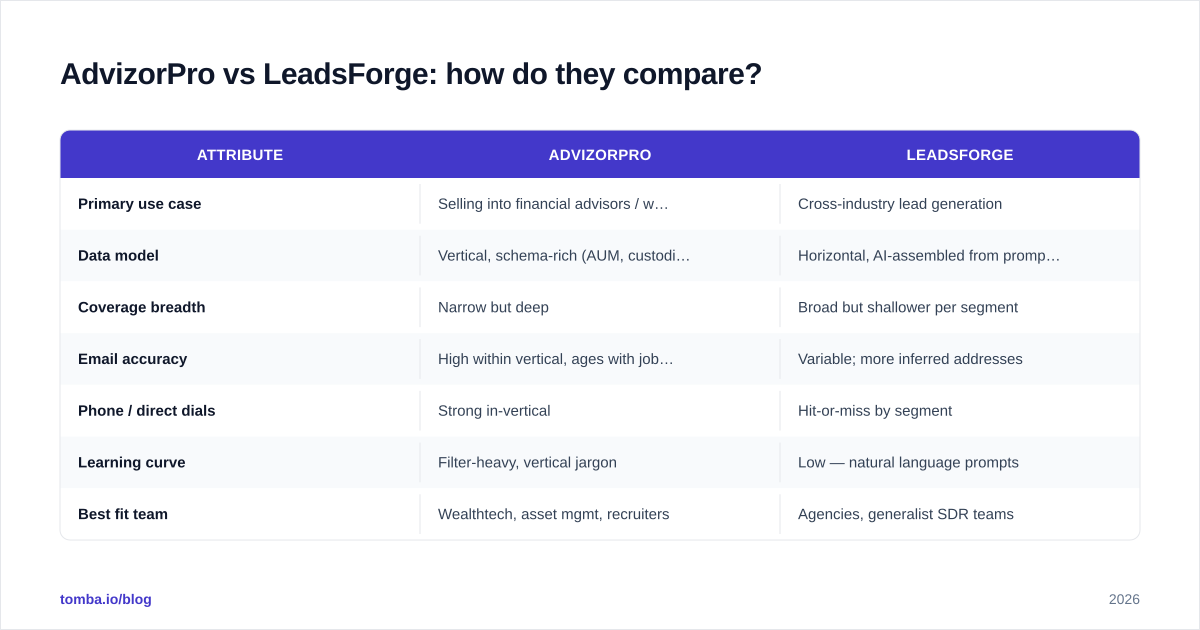
| Attribute | AdvizorPro | LeadsForge |
|---|---|---|
| Primary use case | Selling into financial advisors / wealth | Cross-industry lead generation |
| Data model | Vertical, schema-rich (AUM, custodian, FINRA) | Horizontal, AI-assembled from prompts |
| Coverage breadth | Narrow but deep | Broad but shallower per segment |
| Email accuracy | High within vertical, ages with job moves | Variable; more inferred addresses |
| Phone / direct dials | Strong in-vertical | Hit-or-miss by segment |
| Learning curve | Filter-heavy, vertical jargon | Low — natural language prompts |
| Best fit team | Wealthtech, asset mgmt, recruiters | Agencies, generalist SDR teams |
| Verification included | Limited | Limited |
| Pricing model | Annual, seat + data tiers | Subscription / credit tiers |
| Starting cost | Higher, sales-led quote | Lower entry, scales with volume |
The pattern is consistent: AdvizorPro wins on precision inside one industry, LeadsForge wins on flexibility across many. Neither ships a serious verification engine, which is why bounce rates on raw exports from either tool can sting if you skip a cleaning step.

Which has better data accuracy?#
Neither one is "accurate" in a vacuum—accuracy depends on your segment and how fresh the record is. Two forces work against both platforms:
Job mobility. B2B contacts change roles constantly. Financial advisors switch broker-dealers; SaaS managers get promoted or laid off. A record that was perfect six months ago may now route to a dead inbox. AdvizorPro's vertical focus means it re-checks advisor moves more aggressively, but it can't beat physics—data still decays.
Inference vs. confirmation. LeadsForge, like most AI list builders, sometimes predicts an email from a name-and-domain pattern rather than confirming it exists. That's fine as a starting hypothesis, dangerous as a send-to address. Sending to guessed addresses inflates your bounce rate and damages sender reputation, which quietly tanks deliverability for your good contacts too.
The fix for both is the same: treat every exported list as a draft, then run it through a verifier before it touches your sequencer. A clean email verifier catches invalid, catch-all, and risky addresses so you only send to confirmed inboxes. This single step does more for reply rates than switching platforms ever will.
Which is better for pricing and contracts?#
Pricing is where the two diverge sharply, and where buyers get surprised.
AdvizorPro is typically sold annually through a sales-led quote, priced by seats plus data access tiers. You're paying a premium for vertical depth and regulatory enrichment. For a wealthtech company whose entire revenue depends on reaching advisors, that premium can pay for itself in a single closed deal. For everyone else, it's expensive shelf-ware.
LeadsForge leans toward lower-friction subscription or credit-based tiers, so the entry cost is friendlier and scales with how many leads you pull. That makes it attractive for smaller teams testing outbound—but watch credit burn. If half your AI-generated emails need verification or turn out invalid, your effective cost per usable contact climbs fast.
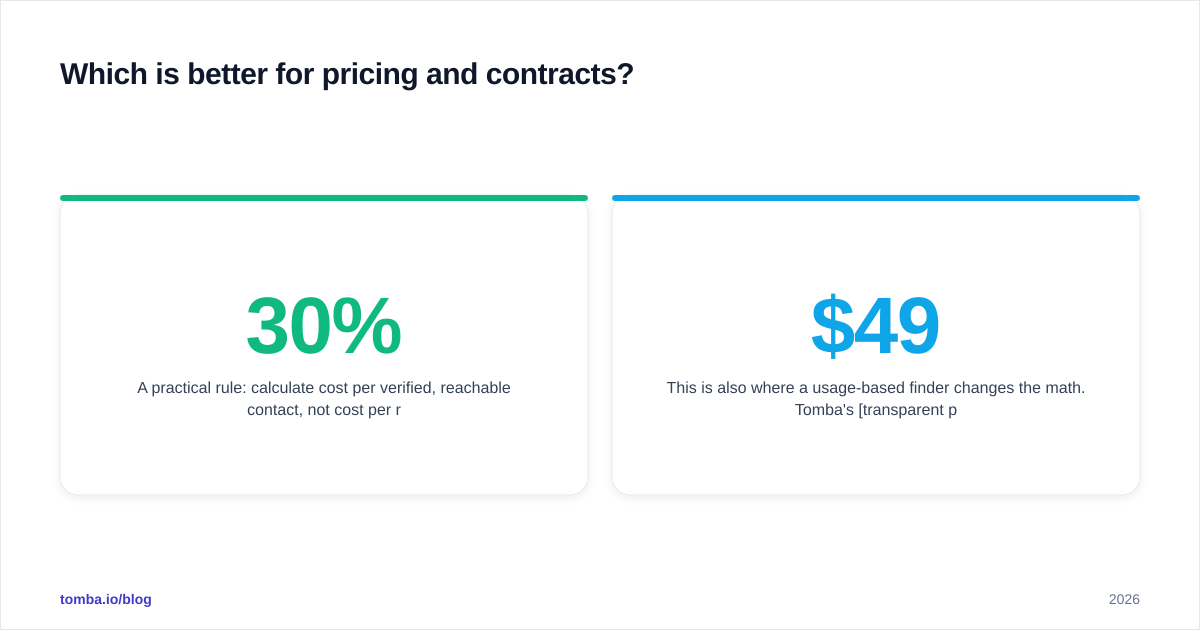
A practical rule: calculate cost per verified, reachable contact, not cost per record. A cheaper list with a 30% bounce rate is more expensive than a pricier list you trust.
This is also where a usage-based finder changes the math. Tomba's transparent pricing starts with a free tier (25 searches/month), then Starter at $49/mo, Growth at $99/mo, and Pro at $249/mo—so you pay for the lookups you actually need instead of a platform-wide annual commitment. For teams that already know who they want and just need verified contact details, that's a fraction of either platform's cost.
Which fits your workflow better?#
Match the tool to how your team actually works.
Choose AdvizorPro if:
- 80%+ of your pipeline is in wealth management or financial services
- You need AUM, custodian, or regulatory data to qualify and personalize
- You sell high-ACV deals where one closed account justifies premium data
- Your reps are trained on vertical jargon and want rich firmographics
Choose LeadsForge if:
- Your ICP changes often or spans multiple industries
- You value speed and natural-language list building over deep filters
- You're an agency running outbound for varied clients
- You want a lower entry price and can absorb variable data quality
Choose a dedicated finder + verifier stack if:
- You already source target accounts (LinkedIn, conferences, referrals, intent tools)
- Your real bottleneck is getting correct emails and direct numbers, not discovering companies
- You want to control cost per contact and keep bounce rates low
- You need an email finder API to enrich records inside your own CRM or app
Most teams discover their actual blocker is the third bucket. You usually know the accounts you want—what's missing is a reliable path to the inbox.
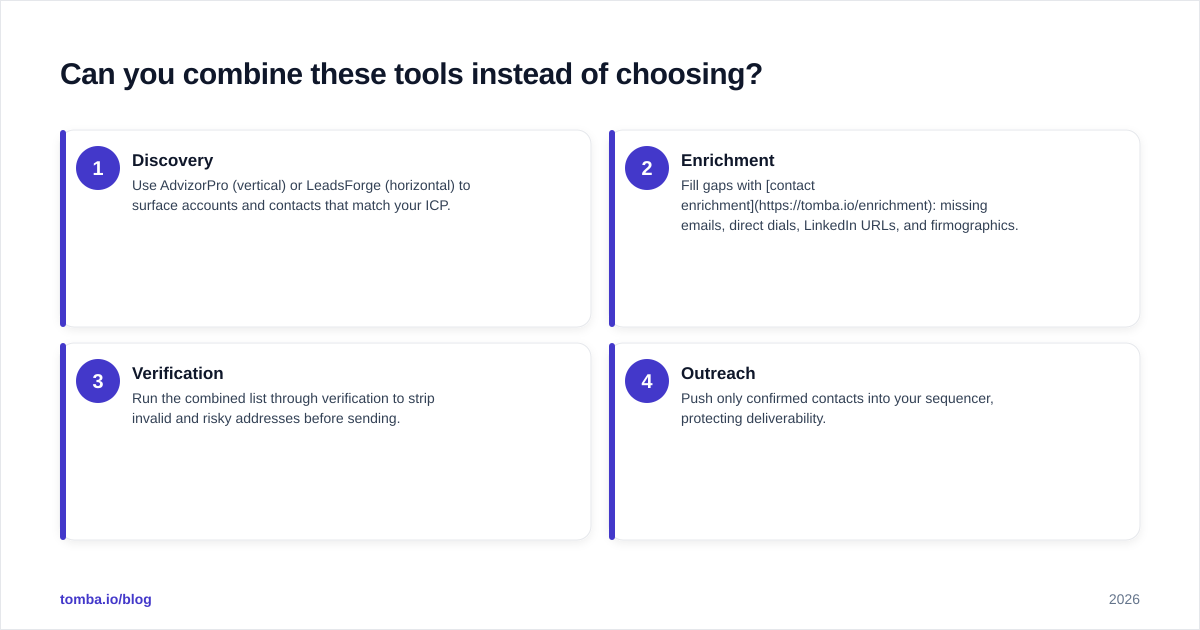
Can you combine these tools instead of choosing?#
Yes—and for many teams that's the smartest answer. The platforms and a focused finder aren't mutually exclusive; they sit at different stages of the funnel.
A common stack looks like this:
- Discovery — Use AdvizorPro (vertical) or LeadsForge (horizontal) to surface accounts and contacts that match your ICP.
- Enrichment — Fill gaps with contact enrichment: missing emails, direct dials, LinkedIn URLs, and firmographics.
- Verification — Run the combined list through verification to strip invalid and risky addresses before sending.
- Outreach — Push only confirmed contacts into your sequencer, protecting deliverability.
This pipeline lets each tool do what it's best at. The platform handles who; the finder and verifier handle how to reach them correctly. You stop paying premium platform credits to send to addresses that bounce, and your domain reputation stays healthy.
For repeatable scale, the same logic applies in bulk. A bulk email finder lets you upload a list of names and domains and return verified emails at volume—ideal when a platform export gives you names but incomplete or stale contact fields.
What about deliverability and compliance?#
Both platforms hand you data; neither guarantees your emails land. Three things protect your campaigns regardless of which you pick:
- Verify before you send. Bounces above ~2-3% signal mailbox providers to throttle or junk you. Verification is the cheapest insurance you can buy.
- Warm up and pace. Don't blast a fresh list of thousands on day one. Gradual volume ramps protect email deliverability.
- Respect regional rules. Financial-services outreach especially carries compliance weight. Honor opt-outs, document sourcing, and follow CAN-SPAM/GDPR obligations. Industry analysts like Gartner regularly flag data governance as a top risk in martech stacks.
The platform you choose won't save you here. Process will.
The verdict: AdvizorPro vs LeadsForge#
There's no universal winner—there's a winner for your motion.
- Sell exclusively into financial advisors? AdvizorPro's vertical depth is hard to beat, and the regulatory enrichment is worth the premium.
- Run cross-industry or agency outbound? LeadsForge's flexible, prompt-driven lists fit better and cost less to start.
- Already know your targets and just need to reach them? Skip the heavy platform spend. A focused finder plus verifier delivers verified contacts at a fraction of the price.
Whichever discovery tool you land on, the contacts are only as good as the inbox they hit. That's the gap most buyers underestimate—and the cheapest one to close.
Ready to turn names into verified inboxes?#
Start with the Tomba Email Finder. Drop in a name and company domain and get a verified professional email back, with confidence scoring and built-in verification so your sequencer only ever sees deliverable addresses. Begin on the free tier (25 searches/month), then scale to Starter at $49/mo when you're ready—no annual lock-in, no paying for vertical data you don't use. Pair it with the B2B database and data enrichment to fill the gaps AdvizorPro or LeadsForge leave behind, and keep your pipeline clean, reachable, and cheap to run.
// get started
Find, verify and enrich your first contacts today
Start on the free plan with 25 searches a month, then scale when your team is ready.
Free plan · No credit card required · GDPR & CCPA
// about the author