AdvizorPro vs ListKit 2026: B2B Data Tools Compared
AdvizorPro targets financial-advisor data; ListKit builds verified cold-email lists. Here's how the two B2B data platforms compare on coverage, accuracy, and price in 2026.
TL;DR
- AdvizorPro is a niche data platform built for one audience: financial advisors, RIAs, broker-dealers, and insurance professionals. If you sell into wealth management, its depth is hard to beat.
- ListKit is a horizontal B2B prospecting tool that builds verified cold-email lists across most industries, with triple-verified emails and a workflow aimed at agencies and SDR teams.
- They overlap less than the "vs" framing suggests: AdvizorPro wins on advisor-specific firmographics; ListKit wins on breadth, email verification, and speed-to-list.
- Pricing differs in kind, not just degree — AdvizorPro is a premium vertical subscription; ListKit sells credit-based plans tuned for outbound volume.
- If your total addressable market isn't financial advisors, AdvizorPro is overkill. If it is, ListKit's generic database won't match its specialization.
What are AdvizorPro and ListKit?#
Short version: AdvizorPro is a specialist; ListKit is a generalist.
AdvizorPro is a sales-intelligence database focused exclusively on the financial-services ecosystem. It tracks registered investment advisors (RIAs), broker-dealers, insurance agents, retirement plan advisors, and the firms they work for. Its data is enriched with regulatory filings (think Form ADV and FINRA records), assets under management, custodian relationships, and advisor movement between firms. That regulatory backbone is the moat — it's data you can't easily scrape or buy generically.
ListKit sits in the cold-email and outbound category. You filter by job title, industry, company size, technology, and geography, then it returns contacts with verified work emails (and often phone numbers and LinkedIn URLs). It markets heavily to agencies and B2B teams running high-volume cold email, and it bundles the list-building step tightly with sequencing workflows.
So the real question isn't "which tool is better" in the abstract. It's "which audience are you selling to, and how do you reach them?"
How do AdvizorPro and ListKit compare head-to-head?#
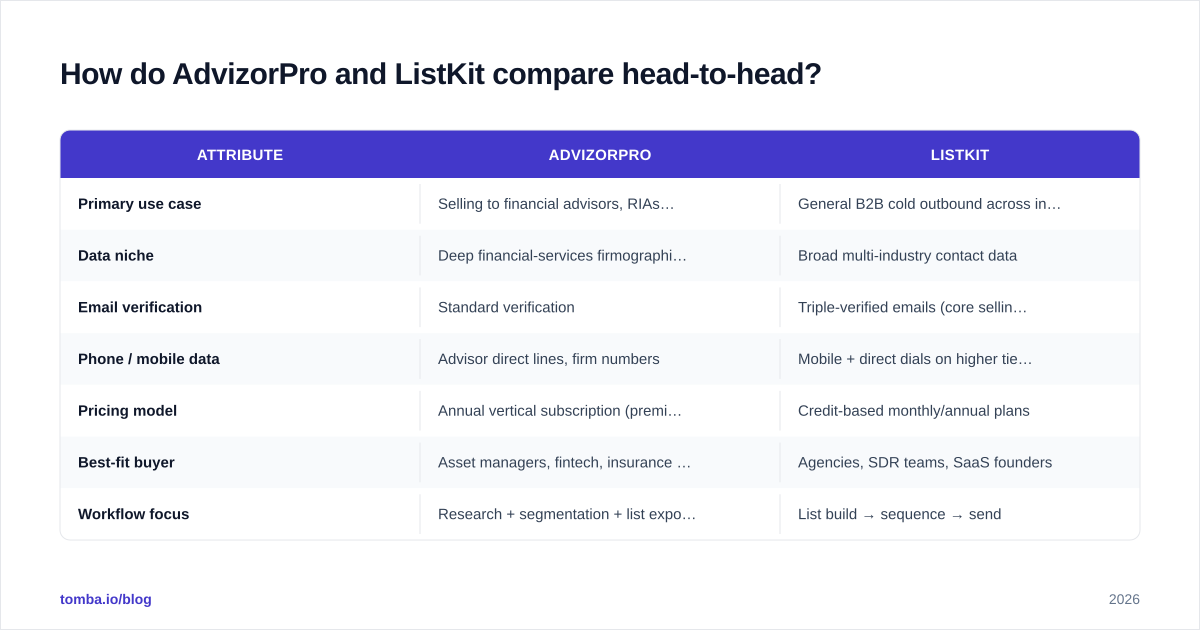
Here's the side-by-side on the attributes that actually change your buying decision.
| Attribute | AdvizorPro | ListKit |
|---|---|---|
| Primary use case | Selling to financial advisors, RIAs, broker-dealers | General B2B cold outbound across industries |
| Data niche | Deep financial-services firmographics (AUM, ADV, custodian) | Broad multi-industry contact data |
| Email verification | Standard verification | Triple-verified emails (core selling point) |
| Phone / mobile data | Advisor direct lines, firm numbers | Mobile + direct dials on higher tiers |
| Pricing model | Annual vertical subscription (premium) | Credit-based monthly/annual plans |
| Best-fit buyer | Asset managers, fintech, insurance vendors | Agencies, SDR teams, SaaS founders |
| Workflow focus | Research + segmentation + list export | List build → sequence → send |
| Coverage outside finance | Minimal by design | Broad |
The pattern is clear. AdvizorPro trades breadth for regulatory-grade depth in one vertical. ListKit trades vertical depth for verified coverage across the whole B2B map. Both are defensible — for different teams.
Which has more accurate data?#
Accuracy depends on what you're measuring, and against whom.
For financial-advisor records, AdvizorPro is generally more accurate and more current than a horizontal provider, because it ingests regulatory filings on a schedule. When an advisor changes firms or an RIA updates its ADV, that signal flows in. A generic database often lags on these moves because it has no reason to monitor SEC and FINRA sources specifically.
For everything else — SaaS buyers, ecommerce operators, healthcare admins, manufacturing ops — ListKit's verified-email approach typically wins, because AdvizorPro simply doesn't cover those people in depth. ListKit's "triple verification" markets itself on bounce reduction, and for cold email that matters: a high bounce rate damages your sender reputation and tanks deliverability before your copy ever gets read.
A caveat worth stating plainly: no provider is 100% accurate, and self-reported verification rates aren't independently audited. Whatever tool you pick, run your final list through an independent email verifier before a send. Double-checking catch-all domains and risky addresses is cheap insurance, and it's the single highest-ROI habit in outbound. Public review data on G2 and Capterra reinforces this — accuracy complaints almost always trace back to lists that were never re-verified at send time.
Is AdvizorPro better than ListKit for cold email?#
For most cold-email programs, ListKit is the more natural fit — unless your entire ICP is financial advisors.
ListKit was built around the outbound motion: filter, verify, export or push into a sequencer, send. The friction between "I found a list" and "I'm emailing it" is low. That's the whole point. If you're an agency running campaigns for ten clients across ten industries, a horizontal tool with strong verification is what you want.
AdvizorPro can feed cold email, but it's optimized for research and precision targeting inside one vertical. You'd reach for it when you're a fintech selling portfolio software to RIAs, or an insurance carrier recruiting agents, and you need to segment by AUM band or custodian relationship — targeting that ListKit can't replicate because it doesn't carry that data.
Think of it like fishing. ListKit hands you a wide net for a big, varied lake. AdvizorPro hands you a precision rig for one specific species. Bring the net to the open lake; bring the rig when you know exactly what you're after.

How does pricing compare?#
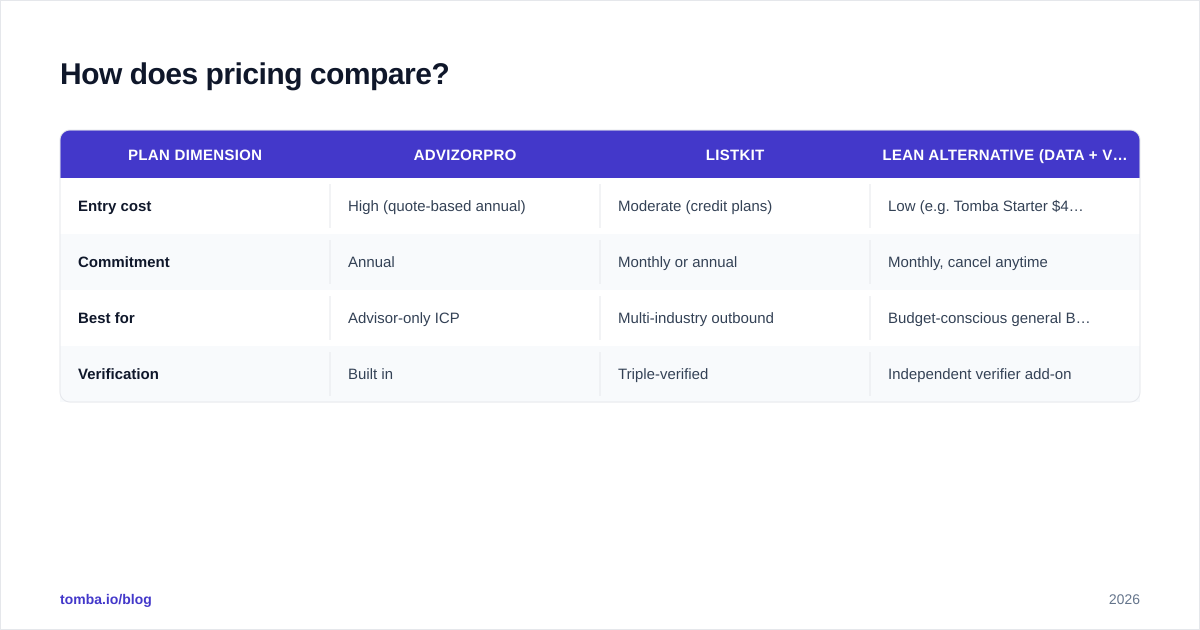
AdvizorPro is a premium annual subscription; ListKit is credit-based and friendlier to start.
AdvizorPro doesn't publish transparent flat pricing — it's a quote-based vertical product, and like most niche data platforms it lands in the premium range because of the regulatory data it maintains. You're paying for a moat, not for raw record volume.
ListKit uses credit-based plans (you consume credits per verified contact), which makes it easier to scale spend with usage and easier to try before you commit. For a small team, that lower entry point matters.
Here's the strategic point most "vs" articles miss: you don't always need either tool's most expensive tier if you pair a leaner data source with strong verification and enrichment. A focused B2B database plus a data enrichment layer can cover a surprising amount of ground at a fraction of a premium vertical subscription — especially for general B2B outreach where you don't need ADV-level depth.
| Plan dimension | AdvizorPro | ListKit | Lean alternative (data + verify) |
|---|---|---|---|
| Entry cost | High (quote-based annual) | Moderate (credit plans) | Low (e.g. Tomba Starter $49/mo) |
| Commitment | Annual | Monthly or annual | Monthly, cancel anytime |
| Best for | Advisor-only ICP | Multi-industry outbound | Budget-conscious general B2B |
| Verification | Built in | Triple-verified | Independent verifier add-on |
For reference, Tomba pricing runs a Free tier (25 searches/mo), Starter at $49/mo, Growth at $99/mo, and Pro at $249/mo — a useful yardstick for what general-purpose finding and verification costs when it isn't bundled into a premium vertical platform.
When should you choose AdvizorPro?#
Choose AdvizorPro when financial advisors are your market, not a segment of it. Specifically:
- You sell software, services, or products to RIAs, broker-dealers, or insurance professionals.
- You need to segment by AUM, custodian, broker-dealer affiliation, or advisor tenure.
- Regulatory-sourced accuracy and advisor-movement tracking are core to your motion (recruiting, M&A, asset-gathering).
- Your deal sizes justify a premium annual data subscription.
In that world, AdvizorPro's depth pays for itself. A generic list would force you to manually qualify every record for "is this person actually a registered advisor with the AUM I care about?" — and that manual work costs more than the subscription.
When should you choose ListKit?#
Choose ListKit when breadth and outbound velocity matter more than vertical depth. Specifically:
- Your ICP spans multiple industries or changes per client (classic agency situation).
- You run high-volume cold email and need verified addresses to protect deliverability.
- You want list-building and sequencing to live close together.
- You're price-sensitive at the start and want credit-based scaling.
This is the larger market by headcount. Most SDR teams, SaaS founders, and lead-gen agencies aren't selling exclusively to financial advisors — so ListKit's general coverage and verification posture line up better with how they actually work.

What's the smarter middle path?#
Match the data source to the ICP, and never skip verification — regardless of vendor.
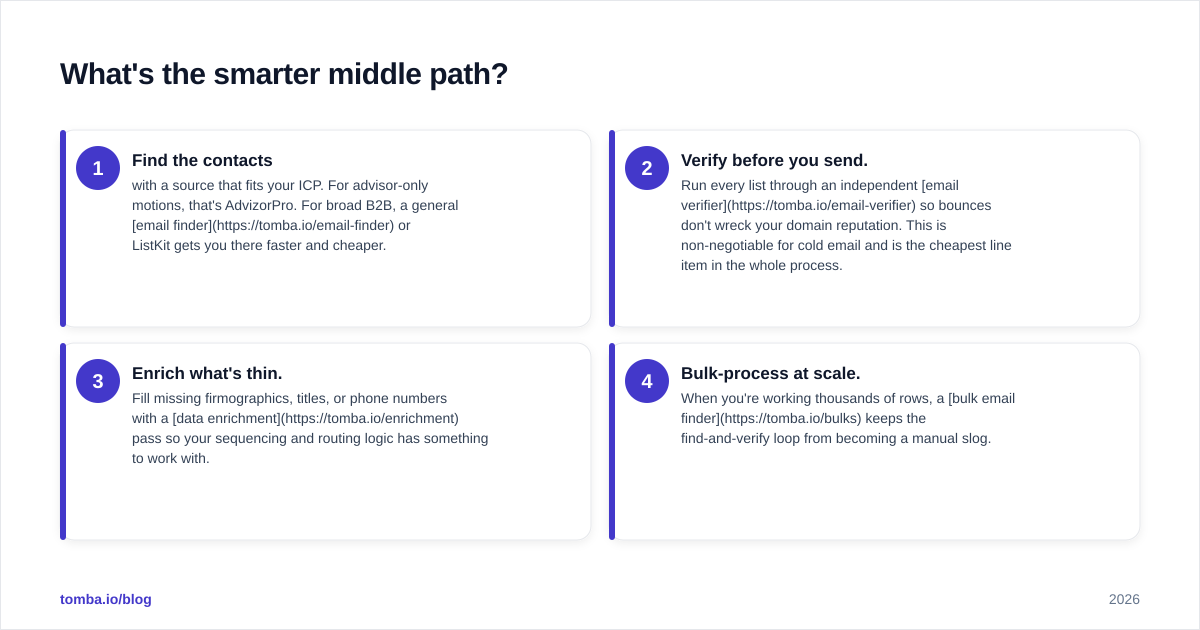
A lot of teams treat "AdvizorPro vs ListKit" as a binary when the right answer is often a stack:
- Find the contacts with a source that fits your ICP. For advisor-only motions, that's AdvizorPro. For broad B2B, a general email finder or ListKit gets you there faster and cheaper.
- Verify before you send. Run every list through an independent email verifier so bounces don't wreck your domain reputation. This is non-negotiable for cold email and is the cheapest line item in the whole process.
- Enrich what's thin. Fill missing firmographics, titles, or phone numbers with a data enrichment pass so your sequencing and routing logic has something to work with.
- Bulk-process at scale. When you're working thousands of rows, a bulk email finder keeps the find-and-verify loop from becoming a manual slog.
The teams that get burned are the ones who buy a single premium tool, export a list, and blast it without re-verifying. The data was fine on the day it was collected — but B2B data decays roughly 2–3% per month as people change jobs. Verification at send time is what keeps a "good list" good.
Frequently asked questions#
Is AdvizorPro only for financial advisors? Effectively, yes. Its value is the depth of financial-services data sourced from regulatory filings. Outside that vertical, a horizontal tool will serve you better and cheaper.
Does ListKit cover financial advisors too? It carries some, as part of broad B2B coverage — but without the ADV/FINRA-grade firmographics (AUM, custodian, broker-dealer affiliation) that AdvizorPro specializes in. For advisor-specific targeting, AdvizorPro is deeper.
Which is cheaper, AdvizorPro or ListKit? ListKit generally has a lower entry point thanks to credit-based plans, while AdvizorPro is a premium quote-based annual subscription. For general B2B, a lean find-plus-verify stack can undercut both.
Do I still need a separate email verifier? Yes. Self-reported verification isn't independently audited, and B2B data decays monthly. An independent verification pass at send time protects deliverability no matter which provider you use.
The bottom line#
AdvizorPro and ListKit aren't really competitors so much as tools built for different jobs. If you live and die by the financial-advisor market, AdvizorPro's regulatory-grade depth is worth the premium. If your outbound spans industries and runs on cold email, ListKit's verified, horizontal data fits the motion better. And for a large slice of general B2B teams, the most cost-effective answer is a lean find-and-verify stack rather than either premium platform.
Whichever way you lean, the find-and-verify step is where campaigns are won or lost. Start with the Tomba Email Finder to source professional emails by domain, name, or company, then verify before every send — it's the difference between a list that converts and a list that bounces. Try it on the free tier (25 searches/month) and only scale spend once you've seen the accuracy on your own ICP.
// get started
Find, verify and enrich your first contacts today
Start on the free plan with 25 searches a month, then scale when your team is ready.
Free plan · No credit card required · GDPR & CCPA
// about the author