9 Best Affinity Alternatives for Relationship CRMs in 2026
Affinity's relationship intelligence is powerful but pricey and overkill for many teams. Here are 9 Affinity alternatives compared on price, data, and fit for 2026.

Affinity built its name on one promise: stop logging contacts by hand and let the CRM map your relationships automatically. For venture, private equity, and investment banking teams, that pitch landed. But Affinity is not the only way to get relationship intelligence in 2026, and for a lot of teams it is either too expensive, too narrow, or simply more platform than they need.
This guide compares the nine strongest Affinity alternatives on the dimensions that actually decide a CRM purchase: pricing transparency, relationship data quality, ease of setup, and which team type each one fits.
TL;DR#
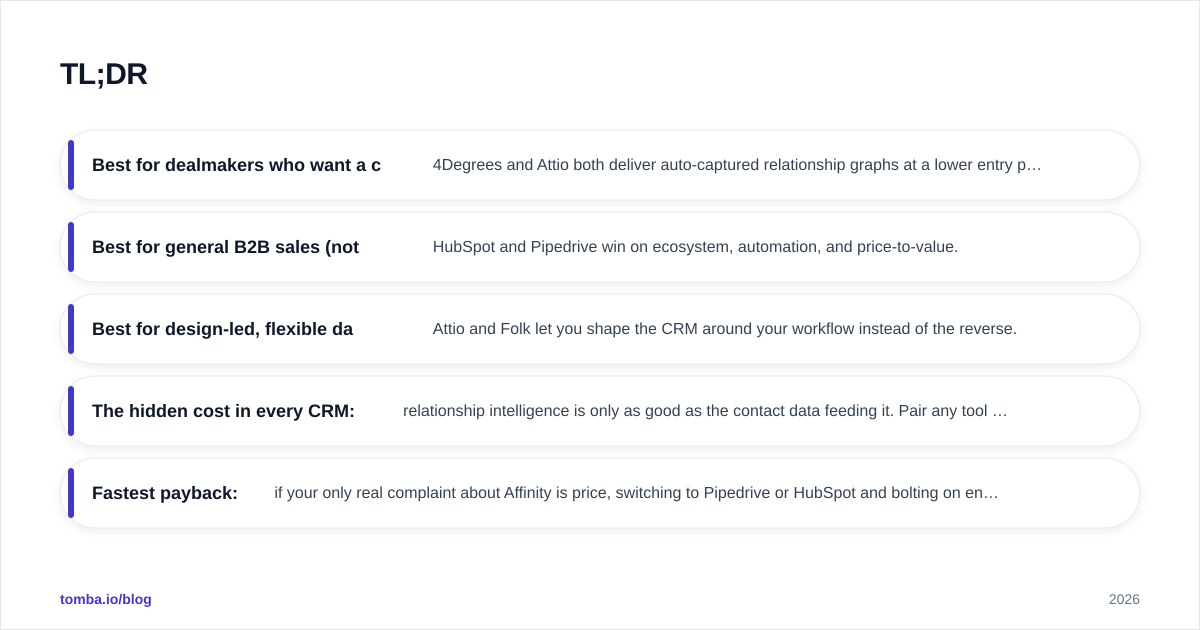
- Best for dealmakers who want a cheaper Affinity clone: 4Degrees and Attio both deliver auto-captured relationship graphs at a lower entry price.
- Best for general B2B sales (not just deals): HubSpot and Pipedrive win on ecosystem, automation, and price-to-value.
- Best for design-led, flexible data models: Attio and Folk let you shape the CRM around your workflow instead of the reverse.
- The hidden cost in every CRM: relationship intelligence is only as good as the contact data feeding it. Pair any tool here with an email finder and data enrichment layer.
- Fastest payback: if your only real complaint about Affinity is price, switching to Pipedrive or HubSpot and bolting on enrichment usually costs less than one Affinity seat.
What is Affinity and why look for alternatives?#
Affinity is a relationship intelligence CRM. Instead of asking reps to manually create contacts and log every call, it sits on top of your email and calendar, reads the metadata (who emailed whom, how often, how recently), and builds a living map of your firm's network. For a VC partner trying to remember "who on my team knows this founder," that warm-intro graph is genuinely valuable. You can see Affinity's positioning on the official Affinity site.
So why do teams shop around? Three recurring reasons:
- Price. Affinity is quote-based and lands in the enterprise tier for most buyers. Smaller funds and sales teams balk at the per-seat cost.
- Scope mismatch. Affinity is optimized for deal-flow and dealmaking. If you run a traditional outbound sales motion, a general-purpose CRM fits your pipeline stages better.
- Rigidity. The relationship-graph model is opinionated. Teams that want a flexible, customizable data model often prefer newer tools like Attio or Folk.
The framework above is the lens to use: first decide whether you need relationship intelligence (auto-captured network graphs) or a pipeline CRM (deal stages, forecasting, sequences). Most Affinity refugees actually want the second thing at a lower price.

How did we compare these Affinity alternatives?#
Every tool below was scored on the same five criteria:
- Relationship intelligence — does it auto-capture interactions and surface warm paths, or is it manual?
- Pricing transparency — published prices beat "contact sales" for most buyers.
- Data enrichment — does it fill in missing emails, titles, and firmographics natively or via integration?
- Setup effort — days to value, not months.
- Best-fit team — VC/PE, agency, or classic B2B sales.
Pricing reflects publicly listed rates as of 2026 and changes often; always confirm on the vendor's own page before you buy. For independent review volume, G2 is a useful cross-check.
Which Affinity alternatives are best in 2026?#
Here is the head-to-head. Prices are the lowest paid tier with meaningful CRM functionality.
| Tool | Starting price | Relationship intelligence | Native enrichment | Best for |
|---|---|---|---|---|
| Affinity | Quote-based (enterprise) | Yes — automatic graph | Yes | VC / PE deal flow |
| Attio | $29/user/mo | Yes — auto-captured | Partial | Flexible, modern teams |
| 4Degrees | Quote-based (mid) | Yes — network strength | Yes | Boutique VC / PE / banking |
| HubSpot | $20/user/mo (Starter) | Limited | Add-on | General B2B sales + marketing |
| Pipedrive | $24/user/mo | No (manual) | Add-on | SMB outbound sales |
| Copper | $12/user/mo | Partial (Google-native) | Limited | Agencies on Google Workspace |
| Folk | $20/user/mo | Partial | Via integrations | Lean teams, community building |
| Salesforce | $25/user/mo (Starter) | Add-on (Einstein) | Add-on | Enterprise, custom processes |
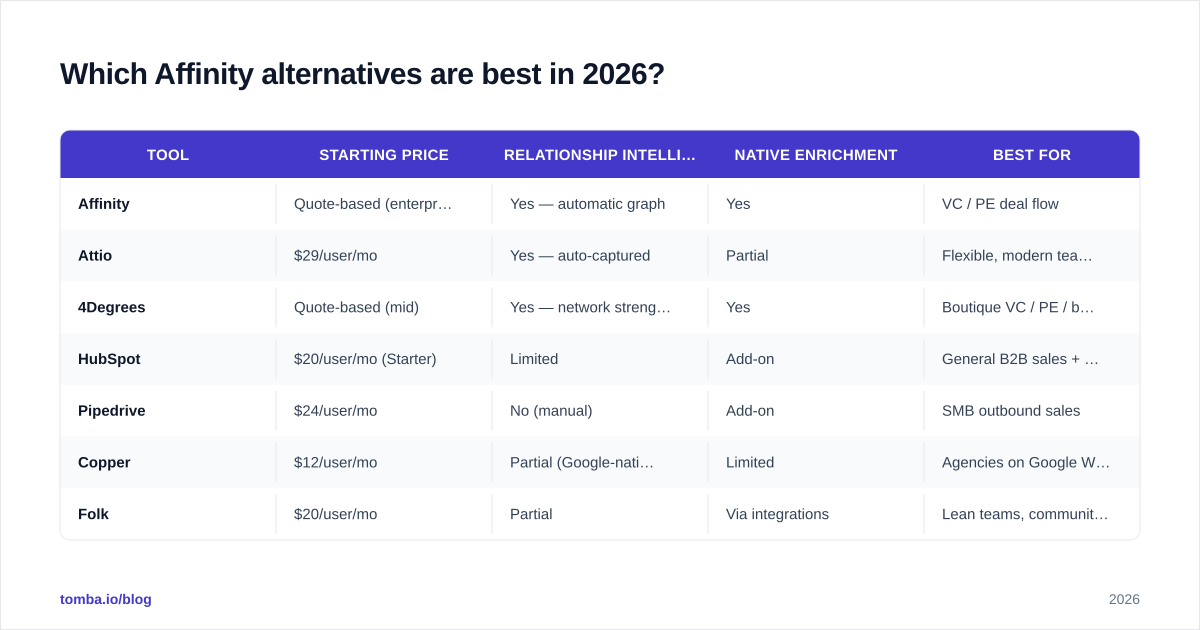
Zoho CRM | $14/user/mo | Limited | Add-on | Budget-conscious SMBs |
A few notes the table can't capture:
Attio is the alternative most often pitched as a direct Affinity replacement. It auto-syncs email and calendar to build relationship context, but wraps it in a flexible, Notion-like data model you can reshape per workflow. At $29/user, published pricing, it undercuts Affinity meaningfully.
4Degrees is the closest like-for-like for finance teams. It was built specifically for VC, PE, and investment banking, scoring relationship strength between your team and any contact. If you loved Affinity's intro graph but not the bill, get a 4Degrees quote.
HubSpot is not a relationship-intelligence tool in Affinity's sense, but for teams whose real need is "a CRM that does sales, marketing, and service well," it dominates on ecosystem. Connect it through the HubSpot integration and you can pipe enriched contacts straight in. HubSpot publishes its tiers openly on hubspot.com.
Salesforce is the heavyweight: infinitely customizable, but you pay for it in setup time and admin overhead. Choose it only if you have the resources to configure it. Tomba connects via the Salesforce integration.
Is Attio a better choice than Affinity?#
For most teams that are price-sensitive, yes — with one caveat.
Attio matches Affinity's core trick (automatic relationship capture from email and calendar) and adds a far more flexible data model. You can build custom objects, pipelines, and reports without engineering help, and the pricing is published rather than hidden behind a sales call. That combination is why Attio shows up on nearly every Affinity-alternative shortlist in 2026.
The caveat: Affinity still has the deeper, finance-specific feature set — deal-flow management, fund reporting, and the most mature relationship-strength scoring. If you are a large fund whose entire operating model runs on Affinity's network graph, the switch may not be worth the disruption. If you are a smaller fund or a sales team that wants relationship context and flexibility, Attio is the stronger value.
Do you still need a relationship CRM, or just better data?#
This is the question most buyers skip, and it is the expensive one.
Here's the analogy: a CRM is like a beautifully organized kitchen. Drawers labeled, knives sharpened, everything in its place. But an organized kitchen with an empty fridge still won't feed anyone. The CRM is your organization layer; contact data is the food. Affinity, Attio, and 4Degrees are all impressive at organizing relationships you already have — but none of them will reliably find the new decision-maker's email at a company you've never talked to.
That gap is where teams overspend. They buy a premium relationship CRM to fix what is actually a data problem.

Before you commit to any tool on this list, audit where your contact data comes from. If reps are guessing email formats or copy-pasting from LinkedIn, no CRM will save the pipeline. A dedicated finder-and-verifier layer fixes the input:
- Use the domain search to pull every known email at a target company in one query.
- Run new contacts through an email verifier so your CRM isn't logging bounces.
- Enrich thin records with titles, firmographics, and social profiles via data enrichment.
Do that, and a $24/month Pipedrive seat with clean data will outperform a premium relationship CRM running on stale contacts.
Which Affinity alternative fits your team?#
Match the team type to the tool instead of chasing feature lists:
| If you are a... | Pick | Why |
|---|---|---|
| VC / PE fund leaving Affinity over price | 4Degrees or Attio | Same relationship-graph value, lower or transparent cost |
| Modern team wanting flexibility | Attio or Folk | Customizable data models, published pricing |
| Classic B2B outbound sales org | Pipedrive or HubSpot | Pipeline stages, sequences, automation |
| Agency living in Google Workspace | Copper | Native Gmail/Calendar integration |
| Enterprise with custom processes | Salesforce | Maximum configurability |
| Budget-first SMB |
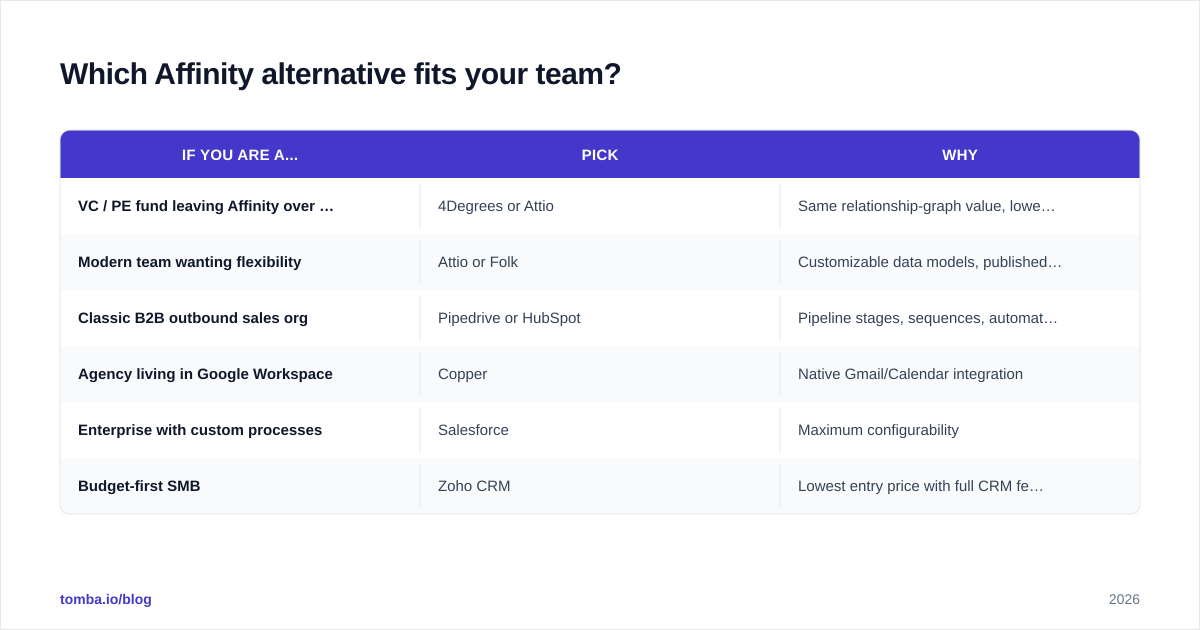
Zoho CRM | Lowest entry price with full CRM features |
Pros and cons at a glance#
Attio — Pro: flexible, modern, auto-capture, transparent price. Con: younger ecosystem, fewer finance-specific features than Affinity.
4Degrees — Pro: purpose-built for dealmakers, strong relationship scoring. Con: quote-based pricing, narrower than a general CRM.
HubSpot — Pro: best-in-class ecosystem, free tier to start, strong automation. Con: relationship intelligence is shallow; costs climb as you add hubs.
Pipedrive — Pro: cheap, intuitive, sales-focused. Con: no automatic relationship graph; enrichment is an add-on.
Salesforce — Pro: does anything you can configure. Con: setup time, admin cost, steep learning curve.
How do you migrate off Affinity without losing data?#
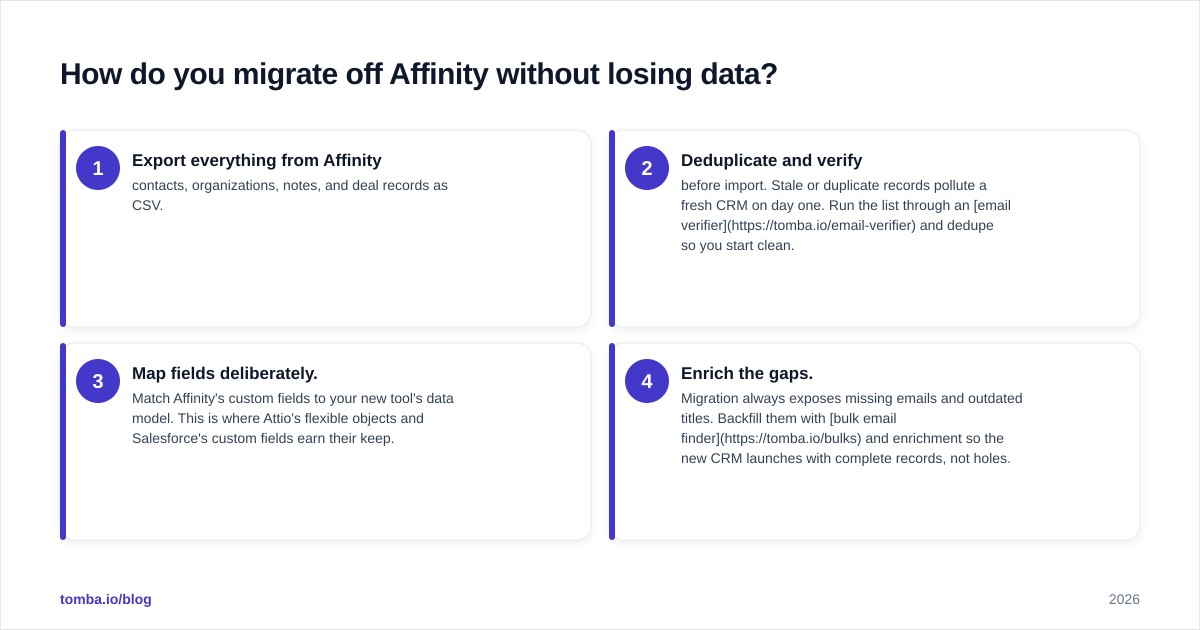
A clean migration comes down to four steps:
- Export everything from Affinity — contacts, organizations, notes, and deal records as CSV.
- Deduplicate and verify before import. Stale or duplicate records pollute a fresh CRM on day one. Run the list through an email verifier and dedupe so you start clean.
- Map fields deliberately. Match Affinity's custom fields to your new tool's data model. This is where Attio's flexible objects and Salesforce's custom fields earn their keep.
- Enrich the gaps. Migration always exposes missing emails and outdated titles. Backfill them with bulk email finder and enrichment so the new CRM launches with complete records, not holes.
The teams that regret a migration are the ones that ported dirty data straight across. The teams that are glad they switched treated the move as a chance to clean house.
Check the full Tomba pricing to see how the finder, verifier, and enrichment tools bundle — the free tier (25 searches/month) is enough to test a migration sample before you commit, with paid plans starting at $49/month.
Frequently asked questions#
Is there a free Affinity alternative? HubSpot offers a genuinely usable free CRM tier, and Zoho's entry plan is the cheapest paid option. Neither matches Affinity's relationship graph, but both work if your real need is a standard CRM.
What is the closest tool to Affinity? 4Degrees for finance-specific relationship intelligence; Attio for a flexible, modern equivalent at transparent pricing.
Will switching CRMs hurt my pipeline? Only if you migrate dirty data. Verify and enrich your export first, and the new CRM launches cleaner than the one you left.
The bottom line#
Affinity is excellent at what it does — and most teams shopping for alternatives don't actually need everything it does. If price is your pain, Attio, 4Degrees, Pipedrive, or HubSpot will cover the relationship-intelligence or pipeline need for far less. If flexibility is your pain, Attio and Folk reshape around your workflow. The one mistake to avoid is treating a data problem like a CRM problem.
Whichever tool you land on, feed it clean, complete contacts. Start with the Tomba Email Finder to find verified professional emails by name, company, or domain, then enrich and import them into your new CRM. The best relationship intelligence in the world can't map a contact you never found — so fix the data layer first, and let the CRM do what it's good at.
// get started
Find, verify and enrich your first contacts today
Start on the free plan with 25 searches a month, then scale when your team is ready.
Free plan · No credit card required · GDPR & CCPA
// about the author