Affinity vs Attio (2026): The Relationship CRM Showdown
Affinity is built for dealmakers who live in their network; Attio is the flexible, modern CRM for fast-moving GTM teams. Here's how the two compare on data model, automation, pricing, and fit in 2026.
You're choosing between two CRMs that both reject the old Salesforce-style playbook, and both promise to do the relationship work for you. So which one actually fits your team?
TL;DR
- Affinity is a relationship-intelligence CRM built for dealmakers — venture capital, private equity, investment banking, and corporate development. Its superpower is automatically mapping who-knows-who across your whole firm.
- Attio is a flexible, fast, modern CRM for go-to-market teams — startups, agencies, and B2B sales orgs that want a customizable data model without a six-month implementation.
- Pricing splits them hard: Attio is self-serve and transparent (free tier up to roughly $119/seat/mo); Affinity is enterprise, sales-led, and typically costs thousands of dollars per seat per year.
- Pick Affinity if your business runs on warm intros and deal-flow relationships. Pick Attio if you want a versatile CRM you can shape to any pipeline and launch this week.
- Either way, a CRM only matters if the contact records inside it are real — pair your choice with a reliable email finder to keep records complete.
What are Affinity and Attio, really?#
Both tools call themselves a CRM, but they were built for different jobs.
Affinity started with one big idea: your firm's most valuable asset is its collective network, and nobody has a full picture of it. Affinity solves that by quietly ingesting every email and calendar event across your team, then scoring relationship strength so you can see the warmest path to any target. Think of it as a shared address book that remembers every handshake your whole company has ever made. It's the default CRM for venture and private-equity firms for exactly that reason — when a deal depends on a warm intro, Affinity tells you who can make it.
Attio approaches the problem from the opposite direction. Instead of a fixed schema, Attio is built on a flexible data model — objects, attributes, and records you define yourself — that feels closer to Airtable than to a legacy CRM. It syncs your email and calendar too, but its center of gravity is customization and speed: you can model a sales pipeline, an investor list, a recruiting funnel, or a partnerships board in the same workspace, and automate the busywork between them. It's the CRM teams reach for when they've outgrown a spreadsheet but refuse to suffer through a Salesforce rollout.
The framework above is the cleanest way to think about the choice: Affinity optimizes for relationship depth across a firm, while Attio optimizes for structural flexibility across use cases. Most of the buying decision comes down to which of those axes your team actually lives on.
How does the data model compare?#
This is the single biggest architectural difference, so it's worth being concrete.
Affinity uses lists. Each list is a pipeline or tracker (deals, portfolio companies, LPs) with fields you configure, and people/organizations flow through them. It's powerful for deal flow but opinionated — you work the way Affinity expects dealmakers to work.
Attio uses objects and records. You start with People, Companies, Deals, and Users, then add your own objects (Investors, Properties, Candidates, Partners) with any attributes you want, plus relationships between them. It behaves like a lightweight relational database with a polished CRM skin on top.
In practice: if your workflows are deal-centric and relationship-driven, Affinity's structure saves you setup time. If your workflows are varied or unusual, Attio's flexibility means you never have to bend your process to fit the tool. For a deeper primer on CRM fundamentals, this CRM glossary entry breaks down the core concepts.
What about relationship intelligence and automation?#
Both products auto-capture activity, but they emphasize different outcomes.
Affinity's relationship intelligence is the marquee feature. It analyzes communication metadata across your organization to surface things like: who on your team has the strongest relationship with a prospect, how warm that relationship is, when it last had contact, and whether it's cooling off. For a 20-person fund chasing competitive deals, this is genuinely hard to replicate elsewhere.
Attio's automation is more about operational leverage. Its workflow builder lets you trigger actions — enrich a record, route a deal, send a Slack alert, update a status — when conditions are met. Attio also ships AI features for research and data entry, and its automation tends to feel modern and developer-friendly. It's less "who can introduce me" and more "do the repetitive CRM work for me."
So the honest framing: Affinity wins on network mapping, Attio wins on flexible automation. Neither fully replaces the other's strength.
Affinity vs Attio: side-by-side comparison#
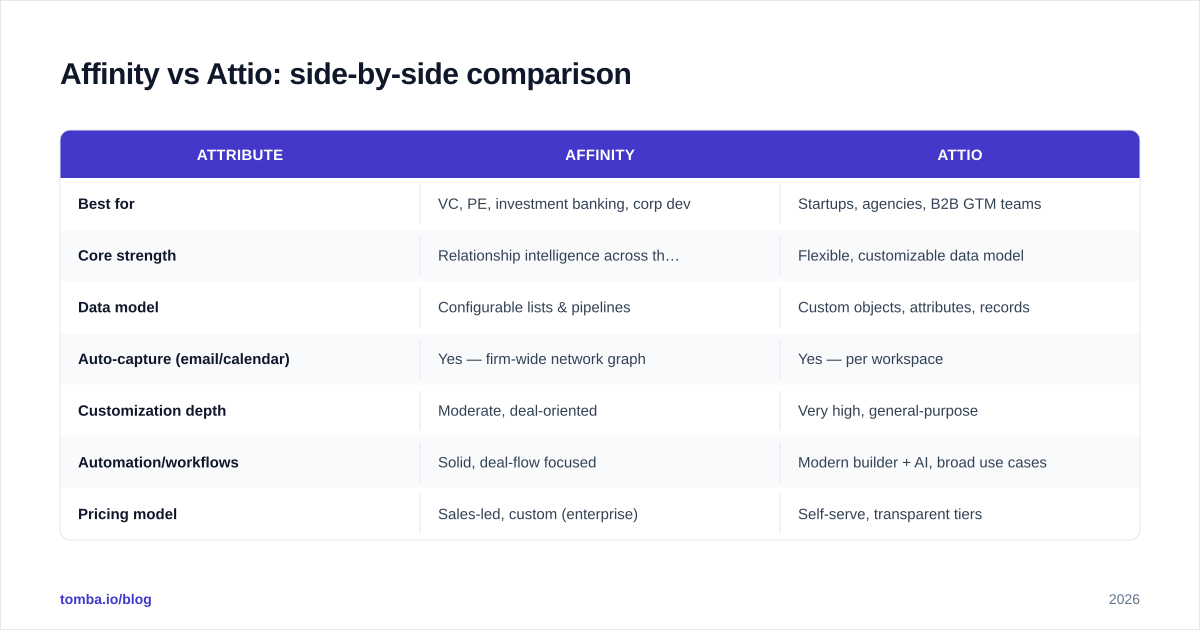
Here's the head-to-head across the attributes that usually decide the purchase. Treat pricing as directional — Attio publishes its tiers, while Affinity quotes per firm, so confirm both with the vendors before you commit.
| Attribute | Affinity | Attio |
|---|---|---|
| Best for | VC, PE, investment banking, corp dev | Startups, agencies, B2B GTM teams |
| Core strength | Relationship intelligence across the firm | Flexible, customizable data model |
| Data model | Configurable lists & pipelines | Custom objects, attributes, records |
| Auto-capture (email/calendar) | Yes — firm-wide network graph | Yes — per workspace |
| Customization depth | Moderate, deal-oriented | Very high, general-purpose |
| Automation/workflows | Solid, deal-flow focused | Modern builder + AI, broad use cases |
| Pricing model | Sales-led, custom (enterprise) | Self-serve, transparent tiers |
| Entry price | Custom quote (typically $2k+/seat/yr) | Free tier; paid from ~$29/seat/mo |
| Setup time | Days to weeks (guided) | Same-day to a few days |
| Free tier | No | Yes |
A quick note on cost: Attio's published plans run from a free tier through Plus, Pro, and Enterprise (roughly $29 to $119 per seat per month at the time of writing, billed annually). Affinity does not publish prices and sells annual enterprise contracts, which is why it tends to land an order of magnitude higher per seat. Always pull a live quote from affinity.co and the attio.com pricing page rather than trusting any blog's numbers — including this one.

Which integrates better with your stack?#
Attio leans into the modern integration ecosystem. It offers a clean public API, native syncs, and connects easily through automation platforms, which makes it a comfortable hub for a startup's tooling. If your team already wires tools together with Zapier or similar, Attio slots in with minimal friction.
Affinity integrates with the tools dealmakers actually use — email, calendar, and data providers tuned for the investment world — and its API supports pushing relationship data into downstream systems. The integrations are fewer but deeper in the niche it serves.
One thing both share: they're only as good as the contact data flowing into them. If reps are hand-typing emails or letting records go stale, no amount of relationship scoring saves you. Connecting an enrichment layer — whether through the Tomba API or a native sync — keeps the records trustworthy, which is the entire point of a relationship CRM.
Is Affinity better than Attio?#
Neither is "better" — they're built for different buyers, and the right answer depends on what your revenue actually runs on.
Choose Affinity if:
- You're a VC, PE firm, investment bank, or corp-dev team.
- Warm introductions and relationship strength drive your deals.
- You need a firm-wide view of who knows whom, scored automatically.
- Budget is not the constraint; competitive deal flow is.
Choose Attio if:
- You're a startup, agency, or B2B sales team.
- You want to model any pipeline without rigid templates.
- You value fast setup, transparent pricing, and a free tier to start.
- You want modern automation and AI baked into daily workflows.
If you put a gun to our head for a default: most general B2B teams will be happier and faster with Attio, while relationship-driven finance teams will get value from Affinity that no generic CRM can match. The mistake is buying Affinity's premium for a use case Attio handles for a fraction of the cost — or forcing Attio to be a relationship graph it was never designed to be.
How do you migrate and fill either CRM with good data?#
Whichever you choose, two things determine whether the rollout succeeds: clean migration and ongoing data hygiene.
For migration, both tools import from CSV and from common CRMs, and both auto-capture going forward so historical email activity backfills itself. Budget a day or two to map fields — more if you're leaving a heavily customized Salesforce instance. Independent reviews on G2 are useful here for reading how real teams describe their switching experience before you commit.
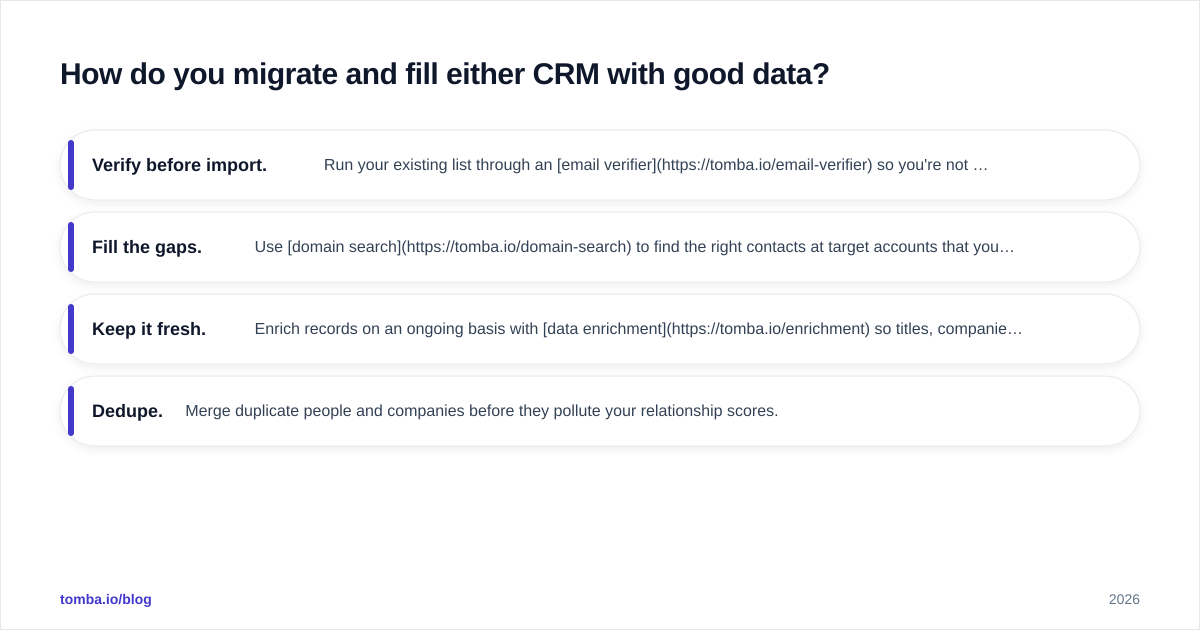
For data hygiene, this is where most CRM projects quietly fail. Relationship intelligence is worthless if half your records lack a valid email, and pipeline reports lie when companies are duplicated or contacts have bounced. A practical checklist:
- Verify before import. Run your existing list through an email verifier so you're not seeding the new CRM with dead addresses.
- Fill the gaps. Use domain search to find the right contacts at target accounts that your current data missed.
- Keep it fresh. Enrich records on an ongoing basis with data enrichment so titles, companies, and emails don't rot.
- Dedupe. Merge duplicate people and companies before they pollute your relationship scores.
Do this once, properly, and both Affinity and Attio reward you with reporting you can actually trust.
The bottom line on Affinity vs Attio#
Affinity and Attio are both bets against the bloated legacy CRM, but they're aimed at opposite ends of the market. Affinity is a specialist: the best relationship-intelligence platform for firms whose deals live and die on warm networks, priced like the enterprise product it is. Attio is a generalist done right: a flexible, fast, fairly priced CRM that molds to almost any go-to-market motion and gets you live in days, not quarters.
Match the tool to how your team actually makes money, confirm live pricing with each vendor, and you'll rarely regret the pick.
One last thing both have in common — they assume you already have the right contacts to put in them. That's the part neither tool solves. Tomba's Email Finder finds verified, professional email addresses by name, company, or domain, so whichever CRM you choose fills up with real people you can actually reach. Start free with 25 searches a month, then scale on a plan that fits — see full Tomba pricing when you're ready. A great CRM plus accurate contact data is what turns a tidy database into closed revenue.
Ready to find emails that actually work?
Join 150,000+ professionals who stopped guessing and started sending. Free credits on signup — no credit card required.
Get the Tomba newsletter
Practical outbound tactics and product updates — once every two weeks.
About the author