Affinity vs Salesforce 2026: Which CRM Wins for Dealmaking
Affinity automates relationship intelligence; Salesforce gives you an infinitely customizable platform. Here's which CRM actually fits your team in 2026.
Choosing between Affinity and Salesforce is really a choice between two philosophies of what a CRM should do. One captures your relationships automatically so nobody has to log anything. The other gives you a blank, infinitely configurable platform you can bend into almost any process. Picking wrong costs you months of migration pain and a five-figure contract you can't easily exit.
This guide breaks down where each tool actually wins in 2026 — pricing, data hygiene, automation, and the type of team each was built for.
TL;DR — Affinity vs Salesforce at a glance#
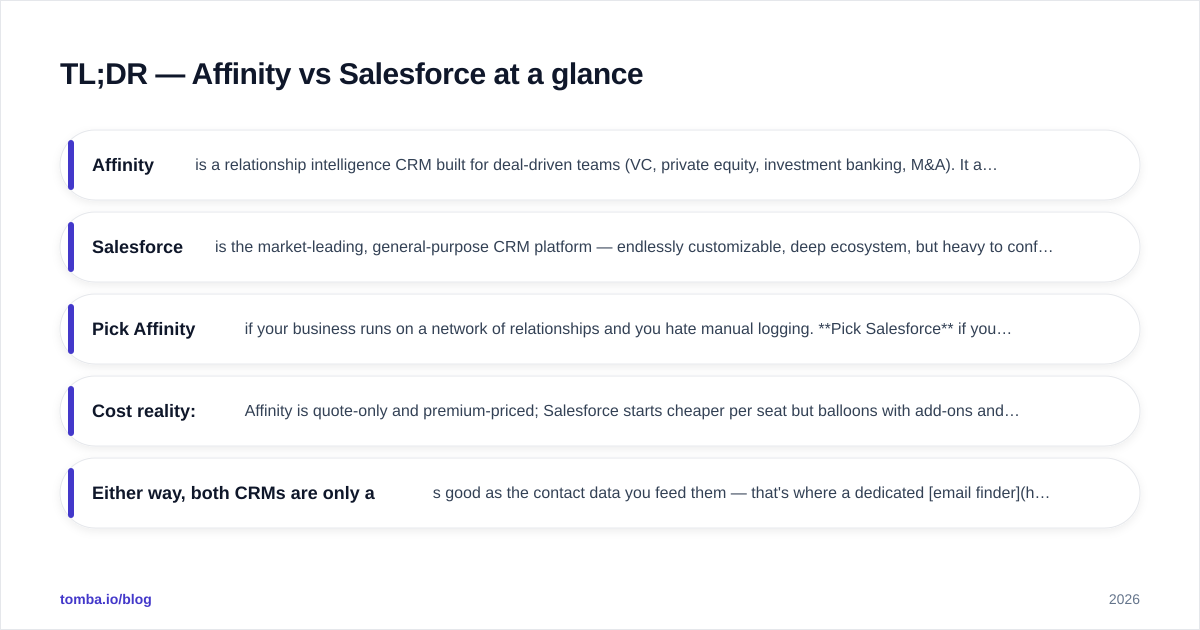
- Affinity is a relationship intelligence CRM built for deal-driven teams (VC, private equity, investment banking, M&A). It auto-captures every email and meeting so reps barely touch data entry.
- Salesforce is the market-leading, general-purpose CRM platform — endlessly customizable, deep ecosystem, but heavy to configure and maintain.
- Pick Affinity if your business runs on a network of relationships and you hate manual logging. Pick Salesforce if you run a structured, high-volume sales motion and need custom workflows, forecasting, and integrations.
- Cost reality: Affinity is quote-only and premium-priced; Salesforce starts cheaper per seat but balloons with add-ons and admin overhead.
- Either way, both CRMs are only as good as the contact data you feed them — that's where a dedicated email finder earns its keep.
What is Affinity?#
Affinity is a relationship intelligence platform. Instead of asking salespeople to manually log calls and emails, it sits on top of your team's inboxes and calendars and builds the CRM automatically. Every interaction with every contact gets captured, scored, and surfaced — so you can answer "who at our firm knows this person, and how well?" in seconds.
That design makes Affinity the default for relationship-led industries: venture capital, private equity, investment banking, commercial real estate, and consulting. In those worlds, your pipeline isn't a list of inbound leads — it's a living web of warm intros, portfolio contacts, and long-cultivated relationships. Affinity's automatic data capture and "relationship strength" scoring are purpose-built for that.
The trade-off is focus. Affinity does relationship-driven dealmaking extremely well, but it is not trying to be a configurable platform for a 200-rep SaaS sales org running complex territory rules and CPQ.
What is Salesforce?#
Salesforce is the 800-pound gorilla of CRM — and has been for two decades. According to Salesforce, it powers sales, service, marketing, and analytics for companies from two-person startups to the Fortune 500. Its strength is breadth and configurability: custom objects, flows, validation rules, AppExchange apps, and an ecosystem of consultants who do nothing but Salesforce.
If you can describe a sales process, you can probably build it in Salesforce. That power is exactly why analysts at G2 consistently rank it at or near the top of the CRM category by market presence.
The flip side: Salesforce is a platform, not a finished product. Out of the box it's a powerful empty room. Getting real value usually means hiring an admin (or an agency), buying add-ons, and accepting that data entry is a discipline your reps must maintain — because Salesforce won't capture relationships for you the way Affinity does.
Affinity vs Salesforce: side-by-side comparison#
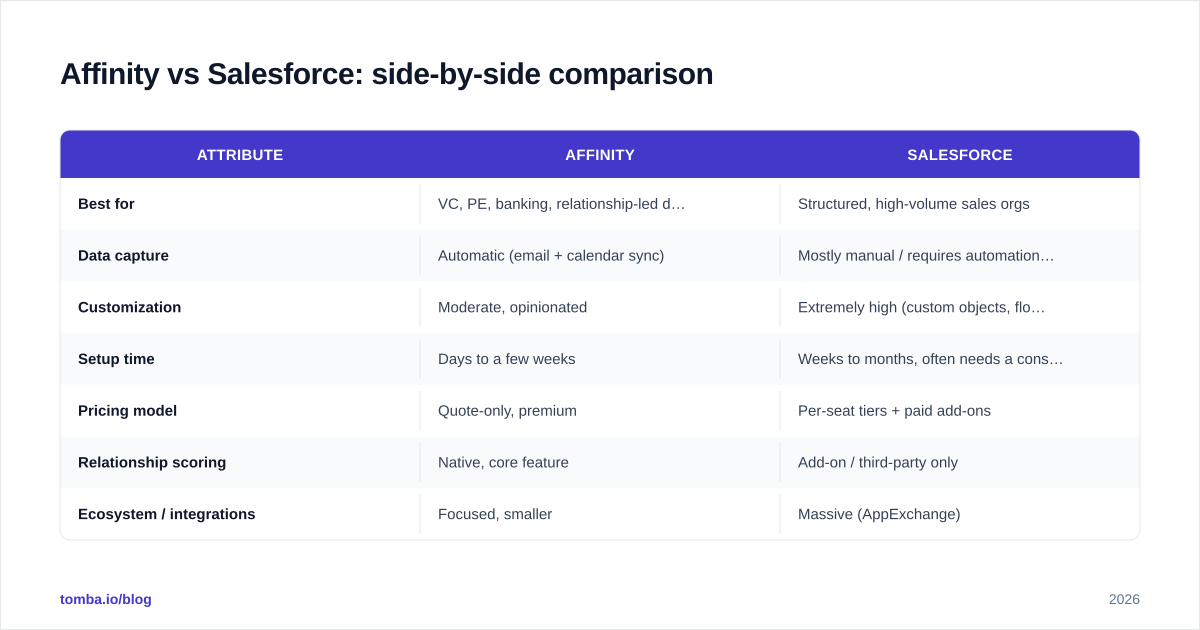
| Attribute | Affinity | Salesforce |
|---|---|---|
| Best for | VC, PE, banking, relationship-led deals | Structured, high-volume sales orgs |
| Data capture | Automatic (email + calendar sync) | Mostly manual / requires automation setup |
| Customization | Moderate, opinionated | Extremely high (custom objects, flows) |
| Setup time | Days to a few weeks | Weeks to months, often needs a consultant |
| Pricing model | Quote-only, premium | Per-seat tiers + paid add-ons |
| Relationship scoring | Native, core feature | Add-on / third-party only |
| Ecosystem / integrations | Focused, smaller | Massive (AppExchange) |
| Admin overhead | Low | High |
| Reporting & forecasting | Good for deal flow | Best-in-class, highly configurable |
Is Affinity better than Salesforce?#
Better for whom is the only question that matters. There is no universal winner here.
Affinity wins when relationships are the product. If your deals come from a network you've spent years building, the automatic capture is transformative. Nobody forgets to log the dinner, the warm intro, or the quarterly check-in, because Affinity logs it for them. Partners get a clean picture of the firm's collective network without nagging anyone to update records.
Salesforce wins when process is the product. If you run a repeatable, metrics-driven sales motion — inbound leads, SDR-to-AE handoffs, defined stages, quota forecasting — Salesforce's configurability and reporting are hard to beat. You can model almost any workflow, enforce it with validation rules, and slice the data however leadership wants.
A useful mental model: Affinity is a self-cleaning kitchen that handles one cuisine beautifully. Salesforce is a fully equipped commercial kitchen that can cook anything — but you have to staff it, configure it, and clean it yourself.
How do Affinity and Salesforce compare on pricing?#
This is where expectations get reset fast.
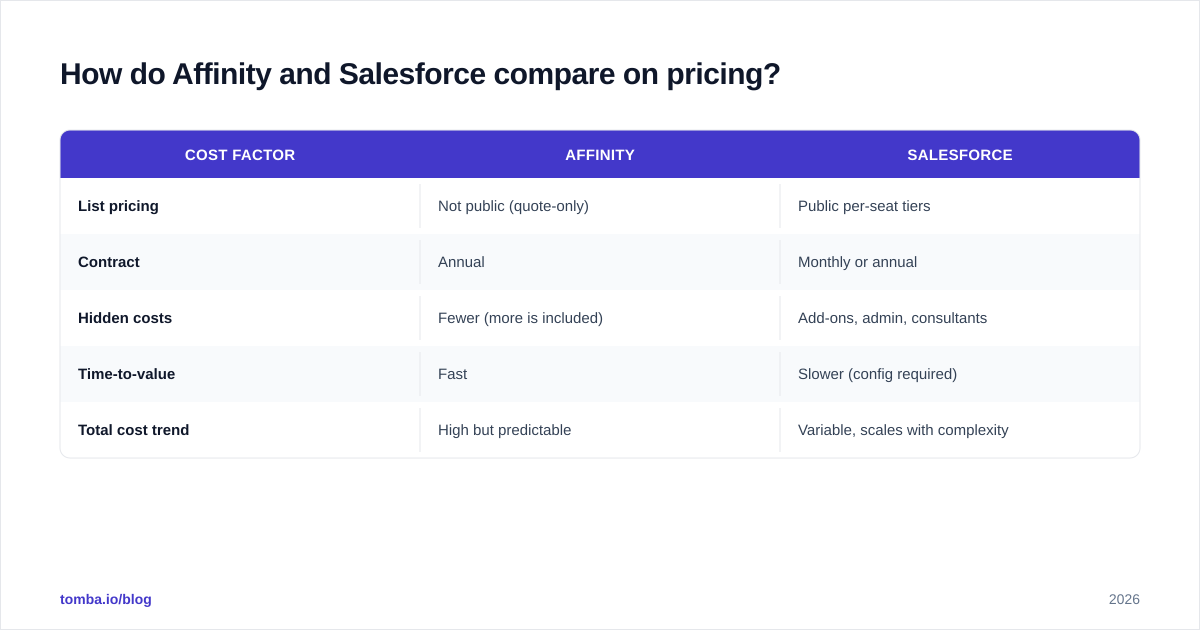
Affinity does not publish standard pricing. It's a quote-only, annual-contract model aimed at firms, and it sits at the premium end of the market. You're paying for the relationship intelligence engine, not a cheap seat license. Expect a meaningful per-user annual commitment and a sales conversation before you see numbers.
Salesforce publishes tiered per-seat pricing — entry tiers look approachable on paper, but the real cost shows up in the add-ons (advanced analytics, CPQ, marketing, sandboxes, premium support) and the admin or consultant you'll need to make it sing. A "cheap" Salesforce can quietly become one of your largest software line items.
| Cost factor | Affinity | Salesforce |
|---|---|---|
| List pricing | Not public (quote-only) | Public per-seat tiers |
| Contract | Annual | Monthly or annual |
| Hidden costs | Fewer (more is included) | Add-ons, admin, consultants |
| Time-to-value | Fast | Slower (config required) |
| Total cost trend | High but predictable | Variable, scales with complexity |
The honest takeaway: don't compare sticker prices, compare total cost of ownership. Affinity bundles capability that you'd assemble piecemeal — and pay admins to maintain — in Salesforce.
Which CRM should your team choose?#
Match the tool to how your revenue actually gets made.
Choose Affinity if:
- Your deals originate from relationships and warm networks.
- You're in VC, PE, IB, real estate, or advisory services.
- Reps resist data entry and your CRM is half-empty because of it.
- You want fast time-to-value without a dedicated admin.
Choose Salesforce if:
- You run a structured, high-volume B2B sales motion.
- You need custom objects, complex automation, and granular forecasting.
- You already live in an ecosystem of tools that integrate with Salesforce.
- You have (or will hire) admin capacity to maintain it.
There's also a hybrid reality: some firms use Salesforce as the system of record for transactional pipeline and adopt Affinity-style relationship tooling for the network-driven side. If you go that route, clean data flowing between systems becomes non-negotiable — duplicate or stale contacts will poison both.
What both CRMs depend on: clean contact data#
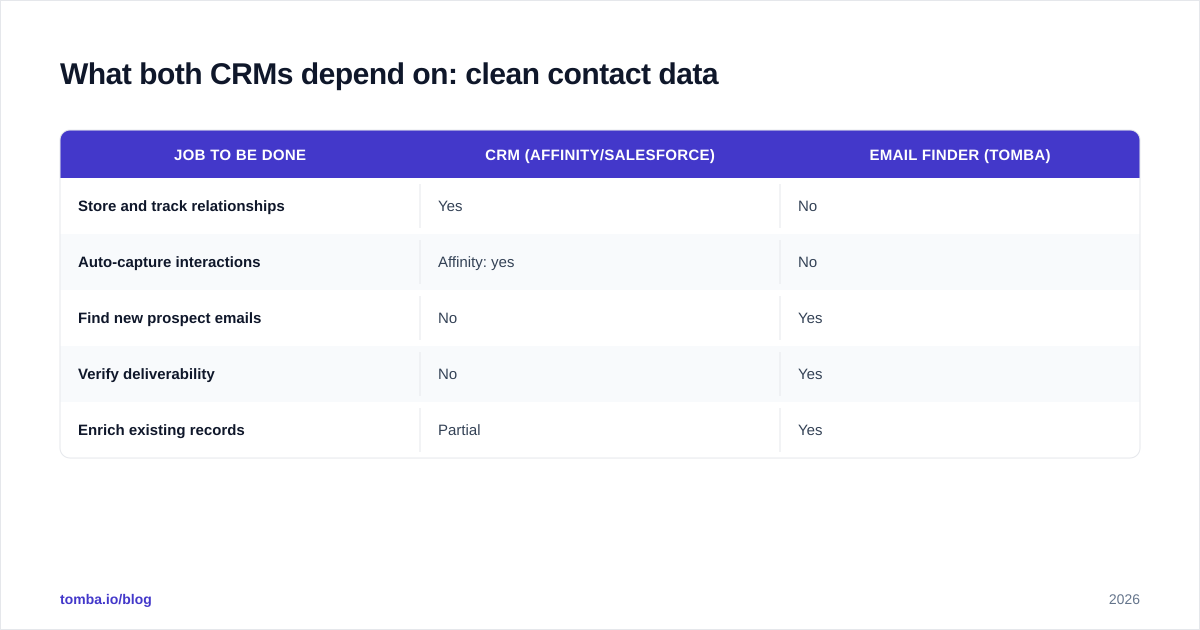
Here's the part the vendor demos skip. Neither Affinity nor Salesforce generates net-new contact data for cold outbound on its own. Affinity captures the relationships you already have; Salesforce stores whatever you put in it. The moment you need to reach someone outside your network — a new prospect, a decision-maker at a target account — you need accurate, verified contact details.
That's a sourcing and hygiene problem, not a CRM problem. If you push unverified addresses into either system, you get bounced sends, damaged sender reputation, and forecasts built on contacts who left the company a year ago. A quick pass through an email verifier before records hit your CRM keeps your database trustworthy.
This is also why teams pair their CRM with a domain search workflow: find the right people at a target company, verify the addresses, then enrich the record before it ever lands in Affinity or Salesforce. The CRM manages the relationship; the data layer makes sure the relationship is reachable.
| Job to be done | CRM (Affinity/Salesforce) | Email finder (Tomba) |
|---|---|---|
| Store and track relationships | Yes | No |
| Auto-capture interactions | Affinity: yes | No |
| Find new prospect emails | No | Yes |
| Verify deliverability | No | Yes |
| Enrich existing records | Partial | Yes |
Frequently asked questions#
Is Affinity a Salesforce competitor? Partly. They overlap as CRMs, but Affinity targets relationship-led firms while Salesforce targets broad, configurable sales operations. Many buyers never seriously cross-shop them because their needs point clearly to one.
Can Affinity integrate with Salesforce? Yes — teams that run both typically sync contacts and activity between them. As always, dedupe and verify data on the way through.
Does Salesforce do relationship intelligence? Not natively to Affinity's depth. You can approximate it with add-ons and third-party apps, but it's not the out-of-the-box core experience.
Which is cheaper? Salesforce's entry tiers look cheaper, but total cost of ownership often converges once you add admin time and add-ons. Affinity is premium but more inclusive.
The bottom line#
Affinity and Salesforce aren't really fighting for the same buyer. If your business runs on relationships and you want a CRM that maintains itself, Affinity is worth its premium. If you need a configurable platform to run a structured, scaling sales operation, Salesforce remains the safe, powerful default.
But whichever you choose, your CRM is downstream of your data. The cleanest pipeline in the world is worthless if the contacts in it bounce. Before a new prospect ever reaches Affinity or Salesforce, find and verify their details with Tomba's Email Finder — search by name, company, or domain, confirm deliverability, and feed your CRM only contacts that are real and reachable. Start free with 25 searches a month, then scale on a plan that fits your outbound volume.
Ready to find emails that actually work?
Join 150,000+ professionals who stopped guessing and started sending. Free credits on signup — no credit card required.
Get the Tomba newsletter
Practical outbound tactics and product updates — once every two weeks.
About the author