Affistash vs Leadzenai: B2B Lead Data Compared (2026)
Affistash and Leadzenai both promise better B2B leads, but they solve different problems. Here's an honest, side-by-side breakdown for 2026.
You typed "Affistash vs Leadzenai" into a search bar because two tools showed up in your research and you cannot tell which one actually moves your pipeline. Fair. Their marketing pages sound nearly identical: more leads, better data, less manual work. The reality is they sit at different points in the lead generation stack, and picking wrong means you pay for a feature set you will never touch.
This breakdown is for B2B founders, SDR leads, and growth marketers deciding where the next subscription dollar goes. No fluff, just the differences that change your buying decision.
TL;DR#
- Affistash leans toward affiliate, partner, and niche-market discovery — it's strong when your "lead" is a publisher, reseller, or partner site rather than a single contact.
- Leadzenai leans toward AI-assisted contact and company intelligence — it's built for SDRs who need names, emails, and firmographics to fill a sequence.
- Neither is a pure email-finding workhorse; if deliverable contact data is your bottleneck, a dedicated email finder will out-perform both on cost-per-valid-email.
- Pricing, data freshness, and export limits matter more than the AI buzzwords on either homepage.
- The right answer depends on whether you prospect partners (Affistash) or people (Leadzenai) — and most teams actually need a verification layer on top of either.
What is Affistash?#
Affistash is a discovery tool aimed at affiliate and partnership marketers. Instead of handing you a list of individual decision-makers, it surfaces websites, publishers, and potential partners that fit a niche or competitor profile. Think of it less like a contact database and more like a scout that maps the terrain around a market: who is already ranking, who promotes adjacent products, and where your affiliate or co-marketing motion could plug in.
That framing matters. If your growth model depends on recruiting affiliates or finding sites that already send buyer-intent traffic, Affistash speaks your language. If you run classic outbound — cold email to named buyers — a lot of its value evaporates, because you still have to figure out who to email at each site you discover.
What is Leadzenai?#
Leadzenai is an AI lead generation and sales intelligence platform. Its pitch is contact-centric: feed it a target profile and it returns people, companies, emails, phone numbers, and enrichment attributes you can drop into a sequence. The "AI" layer typically shows up as scoring, look-alike suggestions, and automated list-building rather than as a fundamentally different data source.
For an SDR or a small sales team, that's a more familiar shape. You define an ICP, you get rows, you push them to your CRM. The open questions — the ones the homepage won't answer — are how fresh that data is, how many of those emails actually deliver, and what happens to your monthly credits when half a list bounces.
Affistash vs Leadzenai: how do they compare?#
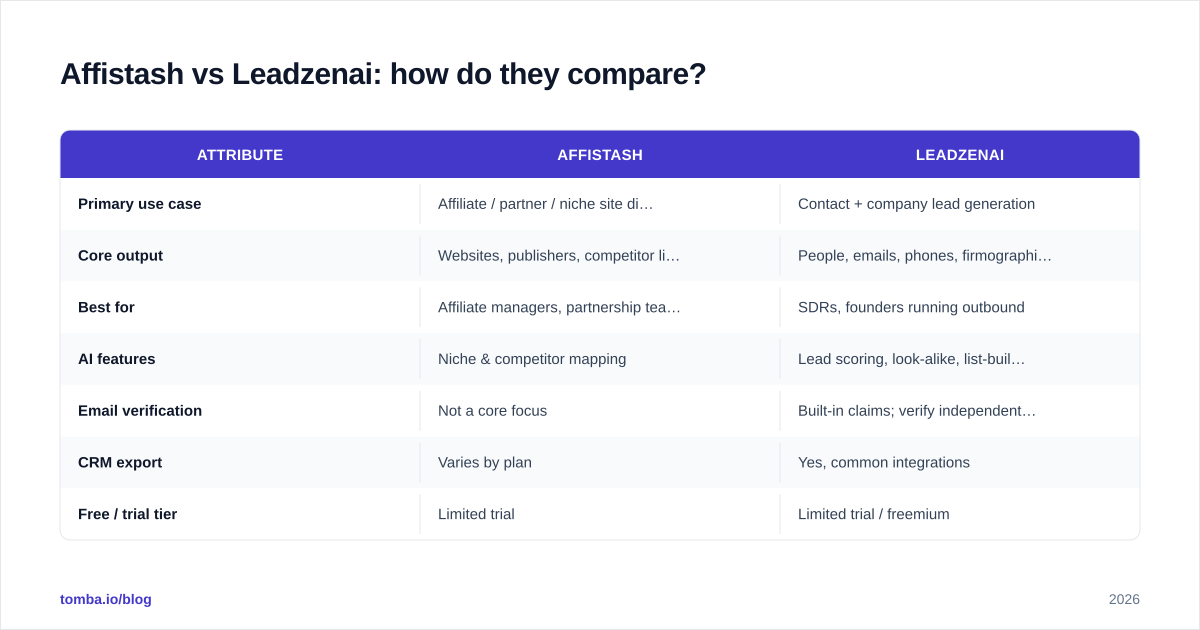
Here's the side-by-side that most "vs" articles bury under 800 words of intro. Pricing and limits shift, so treat exact numbers as directional and confirm on each vendor's site before you buy.
| Attribute | Affistash | Leadzenai |
|---|---|---|
| Primary use case | Affiliate / partner / niche site discovery | Contact + company lead generation |
| Core output | Websites, publishers, competitor links | People, emails, phones, firmographics |
| Best for | Affiliate managers, partnership teams | SDRs, founders running outbound |
| AI features | Niche & competitor mapping | Lead scoring, look-alike, list-building |
| Email verification | Not a core focus | Built-in claims; verify independently |
| CRM export | Varies by plan | Yes, common integrations |
| Free / trial tier | Limited trial | Limited trial / freemium |
| Weak spot | No deep per-contact data | Data freshness & deliverability vary |
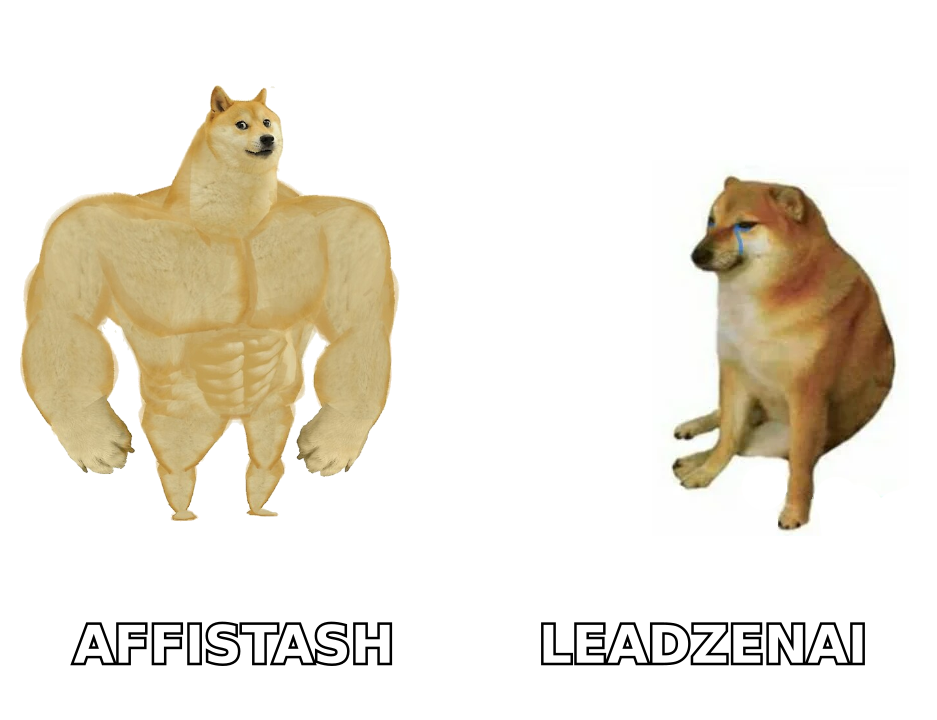
The honest read: these tools are not really head-to-head competitors so much as neighbors. Affistash wins the "where is my market" question. Leadzenai wins the "who do I email" question. The trap is buying one expecting it to do the other's job.
Which one has better data accuracy?#
Neither vendor publishes an independently audited accuracy benchmark, so anyone telling you "Affistash is 98% accurate" is repeating marketing copy. What you can evaluate is category accuracy.
Affistash's data is web-derived — backlinks, rankings, site metadata. That kind of data ages more slowly; a publisher that ranked last quarter probably still exists this quarter. The risk is relevance, not staleness: a site can be real and well-ranked but a terrible fit for your offer.
Leadzenai's data is contact-derived, and contact data decays fast. People change jobs, companies rebrand, and B2B email databases go stale at roughly 22–30% per year according to widely cited industry figures from sources like HubSpot. That's why any contact-first platform should be paired with a verification step. Before you trust a Leadzenai export, run it through an email verifier to strip catch-alls, role accounts, and dead mailboxes — otherwise your bounce rate quietly tanks your sender reputation.
A simple rule: judge a contact tool by valid, deliverable emails per dollar, not by total rows returned. A list of 5,000 contacts where 1,500 bounce is worse than 2,000 clean ones.
How should you choose between them?#
Map the tool to your motion, not to its feature list. Use this quick decision framework:
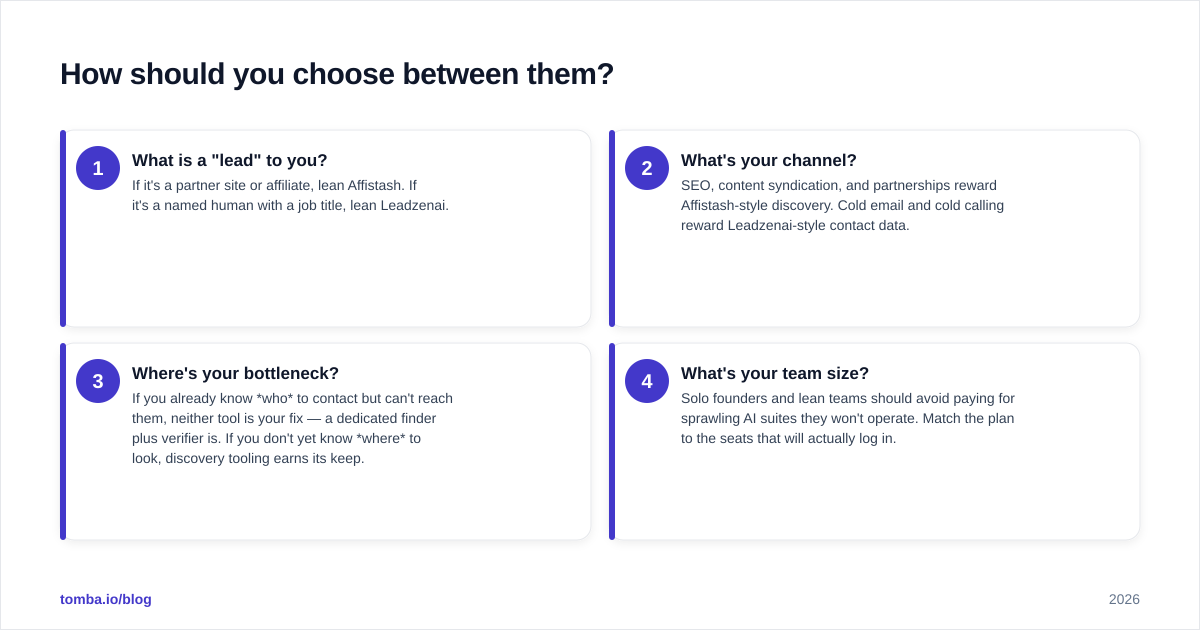
- What is a "lead" to you? If it's a partner site or affiliate, lean Affistash. If it's a named human with a job title, lean Leadzenai.
- What's your channel? SEO, content syndication, and partnerships reward Affistash-style discovery. Cold email and cold calling reward Leadzenai-style contact data.
- Where's your bottleneck? If you already know who to contact but can't reach them, neither tool is your fix — a dedicated finder plus verifier is. If you don't yet know where to look, discovery tooling earns its keep.
- What's your team size? Solo founders and lean teams should avoid paying for sprawling AI suites they won't operate. Match the plan to the seats that will actually log in.
Most teams I've watched evaluate these two end up realizing the question isn't "Affistash or Leadzenai" — it's "discovery tool + contact data + verification." The stack beats any single subscription.
Where does a dedicated email finder fit?#
Both platforms gesture at contact data, but contact discovery and verification is a specialist job. This is where a focused tool changes your unit economics.
Say Affistash surfaces 40 partner sites worth pitching. You still need the right person at each — the partnerships lead, not info@. A domain search takes a company domain and returns the real people and email patterns behind it, so you go from "great site" to "named contact" in seconds. Run the same play after a Leadzenai export to fill the gaps and confirm what's deliverable.
The cost argument is straightforward. General-purpose lead suites bundle data you may not use and price accordingly. A pure-play finder/verifier lets you pay for exactly the contacts you pull. For reference, Tomba pricing starts with a free tier of 25 searches per month, then Starter at $49/mo, Growth at $99/mo, and Pro at $249/mo — so you can scale spend to actual prospecting volume instead of a flat platform fee.
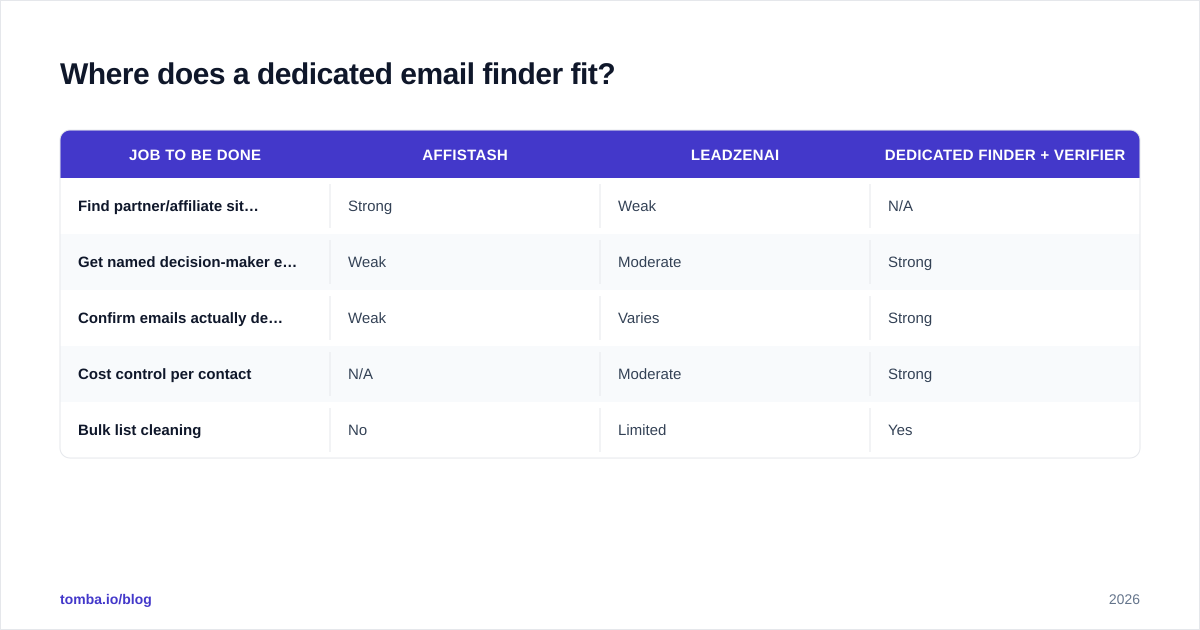
| Job to be done | Affistash | Leadzenai | Dedicated finder + verifier |
|---|---|---|---|
| Find partner/affiliate sites | Strong | Weak | N/A |
| Get named decision-maker emails | Weak | Moderate | Strong |
| Confirm emails actually deliver | Weak | Varies | Strong |
| Cost control per contact | N/A | Moderate | Strong |
| Bulk list cleaning | No | Limited | Yes |
If your evaluation is really about reliable B2B contact data — and for most outbound teams it is — comparing pure lead suites against each other can miss the cheaper, more accurate path. You can read more about where Tomba gets data to judge that for yourself rather than taking a vendor's word.
Is one cheaper than the other?#
Cheaper depends entirely on usage shape, not sticker price. Affistash bills around discovery volume and projects; Leadzenai bills around contact credits and seats. Comparing their headline numbers is apples to oranges.
Two pricing traps to watch on either platform:
- Credit burn on bad data. If a credit is consumed whether or not the email is valid, every bounce is money you already spent. Verification before send protects that spend.
- Seat-based creep. AI sales suites love per-seat pricing. A five-person team can quietly 5x the quoted price. Confirm whether the plan you saw is per-seat or per-account.
For independent pricing and review signal beyond the vendors' own pages, cross-check both on G2 where buyers leave structured feedback on data quality and support — the two things marketing pages never quantify honestly.
What's the verdict on Affistash vs Leadzenai?#
Pick Affistash if your growth engine is partnerships, affiliates, or niche-site discovery and your "lead" is a website. Pick Leadzenai if you need AI-assisted contact lists to feed an outbound sequence and you're comfortable layering verification on top. They're not really rivals — they answer different questions, and a meaningful share of teams that compare them discover they actually needed neither in isolation.
What almost every outbound motion does need is clean, deliverable contact data at a price that scales with volume. That's a finder-and-verifier job, and it's worth running a head-to-head between either of these suites and a focused tool before you commit a year of budget.
Start where the pipeline actually leaks: getting the right person's verified email. Try the Tomba Email Finder free — 25 searches a month, no card — point it at the companies these platforms surface, and measure valid emails per dollar against whatever else you're evaluating. If the numbers favor the dedicated tool, you just simplified your stack and cut your cost per lead at the same time.
// get started
Find, verify and enrich your first contacts today
Start on the free plan with 25 searches a month, then scale when your team is ready.
Free plan · No credit card required · GDPR & CCPA
// about the author