Affistash vs Limeleads 2026: Which B2B Lead Tool Wins?
Affistash and Limeleads both promise B2B leads on demand, but they solve different problems. Here is the honest 2026 breakdown of pricing, data, and fit.
TL;DR
- Affistash is built for affiliate and partner discovery — it surfaces websites, publishers, and partners in a niche, then hands you contact details to recruit them.
- Limeleads is a classic B2B contact-list builder — filter by industry, title, geography, and company size, then export a static CSV of emails and phone numbers.
- They are not really the same product. Affistash answers "who should I partner with?"; Limeleads answers "give me 1,000 marketing directors in SaaS."
- Both ship stale data on their lowest tiers. Verification is on you, and neither replaces a real-time finder-plus-verifier stack.
- If your bottleneck is accurate, fresh email addresses for outbound, a dedicated finder like Tomba beats both — pair it with either tool for sourcing.
What are Affistash and Limeleads?#
Short version: they look similar in a feature grid and feel completely different in daily use.
Affistash is a partnership and affiliate prospecting platform. Think of it like a scout for your partner program. You give it a niche or a competitor, and it returns a list of websites, content publishers, coupon sites, and potential affiliates already operating in that space — plus the contact details to reach the people who run them. Its whole reason to exist is recruiting partners, not blasting cold email to buyers.
Limeleads is a self-serve B2B database. It is closer to a vending machine for contact lists: pick filters (industry, job title, company headcount, revenue, location), preview matching records, then spend credits to unlock and export emails and direct-dial numbers. The output is a spreadsheet you drop into your CRM or sequencer.
The confusion happens because both end the same way — you walk away with names and email addresses. But the job-to-be-done is different, and that difference should decide which one (if either) you pay for.
How does each tool actually work?#
Here is the mental model before the spec sheet.
With Affistash, you start from intent: "I want partners who already reach my audience." You search a vertical, it clusters sites by traffic and relevance, and you build a recruitment list. The value is discovery — finding partners you did not already know existed. Contact data is the means to an end.
With Limeleads, you start from a persona: "I want every VP of Marketing at a 50–200 person software company in North America." You stack filters, watch the result count shrink, and unlock the slice you want. The value is volume on a known ICP — fast list assembly for a profile you have already defined.
That is why a side-by-side "winner" is misleading. A partnerships manager and an SDR are buying for two different motions.
Affistash vs Limeleads: feature and pricing comparison#
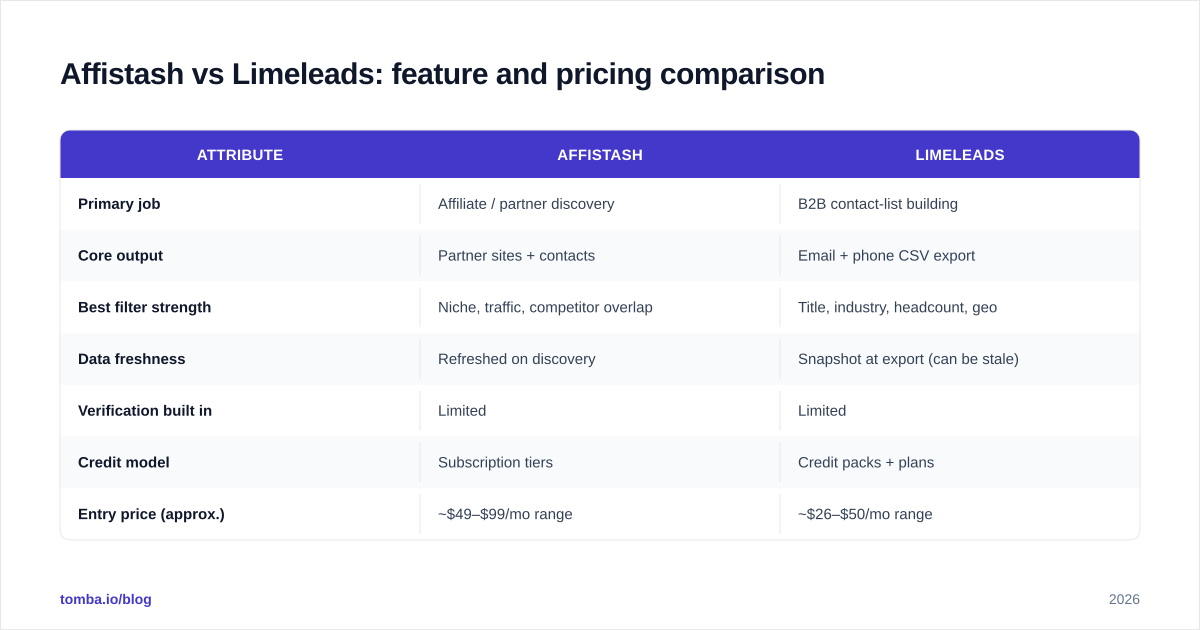
The table below is the honest snapshot. Pricing on both moves, so treat dollar figures as ballpark and confirm on each vendor's site before you buy.
| Attribute | Affistash | Limeleads |
|---|---|---|
| Primary job | Affiliate / partner discovery | B2B contact-list building |
| Core output | Partner sites + contacts | Email + phone CSV export |
| Best filter strength | Niche, traffic, competitor overlap | Title, industry, headcount, geo |
| Data freshness | Refreshed on discovery | Snapshot at export (can be stale) |
| Verification built in | Limited | Limited |
| Credit model | Subscription tiers | Credit packs + plans |
| Entry price (approx.) | ~$49–$99/mo range | ~$26–$50/mo range |
| Ideal user | Partnerships / affiliate managers | SDRs, demand-gen, recruiters |
| CRM export | CSV / manual | CSV / manual |
| API access | Limited | Limited |
A few honest caveats. Limeleads is usually cheaper to get started and is genuinely fast for a known ICP, but its database is a periodic snapshot — emails go stale between refreshes, and you carry the bounce risk. Affistash costs more because partner discovery is a narrower, higher-value use case, but you are not paying it to be a general cold-email database, so judging it as one is unfair.
)
Which one has better data quality?#
Neither wins outright — and that is the point most comparison posts bury.
Both tools sell sourcing, and both treat verification as someone else's problem. Limeleads gives you a CSV that was accurate the last time its database was refreshed; by the time you import it, a chunk of those people have changed jobs, and a chunk of those mailboxes no longer exist. Affistash points you at live, operating websites, so the organization is real, but the specific inbox it hands you can still be a role address or an outdated personal one.
This is the single biggest reason cold campaigns underperform: teams treat "I have an email address" as the same thing as "this email will deliver and reach a human." It is not. Industry deliverability data consistently shows that unverified B2B lists bounce in the 15–30% range, and a bounce rate above ~3% starts dragging your email deliverability and sender reputation down for every future send.
So whichever tool you pick for sourcing, run the output through an email verifier before the first send. The cost of verification is trivial next to the cost of a burned sending domain.
Rule of thumb: source with one tool, verify with another, and never send to a list you have not validated in the last 30 days.
When should you choose Affistash?#
Pick Affistash when your growth motion is partnerships, affiliates, or co-marketing — not one-to-one cold outbound.
Choose it if:
- You run or are launching an affiliate / partner program and need a pipeline of relevant publishers to recruit.
- You want to find sites that already rank for or write about your category, so you can pitch sponsorships, guest content, or revenue-share deals.
- You care more about who reaches your audience than about scraping thousands of individual buyer emails.
- Your team is small and you would rather recruit 50 high-leverage partners than email 5,000 strangers.
Affistash is the wrong tool if you are an SDR with a quota measured in meetings booked from cold sequences. It will feel expensive and narrow, because you are using a scalpel to dig a ditch.
When should you choose Limeleads?#
Pick Limeleads when you have a crisp ICP and need volume fast on a budget.
Choose it if:
- You can describe your buyer in filter terms: title, industry, company size, location.
- You need a quick list this afternoon and do not want a sales call or annual contract.
- You are doing recruiting, event invites, or straightforward cold outreach where a snapshot list is "good enough" to start.
- Price sensitivity is high and you will do your own verification downstream.
Limeleads is the wrong tool if you need real-time accuracy, deep firmographic enrichment, or coverage outside its strongest regions. Treat it as a starting point you clean up, not a finished list.
)
How do they compare to a dedicated email finder?#
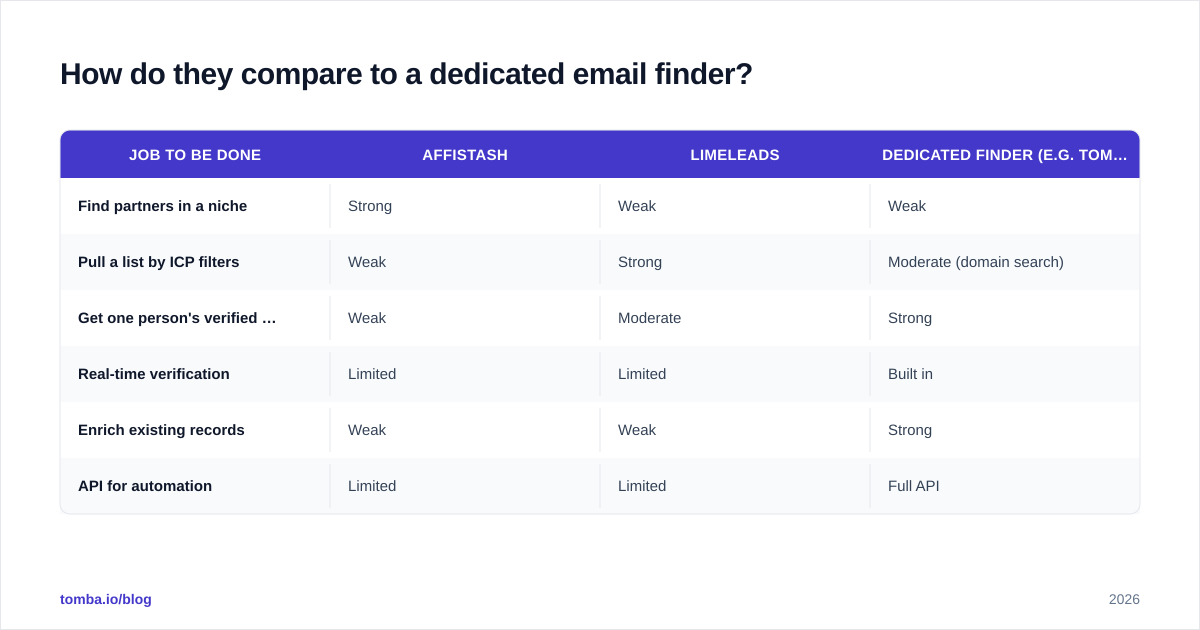
Here is the uncomfortable truth for both: if your actual problem is "I have a name and a company and I need their correct, current work email," neither tool is purpose-built for that. Affistash is optimized for discovery and Limeleads for static list pulls.
A dedicated finder works the other way around. You feed it a person and a domain, and it returns the most likely address with a confidence score and a verification status at request time — not a snapshot from last quarter. That is a meaningfully different guarantee.
| Job to be done | Affistash | Limeleads | Dedicated finder (e.g. Tomba) |
|---|---|---|---|
| Find partners in a niche | Strong | Weak | Weak |
| Pull a list by ICP filters | Weak | Strong | Moderate (domain search) |
| Get one person's verified email | Weak | Moderate | Strong |
| Real-time verification | Limited | Limited | Built in |
| Enrich existing records | Weak | Weak | Strong |
| API for automation | Limited | Limited | Full API |
This is where stacking tools beats betting on one. Use Affistash or Limeleads for sourcing, then resolve and verify the actual contacts with a finder. Tomba's email finder returns addresses by name and domain with a confidence score, its domain search pulls every public address at a company in one pass, and data enrichment fills the firmographic gaps a static CSV leaves behind. You can also check accuracy yourself before committing budget — see Tomba's published data sources.
You do not have to take any vendor's word on quality. Cross-check ratings on G2 and Capterra, and read the source pages directly — Affistash and LimeLeads both document their own scope, and the gaps in that documentation tell you a lot.
What does a smart 2026 stack look like?#
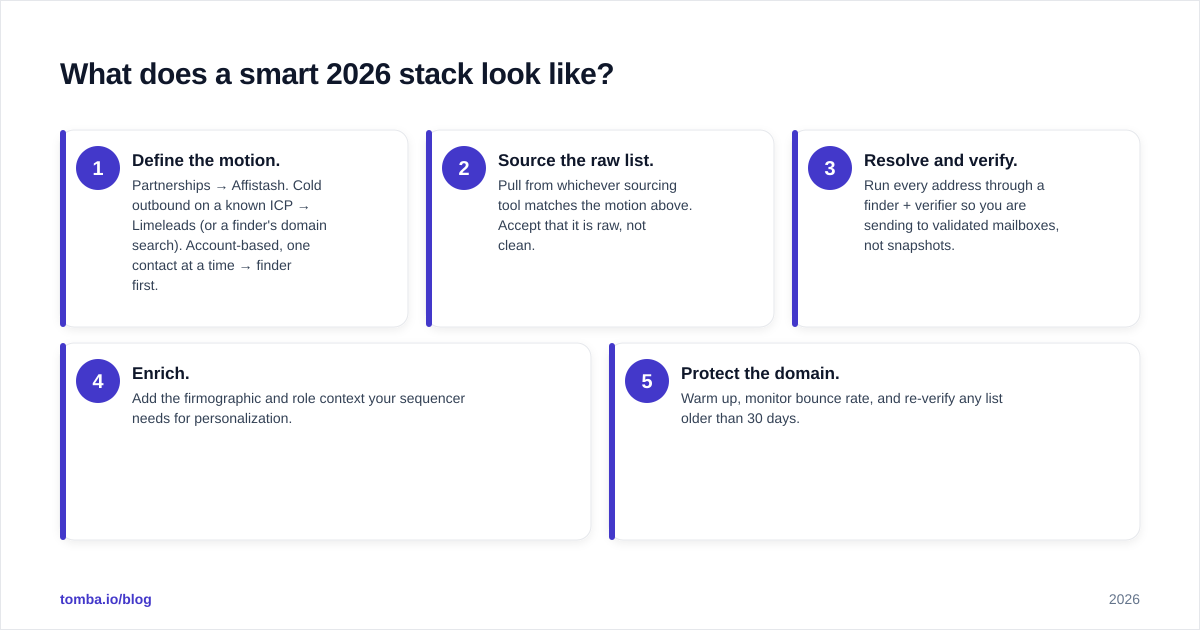
Layer the tools by job instead of forcing one to do everything.
- Define the motion. Partnerships → Affistash. Cold outbound on a known ICP → Limeleads (or a finder's domain search). Account-based, one contact at a time → finder first.
- Source the raw list. Pull from whichever sourcing tool matches the motion above. Accept that it is raw, not clean.
- Resolve and verify. Run every address through a finder + verifier so you are sending to validated mailboxes, not snapshots.
- Enrich. Add the firmographic and role context your sequencer needs for personalization.
- Protect the domain. Warm up, monitor bounce rate, and re-verify any list older than 30 days.
The teams that win in 2026 are not the ones with the biggest exported list. They are the ones whose lists actually deliver, because they treated sourcing and verification as two separate, deliberate steps.
The verdict: Affistash vs Limeleads#
There is no single winner, because they answer different questions.
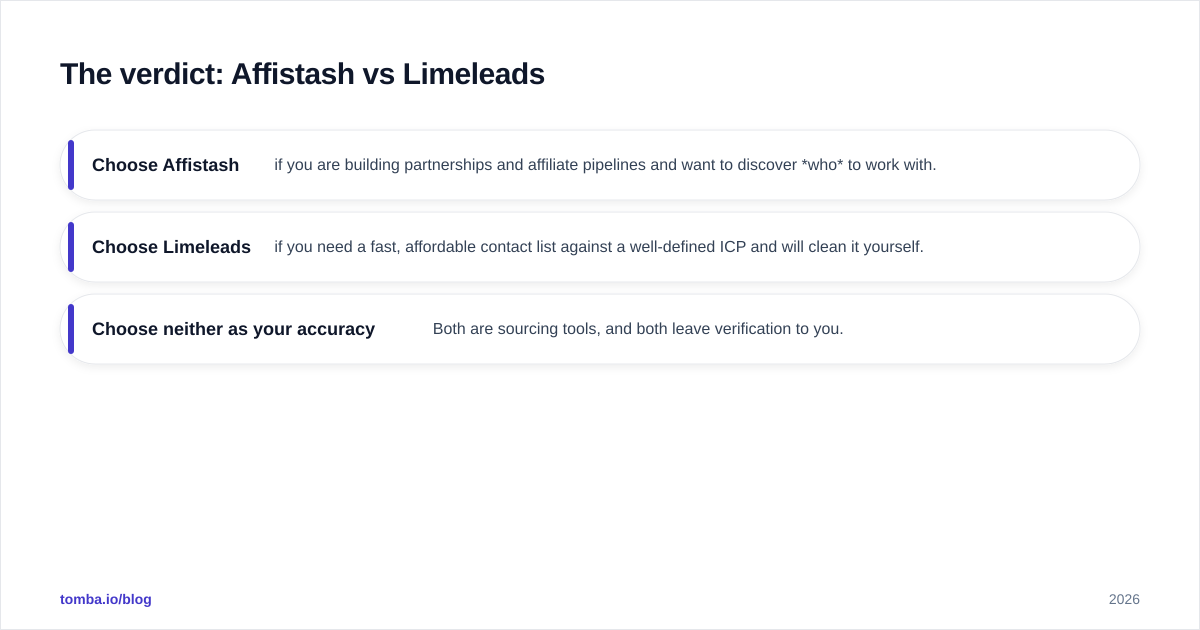
- Choose Affistash if you are building partnerships and affiliate pipelines and want to discover who to work with.
- Choose Limeleads if you need a fast, affordable contact list against a well-defined ICP and will clean it yourself.
- Choose neither as your accuracy layer. Both are sourcing tools, and both leave verification to you.
The common failure mode is buying one of these, exporting a list, and sending cold — then wondering why open and reply rates crater. The list was never the problem. The unverified list was.
Get verified emails your sequencer will thank you for#
If the real goal is booked meetings, the highest-leverage spend is not another raw list — it is making sure the emails you already have are correct, current, and safe to send. Start with the Tomba Email Finder to resolve names into verified work addresses with a confidence score, run bulk lists through verification before your first touch, and keep your sender reputation intact. Pair it with Affistash or Limeleads for sourcing, and you get the best of both: discovery from them, deliverability from Tomba. Compare Tomba pricing — including a free tier with 25 searches a month — and test it against your next list before you hit send.
// get started
Find, verify and enrich your first contacts today
Start on the free plan with 25 searches a month, then scale when your team is ready.
Free plan · No credit card required · GDPR & CCPA
// about the author