Affistash vs SignalHire 2026: Which Lead Tool Wins?
Affistash recruits affiliate partners; SignalHire finds emails and phones. Here is an honest 2026 breakdown of where each tool wins, what they cost, and the cheaper way to source verified contacts.
TL;DR
- They solve different problems. Affistash is an affiliate-recruitment engine built to discover partners, publishers, and creators; SignalHire is a contact finder that surfaces verified emails and direct-dial phone numbers for sales and recruiting.
- Pick by job-to-be-done. If you run an affiliate or partner program, Affistash is purpose-built. If you need to reach decision-makers cold, SignalHire's contact data is the better fit.
- Both get expensive at scale. SignalHire charges per credit/reveal; Affistash sells partner-discovery seats. Neither is the cheapest way to source raw verified emails in bulk.
- Data quality varies by use case. SignalHire leans on a large contact database with phone coverage; Affistash optimizes for affiliate-fit, not deliverability.
- A dedicated finder often beats both on cost-per-valid-email. If your real goal is verified B2B contacts, a focused tool like Tomba usually wins on price and verification.
What Are Affistash and SignalHire?#
Short answer: Affistash helps you find partners to promote your product, and SignalHire helps you find the contact details of specific people. They get lumped together because both are "discovery" tools, but the thing they discover is different.
Affistash is an AI-assisted affiliate and influencer recruitment platform. You tell it your niche or competitor, and it returns a list of potential affiliates, publishers, content sites, and creators who could promote your offer, along with traffic and relevance signals. It is aimed at affiliate managers, partnership teams, and DTC brands building a partner program from scratch.
SignalHire is a contact-finder and talent-sourcing tool. Give it a name, a LinkedIn profile, or a company, and it returns business emails, personal emails, and direct phone numbers. It is popular with recruiters and SDRs because of its phone-number coverage and its browser extension that works over LinkedIn and the web.
So the honest framing for "affistash vs signalhire" is not "which is better" in a vacuum — it is "which job are you hiring the tool to do?"
How Do You Choose Between Them?#
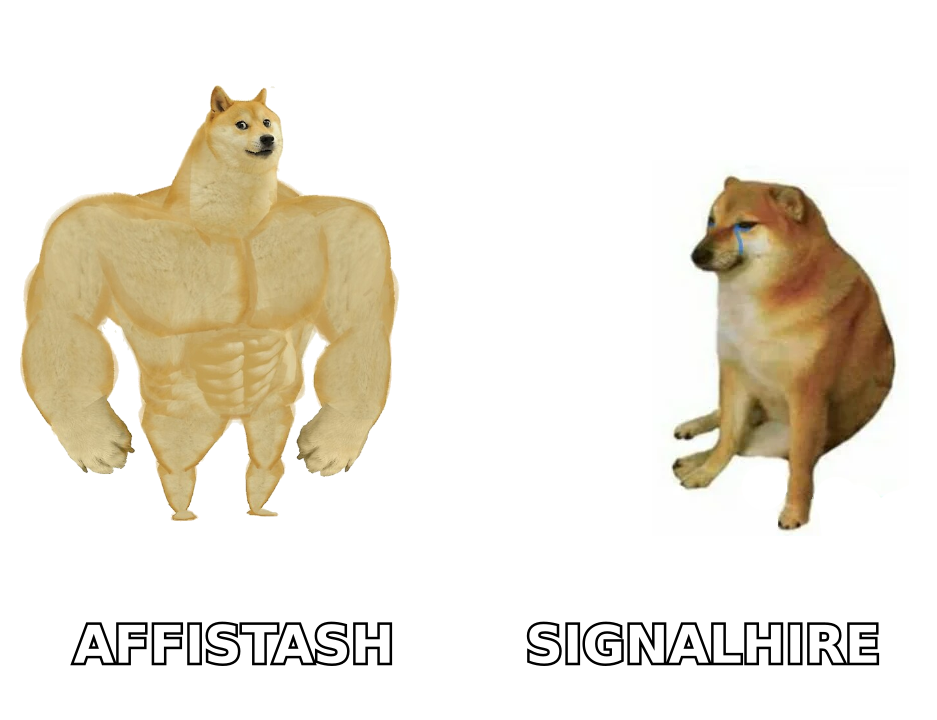
Use a simple decision framework. The diagram below maps the two tools to the workflow stage they actually serve.
Ask three questions:
- Who am I trying to reach? Affiliates and creators who promote → Affistash. Buyers, candidates, or decision-makers you sell or recruit → SignalHire.
- What contact data do I need? Partner-fit and traffic signals → Affistash. Verified email + direct dial → SignalHire.
- At what volume, and what's my cost ceiling? High-volume verified email at low cost-per-record → neither; use a dedicated email finder (more on that below).
If two of your three answers point the same way, you have your tool.
Affistash vs SignalHire: Feature Comparison#
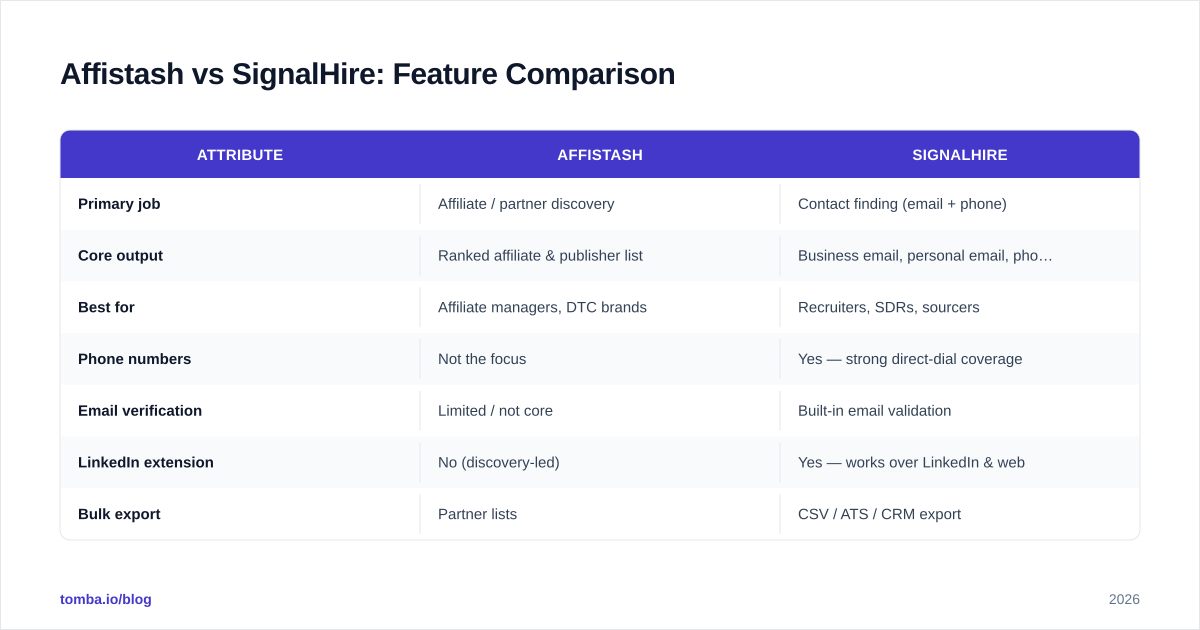
Here is the side-by-side. Treat published pricing as directional — both vendors change tiers, and credit definitions differ, so always confirm on their own pages.
| Attribute | Affistash | SignalHire |
|---|---|---|
| Primary job | Affiliate / partner discovery | Contact finding (email + phone) |
| Core output | Ranked affiliate & publisher list | Business email, personal email, phone |
| Best for | Affiliate managers, DTC brands | Recruiters, SDRs, sourcers |
| Phone numbers | Not the focus | Yes — strong direct-dial coverage |
| Email verification | Limited / not core | Built-in email validation |
| LinkedIn extension | No (discovery-led) | Yes — works over LinkedIn & web |
| Bulk export | Partner lists | CSV / ATS / CRM export |
| Typical entry price | Subscription seat (mid-tier) | ~$49 for ~350 credits, scales up |
| Free option | Limited trial | Limited free credits |
| API access | Limited | Yes |
The pattern is clear: SignalHire is built around reaching a known person, while Affistash is built around discovering unknown partners. Neither replaces the other.
Which Tool Has Better Data?#
It depends entirely on what "data" means to you.
SignalHire competes on contact coverage. Its strength is phone numbers — recruiters specifically choose it for direct dials that many email-only tools lack. Email accuracy is solid for common corporate domains but, like every database vendor, it degrades on smaller companies, catch-all domains, and recently changed roles. If you push SignalHire data into a cold campaign, you still want an independent verification pass before you send, because a bounced send hurts your sender reputation regardless of where the address came from.
Affistash is not trying to win on contact accuracy — it is trying to win on relevance. Its value is telling you that a given site or creator is a good fit for your affiliate program, with traffic and topical signals attached. Judging Affistash by email-verification standards misses the point; judge it by how many recruited partners actually convert.
A practical move many teams use: discover with one tool, then enrich and verify with a dedicated layer. If Affistash hands you a publisher and you need the partnership manager's real inbox, you run that through an email verifier before adding them to outreach. Same with SignalHire exports headed into a high-volume sequence.
Note: replace the screenshot above with a real captured image of the SignalHire extension panel during editing.
How Much Do Affistash and SignalHire Cost?#
Both use consumption-style economics, just measured differently.
- SignalHire sells credits, where one credit roughly equals one revealed contact. Entry plans start in the ~$49/month range for a few hundred credits and scale with volume; annual and team plans lower the per-credit rate. Phone reveals can consume credits faster than email-only lookups.
- Affistash sells access to its discovery engine on a subscription seat, priced for affiliate and partnership teams rather than per-contact. The math you care about is cost-per-recruited-partner, not cost-per-email.
The trap on both sides is the same: you pay for reveals or seats, not for verified, deliverable records. If half your revealed emails are stale or risky, your effective cost per usable contact doubles. That is exactly the gap a focused finder-plus-verifier closes — and why cost-per-valid-email, not sticker price, is the number to track.
When Should You Use Something Else Entirely?#
When your actual goal is high-volume, verified B2B email at a predictable cost, neither an affiliate-discovery tool nor a phone-first contact finder is the most efficient buy. That is a dedicated email-finding job.
This is where a tool like Tomba fits between or beneath both options. Instead of paying affiliate-program pricing or phone-credit pricing, you pay for the specific thing cold outreach runs on: an accurate, verified address.
A few common scenarios where a dedicated finder wins:
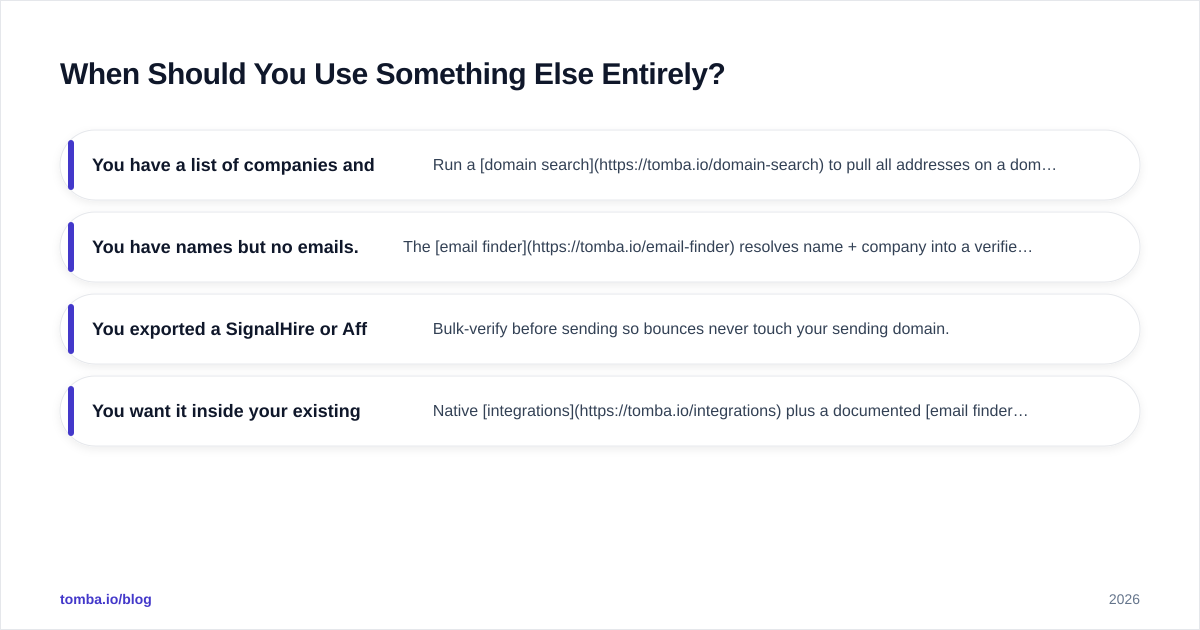
- You have a list of companies and need every relevant inbox. Run a domain search to pull all addresses on a domain with confidence scores, instead of revealing one contact at a time.
- You have names but no emails. The email finder resolves name + company into a verified address, then validates it in the same step.
- You exported a SignalHire or Affistash list and need to clean it. Bulk-verify before sending so bounces never touch your sending domain.
- You want it inside your existing stack. Native integrations plus a documented email finder API mean you can wire finding and verification into your CRM or sequencer.
None of this makes Affistash or SignalHire bad — it makes them specialized. If affiliate recruiting is your problem, keep Affistash. If direct dials are your edge, keep SignalHire. Just don't ask either one to be your primary verified-email engine.
Affistash vs SignalHire: Pros and Cons#
| Pros | Cons | |
|---|---|---|
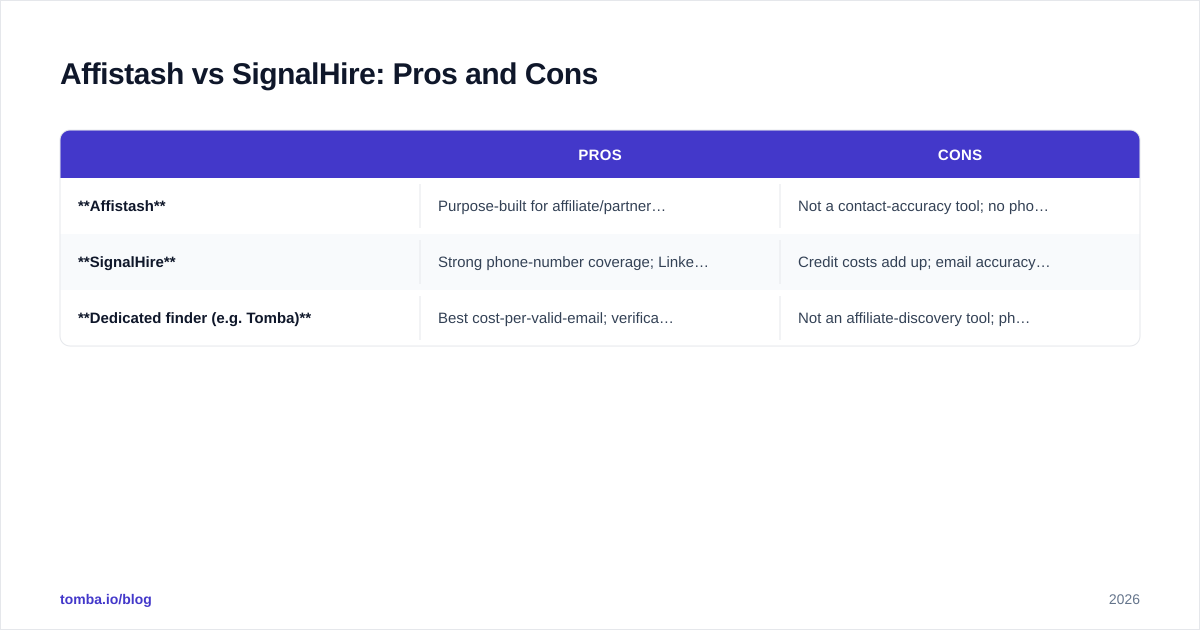
| Affistash | Purpose-built for affiliate/partner discovery; relevance and traffic signals; saves manual prospecting of publishers | Not a contact-accuracy tool; no phone focus; narrow use case outside partner programs |
| SignalHire | Strong phone-number coverage; LinkedIn extension; built-in email validation; API | Credit costs add up; email accuracy varies on SMB/catch-all; overkill if you only need emails |
| Dedicated finder (e.g. Tomba) | Best cost-per-valid-email; verification built in; bulk + API + integrations | Not an affiliate-discovery tool; phone data is secondary to email |
Which One Should You Buy in 2026?#
Conclusion first: buy for the job, not the brand.
- Running or scaling an affiliate / partner program? Affistash is the natural pick because partner discovery is its entire reason to exist. Validate any partner contact emails separately before outreach.
- Doing recruiting or phone-heavy sales where direct dials matter? SignalHire earns its credits, especially for sourcers who live in LinkedIn.
- Sending cold email at volume and optimizing cost-per-valid-contact? A dedicated finder-and-verifier is almost always cheaper and cleaner than stretching either tool into that role.
Plenty of teams run a combination: discover partners or candidates with the specialist tool, then standardize on one verification layer so every address — no matter its source — clears the same deliverability bar. Check current Tomba pricing against your SignalHire credit spend and you will usually find the per-verified-email cost favors the dedicated tool, with the free tier (25 searches/month) enough to test the difference before you commit.
For independent reviews and side-by-side ratings while you decide, cross-check what real users say on G2 and confirm feature claims on the SignalHire and Affistash sites directly — vendor tiers shift, and the numbers in any comparison post age fast.
Ready to Stop Paying for Unverified Contacts?#
Whichever discovery tool you keep, the addresses still have to land. Tomba's Email Finder turns a name and domain into a verified, deliverable email — with verification built in, bulk processing, and an API that drops into the stack you already run. Start on the free tier (25 searches/month), test it against your last SignalHire or Affistash export, and compare the bounce rates yourself. If the verified-email math wins, scale up from $49/month on the Starter plan and keep your sending reputation intact.
// get started
Find, verify and enrich your first contacts today
Start on the free plan with 25 searches a month, then scale when your team is ready.
Free plan · No credit card required · GDPR & CCPA
// about the author